
CAS 111-20-6PubChem CID 5192
Sebacic Acid
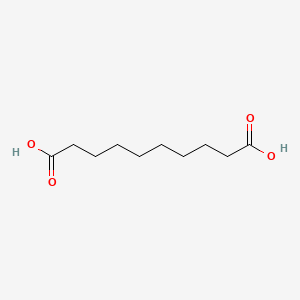
Sebacic acid is an alpha,-dicarboxylic acid that is the 1,8-dicarboxy derivative of octane. It has a role as a plant metabolite and a human metabolite. It is a dicarboxylic fatty acid and an alpha,omega-dicarboxylic acid. It is a conjugate acid of a sebacate and a sebacate(2-). It derives from a hydride of a decane. — ChEBI
- IUPAC 명칭
- decanedioic acid
- 분자식
- C10H18O4
- 분자량
- 202.25 g/mol
- 정확한 질량
- 202.12050905 Da
- XLogP3
- 2.1
- 위상 극성 표면적
- 74.6 Ų
- 수소 결합 공여체
- 2
- 수소 결합 수용체
- 4
- 공유결합 단위
- 1
- 정의된 입체중심
- 0
다른 이름
1,8-Octanedicarboxylic acid1,10-Decanedioic acidSebacinsaureDecanedicarboxylic acidn-Decanedioic acidAcide sebaciqueSebacinsaeureUSAF HC-1
보고된 명칭 16개 더 보기
Ipomic acid1,8-dicarboxyoctane97AN39ICTCNSC-19492FEMA NO. 4943CHEBI:41865RefChem:9117203-845-54-Oxodecanedioic acidSeracic acidoctane-1,8-dicarboxylic acidNSC 19492POLY(SEBACIC ANHYDRIDE)Sebacinsaure [German]Acide sebacique [French]UNII-97AN39ICTC
외부 데이터베이스 식별자
- ChEBI:CHEBI:41865
- ChEMBL:CHEMBL1232164
- EPA DTXSID:DTXSID7026867
- PubMed:22139757
- PubMed:21978582
- PubMed:21900319
- PubMed:21580506
- PubMed:21577592
- PubMed:21522598
- PubMed:21505410
- PubMed:21430954
- PubMed:20977585
- PubMed:20854883
- PubMed:20724647
- PubMed:20669260
추가 과학 데이터베이스의 근거
NIH PubChem PUG-View
식별자 정확히 일치5192
Attributed physical-property, hazard, environmental and use annotations.
- Boiling Point: 563 °F at 100 mmHg (NTP, 1992) 출처: CAMEO Chemicals
- Boiling Point: 364.00 to 365.00 °C. @ 760.00 mm Hg 출처: Human Metabolome Database (HMDB)
- Boiling Point: at 13.3kPa: 294 °C 출처: ILO-WHO International Chemical Safety Cards (ICSCs)
- Density: 1.2075 at 68 °F (NTP, 1992) - Denser than water; will sink 출처: CAMEO Chemicals
- Density: 1.2 g/cm³ 출처: ILO-WHO International Chemical Safety Cards (ICSCs)
- Flash Point: 220 °C 출처: ILO-WHO International Chemical Safety Cards (ICSCs)
- LogP: 2.2 출처: ILO-WHO International Chemical Safety Cards (ICSCs)
- Melting Point: 274.1 °F (NTP, 1992) 출처: CAMEO Chemicals
- Melting Point: 130.8 °C 출처: Human Metabolome Database (HMDB)
- Melting Point: 131 °C 출처: ILO-WHO International Chemical Safety Cards (ICSCs)
- Physical Description: Sebacic acid is a white granular powder. Melting point 153 °F. Slightly soluble in water. Sublimes slowly at 750 mmHg when heated to melting point. 출처: CAMEO Chemicals
- Physical Description: Dry Powder; Other Solid; Large Crystals; CBI; Large Crystals; Other Solid; Liquid; Liquid; Other Solid 출처: EPA Chemical Data Reporting (CDR)
- Physical Description: Solid; [Merck Index] White solid; [Acros Organics MSDS] 출처: Haz-Map, Information on Hazardous Chemicals and Occupational Diseases
- Physical Description: Solid 출처: Human Metabolome Database (HMDB)
- Physical Description: WHITE POWDER WITH CHARACTERISTIC ODOUR. 출처: ILO-WHO International Chemical Safety Cards (ICSCs)
- Solubility: less than 1 mg/mL at 70 °F (NTP, 1992) 출처: CAMEO Chemicals
- Solubility: 1.0 mg/mL 출처: Human Metabolome Database (HMDB)
- Solubility: Solubility in water, g/100ml: 0.1 (poor) 출처: ILO-WHO International Chemical Safety Cards (ICSCs)
- Vapor Pressure: 1 mmHg at 361 °F ; 100 mmHg at 562.1 °F; 760 mmHg at 666.1 °F (NTP, 1992) 출처: CAMEO Chemicals
- Vapor Pressure: 0.00000289 [mmHg] 출처: Haz-Map, Information on Hazardous Chemicals and Occupational Diseases
- Carcinogen Classification: No indication of carcinogenicity to humans (not listed by IARC). 출처: Toxin and Toxin Target Database (T3DB)
- Exposure Routes: The substance can be absorbed into the body by ingestion. 출처: ILO-WHO International Chemical Safety Cards (ICSCs)
- First Aid: EYES: First check the victim for contact lenses and remove if present. Flush victim's eyes with water or normal saline solution for 20 to 30 minutes while simultaneously calling a hospital or poison control center. Do not put any ointments, oils, or medication in the victim's eyes without specific instructions from a physician. IMMEDIATELY transport the victim after flushing eyes to a hospital even if no symptoms (such as redness or irritation) develop.; SKIN: IMMEDIATELY flood affected skin with water while removing and isolating all contaminated clothing. Gently wash all affected skin areas thoroughly with soap and water. If symptoms such as redness or irritation develop, IMMEDIATELY call a physician and be prepared to transport the victim to a hospital for treatment.; INHALATION: IMMEDIATELY leave the contaminated area; take deep breaths of fresh air. If symptoms (such as wheezing, coughing, shortness of breath, or burning in the mouth, throat, or chest) develop, call a physician and be prepared to transport the victim to a hospital. Provide proper respiratory protection to rescuers entering an unknown atmosphere. Whenever possible, Self-Contained Breathing Apparatus (SCBA) shou 출처: CAMEO Chemicals
- Note: This chemical does not meet GHS hazard criteria for 99.5% (2752 of 2766) of all reports. 출처: European Chemicals Agency (ECHA)
- GHS Hazard Statements: Not Classified; Reported as not meeting GHS hazard criteria by 2752 of 2766 companies (only 0.5% companies provided GHS information). For more detailed information, please visit ECHA C&L website. 출처: European Chemicals Agency (ECHA)
- ECHA C&L Notifications Summary: Aggregated GHS information provided per 2766 reports by companies from 9 notifications to the ECHA C&L Inventory.; Reported as not meeting GHS hazard criteria per 2752 of 2766 reports by companies.; There are 6 notifications provided by 14 of 2766 reports by companies with hazard statement code(s).; Information may vary between notifications depending on impurities, additives, and other factors. The percentage value in parenthesis indicates the notified classification ratio from companies that provide hazard codes. Only hazard codes with percentage values above 10% are shown. For more detailed information, please visit ECHA C&L website. 출처: European Chemicals Agency (ECHA)
- Cosmetic Ingredient Review Finding(s): Safe in the present practices of use and concentration. Ingredient, concentration, and use information are available in documents discoverable at https://cir-reports.cir-safety.org 출처: Cosmetic Ingredient Review (CIR)
- Consumer Uses: Lubricating agent; Anti-freeze agent; Anti-adhesive/cohesive; pH regulating agent; Corrosion inhibitor; Not Known or Reasonably Ascertainable; Adhesion/cohesion promoter; Hardener; Intermediate 출처: EPA Chemical Data Reporting (CDR)
- Industry Uses: Wetting agent (non-aqueous); Other; Binder; Lubricating agent; Anti-freeze agent; Anti-adhesive/cohesive; Processing aids not otherwise specified; Surfactant (surface active agent); Monomers; Not Known or Reasonably Ascertainable; Corrosion inhibitor; Plasticizer; Hardener; Intermediate 출처: EPA Chemical Data Reporting (CDR)
- Cosmetic Ingredient Review Link: CIR ingredient: Sebacic Acid 출처: Cosmetic Ingredient Review (CIR)
- Sources/Uses: Used as a raw material for alkyd and polyester resins, plasticizers, polyester rubbers, and polyamide synthetic fibers; [Merck Index] Used as a topical emollient; [ExPub: TERIS] Used as a stabilizer in alkyd resins, maleic and other polyesters, polyurethanes, and fibers; Also used in paint products, candles, perfumes, low temperature lubricants, and hydraulic fluids, and to make nylon; [NTP] 출처: Haz-Map, Information on Hazardous Chemicals and Occupational Diseases
- Industrial Processes with risk of exposure: Painting (Pigments, Binders, and Biocides) [Category: Paint] 출처: Haz-Map, Information on Hazardous Chemicals and Occupational Diseases
매핑 기준: Existing checksum-valid CAS to unique PubChem CID match. 가져온 시각: 2026-08-31. 출처 기록 열기
과학적 분류와 유해성 주석은 맥락을 제공할 뿐이며, 위에 표시된 시장별 규제 판단을 대체하지 않습니다.
추가 출처 적용 범위 및 일치 상태
| 출처 | 결과 | 확인됨 |
|---|---|---|
| NIH PubChem PUG-View | 정확히 일치 | 2026-08-31 |
기록된 불일치는 출처를 확인했다는 유용한 근거이며, 해당 물질이 다른 곳에 존재하지 않는다는 주장이 아닙니다.
체크섬이 유효한 CAS 일치를 통해 2026-08-31에 NIH PubChem에서 가져왔습니다. 화학적 특성은 이 페이지의 규제 판단을 대체하지 않습니다.