
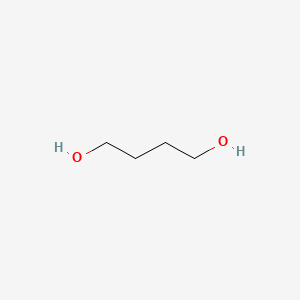
1,4-Butanediol
Butane-1,4-diol is a butanediol that is butane in which one hydrogen of each of the methyl groups is substituted by a hydroxy group. A colourless, water-miscible, viscous liquid at room temperature (m.p. 16C) with a high boiling point (230C), it is mainly used for the production of other organic chemicals, particularly the solvent oxolane (also known as tetrahydrofuran or THF). It has a role as a protic solvent, a prodrug and a neurotoxin. It is a glycol and a butanediol. — ChEBI
- IUPAC 명칭
- butane-1,4-diol
- 분자식
- C4H10O2
- 분자량
- 90.12 g/mol
- 정확한 질량
- 90.068079557 Da
- XLogP3
- -0.8
- 위상 극성 표면적
- 40.5 Ų
- 수소 결합 공여체
- 2
- 수소 결합 수용체
- 2
- 공유결합 단위
- 1
- 정의된 입체중심
- 0
다른 이름
보고된 명칭 16개 더 보기
외부 데이터베이스 식별자
- ChEBI:CHEBI:41189
- ChEMBL:CHEMBL171623
- EPA DTXSID:DTXSID2024666
- PubMed:23105783
- PubMed:23008214
- PubMed:22998632
- PubMed:22972776
- PubMed:22917943
- PubMed:22870450
- PubMed:22835692
- PubMed:22830993
- PubMed:22807313
- PubMed:22746383
- PubMed:22736370
- PubMed:22730800
추가 과학 데이터베이스의 근거
NIH PubChem PUG-View
Attributed physical-property, hazard, environmental and use annotations.
- Autoignition Temperature: 671 °F (USCG, 1999) 출처: CAMEO Chemicals
- Autoignition Temperature: 662 °F (350 °C) 출처: Hazardous Substances Data Bank (HSDB)
- Autoignition Temperature: 350 °C 출처: ILO-WHO International Chemical Safety Cards (ICSCs)
- Boiling Point: 446 °F at 760 mmHg (NTP, 1992) 출처: CAMEO Chemicals
- Boiling Point: 235 °C 출처: DrugBank
- Boiling Point: 229.5 °C 출처: Hazardous Substances Data Bank (HSDB)
- Boiling Point: 228 °C 출처: ILO-WHO International Chemical Safety Cards (ICSCs)
- Boiling Point: 230 °C @760 [mm Hg] 출처: PAC Chemical Database, U.S. Department of Energy
- Color/Form: Colorless, oily liquid 출처: Hazardous Substances Data Bank (HSDB)
- Color/Form: Colorless liquid 출처: Hazardous Substances Data Bank (HSDB)
- Color/Form: Colorless, viscous liquid or crystals; to needles on chilling 출처: Hazardous Substances Data Bank (HSDB)
- Density: 1.017 at 68 °F (USCG, 1999) - Denser than water; will sink 출처: CAMEO Chemicals
- Density: 1.0171 g/cu cm at 20 °C 출처: Hazardous Substances Data Bank (HSDB)
- Density: Relative density (water = 1): 1.02 출처: ILO-WHO International Chemical Safety Cards (ICSCs)
- Density: 3.1 @25 °C 출처: PAC Chemical Database, U.S. Department of Energy
- pKa: 14.5 (at 25 °C) 출처: DrugBank
- Dissociation Constants: pKa = 14.5 출처: Hazardous Substances Data Bank (HSDB)
- Flash Point: 247 °F (NTP, 1992) 출처: CAMEO Chemicals
- Flash Point: 121 °C 출처: Haz-Map, Information on Hazardous Chemicals and Occupational Diseases
- Flash Point: 134 °C (273 °F) - closed cup 출처: Hazardous Substances Data Bank (HSDB)
- Flash Point: 250 °F (121 °C) - open cup 출처: Hazardous Substances Data Bank (HSDB)
- Flash Point: 121 °C o.c. 출처: ILO-WHO International Chemical Safety Cards (ICSCs)
- LogP: -0.83 출처: DrugBank
- LogP: log Kow = -0.83 출처: Hazardous Substances Data Bank (HSDB)
- Melting Point: 61 °F (NTP, 1992) 출처: CAMEO Chemicals
- Melting Point: 20.1 °C 출처: DrugBank
- Melting Point: 20.43 °C 출처: Hazardous Substances Data Bank (HSDB)
- Melting Point: 20 °C 출처: ILO-WHO International Chemical Safety Cards (ICSCs)
- Melting Point: 16 °C 출처: PAC Chemical Database, U.S. Department of Energy
- Odor: Almost odorless 출처: Hazardous Substances Data Bank (HSDB)
- Physical Description: 1,4-butanediol appears as odorless colorless liquid or solid (depending upon temperature). (USCG, 1999) 출처: CAMEO Chemicals
- Physical Description: Liquid; Large Crystals 출처: EPA Chemical Data Reporting (CDR)
- Physical Description: Colorless liquid; [Hawley] Hygroscopic; [CAMEO] Colorless liquid or yellow melt; mp 19-20 deg C; [MSDSonline] 출처: Haz-Map, Information on Hazardous Chemicals and Occupational Diseases
- Physical Description: COLOURLESS VISCOUS LIQUID. 출처: ILO-WHO International Chemical Safety Cards (ICSCs)
- Refractive Index: Index of refraction: 1.4460 at 20 °C 출처: Hazardous Substances Data Bank (HSDB)
- Solubility: greater than or equal to 100 mg/mL at 73 °F (NTP, 1992) 출처: CAMEO Chemicals
- Solubility: 1000000 mg/L (at 20 °C) 출처: DrugBank
- Solubility: In water, 1.0X10+6 mg/L at 20 °C /miscible/ 출처: Hazardous Substances Data Bank (HSDB)
- Solubility: Miscible in water 출처: Hazardous Substances Data Bank (HSDB)
- Solubility: Soluble in water 출처: Hazardous Substances Data Bank (HSDB)
- Solubility: Readily soluble in water 출처: Hazardous Substances Data Bank (HSDB)
- Solubility: For more Solubility (Complete) data for 1,4-Butanediol (7 total), please visit the HSDB record page. 출처: Hazardous Substances Data Bank (HSDB)
- Solubility: Solubility in water: miscible 출처: ILO-WHO International Chemical Safety Cards (ICSCs)
- Vapor Pressure: less than 1 mmHg at 100 °F (NTP, 1992) 출처: CAMEO Chemicals
- Vapor Pressure: 0.01 [mmHg] 출처: Haz-Map, Information on Hazardous Chemicals and Occupational Diseases
- Vapor Pressure: 0.0105 mm Hg at 25 °C 출처: Hazardous Substances Data Bank (HSDB)
- Vapor Pressure: Vapor pressure, Pa at 38 °C: 출처: ILO-WHO International Chemical Safety Cards (ICSCs)
- Vapor Pressure: 0.0105 [mm Hg] @25 °C 출처: PAC Chemical Database, U.S. Department of Energy
- Viscosity: 84.9 mPa.s at 20 °C 출처: Hazardous Substances Data Bank (HSDB)
- Exposure Routes: The substance can be absorbed into the body by inhalation of its vapour and by ingestion. 출처: ILO-WHO International Chemical Safety Cards (ICSCs)
- First Aid: EYES: First check the victim for contact lenses and remove if present. Flush victim's eyes with water or normal saline solution for 20 to 30 minutes while simultaneously calling a hospital or poison control center. Do not put any ointments, oils, or medication in the victim's eyes without specific instructions from a physician. IMMEDIATELY transport the victim after flushing eyes to a hospital even if no symptoms (such as redness or irritation) develop.; SKIN: IMMEDIATELY flood affected skin with water while removing and isolating all contaminated clothing. Gently wash all affected skin areas thoroughly with soap and water. If symptoms such as redness or irritation develop, IMMEDIATELY call a physician and be prepared to transport the victim to a hospital for treatment.; INHALATION: IMMEDIATELY leave the contaminated area; take deep breaths of fresh air. If symptoms (such as wheezing, coughing, shortness of breath, or burning in the mouth, throat, or chest) develop, call a physician and be prepared to transport the victim to a hospital. Provide proper respiratory protection to rescuers entering an unknown atmosphere. Whenever possible, Self-Contained Breathing Apparatus (SCBA) shou 출처: CAMEO Chemicals
- Note: This chemical does not meet GHS hazard criteria for 10.4% (112 of 1080) of reports. 출처: European Chemicals Agency (ECHA)
- Signal: Warning 출처: European Chemicals Agency (ECHA)
- GHS Hazard Statements: H302 (89.6%): Harmful if swallowed [Warning Acute toxicity, oral]; H336 (70.6%): May cause drowsiness or dizziness [Warning Specific target organ toxicity, single exposure; Narcotic effects] 출처: European Chemicals Agency (ECHA)
- Precautionary Statement Codes: P261, P264, P270, P271, P301+P317, P304+P340, P319, P330, P403+P233, P405, and P501 (click each P-code to see the statement) 출처: European Chemicals Agency (ECHA)
- ECHA C&L Notifications Summary: Aggregated GHS information provided per 1080 reports by companies from 32 notifications to the ECHA C&L Inventory. Each notification may be associated with multiple companies.; Reported as not meeting GHS hazard criteria per 112 of 1080 reports by companies.; There are 31 notifications provided by 968 of 1080 reports by companies with hazard statement code(s).; Information may vary between notifications depending on impurities, additives, and other factors. The percentage value in parenthesis indicates the notified classification ratio from companies that provide hazard codes. Only hazard codes with percentage values above 10% are shown. For more detailed information, please visit ECHA C&L website. 출처: European Chemicals Agency (ECHA)
- Signal: Warning 출처: Hazardous Chemical Information System (HCIS), Safe Work Australia
- GHS Hazard Statements: H302: Harmful if swallowed [Warning Acute toxicity, oral]; H336: May cause drowsiness or dizziness [Warning Specific target organ toxicity, single exposure; Narcotic effects] 출처: Hazardous Chemical Information System (HCIS), Safe Work Australia
- Precautionary Statement Codes: P261, P264, P270, P271, P301+P317, P304+P340, P319, P330, P403+P233, P405, and P501 (click each P-code to see the statement) 출처: Hazardous Chemical Information System (HCIS), Safe Work Australia
- Signal: Warning 출처: Hazardous Substances Data Bank (HSDB)
- GHS Hazard Statements: H302: Harmful if swallowed [Warning Acute toxicity, oral]; H336: May cause drowsiness or dizziness [Warning Specific target organ toxicity, single exposure; Narcotic effects] 출처: Hazardous Substances Data Bank (HSDB)
- Precautionary Statement Codes: P261, P264, P270, P271, P301+P317, P304+P340, P319, P330, P403+P233, P405, and P501 (click each P-code to see the statement) 출처: Hazardous Substances Data Bank (HSDB)
- NFPA Health Rating: 1 - Materials that, under emergency conditions, can cause significant irritation. 출처: Hazardous Substances Data Bank (HSDB)
- NFPA Fire Rating: 1 - Materials that must be preheated before ignition can occur. Materials require considerable preheating, under all ambient temperature conditions, before ignition and combustion can occur. 출처: Hazardous Substances Data Bank (HSDB)
- NFPA Instability Rating: 0 - Materials that in themselves are normally stable, even under fire conditions. 출처: Hazardous Substances Data Bank (HSDB)
- Cosmetic Ingredient Review Conclusion: The Panel also concluded that the available data are insufficient to make a determination that 1,4-Butanediol... is safe under the intended conditions of use in cosmetic formulations. 출처: Cosmetic Ingredient Review (CIR)
- Cosmetic Ingredient Review Finding(s): The available data are insufficient to support safety 출처: Cosmetic Ingredient Review (CIR)
- Toxicity Summary: IDENTIFICATION AND USE: 1,4-Butanediol is a colorless, oily liquid. It is used as an industrial solvent, intermediate in organic synthesis, and polymer feedstock. Two studies have been identified concerning the experimental use of 1,4-butanediol as a sedative. HUMAN STUDIES: It was reported that sleep is induced by intravenous administration or by infusion. Undesirable side-effects which may occur include restlessness and clonic spasms of the muscle of the extremities. Cases of abuse and fatal intoxication have been reported. ANIMAL STUDIES: Gauze patches with undiluted 1,4-butanediol were applied to the intact and abraded skin of rabbits with occlusive dressing for 24 hours. After 1, 24, 48 and 72 hours, no reaction was observed on the intact and abraded skin. The main signs of toxicity seen in mice and rats were accelerated breathing, dyspnea, spasmodic breathing, bradycardia, exsiccosis, exophthalmus, apathy, hyperreflexia, hyporeflexia, areflexia, ataxia, atonia, twitching, reduced motility, analgesia, lying on the side, loss of righting reflexes, sedation, narcosis, hair loss and ruffled fur. Death occurred within 24 hours. Respiratory failure was thought to be the cause of de 출처: Hazardous Substances Data Bank (HSDB)
- Environmental Bioconcentration: An estimated BCF of 3 was calculated in fish for 1,4-butanediol(SRC), using a log Kow of -0.83(1) and a regression-derived equation(2). According to a classification scheme(3), this BCF suggests the potential for bioconcentration in aquatic organisms is low(SRC). 출처: Hazardous Substances Data Bank (HSDB)
- Environmental Fate: TERRESTRIAL FATE: Based on a classification scheme(1), an estimated Koc value of 1(SRC), determined from a structure estimation method(2), indicates that 1,4-butanediol is expected to have very high mobility in soil(SRC). Volatilization of 1,4-butanediol from moist soil surfaces is not expected to be an important fate process(SRC) given an estimated Henry's Law constant of 1.2X10⁻⁹ atm-cu m/mole(SRC), based upon its vapor pressure, 0.0105 mm Hg(3), and assigned value for water solubility of 1X10+6 mg/L (miscible)(4). 1,4-Butanediol is not expected to volatilize from dry soil surfaces(SRC) based upon its vapor pressure(3). An 83% of Theoretical BOD using activated sludge in the Japanese MITI test(5) suggests that biodegradation is an important environmental fate process in soil(SRC). 출처: Hazardous Substances Data Bank (HSDB)
- Environmental Fate: AQUATIC FATE: Based on a classification scheme(1), an estimated Koc value of 1(SRC), determined from a structure estimation method(2), indicates that 1,4-butanediol is not expected to adsorb to suspended solids and sediment(SRC). Volatilization from water surfaces is not expected(3) based upon an estimated Henry's Law constant of 1.2X10⁻⁹ atm-cu m/mole(SRC), derived from its vapor pressure, 0.0105 mm Hg(4), assigned value for water solubility of 1X10+6 mg/L (miscible)(5). 1,4-Butanediol is not expected to undergo hydrolysis in the environment due to the lack of functional groups that hydrolyze under environmental conditions(3). According to a classification scheme(6), an estimated BCF of 3(SRC), from its log Kow of -0.83(7) and a regression-derived equation(2), suggests the potential for bioconcentration in aquatic organisms is low. An 83% of Theoretical BOD using activated sludge in the Japanese MITI test(8) suggests that biodegradation is an important environmental fate process in water(SRC). 출처: Hazardous Substances Data Bank (HSDB)
- Environmental Fate: ATMOSPHERIC FATE: According to a model of gas/particle partitioning of semivolatile organic compounds in the atmosphere(1), 1,4-butanediol, which has a vapor pressure of 0.0105 mm Hg at 25 °C(2), is expected to exist solely as a vapor in the ambient atmosphere. Vapor-phase 1,4-butanediol is degraded in the atmosphere by reaction with photochemically-produced hydroxyl radicals(SRC); the half-life for this reaction in air is estimated to be 10 hours(SRC), calculated from its rate constant of 3.67X10⁻¹¹ cu cm/molecule-sec(3). 1,4-Butanediol does not contain chromophores that absorb at wavelengths >290 nm(4) and, therefore, is not expected to be susceptible to direct photolysis by sunlight(SRC). 출처: Hazardous Substances Data Bank (HSDB)
- Consumer Uses: Hardener; Intermediate; Not Known or Reasonably Ascertainable 출처: EPA Chemical Data Reporting (CDR)
- Industry Uses: Intermediate; Hardener; Surface modifier; Plasticizer; Not Known or Reasonably Ascertainable; Monomers; Wrinkle resisting agent; Solvent 출처: EPA Chemical Data Reporting (CDR)
- Cosmetic Ingredient Review Link: CIR ingredient: 1,4-Butanediol 출처: Cosmetic Ingredient Review (CIR)
- Sources/Uses: Used as a chemical intermediate for tetrahydrofuran and other acetylenic chemicals; as a monomer for polybutylene terephthalate resins; as a chain extender for polyurethane resins; as an intermediate in polyester resins; in the production of 1,4-butanediol dimethanesulfonate (myleran); Also used as a humectant; [HSDB] Used as a solvent, an intermediate for plasticizers, and a cross-linking agent in polyurethane elastomers; [Hawley] 출처: Haz-Map, Information on Hazardous Chemicals and Occupational Diseases
- Industrial Processes with risk of exposure: Painting (Solvents) [Category: Paint]; Plastic Composites Manufacturing [Category: Industry] 출처: Haz-Map, Information on Hazardous Chemicals and Occupational Diseases
- Uses: 1,4-Butanediol is a versatile intermediate for the chemical industry. The most important area of application is the production of polyurethanes and poly(butylene terephthalate). Among the polyurethanes produced from 1,4-butanediol, cellular and compact elastomers are of prime importance. 출처: Hazardous Substances Data Bank (HSDB)
- Uses: Industrial solvent; intermediate in organic synthesis; polymer feedstock. 출처: Hazardous Substances Data Bank (HSDB)
- Uses: MEDICATION 출처: Hazardous Substances Data Bank (HSDB)
- Uses: Humectant, intermediate for plasticizers, pharmaceuticals, cross-linking agent in polyurethane elastomers, manufacture of tetrahydrofuran, terephthalate plastics. 출처: Hazardous Substances Data Bank (HSDB)
- Uses: For more Uses (Complete) data for 1,4-Butanediol (6 total), please visit the HSDB record page. 출처: Hazardous Substances Data Bank (HSDB)
매핑 기준: Existing checksum-valid CAS to unique PubChem CID match. 가져온 시각: 2026-08-31. 출처 기록 열기
과학적 분류와 유해성 주석은 맥락을 제공할 뿐이며, 위에 표시된 시장별 규제 판단을 대체하지 않습니다.
추가 출처 적용 범위 및 일치 상태
| 출처 | 결과 | 확인됨 |
|---|---|---|
| NIH PubChem PUG-View | 정확히 일치 | 2026-08-31 |
기록된 불일치는 출처를 확인했다는 유용한 근거이며, 해당 물질이 다른 곳에 존재하지 않는다는 주장이 아닙니다.
체크섬이 유효한 CAS 일치를 통해 2026-08-31에 NIH PubChem에서 가져왔습니다. 화학적 특성은 이 페이지의 규제 판단을 대체하지 않습니다.