
CAS
기록 1건
CAS 110-46-3
CAS 110-46-3은(는) 규정 1223/2009의 부속서 II–VI에 걸쳐 EU 부속서 기록 1건과 일치합니다.
CAS 110-46-3의 기록
1 총화학적 정체 및 특성
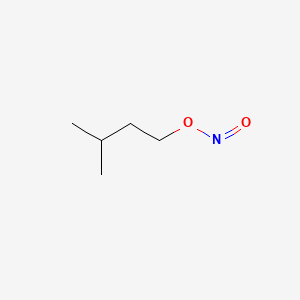
CAS 110-46-3PubChem CID 8053
Isoamyl Nitrite
Isoamyl nitrite is a nitrite ester having isopentyl as the alkyl group. It has a role as a vasodilator agent and an antihypertensive agent. It is functionally related to an isoamylol. — ChEBI
- IUPAC 명칭
- 3-methylbutyl nitrite
- 분자식
- C5H11NO2
- 분자량
- 117.15 g/mol
- 정확한 질량
- 117.078978594 Da
- XLogP3
- 1.7
- 위상 극성 표면적
- 38.7 Ų
- 수소 결합 공여체
- 0
- 수소 결합 수용체
- 3
- 공유결합 단위
- 1
- 정의된 입체중심
- 0
다른 이름
Isopentyl nitriteVaporoleAmilnitriteAspiralNitrous acid, 3-methylbutyl ester3-Methylbutanol nitritePentanoli nitrisNitrous acid, isopentyl ester
보고된 명칭 16개 더 보기
Isopentyl alcohol, nitriteAmyl nitrosum5N0U5TUC9ZNSC-7903CHEBI:2691Nitrite, AmylRefChem:54193Nitrous acid, 3-methyl butyl ester203-770-81-PENTYL NITRITE22T8Z09XAKAmyl NitriteNitramylNitrous Acid, 2-methylbutyl Ester, mixt. with 3-methylbutylnitriteAmyl nitrite INitramyl (VAN)
외부 데이터베이스 식별자
- ChEBI:CHEBI:2691
- ChEMBL:CHEMBL1535371
- EPA DTXSID:DTXSID9025455
- PubMed:22606955
- PubMed:22268155
- PubMed:22174654
- PubMed:21711620
- PubMed:21587610
- PubMed:21581251
- PubMed:21495143
- PubMed:20416372
- PubMed:19425783
- PubMed:19294290
- PubMed:19109018
- PubMed:18940810
추가 과학 데이터베이스의 근거
NIH PubChem PUG-View
식별자 정확히 일치8053
Attributed physical-property, hazard, environmental and use annotations.
- Autoignition Temperature: 408 °F (NTP, 1992) 출처: CAMEO Chemicals
- Autoignition Temperature: 408 °F 출처: Hazardous Substances Data Bank (HSDB)
- Autoignition Temperature: 209 °C 출처: ILO-WHO International Chemical Safety Cards (ICSCs)
- Boiling Point: 205 to 210 °F at 760 mmHg (NTP, 1992) 출처: CAMEO Chemicals
- Boiling Point: 99.2 °C 출처: Hazardous Substances Data Bank (HSDB)
- Boiling Point: 99.2 °C 출처: Human Metabolome Database (HMDB)
- Boiling Point: 97-99 °C 출처: ILO-WHO International Chemical Safety Cards (ICSCs)
- Boiling Point: 99.2 °C @760 [mm Hg] 출처: PAC Chemical Database, U.S. Department of Energy
- Color/Form: Yellowish, transparent liquid 출처: Hazardous Substances Data Bank (HSDB)
- Density: 0.8528 at 68 °F (NTP, 1992) - Less dense than water; will float 출처: CAMEO Chemicals
- Density: 0.875 @ 25 °C 출처: Hazardous Substances Data Bank (HSDB)
- Density: Relative density (water = 1): 0.875 출처: ILO-WHO International Chemical Safety Cards (ICSCs)
- Density: 0.8828 @ 20°C 출처: PAC Chemical Database, U.S. Department of Energy
- Flash Point: less than 69 °F (NTP, 1992) 출처: CAMEO Chemicals
- Flash Point: 3 °C 출처: ILO-WHO International Chemical Safety Cards (ICSCs)
- Odor: Penetrating fragrant, somewhat fruity odor 출처: Hazardous Substances Data Bank (HSDB)
- Physical Description: Isoamyl nitrite is a clear yellow liquid. (NTP, 1992) 출처: CAMEO Chemicals
- Physical Description: Yellowish transparent liquid with a penetrating, somewhat fruity odor; Unstable, decomposed by light and air; [Merck Index] Colorless liquid; [MSDSonline] 출처: Haz-Map, Information on Hazardous Chemicals and Occupational Diseases
- Physical Description: Liquid 출처: Human Metabolome Database (HMDB)
- Physical Description: YELLOW LIQUID WITH CHARACTERISTIC ODOUR. 출처: ILO-WHO International Chemical Safety Cards (ICSCs)
- Refractive Index: Index of refraction: 1.3918 @ 20 °C 출처: Hazardous Substances Data Bank (HSDB)
- Solubility: less than 0.1 mg/mL at 64 °F (NTP, 1992) 출처: CAMEO Chemicals
- Solubility: MISCIBLE WITH ETHER, ALCOHOL, CHLOROFORM 출처: Hazardous Substances Data Bank (HSDB)
- Solubility: Very slightly soluble in water 출처: Hazardous Substances Data Bank (HSDB)
- Solubility: Solubility in water: none 출처: ILO-WHO International Chemical Safety Cards (ICSCs)
- Vapor Pressure: 26.3 [mmHg] 출처: Haz-Map, Information on Hazardous Chemicals and Occupational Diseases
- Vapor Pressure: Vapor pressure, kPa at 20 °C: 3.5 출처: ILO-WHO International Chemical Safety Cards (ICSCs)
- Exposure Routes: The substance can be absorbed into the body by inhalation and through the skin. 출처: ILO-WHO International Chemical Safety Cards (ICSCs)
- First Aid: EYES: First check the victim for contact lenses and remove if present. Flush victim's eyes with water or normal saline solution for 20 to 30 minutes while simultaneously calling a hospital or poison control center. Do not put any ointments, oils, or medication in the victim's eyes without specific instructions from a physician. IMMEDIATELY transport the victim after flushing eyes to a hospital even if no symptoms (such as redness or irritation) develop.; SKIN: IMMEDIATELY flood affected skin with water while removing and isolating all contaminated clothing. Gently wash all affected skin areas thoroughly with soap and water. If symptoms such as redness or irritation develop, IMMEDIATELY call a physician and be prepared to transport the victim to a hospital for treatment.; INHALATION: IMMEDIATELY leave the contaminated area; take deep breaths of fresh air. If symptoms (such as wheezing, coughing, shortness of breath, or burning in the mouth, throat, or chest) develop, call a physician and be prepared to transport the victim to a hospital. Provide proper respiratory protection to rescuers entering an unknown atmosphere. Whenever possible, Self-Contained Breathing Apparatus (SCBA) shou 출처: CAMEO Chemicals
- ERG2024, Guide 129 (Amyl nitrite): General First Aid:; · Call 911 or emergency medical service.; · Ensure that medical personnel are aware of the material(s) involved, take precautions to protect themselves and avoid contamination.; · Move victim to fresh air if it can be done safely.; · Administer oxygen if breathing is difficult.; · If victim is not breathing:; -- DO NOT perform mouth-to-mouth resuscitation; the victim may have ingested or inhaled the substance.; -- If equipped and pulse detected, wash face and mouth, then give artificial respiration using a proper respiratory medical device (bag-valve mask, pocket mask equipped with a one-way valve or other device).; -- If no pulse detected or no respiratory medical device available, provide continuous compressions. Conduct a pulse check every two minutes or monitor for any signs of spontaneous respirations.; · Remove and isolate contaminated clothing and shoes.; · For minor skin contact, avoid spreading material on unaffected skin.; · In case of contact with substance, remove immediately by flushing skin or eyes with running water for at least 20 minutes.; · For severe burns, immediate medical attention is required.; · Effects of exposure (inhalation, ingestion, 출처: Emergency Response Guidebook (ERG)
- Signal: Danger 출처: Regulation (EC) No 1272/2008 of the European Parliament and of the Council
- GHS Hazard Statements: H225: Highly Flammable liquid and vapor [Danger Flammable liquids]; H302: Harmful if swallowed [Warning Acute toxicity, oral]; H332: Harmful if inhaled [Warning Acute toxicity, inhalation] 출처: Regulation (EC) No 1272/2008 of the European Parliament and of the Council
- Precautionary Statement Codes: P210, P233, P240, P241, P242, P243, P261, P264, P270, P271, P280, P301+P317, P303+P361+P353, P304+P340, P317, P330, P370+P378, P403+P235, and P501 (click each P-code to see the statement) 출처: Regulation (EC) No 1272/2008 of the European Parliament and of the Council
- Signal: Danger 출처: European Chemicals Agency (ECHA)
- GHS Hazard Statements: H225 (100%): Highly Flammable liquid and vapor [Danger Flammable liquids]; H302 (100%): Harmful if swallowed [Warning Acute toxicity, oral]; H314 (13.5%): Causes severe skin burns and eye damage [Danger Skin corrosion/irritation]; H317 (13.5%): May cause an allergic skin reaction [Warning Sensitization, Skin]; H318 (13.5%): Causes serious eye damage [Danger Serious eye damage/eye irritation]; H332 (93.2%): Harmful if inhaled [Warning Acute toxicity, inhalation]; H341 (13.5%): Suspected of causing genetic defects [Warning Germ cell mutagenicity] 출처: European Chemicals Agency (ECHA)
- Precautionary Statement Codes: P203, P210, P233, P240, P241, P242, P243, P260, P261, P264, P264+P265, P270, P271, P272, P280, P301+P317, P301+P330+P331, P302+P352, P302+P361+P354, P303+P361+P353, P304+P340, P305+P354+P338, P316, P317, P318, P321, P330, P333+P317, P362+P364, P363, P370+P378, P403+P235, P405, and P501 (click each P-code to see the statement) 출처: European Chemicals Agency (ECHA)
- ECHA C&L Notifications Summary: Aggregated GHS information provided per 74 reports by companies from 5 notifications to the ECHA C&L Inventory. Each notification may be associated with multiple companies.; Information may vary between notifications depending on impurities, additives, and other factors. The percentage value in parenthesis indicates the notified classification ratio from companies that provide hazard codes. Only hazard codes with percentage values above 10% are shown. For more detailed information, please visit ECHA C&L website. 출처: European Chemicals Agency (ECHA)
- Signal: Warning 출처: NITE-CMC
- GHS Hazard Statements: H317: May cause an allergic skin reaction [Warning Sensitization, Skin]; H400: Very toxic to aquatic life [Warning Hazardous to the aquatic environment, acute hazard]; H412: Harmful to aquatic life with long lasting effects [Hazardous to the aquatic environment, long-term hazard] 출처: NITE-CMC
- Precautionary Statement Codes: P261, P272, P273, P280, P302+P352, P321, P333+P317, P362+P364, P391, and P501 (click each P-code to see the statement) 출처: NITE-CMC
- Signal: Danger 출처: NITE-CMC
- GHS Hazard Statements: H225: Highly Flammable liquid and vapor [Danger Flammable liquids]; H331: Toxic if inhaled [Danger Acute toxicity, inhalation]; H370: Causes damage to organs [Danger Specific target organ toxicity, single exposure] 출처: NITE-CMC
- Sources/Uses: Used in perfumes and to make diazonium compounds; Also used as a drug (vasodilator for angina and antidote for hydrogen cyanide poisoning); [HSDB] 출처: Haz-Map, Information on Hazardous Chemicals and Occupational Diseases
- Uses: Used in perfumes; preparation of diazonium compounds 출처: Hazardous Substances Data Bank (HSDB)
- Uses: Used as a vasodilator in angina therapy in the treatment of hydrogen cyanide and hydrogen sulfide poisonings, and as an industrial chemical and perfume scent 출처: Hazardous Substances Data Bank (HSDB)
- Uses: MEDICATION 출처: Hazardous Substances Data Bank (HSDB)
- Uses: MEDICATION (VET) 출처: Hazardous Substances Data Bank (HSDB)
매핑 기준: Existing checksum-valid CAS to unique PubChem CID match. 가져온 시각: 2026-08-31. 출처 기록 열기
과학적 분류와 유해성 주석은 맥락을 제공할 뿐이며, 위에 표시된 시장별 규제 판단을 대체하지 않습니다.
추가 출처 적용 범위 및 일치 상태
| 출처 | 결과 | 확인됨 |
|---|---|---|
| NIH PubChem PUG-View | 정확히 일치 | 2026-08-31 |
기록된 불일치는 출처를 확인했다는 유용한 근거이며, 해당 물질이 다른 곳에 존재하지 않는다는 주장이 아닙니다.
체크섬이 유효한 CAS 일치를 통해 2026-08-31에 NIH PubChem에서 가져왔습니다. 화학적 특성은 이 페이지의 규제 판단을 대체하지 않습니다.
이 사이트에서 CAS 110-46-3을(를) 사용하는 방식
CAS 110-46-3은(는) 이 페이지를 특정 물질에 고정하는 데 사용하는 Chemical Abstracts Service 식별자입니다. 현재 데이터세트에서는 EU 부속서 기록 1건이 이 식별자를 공유하며, 같은 물질이 하나의 규제 맥락에 나타나는지 여러 맥락에 나타나는지 교차 확인하는 데 도움이 됩니다.
공급업체 규격서, SDS 또는 원료 문서에 CAS 110-46-3이(가) 제시되어 있고 연결된 모든 부속서 II–VI 기록을 한곳에서 확인해야 할 때 이 페이지를 이용하세요. 위의 항목 카드는 농도 한도, 경고 문구, 부속서 위치 및 제품 유형 조건을 가장 빠르게 확인하는 방법입니다.
자주 묻는 질문
CAS 110-46-3로 식별되는 물질은 맥락에 따라 다른 조건이 적용되는 경우 EU 화장품 규정의 여러 부속서에 나타날 수 있습니다. 예를 들어 어떤 물질이 부속서 III에서 특정 조건으로 사용제한될 수 있고, 같은 CAS가 부속서 IV에서 별도의 항목 조건에 따라 허용 색소로 나타날 수도 있습니다. 각 항목은 개별적으로 검토해야 합니다.
CAS 번호를 원료 규격서 및 CoA 문서와 대조하세요. CAS가 부속서 II에 있으면 해당 물질이 없는지 확인하세요. 부속서 III에 있으면 처방에서 농도 한도와 제품 유형 조건이 충족되는지 확인하세요. 이 CAS 번호를 공유하는 모든 부속서 항목이 위에 나열되어 있습니다.
CAS 번호는 미국의 Chemical Abstracts Service가 부여하며 전 세계적으로 통용됩니다. EC 번호는 EINECS, ELINCS 또는 NLP 목록 같은 목록에 수록된 유럽연합 집행위원회 식별자입니다. 두 식별자 모두 EU 화장품 부속서 항목에 나타날 수 있습니다. 두 가지를 모두 가진 물질도 있고, 하나만 가진 물질도 있으며, 일부 오래된 항목은 둘 다 없을 수도 있습니다.
INCI 검사기는 원료명, CAS 번호 및 EC 번호를 받습니다. 이 CAS 번호를 직접 확인한 다음, 결과를 공급업체 규격서 및 연결된 모든 부속서 조건과 대조하세요.