
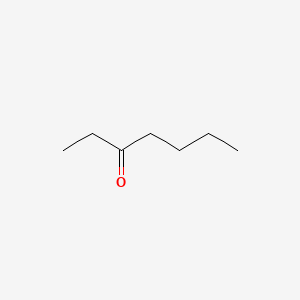
CAS 106-35-4PubChem CID 7802
3-Heptanone
Ethyl butyl ketone is a colorless odorless liquid with a mild fruity odor. Flash point 140 °F. — CAMEO Chemicals
- IUPAC 명칭
- heptan-3-one
- 분자식
- C7H14O
- 분자량
- 114.19 g/mol
- 정확한 질량
- 114.104465066 Da
- XLogP3
- 1.8
- 위상 극성 표면적
- 17.1 Ų
- 수소 결합 공여체
- 0
- 수소 결합 수용체
- 1
- 공유결합 단위
- 1
- 정의된 입체중심
- 0
다른 이름
Butyl ethyl ketonen-Butyl ethyl ketoneAethylbutylketonEthylbutylcetoneETHYL BUTYL KETONEEthylbutylketonEtilbutilchetoneEthyl-n-butyl ketone
보고된 명칭 16개 더 보기
Eptan-3-oneHeptan-3-onFEMA No. 254510GA6SR3ATNSC-8448CHEBI:50139RefChem:94007203-388-1Ethyl n-butyl ketoneEthyl butyl ketone 3-HeptanoneAethylbutylketon [German]NSC 8448n-Heptan-3-oneHeptan-3-on [Dutch, German]n-C4H9COC2H5Aethylbutylketon (german)
외부 데이터베이스 식별자
추가 과학 데이터베이스의 근거
EMBL-EBI ChEBI
식별자 정확히 일치CHEBI:50139
heptan-3-one
A dialkyl ketone with butyl and ethyl as the two alkyl groups.
- 처방
- C7H14O
- 평균 질량
- 114.188 g/mol
- 단일 동위원소 질량
- 114.10447 Da
- 형식 전하
- 0
- dialkyl ketone — is a (CHEBI:18044)
- biomarker — has role (CHEBI:59163)
- metabolite — has role (CHEBI:25212)
- biomarker — has role (CHEBI:59163)
- metabolite — has role (CHEBI:25212)
- dialkyl ketone — is a (CHEBI:18044)
추가 선별 명칭
heptan-3-one3-HeptanoneAethylbutylketonButyl ethyl ketoneEthylbutylcetoneEthyl n-butyl ketoneEthyl-n-butyl ketonen-Butyl ethyl ketone
이 출처의 상호 참조
- CAS: 106-35-4 — NIST Chemistry WebBook
- CAS: 106-35-4 — ChemIDplus
- MANUAL_X_REF: 3-Heptanone — Wikipedia
- MANUAL_X_REF: HMDB0031482 — HMDB
- REGISTRY_NUMBER: 506161 — Reaxys
매핑 기준: Exact CAS cross-reference in the ChEBI compound record. 출처 업데이트: 2021-01-22. 가져온 시각: 2026-08-31. 출처 기록 열기
NIH PubChem PUG-View
식별자 정확히 일치7802
Attributed physical-property, hazard, environmental and use annotations.
- Boiling Point: 297 °F at 760 mmHg (USCG, 1999) 출처: CAMEO Chemicals
- Boiling Point: 147 °C 출처: Hazardous Substances Data Bank (HSDB)
- Boiling Point: 146.00 to 148.00 °C. @ 760.00 mm Hg 출처: Human Metabolome Database (HMDB)
- Boiling Point: 147 °C 출처: ILO-WHO International Chemical Safety Cards (ICSCs)
- Boiling Point: 149 °C 출처: Joint FAO/WHO Expert Committee on Food Additives (JECFA)
- Boiling Point: 298 °F 출처: Occupational Safety and Health Administration (OSHA)
- Boiling Point: 298 °F 출처: The National Institute for Occupational Safety and Health (NIOSH)
- Color/Form: Clear liquid 출처: Hazardous Substances Data Bank (HSDB)
- Color/Form: Colorless liquid 출처: Hazardous Substances Data Bank (HSDB)
- Density: 0.818 (USCG, 1999) - Less dense than water; will float 출처: CAMEO Chemicals
- Density: 0.8183 at 20 °C/4 °C 출처: Hazardous Substances Data Bank (HSDB)
- Density: Bulk density: 6.8 lb/gal 출처: Hazardous Substances Data Bank (HSDB)
- Density: Relative density (water = 1): 0.8 출처: ILO-WHO International Chemical Safety Cards (ICSCs)
- Density: 0.813-0.818 출처: Joint FAO/WHO Expert Committee on Food Additives (JECFA)
- Density: 0.82 출처: Occupational Safety and Health Administration (OSHA)
- Density: 0.8198 @ 20°C 출처: PAC Chemical Database, U.S. Department of Energy
- Density: 0.82 출처: The National Institute for Occupational Safety and Health (NIOSH)
- Flash Point: 115 °F (USCG, 1999) 출처: CAMEO Chemicals
- Flash Point: 46 °C 출처: Haz-Map, Information on Hazardous Chemicals and Occupational Diseases
- Flash Point: 115 °F (46 °C) (Open cup) 출처: Hazardous Substances Data Bank (HSDB)
- Flash Point: 46 °C o.c. 출처: ILO-WHO International Chemical Safety Cards (ICSCs)
- Flash Point: 115 °F (open cup) 출처: Occupational Safety and Health Administration (OSHA)
- Flash Point: (oc) 115 °F 출처: The National Institute for Occupational Safety and Health (NIOSH)
- Melting Point: -38 °F (USCG, 1999) 출처: CAMEO Chemicals
- Melting Point: -39 °C 출처: Hazardous Substances Data Bank (HSDB)
- Melting Point: -39 °C 출처: Human Metabolome Database (HMDB)
- Melting Point: -39 °C 출처: ILO-WHO International Chemical Safety Cards (ICSCs)
- Melting Point: -38 °F 출처: Occupational Safety and Health Administration (OSHA)
- Melting Point: -36.7 °C 출처: PAC Chemical Database, U.S. Department of Energy
- Melting Point: -38 °F 출처: The National Institute for Occupational Safety and Health (NIOSH)
- Odor: GREEN ODOR 출처: Hazardous Substances Data Bank (HSDB)
- Odor: Powerful, fruity odor 출처: Hazardous Substances Data Bank (HSDB)
- Physical Description: Ethyl butyl ketone is a colorless odorless liquid with a mild fruity odor. Flash point 140 °F. 출처: CAMEO Chemicals
- Physical Description: Colorless liquid with a powerful, fruity odor; [NIOSH] 출처: Haz-Map, Information on Hazardous Chemicals and Occupational Diseases
- Physical Description: Liquid 출처: Human Metabolome Database (HMDB)
- Physical Description: COLOURLESS LIQUID WITH CHARACTERISTIC ODOUR. 출처: ILO-WHO International Chemical Safety Cards (ICSCs)
- Physical Description: colourless, mobile liquid with a fruity, green, fatty odour 출처: Joint FAO/WHO Expert Committee on Food Additives (JECFA)
- Physical Description: Colorless liquid with a fruity odor. 출처: Occupational Safety and Health Administration (OSHA)
- Physical Description: Colorless liquid with a powerful, fruity odor. 출처: The National Institute for Occupational Safety and Health (NIOSH)
- Refractive Index: Index of refraction: 1.4057 at 20 °C/D 출처: Hazardous Substances Data Bank (HSDB)
- Refractive Index: 1.404-1.411 출처: Joint FAO/WHO Expert Committee on Food Additives (JECFA)
- Solubility: 1 % (NIOSH, 2024) 출처: CAMEO Chemicals
- Solubility: Slightyl soluble in carbon tetrachloride; miscible in ethanol, ether 출처: Hazardous Substances Data Bank (HSDB)
- Solubility: In water, 4.3X10+3 mg/L at 20 °C 출처: Hazardous Substances Data Bank (HSDB)
- Solubility: 4.3 mg/mL at 20 °C 출처: Human Metabolome Database (HMDB)
- Solubility: Solubility in water: poor 출처: ILO-WHO International Chemical Safety Cards (ICSCs)
- Solubility: miscible with alcohol and ether; 1 ml in 70 ml water 출처: Joint FAO/WHO Expert Committee on Food Additives (JECFA)
- Solubility: (in ethanol) 출처: Joint FAO/WHO Expert Committee on Food Additives (JECFA)
- Solubility: 1% 출처: The National Institute for Occupational Safety and Health (NIOSH)
- Vapor Pressure: 4 mmHg (NIOSH, 2024) 출처: CAMEO Chemicals
- Vapor Pressure: 2.6 [mmHg] 출처: Haz-Map, Information on Hazardous Chemicals and Occupational Diseases
- Vapor Pressure: 2.6 mm Hg at 20 °C 출처: Hazardous Substances Data Bank (HSDB)
- Vapor Pressure: Vapor pressure, Pa at 25 °C: 187 출처: ILO-WHO International Chemical Safety Cards (ICSCs)
- Vapor Pressure: 4 mmHg 출처: Occupational Safety and Health Administration (OSHA)
- Vapor Pressure: 4 mmHg 출처: The National Institute for Occupational Safety and Health (NIOSH)
- Viscosity: 0.84 cP at 20 °C 출처: Hazardous Substances Data Bank (HSDB)
- Exposure Routes: The substance can be absorbed into the body by inhalation of its vapour. 출처: ILO-WHO International Chemical Safety Cards (ICSCs)
- Exposure Routes: inhalation, ingestion, skin and/or eye contact 출처: The National Institute for Occupational Safety and Health (NIOSH)
- First Aid: Excerpt from NIOSH Pocket Guide for Ethyl butyl ketone:; Eye: IRRIGATE IMMEDIATELY - If this chemical contacts the eyes, immediately wash (irrigate) the eyes with large amounts of water, occasionally lifting the lower and upper lids. Get medical attention immediately.; Skin: WATER FLUSH - If this chemical contacts the skin, flush the contaminated skin with water. Where there is evidence of skin irritation, get medical attention.; Breathing: RESPIRATORY SUPPORT - If a person breathes large amounts of this chemical, move the exposed person to fresh air at once. If breathing has stopped, perform artificial respiration. Keep the affected person warm and at rest. Get medical attention as soon as possible.; Swallow: MEDICAL ATTENTION IMMEDIATELY - If this chemical has been swallowed, get medical attention immediately. (NIOSH, 2024) 출처: CAMEO Chemicals
- First Aid: (General first aid procedures); Eye: Irrigate immediately - If this chemical contacts the eyes, immediately wash (irrigate) the eyes with large amounts of water, occasionally lifting the lower and upper lids. Get medical attention immediately.; Skin: Water flush - If this chemical contacts the skin, flush the contaminated skin with water. Where there is evidence of skin irritation, get medical attention.; Breathing: Respiratory support; Swallow: Medical attention immediately - If this chemical has been swallowed, get medical attention immediately. 출처: The National Institute for Occupational Safety and Health (NIOSH)
- Signal: Warning 출처: Regulation (EC) No 1272/2008 of the European Parliament and of the Council
- GHS Hazard Statements: H226: Flammable liquid and vapor [Warning Flammable liquids]; H319: Causes serious eye irritation [Warning Serious eye damage/eye irritation]; H332: Harmful if inhaled [Warning Acute toxicity, inhalation] 출처: Regulation (EC) No 1272/2008 of the European Parliament and of the Council
- Precautionary Statement Codes: P210, P233, P240, P241, P242, P243, P261, P264+P265, P271, P280, P303+P361+P353, P304+P340, P305+P351+P338, P317, P337+P317, P370+P378, P403+P235, and P501 (click each P-code to see the statement) 출처: Regulation (EC) No 1272/2008 of the European Parliament and of the Council
- Note: This chemical does not meet GHS hazard criteria for < 0.1% (1 of 1754) of reports. 출처: European Chemicals Agency (ECHA)
- Signal: Warning 출처: European Chemicals Agency (ECHA)
- GHS Hazard Statements: H226 (> 99.9%): Flammable liquid and vapor [Warning Flammable liquids]; H319 (97.9%): Causes serious eye irritation [Warning Serious eye damage/eye irritation]; H332 (> 99.9%): Harmful if inhaled [Warning Acute toxicity, inhalation] 출처: European Chemicals Agency (ECHA)
- Precautionary Statement Codes: P210, P233, P240, P241, P242, P243, P261, P264+P265, P271, P280, P303+P361+P353, P304+P340, P305+P351+P338, P317, P337+P317, P370+P378, P403+P235, and P501 (click each P-code to see the statement) 출처: European Chemicals Agency (ECHA)
- ECHA C&L Notifications Summary: Aggregated GHS information provided per 1754 reports by companies from 5 notifications to the ECHA C&L Inventory. Each notification may be associated with multiple companies.; Reported as not meeting GHS hazard criteria per 1 of 1754 reports by companies.; There are 4 notifications provided by 1753 of 1754 reports by companies with hazard statement code(s).; Information may vary between notifications depending on impurities, additives, and other factors. The percentage value in parenthesis indicates the notified classification ratio from companies that provide hazard codes. Only hazard codes with percentage values above 10% are shown. For more detailed information, please visit ECHA C&L website. 출처: European Chemicals Agency (ECHA)
- Signal: Warning 출처: NITE-CMC
- GHS Hazard Statements: H226: Flammable liquid and vapor [Warning Flammable liquids]; H320: Causes eye irritation [Warning Serious eye damage/eye irritation]; H335: May cause respiratory irritation [Warning Specific target organ toxicity, single exposure; Respiratory tract irritation]; H336: May cause drowsiness or dizziness [Warning Specific target organ toxicity, single exposure; Narcotic effects] 출처: NITE-CMC
- Precautionary Statement Codes: P210, P233, P240, P241, P242, P243, P261, P264+P265, P271, P280, P303+P361+P353, P304+P340, P305+P351+P338, P319, P337+P317, P370+P378, P403+P233, P403+P235, P405, and P501 (click each P-code to see the statement) 출처: NITE-CMC
- GHS Hazard Statements: H226: Flammable liquid and vapor [Warning Flammable liquids]; H303: May be harmful if swallowed [Warning Acute toxicity, oral]; H305: May be harmful if swallowed and enters airways [Warning Aspiration hazard]; H315: Causes skin irritation [Warning Skin corrosion/irritation]; H320: Causes eye irritation [Warning Serious eye damage/eye irritation]; H335: May cause respiratory irritation [Warning Specific target organ toxicity, single exposure; Respiratory tract irritation]; H336: May cause drowsiness or dizziness [Warning Specific target organ toxicity, single exposure; Narcotic effects] 출처: NITE-CMC
- NFPA Health Rating: 2 - Materials that, under emergency conditions, can cause temporary incapacitation or residual injury. 출처: Hazardous Substances Data Bank (HSDB)
- NFPA Fire Rating: 2 - Materials that must be moderately heated or exposed to relatively high ambient temperatures before ignition can occur. Materials would not under normal conditions form hazardous atmospheres with air, but under high ambient temperatures or under moderate heating could release vapor in sufficient quantities to produce hazardous atmospheres with air. 출처: Hazardous Substances Data Bank (HSDB)
- NFPA Instability Rating: 0 - Materials that in themselves are normally stable, even under fire conditions. 출처: Hazardous Substances Data Bank (HSDB)
- Target Organs: Eyes, skin, respiratory system, central nervous system 출처: The National Institute for Occupational Safety and Health (NIOSH)
- Environmental Bioconcentration: An estimated BCF of 6 was calculated in fish for 3-heptanone(SRC), using a water solubility of 4,300 mg/L(1) and a regression-derived equation(2). According to a classification scheme(3), this BCF suggests the potential for bioconcentration in aquatic organisms is low(SRC). 출처: Hazardous Substances Data Bank (HSDB)
- Environmental Fate: TERRESTRIAL FATE: Based on a classification scheme(1), an estimated Koc value of 44(SRC), determined from a water solubility of 4,300 mg/L(2) and a regression-derived equation(3), indicates that 3-heptanone is expected to have very high mobility in soil(SRC). Volatilization of 3-heptanone from moist soil surfaces is expected to be an important fate process(SRC) given an estimated Henry's Law constant of 9.1X10⁻⁵ atm-cu m/mole(SRC), derived from its vapor pressure, 2.6 mm Hg(4) and its water solubility(2). 3-Heptanone is expected to volatilize from dry soil surfaces(SRC) based upon its vapor pressure(4). Biodegradation of 3-heptanone may be expected based upon screeening aqueous biodegradation tests(5). 출처: Hazardous Substances Data Bank (HSDB)
- Environmental Fate: AQUATIC FATE: Based on a classification scheme(1), an estimated Koc value of 44(SRC), determined from a water solubility of 4,300 mg/L(2) and a regression-derived equation(3), indicates that 3-heptanone is not expected to adsorb to suspended solids and sediment(SRC). Volatilization from water surfaces is expected(3) based upon an estimated Henry's Law constant of 9.1X10⁻⁵ atm-cu m/mole(SRC), derived from its vapor pressure, 2.6 mm Hg(4) and its water solubility(2). Using this Henry's Law constant and an estimation method(3), volatilization half-lives for a model river and model lake are 13 hours and 7.4 days, respectively(SRC). According to a classification scheme(5), an estimated BCF of 6(SRC), from its water solubility(2) and a regression-derived equation(3), suggests the potential for bioconcentration in aquatic organisms is low(SRC). Biodegradation of 3-heptanone may be expected based upon screeening aqueous biodegradation tests(6). 출처: Hazardous Substances Data Bank (HSDB)
- Environmental Fate: ATMOSPHERIC FATE: According to a model of gas/particle partitioning of semivolatile organic compounds in the atmosphere(1), 3-heptanone, which has a vapor pressure of 2.6 mm Hg at 20 °C(2), is expected to exist solely as a vapor in the ambient atmosphere. Vapor-phase 3-heptanone is degraded in the atmosphere by reaction with photochemically-produced hydroxyl radicals(SRC); the half-life for this reaction in air is estimated to be 2 days(SRC), calculated from its rate constant of 7.9X10⁻¹² cu cm/molecule-sec at 25 °C(SRC) that was derived using a structure estimation method(3). 3-Heptanone contains chromophores that absorb at wavelengths >290 nm and therefore may be susceptible to direct photolysis by sunlight(4). 출처: Hazardous Substances Data Bank (HSDB)
- Sources/Uses: Used as a fragrance and a solvent for resins and coatings; it occurs naturally in breads. [ACGIH] 출처: Haz-Map, Information on Hazardous Chemicals and Occupational Diseases
- Industrial Processes with risk of exposure: Painting (Solvents) [Category: Paint]; Plastic Composites Manufacturing [Category: Industry] 출처: Haz-Map, Information on Hazardous Chemicals and Occupational Diseases
- Uses: SYNTHETIC FLAVORING INGREDIENT 출처: Hazardous Substances Data Bank (HSDB)
- Uses: ... Used as ... an intermediate in organic synthesis. ... 출처: Hazardous Substances Data Bank (HSDB)
- Uses: SPECIALTY SOLVENT FOR LACQUERS 출처: Hazardous Substances Data Bank (HSDB)
- Uses: Solvent mixtures for air-dried and baked finishes; for polyvinyl & nitrocellulose resins. 출처: Hazardous Substances Data Bank (HSDB)
- Uses: For more Uses (Complete) data for 3-HEPTANONE (6 total), please visit the HSDB record page. 출처: Hazardous Substances Data Bank (HSDB)
매핑 기준: Existing checksum-valid CAS to unique PubChem CID match. 가져온 시각: 2026-08-31. 출처 기록 열기
과학적 분류와 유해성 주석은 맥락을 제공할 뿐이며, 위에 표시된 시장별 규제 판단을 대체하지 않습니다.
추가 출처 적용 범위 및 일치 상태
| 출처 | 결과 | 확인됨 |
|---|---|---|
| EMBL-EBI ChEBI | 정확히 일치 | 2026-08-31 |
| NIH PubChem PUG-View | 정확히 일치 | 2026-08-31 |
기록된 불일치는 출처를 확인했다는 유용한 근거이며, 해당 물질이 다른 곳에 존재하지 않는다는 주장이 아닙니다.
체크섬이 유효한 CAS 일치를 통해 2026-08-31에 NIH PubChem에서 가져왔습니다. 화학적 특성은 이 페이지의 규제 판단을 대체하지 않습니다.