
CAS
기록 1건
CAS 103361-09-7
CAS 103361-09-7은(는) 규정 1223/2009의 부속서 II–VI에 걸쳐 EU 부속서 기록 1건과 일치합니다.
CAS 103361-09-7의 기록
1 총화학적 정체 및 특성
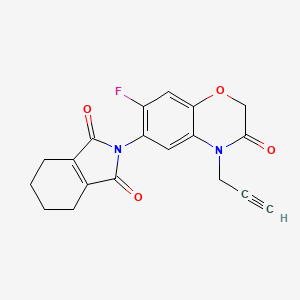
CAS 103361-09-7PubChem CID 92425
Flumioxazin
Flumioxazin is a benzoxazine that is N-(prop-2-yn-1-yl)-2H-1,4-benzoxazin-3(4H)-one which is substituted at position 6 by a 1,3-dioxo-1,3,4,5,6,7-hexahydro-2H-isoindol-2-yl group and at position 7 by a fluorine. A protoporphyrinogen oxidase inhibitor, it is used for the control of weeds in soya, peanuts, and a variety of vegetable and fruit crops. It has a role as a herbicide, an agrochemical, a teratogenic agent and an EC 1.3.3.4 (protoporphyrinogen oxidase) inhibitor. It is a dicarboximide, an organofluorine compound, a benzoxazine and a terminal acetylenic compound. — ChEBI
- IUPAC 명칭
- 2-(7-fluoro-3-oxo-4-prop-2-ynyl-1,4-benzoxazin-6-yl)-4,5,6,7-tetrahydroisoindole-1,3-dione
- 분자식
- C19H15FN2O4
- 분자량
- 354.3 g/mol
- 정확한 질량
- 354.10158513 Da
- XLogP3
- 1.8
- 위상 극성 표면적
- 66.9 Ų
- 수소 결합 공여체
- 0
- 수소 결합 수용체
- 5
- 공유결합 단위
- 1
- 정의된 입체중심
- 0
다른 이름
SumisoyaS-53482VALORS 53482V 53482EINECS Annex I Index 613-166-00-XL0PX7OGI22CHEBI:8939
보고된 명칭 16개 더 보기
7-Fluoro-6-(3,4,5,6-tetrahydrophthalimido)-4-(2-propynyl)-1,4-benzoxazin-3(2H)-one7-fluoro-6-((3,4,5,6-tetrahydro)phthalimido)-4-(2-propynyl)-1,4-benzoxazin-3(2 H)-oneV-53482n-(7-fluoro-3,4-dihydro-3-oxo-4-prop-2-ynyl-2h-1,4-benzoxazin-6-yl)cyclohex-1-ene-1,2-dicarboxamide2-(7-fluoro-3-oxo-4-(prop-2-yn-1-yl)-3,4-dihydro-2H-1,4-benzoxazin-6-yl)-2,3,4,5,6,7-hexahydro-1H-isoindole-1,3-dione2-[7-fluoro-3-oxo-4-(prop-2-yn-1-yl)-3,4-dihydro-2H-1,4-benzoxazin-6-yl]-2,3,4,5,6,7-hexahydro-1H-isoindole-1,3-dioneRefChem:1408481H-Isoindole-1,3(2H)-dione, 2-(7-fluoro-3,4-dihydro-3-oxo-4-(2-propyn-1-yl)-2H-1,4-benzoxazin-6-yl)-4,5,6,7-tetrahydro-Flumioxazin [ISO]Sumisoya; V 534822-[7-Fluoro-3,4-dihydro-3-oxo-4-(2-propyn-1-yl)-2H-1,4-benzoxazin-6-yl]-4,5,6,7-tetrahydro-1H-isoindole-1,3(2H)-dioneFlumioxazineFlumizinFlumioxazin Solution in Acetonitrile1H-Isoindole-1,3(2H)-dione,2-[7-fluoro-3,4-dihydro-3-oxo-4-(2-propynyl)-2H-1,4-benzoxazin-6-yl]-4,5,6,7-tetrahydro-2-[7-fluoro-3-oxo-4-(prop-2-yn-1-yl)-3,4-dihydro-2H-1,4-benzoxazin-6-yl]-4,5,6,7-tetrahydro-1H-isoindole-1,3(2H)-dione
외부 데이터베이스 식별자
- ChEBI:CHEBI:8939
- ChEMBL:CHEMBL2133606
- EPA DTXSID:DTXSID7032555
- PubMed:42162654
- PubMed:24753331
- PubMed:22960102
- PubMed:22412731
- PubMed:21919467
- PubMed:21837100
- PubMed:21754562
- PubMed:21754056
- PubMed:21589104
- PubMed:21589037
- PubMed:21587879
- PubMed:21581725
추가 과학 데이터베이스의 근거
EMBL-EBI ChEBI
식별자 정확히 일치CHEBI:8939
flumioxazin
A benzoxazine that is N-(prop-2-yn-1-yl)-2H-1,4-benzoxazin-3(4H)-one which is substituted at position 6 by a 1,3-dioxo-1,3,4,5,6,7-hexahydro-2H-isoindol-2-yl group and at position 7 by a fluorine. A protoporphyrinogen oxidase inhibitor, it is used for the control of weeds in soya, peanuts, and a variety of vegetable and fruit crops.
- 처방
- C19H15FN2O4
- 평균 질량
- 354.337 g/mol
- 단일 동위원소 질량
- 354.10159 Da
- 형식 전하
- 0
- benzoxazine — is a (CHEBI:46969)
- terminal acetylenic compound — is a (CHEBI:73477)
- dicarboximide — is a (CHEBI:35356)
- organofluorine compound — is a (CHEBI:37143)
- teratogenic agent — has role (CHEBI:50905)
- herbicide — has role (CHEBI:24527)
- agrochemical — has role (CHEBI:33286)
- EC 1.3.3.4 (protoporphyrinogen oxidase) inhibitor — has role (CHEBI:73192)
- teratogenic agent — has role (CHEBI:50905)
- herbicide — has role (CHEBI:24527)
- agrochemical — has role (CHEBI:33286)
- EC 1.3.3.4 (protoporphyrinogen oxidase) inhibitor — has role (CHEBI:73192)
- benzoxazine — is a (CHEBI:46969)
- terminal acetylenic compound — is a (CHEBI:73477)
- dicarboximide — is a (CHEBI:35356)
- organofluorine compound — is a (CHEBI:37143)
추가 선별 명칭
2-[7-fluoro-3-oxo-4-(prop-2-yn-1-yl)-3,4-dihydro-2H-1,4-benzoxazin-6-yl]-4,5,6,7-tetrahydro-1H-isoindole-1,3(2H)-dione2-[7-fluoro-3,4-dihydro-3-oxo-4-(2-propyn-1-yl)-2H-1,4-benzoxazin-6-yl]-4,5,6,7-tetrahydro-1H-isoindole-1,3(2H)-dione7-fluoro-6-(3,4,5,6-tetrahydrophthalimido)-4-(2-propynyl)-1,4-benzoxazin-3(2H)-oneN-(7-fluoro-3,4-dihydro-3-oxo-4-prop-2-ynyl-2H-1,4-benzoxazin-6-yl)cyclohex-1-ene-1,2-dicarboxamideflumioxazineS 53482S-53482V 53482
이 출처의 상호 참조
- CAS: 103361-09-7 — Alan Wood's Pesticides
- CAS: 103361-09-7 — KEGG COMPOUND
- CAS: 103361-09-7 — ChemIDplus
- MANUAL_X_REF: 335 — PPDB
- MANUAL_X_REF: C11035 — KEGG COMPOUND
- MANUAL_X_REF: flumioxazin — Alan Wood's Pesticides
- MANUAL_X_REF: HMDB0034854 — HMDB
- REGISTRY_NUMBER: 8290535 — Reaxys
매핑 기준: Exact CAS cross-reference in the ChEBI compound record. 출처 업데이트: 2017-08-11. 가져온 시각: 2026-08-31. 출처 기록 열기
NIH PubChem PUG-View
식별자 정확히 일치92425
Attributed physical-property, hazard, environmental and use annotations.
- Color/Form: Light tan powdered solid 출처: Hazardous Substances Data Bank (HSDB)
- Color/Form: Yellow-brown powder 출처: Hazardous Substances Data Bank (HSDB)
- Color/Form: Yellow brown solid (technical); Light brown solid (end-use) 출처: Hazardous Substances Data Bank (HSDB)
- Density: 1.5136 g/ml @ 20 °C 출처: Hazardous Substances Data Bank (HSDB)
- Dissociation Constants: Does not dissociate 출처: Hazardous Substances Data Bank (HSDB)
- LogP: log Kow = 2.55 @ 20 °C 출처: Hazardous Substances Data Bank (HSDB)
- LogP: 2.550 출처: Human Metabolome Database (HMDB)
- Melting Point: 201-204 °C 출처: Hazardous Substances Data Bank (HSDB)
- Melting Point: 201 - 204 °C 출처: Human Metabolome Database (HMDB)
- Odor: Slight (end-use) 출처: Hazardous Substances Data Bank (HSDB)
- Physical Description: Solid 출처: Human Metabolome Database (HMDB)
- Solubility: Soluble in common organic solvents 출처: Hazardous Substances Data Bank (HSDB)
- Solubility: In water, 1.79 mg/l @ 25 °C 출처: Hazardous Substances Data Bank (HSDB)
- Solubility: 1.79 mg/L @ 25 °C (exp) 출처: Human Metabolome Database (HMDB)
- Vapor Pressure: 2.41X10⁻⁶ mm Hg @ 25 °C 출처: Hazardous Substances Data Bank (HSDB)
- pH: pH= 6.2-6.4 @ 20 °C (end-use) 출처: Hazardous Substances Data Bank (HSDB)
- Carcinogen Classification: No indication of carcinogenicity to humans (not listed by IARC). 출처: Toxin and Toxin Target Database (T3DB)
- Signal: Warning 출처: Regulation (EC) No 1272/2008 of the European Parliament and of the Council
- GHS Hazard Statements: H361d: Suspected of damaging the unborn child [Warning Reproductive toxicity]; H400: Very toxic to aquatic life [Warning Hazardous to the aquatic environment, acute hazard]; H410: Very toxic to aquatic life with long lasting effects [Warning Hazardous to the aquatic environment, long-term hazard] 출처: Regulation (EC) No 1272/2008 of the European Parliament and of the Council
- Precautionary Statement Codes: P203, P273, P280, P318, P391, P405, and P501 (click each P-code to see the statement) 출처: Regulation (EC) No 1272/2008 of the European Parliament and of the Council
- Signal: Danger 출처: European Chemicals Agency (ECHA)
- GHS Hazard Statements: H360 (35.6%): May damage fertility or the unborn child [Danger Reproductive toxicity]; H361d (64.4%): Suspected of damaging the unborn child [Warning Reproductive toxicity]; H400 (100%): Very toxic to aquatic life [Warning Hazardous to the aquatic environment, acute hazard]; H410 (100%): Very toxic to aquatic life with long lasting effects [Warning Hazardous to the aquatic environment, long-term hazard] 출처: European Chemicals Agency (ECHA)
- Precautionary Statement Codes: P203, P273, P280, P318, P391, P405, and P501 (click each P-code to see the statement) 출처: European Chemicals Agency (ECHA)
- ECHA C&L Notifications Summary: Aggregated GHS information provided per 208 reports by companies from 8 notifications to the ECHA C&L Inventory. Each notification may be associated with multiple companies.; Information may vary between notifications depending on impurities, additives, and other factors. The percentage value in parenthesis indicates the notified classification ratio from companies that provide hazard codes. Only hazard codes with percentage values above 10% are shown. For more detailed information, please visit ECHA C&L website. 출처: European Chemicals Agency (ECHA)
- Signal: Warning 출처: Hazardous Chemical Information System (HCIS), Safe Work Australia
- GHS Hazard Statements: H361d: Suspected of damaging the unborn child [Warning Reproductive toxicity]; H410: Very toxic to aquatic life with long lasting effects [Warning Hazardous to the aquatic environment, long-term hazard] 출처: Hazardous Chemical Information System (HCIS), Safe Work Australia
- Precautionary Statement Codes: P203, P273, P280, P318, P391, P405, and P501 (click each P-code to see the statement) 출처: Hazardous Chemical Information System (HCIS), Safe Work Australia
- Environmental Bioconcentration: An estimated BCF of 18 was calculated for flumioxazin(SRC), using an experimental log Kow of 2.55(1) and a regression-derived equation(2). According to a classification scheme(3), this BCF suggests the potential for bioconcentration in aquatic organisms is low(SRC). 출처: Hazardous Substances Data Bank (HSDB)
- Environmental Fate: TERRESTRIAL FATE: Based on column leaching studies and the short aerobic soil half-life, the potential for flumioxazin to leach in field agricultural soil is low(1). In soils that have been treated with flumioxazin, it is generally not found below 3 inches in depth(2). Volatilization losses from soil surfaces are negligible(1). Flumioxazin degrades rapidly in soil water via hydrolysis with half-lives of 3.4 to 5.1 days at pH 5.0, 21.4-24.6 hours at pH 7.0, and 14.6-22.0 minutes at pH 9.0(1); therefore, aqueous hydrolysis in moist soils will be an important fate process(SRC). Microbial degradation in soil is also an important fate process(1); the half-life for aerobic soil metabolism is 11.9 to 17.5 days, with an average of 14.7 days(1,2). The photolysis half-life on soil is 3.2 to 8.4 days (average 5.8 days)(2). The rapid soil dissipation rate indicates flumioxazin is not persistent in soil(1). 출처: Hazardous Substances Data Bank (HSDB)
- Environmental Fate: AQUATIC FATE: Based on a classification scheme(1), an estimated Koc value of 13000(SRC), determined from a structure estimation method(2), indicates that flumioxazin is expected to adsorb to suspended solids and sediment(SRC). The hydrolytic degradation half-life of flumioxazin in soil water is 3.4 to 5.1 days at pH 5.0, 21.4-24.6 hours at pH 7.0, and 14.6-22.0 minutes at pH 9.0(3); therefore, hydrolysis will be the major degradation process in water(SRC). An anaerobic aquatic metabolism half-life of 0.2 days has been reported(4). The photolysis half-life in water at pH 5 is 1 day(4). Volatilization from water surfaces is expected to be slow(5) based upon an estimated Henry's Law constant of 6.28X10⁻⁷ atm-cu m/mole(SRC), derived from its vapor pressure, 2.41X10⁻⁶ mm Hg(6), and water solubility, 1.79 mg/l(4). Using this estimated Henry's Law constant and an estimation method(5), volatilization half-lives for a model river and model lake are 1,765 hours and 809 days, respectively(SRC). According to a classification scheme(7), an estimated BCF of 18(SRC), from a log Kow of 2.55(4) suggests the potential for bioconcentration in aquatic organisms is low(SRC). 출처: Hazardous Substances Data Bank (HSDB)
- Environmental Fate: ATMOSPHERIC FATE: According to a model of gas/particle partitioning of semivolatile organic compounds in the atmosphere(1), flumioxazin, which has a vapor pressure of 2.41X10⁻⁶ mm Hg at 25 °C (2), will exist in both the vapor and particulate phases in the ambient atmosphere. Vapor-phase flumioxazin is degraded in the atmosphere by reaction with photochemically-produced hydroxyl radicals(SRC); the half-life for this reaction in air is estimated to be 6.8 hours(SRC), calculated from its rate constant of 5.68X10⁻¹¹ cu cm/molecule-sec at 25 °C(SRC) (that was derived using a structure estimation method(3). Particulate-phase flumioxazin may be removed from the air by wet and dry deposition(SRC). 출처: Hazardous Substances Data Bank (HSDB)
- Uses: For Flumioxazin (USEPA/OPP Pesticide Code: 129034) ACTIVE products with label matches. /SRP: Registered for use in the U.S. but approved pesticide uses may change periodically and so federal, state and local authorities must be consulted for currently approved uses./ 출처: Hazardous Substances Data Bank (HSDB)
- Uses: Preemergence herbicide to effectively control a wide variety of broadleaf weeds 출처: Hazardous Substances Data Bank (HSDB)
- Uses: This is a man-made compound that is used as a pesticide. 출처: Toxin and Toxin Target Database (T3DB)
매핑 기준: Existing checksum-valid CAS to unique PubChem CID match. 가져온 시각: 2026-08-31. 출처 기록 열기
과학적 분류와 유해성 주석은 맥락을 제공할 뿐이며, 위에 표시된 시장별 규제 판단을 대체하지 않습니다.
추가 출처 적용 범위 및 일치 상태
| 출처 | 결과 | 확인됨 |
|---|---|---|
| EMBL-EBI ChEBI | 정확히 일치 | 2026-08-31 |
| NIH PubChem PUG-View | 정확히 일치 | 2026-08-31 |
기록된 불일치는 출처를 확인했다는 유용한 근거이며, 해당 물질이 다른 곳에 존재하지 않는다는 주장이 아닙니다.
체크섬이 유효한 CAS 일치를 통해 2026-09-02에 NIH PubChem에서 가져왔습니다. 화학적 특성은 이 페이지의 규제 판단을 대체하지 않습니다.
이 사이트에서 CAS 103361-09-7을(를) 사용하는 방식
CAS 103361-09-7은(는) 이 페이지를 특정 물질에 고정하는 데 사용하는 Chemical Abstracts Service 식별자입니다. 현재 데이터세트에서는 EU 부속서 기록 1건이 이 식별자를 공유하며, 같은 물질이 하나의 규제 맥락에 나타나는지 여러 맥락에 나타나는지 교차 확인하는 데 도움이 됩니다.
공급업체 규격서, SDS 또는 원료 문서에 CAS 103361-09-7이(가) 제시되어 있고 연결된 모든 부속서 II–VI 기록을 한곳에서 확인해야 할 때 이 페이지를 이용하세요. 위의 항목 카드는 농도 한도, 경고 문구, 부속서 위치 및 제품 유형 조건을 가장 빠르게 확인하는 방법입니다.
자주 묻는 질문
CAS 103361-09-7로 식별되는 물질은 맥락에 따라 다른 조건이 적용되는 경우 EU 화장품 규정의 여러 부속서에 나타날 수 있습니다. 예를 들어 어떤 물질이 부속서 III에서 특정 조건으로 사용제한될 수 있고, 같은 CAS가 부속서 IV에서 별도의 항목 조건에 따라 허용 색소로 나타날 수도 있습니다. 각 항목은 개별적으로 검토해야 합니다.
CAS 번호를 원료 규격서 및 CoA 문서와 대조하세요. CAS가 부속서 II에 있으면 해당 물질이 없는지 확인하세요. 부속서 III에 있으면 처방에서 농도 한도와 제품 유형 조건이 충족되는지 확인하세요. 이 CAS 번호를 공유하는 모든 부속서 항목이 위에 나열되어 있습니다.
CAS 번호는 미국의 Chemical Abstracts Service가 부여하며 전 세계적으로 통용됩니다. EC 번호는 EINECS, ELINCS 또는 NLP 목록 같은 목록에 수록된 유럽연합 집행위원회 식별자입니다. 두 식별자 모두 EU 화장품 부속서 항목에 나타날 수 있습니다. 두 가지를 모두 가진 물질도 있고, 하나만 가진 물질도 있으며, 일부 오래된 항목은 둘 다 없을 수도 있습니다.
INCI 검사기는 원료명, CAS 번호 및 EC 번호를 받습니다. 이 CAS 번호를 직접 확인한 다음, 결과를 공급업체 규격서 및 연결된 모든 부속서 조건과 대조하세요.