
CAS
기록 1건
CAS 1024-57-3
CAS 1024-57-3은(는) 규정 1223/2009의 부속서 II–VI에 걸쳐 EU 부속서 기록 1건과 일치합니다.
CAS 1024-57-3의 기록
1 총화학적 정체 및 특성
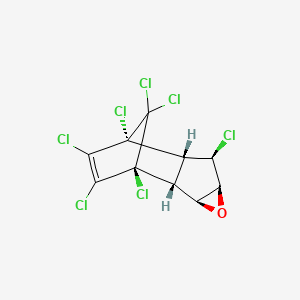
CAS 1024-57-3PubChem CID 15559699
Heptachlor Epoxide
Heptachlor Epoxide can cause cancer according to an independent committee of scientific and health experts. — California Office of Environmental Health Hazard Assessment (OEHHA)
- IUPAC 명칭
- (1S,2R,3S,5S,6R,7S,8R)-1,6,8,9,10,11,11-heptachloro-4-oxatetracyclo[6.2.1.02,7.03,5]undec-9-ene
- 분자식
- C10H5Cl7O
- 분자량
- 389.3 g/mol
- 정확한 질량
- 387.813059 Da
- XLogP3
- 3.7
- 위상 극성 표면적
- 12.5 Ų
- 수소 결합 공여체
- 0
- 수소 결합 수용체
- 1
- 공유결합 단위
- 1
- 정의된 입체중심
- 7
다른 이름
EpoxyheptachlorVelsicol 53-CS-17055UWF6R6IENT 25,5841,4,5,6,7,8,8-Heptachloro-2,3-epoxy-2,3,3a,4,7,7a-hexahydro-4,7-methanoindene1,4,5,6,7,8,8-Heptachloro-2,3-epoxy-3a,4,7,7a-tetrahydro-4,7-methanoindan2,5-Methano-2H-oxireno(a)indene, 2,3,4,5,6,7,7-heptachlor-1a,1b,5,5a,6,6a-hexahydro-2,5-Methano-2H-oxireno(a)indene, 2,3,4,5,6,7,7-heptachloro-1a,1b,5,5a,6,6a-hexahydro-
보고된 명칭 16개 더 보기
4,7-Methanoindan, 1,4,5,6,7,8,8-heptachloro-2,3-epoxy-3a,4,7,7a-tetrahydro-2,5-Methano-2H-indeno(1,2-b)oxirene, 2,3,4,5,6,7,7-heptachloro-1a,1b,5,5a,6,6a-hexahydro-, (1aalpha,1bbeta,2alpha,5alpha,5abeta,6beta,6aalpha)-2,5-Methano-2H-indeno(1,2-b)oxirene, 2,3,4,5,6,7,7-heptachloro-1a,1b,5,5a,6,6a-hexahydro-,(1aR,1bS,2R,5S,5aR,6S,6aR)-rel-Epoxide, HeptachlorVelsicol 53CS17RefChem:7835831,6,8,9,10,11,11-heptachloro-4-oxatetracyclo(6.2.1.02,7.03,5)undec-9-ene213-831-0cis-Heptachlor Epoxiderel-(1aR,1bS,2R,5S,5aR,6S,6aR)-2,3,4,5,6,7,7-Heptachloro-1a,1b,5,5a,6,6a-hexahydro-2,5-methano-2H-indeno[1,2-b]oxirene(+/-)-cis-Heptachlor epoxideUNII-055UWF6R6ICCRIS 9452cis-Heptachlor-exo-epoxide (isomer B)HSDB 6182EINECS 213-831-0
외부 데이터베이스 식별자
추가 과학 데이터베이스의 근거
EMBL-EBI ChEBI
식별자 정확히 일치CHEBI:34786
Heptachlor epoxide
- 처방
- C10H5Cl7O
- 평균 질량
- 389.320 g/mol
- 단일 동위원소 질량
- 385.81601 Da
- 형식 전하
- 0
- oxanes — is a (CHEBI:46942)
- oxanes — is a (CHEBI:46942)
추가 선별 명칭
Heptachlor epoxide
이 출처의 상호 참조
- CAS: 1024-57-3 — KEGG COMPOUND
- MANUAL_X_REF: C14327 — KEGG COMPOUND
매핑 기준: Exact CAS cross-reference in the ChEBI compound record. 출처 업데이트: 2014-07-28. 가져온 시각: 2026-08-31. 출처 기록 열기
NIH PubChem PUG-View
식별자 정확히 일치15559699
Attributed physical-property, hazard, environmental and use annotations.
- LogP: log Kow= 5.40 출처: Hazardous Substances Data Bank (HSDB)
- Melting Point: 160-161.5 °C 출처: Hazardous Substances Data Bank (HSDB)
- Melting Point: 160 °C 출처: PAC Chemical Database, U.S. Department of Energy
- Physical Description: Heptachlor epoxide appears as a degradation product of heptachlor that occurs in soil and in or on crops when treatments with heptachlor, an insecticide, have been made. Forms readily upon exposing heptachlor to air. 출처: CAMEO Chemicals
- Physical Description: Crystalline solid; [MSDSonline] 출처: Haz-Map, Information on Hazardous Chemicals and Occupational Diseases
- Solubility: 0.350 PPM IN WATER 출처: Hazardous Substances Data Bank (HSDB)
- Carcinogen Classification: No indication of carcinogenicity (not listed by IARC). (L135) 출처: Toxin and Toxin Target Database (T3DB)
- Exposure Routes: Oral (L118) ; inhalation (L118) ; dermal (L118) 출처: Toxin and Toxin Target Database (T3DB)
- First Aid: EYES: First check the victim for contact lenses and remove if present. Flush victim's eyes with water or normal saline solution for 20 to 30 minutes while simultaneously calling a hospital or poison control center. Do not put any ointments, oils, or medication in the victim's eyes without specific instructions from a physician. IMMEDIATELY transport the victim after flushing eyes to a hospital even if no symptoms (such as redness or irritation) develop.; SKIN: IMMEDIATELY flood affected skin with water while removing and isolating all contaminated clothing. Gently wash all affected skin areas thoroughly with soap and water. IMMEDIATELY call a hospital or poison control center even if no symptoms (such as redness or irritation) develop. IMMEDIATELY transport the victim to a hospital for treatment after washing the affected areas.; INHALATION: IMMEDIATELY leave the contaminated area; take deep breaths of fresh air. IMMEDIATELY call a physician and be prepared to transport the victim to a hospital even if no symptoms (such as wheezing, coughing, shortness of breath, or burning in the mouth, throat, or chest) develop. Provide proper respiratory protection to rescuers entering an unknow 출처: CAMEO Chemicals
- Signal: Danger 출처: Regulation (EC) No 1272/2008 of the European Parliament and of the Council
- GHS Hazard Statements: H301: Toxic if swallowed [Danger Acute toxicity, oral]; H351: Suspected of causing cancer [Warning Carcinogenicity]; H373 **: May causes damage to organs through prolonged or repeated exposure [Warning Specific target organ toxicity, repeated exposure]; H400: Very toxic to aquatic life [Warning Hazardous to the aquatic environment, acute hazard]; H410: Very toxic to aquatic life with long lasting effects [Warning Hazardous to the aquatic environment, long-term hazard] 출처: Regulation (EC) No 1272/2008 of the European Parliament and of the Council
- Precautionary Statement Codes: P203, P260, P264, P270, P273, P280, P301+P316, P318, P319, P321, P330, P391, P405, and P501 (click each P-code to see the statement) 출처: Regulation (EC) No 1272/2008 of the European Parliament and of the Council
- Signal: Danger 출처: European Chemicals Agency (ECHA)
- GHS Hazard Statements: H300 (58.3%): Fatal if swallowed [Danger Acute toxicity, oral]; H301 (41.7%): Toxic if swallowed [Danger Acute toxicity, oral]; H351 (100%): Suspected of causing cancer [Warning Carcinogenicity]; H373 (100%): May causes damage to organs through prolonged or repeated exposure [Warning Specific target organ toxicity, repeated exposure]; H400 (100%): Very toxic to aquatic life [Warning Hazardous to the aquatic environment, acute hazard]; H410 (100%): Very toxic to aquatic life with long lasting effects [Warning Hazardous to the aquatic environment, long-term hazard] 출처: European Chemicals Agency (ECHA)
- Precautionary Statement Codes: P203, P260, P264, P270, P273, P280, P301+P316, P318, P319, P321, P330, P391, P405, and P501 (click each P-code to see the statement) 출처: European Chemicals Agency (ECHA)
- ECHA C&L Notifications Summary: Aggregated GHS information provided per 12 reports by companies from 6 notifications to the ECHA C&L Inventory. Each notification may be associated with multiple companies.; Information may vary between notifications depending on impurities, additives, and other factors. The percentage value in parenthesis indicates the notified classification ratio from companies that provide hazard codes. Only hazard codes with percentage values above 10% are shown. For more detailed information, please visit ECHA C&L website. 출처: European Chemicals Agency (ECHA)
- Signal: Danger 출처: NITE-CMC
- GHS Hazard Statements: H300: Fatal if swallowed [Danger Acute toxicity, oral]; H351: Suspected of causing cancer [Warning Carcinogenicity]; H360: May damage fertility or the unborn child [Danger Reproductive toxicity]; H372: Causes damage to organs through prolonged or repeated exposure [Danger Specific target organ toxicity, repeated exposure]; H400: Very toxic to aquatic life [Warning Hazardous to the aquatic environment, acute hazard]; H410: Very toxic to aquatic life with long lasting effects [Warning Hazardous to the aquatic environment, long-term hazard] 출처: NITE-CMC
- Precautionary Statement Codes: P203, P260, P264, P270, P273, P280, P301+P316, P318, P319, P321, P330, P391, P405, and P501 (click each P-code to see the statement) 출처: NITE-CMC
- GHS Hazard Statements: H300: Fatal if swallowed [Danger Acute toxicity, oral]; H351: Suspected of causing cancer [Warning Carcinogenicity]; H360: May damage fertility or the unborn child [Danger Reproductive toxicity]; H372: Causes damage to organs through prolonged or repeated exposure [Danger Specific target organ toxicity, repeated exposure] 출처: NITE-CMC
- Precautionary Statement Codes: P203, P260, P264, P270, P280, P301+P316, P318, P319, P321, P330, P405, and P501 (click each P-code to see the statement) 출처: NITE-CMC
- Health Effects: Exposure to heptachlor epoxide may cause damage to liver, nervous system, and immune system. (L118) 출처: Toxin and Toxin Target Database (T3DB)
- Target Organs: Hepatic 출처: EPA Integrated Risk Information System (IRIS)
- Toxicity Summary: Heptachlor epoxide is a central nervous system stimulant. It non-competitively blocks neurotransmitter action at gamma-amino butyric acid receptors, resulting in overstimulation of the nervous system. Heptachlor epoxide is also believed to exert carcinogenic effects by activating key kinases in signalling pathways and inhibiting apoptosis. (L118, A81, A82) 출처: Toxin and Toxin Target Database (T3DB)
- Environmental Bioconcentration: EIGHT PESTICIDES, INCLUDING HEPTACHLOR EPOXIDE, WERE BIOCONCENTRATED IN THE FAT OF CLAMS IMPLANTED IN CAGES ANCHORED TO THE BOTTOM OF THE KASKASKIA RIVER NEAR TUSCOLA, ILLINOIS OVER 72 DAYS. 출처: Hazardous Substances Data Bank (HSDB)
- Environmental Bioconcentration: STUDY PLOTS WERE TREATED AT 0.56, 2.24, OR 8.97 KG ACTIVE INGREDIENT/HA WITH HEPTACHLOR. EARTHWORMS & SOILS WERE SAMPLED FROM EACH PLOT WHEN TREATED & 0.5 TO 24 MO THEREAFTER. IN SOILS & EARTHWORMS, HEPTACHLOR EPOXIDE INCREASED SIGNIFICANTLY DURING THE 2 YR STUDY. 출처: Hazardous Substances Data Bank (HSDB)
- Environmental Bioconcentration: ... /IT PASSES/ THROUGH FOOD CHAINS & UNDERGOES BIOLOGIC MAGNIFICATION. 출처: Hazardous Substances Data Bank (HSDB)
- Environmental Bioconcentration: Heptachlor exhibits a tendency for bioaccumulation, with bioconcentration factors on the order of 1X10+4 for several organisms. ... /Heptachlor/ 출처: Hazardous Substances Data Bank (HSDB)
- Environmental Bioconcentration: The bioconcentration of heptachlor epoxide in freshwater clam (Corbicula manilensis) fat was 2330 as determined in a 72 day experiment(1). In fathead minnows the BCF was 14400 as determined in a 32 day test in a flow-through aquarium(2). The steady state BCF for sheepshead minnow (Cyprinodon variegatus), pinfish (Lagodon rhomboides), mussels (Mytilus edulis), and oyster (Crassostrea virginica) is 4500, 2900, 1700, and 851, respectively(3). In a 33 day model ecosystem, the BCF was 4900 in fish (Gambusia), 66000 in snail (Physa), and 1600 in alga (Oedogonium)(6). Based on the log octanol/water partition coefficient of 5.40(4), one would estimate a BCF of 7500 in fish using a recommended regression equation(5,SRC). 출처: Hazardous Substances Data Bank (HSDB)
- Environmental Fate: TERRESTRIAL FATE: LABELED HEPTACHLOR WAS APPLIED TO ... SOIL. ANALYSES ... INDICATED PRESENCE OF 1-HYDROXYCHLORDENE, HEPTACHLOR EPOXIDE & A METABOLITE LESS HYDROPHILIC THAN HEPTACHLOR EPOXIDE. 출처: Hazardous Substances Data Bank (HSDB)
- Environmental Fate: TERRESTRIAL FATE: Heptachlor epoxide adsorbs strongly to soil and is extemely resistant to biodegradation. Monitoring studies reveal that it persists for many years in soil and does not appear to leach significantly into the lower soil layers. On the soil surface, heptachlor epoxide may slowly photodegrade, particularly during the summer months (1% per month). Heptachlor epoxide loss from soil in a microagricultural chamber is observed after application, but the rate of loss decreases over the course of a few days. This loss may be due to volatilization or photolysis of the chemical from the surface microlayer. (SRC) 출처: Hazardous Substances Data Bank (HSDB)
- Environmental Fate: AQUATIC FATE: If released into water, heptachlor epoxide will adsorb strongly to suspended and bottom sediment. Little biodegradation would be expected and photolysis probably would only be significant in surface waters in the presence of photosensitizers. While slow volatilization of the free molecule (half-life 60 hr from a model river) would be expected, since heptachlor epoxide would be mainly adsorbed to particulate matter, this would not be a primary loss mechanism. No measureable degradation occurred when 10 ppb of heptachlor epoxide was incubated in water of the Little Miami River, a stream receiving domestic, industrial, and agricultural wastes, for 8 wks in sealed jars under sunlight and artificial lights(1). Heptachlor epoxide was very persistant in a model ecosystem, having approximately the same environmental stability as dieldrin(2). Its estimated half-life in the lower Rhine River based on concentration differences between sampling points was 35 days(3). 출처: Hazardous Substances Data Bank (HSDB)
- Environmental Fate: ATMOSPHERIC FATE: Based upon the vapor pressure, heptachlor epoxide is expected to exist in both vapor and particulate phases in ambient air. In the atmosphere, vapor phases reactions with photochemically produced hydroxyl radicals may be an important fate process. The rate constant for the vapor-phase reaction of heptachlor epoxide with photochemically produced hydroxyl radicals has been estimated to be 1.09X10⁻¹¹ cu cm/molecule-sec at 25 °C, which corresponds to an atmospheric half-life of about 1.5 days at an atmospheric concentration of 5X10+5 hydroxyl radicals per cu cm(2). Heptachlor epoxide that is associated with particulate matter and aerosols and should be subject to gravitational settling and washout by rain. Contamination of lakes with heptachlor epoxide is believed to occur primarily by wet deposition. Under the proper conditions, heptachlor epoxide bearing dust can be transported for thousands of miles. Photolysis would be expected to occur but there are no data on the extent of heptachlor epoxide degradation in dispersed dust and aerosols(SRC). 출처: Hazardous Substances Data Bank (HSDB)
- Sources/Uses: An environmental contaminant; Not available as a commercial product; [ACGIH] 출처: Haz-Map, Information on Hazardous Chemicals and Occupational Diseases
- Industrial Processes with risk of exposure: Farming (Pesticides) [Category: Industry] 출처: Haz-Map, Information on Hazardous Chemicals and Occupational Diseases
- Uses: ... NOT AVAIL AS COMMERCIAL PRODUCT IN USA, & IT IS NOT NORMALLY PRESENT IN COMMERCIAL HEPTACHLOR ... /SRP: HEPTACHLOR EPOXIDE IS FORMED FROM HEPTACHLOR IN THE ENVIRONMENT/. 출처: Hazardous Substances Data Bank (HSDB)
- Uses: Heptachlor epoxide is a chemical produced when heptachlor is broken down by bacteria and animals. Heptachlor was originally widely produced as an insecticide, but is now used only in fire and control in underground transformers. (L118) 출처: Toxin and Toxin Target Database (T3DB)
매핑 기준: Existing checksum-valid CAS to unique PubChem CID match. 가져온 시각: 2026-08-31. 출처 기록 열기
과학적 분류와 유해성 주석은 맥락을 제공할 뿐이며, 위에 표시된 시장별 규제 판단을 대체하지 않습니다.
추가 출처 적용 범위 및 일치 상태
| 출처 | 결과 | 확인됨 |
|---|---|---|
| EMBL-EBI ChEBI | 정확히 일치 | 2026-08-31 |
| NIH PubChem PUG-View | 정확히 일치 | 2026-08-31 |
기록된 불일치는 출처를 확인했다는 유용한 근거이며, 해당 물질이 다른 곳에 존재하지 않는다는 주장이 아닙니다.
체크섬이 유효한 CAS 일치를 통해 2026-08-31에 NIH PubChem에서 가져왔습니다. 화학적 특성은 이 페이지의 규제 판단을 대체하지 않습니다.
이 사이트에서 CAS 1024-57-3을(를) 사용하는 방식
CAS 1024-57-3은(는) 이 페이지를 특정 물질에 고정하는 데 사용하는 Chemical Abstracts Service 식별자입니다. 현재 데이터세트에서는 EU 부속서 기록 1건이 이 식별자를 공유하며, 같은 물질이 하나의 규제 맥락에 나타나는지 여러 맥락에 나타나는지 교차 확인하는 데 도움이 됩니다.
공급업체 규격서, SDS 또는 원료 문서에 CAS 1024-57-3이(가) 제시되어 있고 연결된 모든 부속서 II–VI 기록을 한곳에서 확인해야 할 때 이 페이지를 이용하세요. 위의 항목 카드는 농도 한도, 경고 문구, 부속서 위치 및 제품 유형 조건을 가장 빠르게 확인하는 방법입니다.
자주 묻는 질문
CAS 1024-57-3로 식별되는 물질은 맥락에 따라 다른 조건이 적용되는 경우 EU 화장품 규정의 여러 부속서에 나타날 수 있습니다. 예를 들어 어떤 물질이 부속서 III에서 특정 조건으로 사용제한될 수 있고, 같은 CAS가 부속서 IV에서 별도의 항목 조건에 따라 허용 색소로 나타날 수도 있습니다. 각 항목은 개별적으로 검토해야 합니다.
CAS 번호를 원료 규격서 및 CoA 문서와 대조하세요. CAS가 부속서 II에 있으면 해당 물질이 없는지 확인하세요. 부속서 III에 있으면 처방에서 농도 한도와 제품 유형 조건이 충족되는지 확인하세요. 이 CAS 번호를 공유하는 모든 부속서 항목이 위에 나열되어 있습니다.
CAS 번호는 미국의 Chemical Abstracts Service가 부여하며 전 세계적으로 통용됩니다. EC 번호는 EINECS, ELINCS 또는 NLP 목록 같은 목록에 수록된 유럽연합 집행위원회 식별자입니다. 두 식별자 모두 EU 화장품 부속서 항목에 나타날 수 있습니다. 두 가지를 모두 가진 물질도 있고, 하나만 가진 물질도 있으며, 일부 오래된 항목은 둘 다 없을 수도 있습니다.
INCI 검사기는 원료명, CAS 번호 및 EC 번호를 받습니다. 이 CAS 번호를 직접 확인한 다음, 결과를 공급업체 규격서 및 연결된 모든 부속서 조건과 대조하세요.