
CAS
기록 1건
CAS 10042-76-9
CAS 10042-76-9은(는) 규정 1223/2009의 부속서 II–VI에 걸쳐 EU 부속서 기록 1건과 일치합니다.
CAS 10042-76-9의 기록
1 총화학적 정체 및 특성
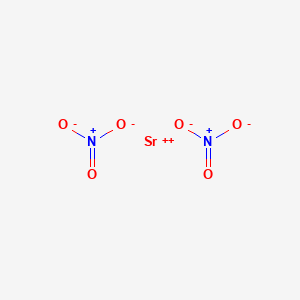
CAS 10042-76-9PubChem CID 24848
Strontium nitrate
Strontium nitrate appears as a white crystalline solid. Noncombustible but accelerates burning of combustible materials. May explode if large quantities are involved in a fire or the combustible material is finely divided. May explode under prolonged exposure to heat or fire. Toxic oxides of nitrogen are produced in fires. Used in pyrotechnics, in medicine, and to make other chemicals. — CAMEO Chemicals
- IUPAC 명칭
- strontium dinitrate
- 분자식
- N2O6Sr
- 분자량
- 211.63 g/mol
- 정확한 질량
- 211.88124798 Da
- 위상 극성 표면적
- 126.0 Ų
- 수소 결합 공여체
- 0
- 수소 결합 수용체
- 6
- 공유결합 단위
- 3
- 정의된 입체중심
- 0
다른 이름
Nitric acid, strontium saltStrontium nitrate (Sr(NO3)2)Strontium nitricumNitrate de strontiumNitric acid, strontium salt (2:1)Strontium(II) nitrate (1:2)BDG873AQZLNitric acid strontium salt (2:1)
보고된 명칭 16개 더 보기
STRONTIUM(2+) NITRATERefChem:6263strontium(2+) ion dinitrate233-131-9strontium;dinitrateStrontium Nitrate AnhydrousStrontium nitrate, anhydrousNitrate de strontium [French]HSDB 787N2O6SrEINECS 233-131-9UNII-BDG873AQZLUN1507strontium(II) nitratestrontium (II) nitrateEC 233-131-9
외부 데이터베이스 식별자
- ChEMBL:CHEMBL2219742
- EPA DTXSID:DTXSID9064924
추가 과학 데이터베이스의 근거
NIH PubChem PUG-View
식별자 정확히 일치24848
Attributed physical-property, hazard, environmental and use annotations.
- Boiling Point: 1193 °F at 760 mmHg (USCG, 1999) 출처: CAMEO Chemicals
- Boiling Point: 645 °C 출처: Hazardous Substances Data Bank (HSDB)
- Boiling Point: 645 °C @760 [mm Hg] 출처: PAC Chemical Database, U.S. Department of Energy
- Color/Form: WHITE GRANULES OR POWDER 출처: Hazardous Substances Data Bank (HSDB)
- Color/Form: Colorless cubic crystals 출처: Hazardous Substances Data Bank (HSDB)
- Density: 2.98 (USCG, 1999) - Denser than water; will sink 출처: CAMEO Chemicals
- Density: 2.99 g/cu-cm 출처: Hazardous Substances Data Bank (HSDB)
- Density: 2.99 @25 °C 출처: PAC Chemical Database, U.S. Department of Energy
- Melting Point: 1058 °F (USCG, 1999) 출처: CAMEO Chemicals
- Melting Point: 570 °C 출처: Hazardous Substances Data Bank (HSDB)
- Melting Point: 570 °C 출처: PAC Chemical Database, U.S. Department of Energy
- Physical Description: Strontium nitrate appears as a white crystalline solid. Noncombustible but accelerates burning of combustible materials. May explode if large quantities are involved in a fire or the combustible material is finely divided. May explode under prolonged exposure to heat or fire. Toxic oxides of nitrogen are produced in fires. Used in pyrotechnics, in medicine, and to make other chemicals. 출처: CAMEO Chemicals
- Physical Description: Dry Powder; CBI; Large Crystals 출처: EPA Chemical Data Reporting (CDR)
- Physical Description: White solid; [Merck Index] White odorless crystalline solid; [MSDSonline] 출처: Haz-Map, Information on Hazardous Chemicals and Occupational Diseases
- Solubility: 70.9 g/100 ml water at 18 °C, 100 g/100 ml water at 100 °C 출처: Hazardous Substances Data Bank (HSDB)
- Solubility: 401 G/L OF WATER @ 0 °C; 1 KG/L WATER @ 90 °C 출처: Hazardous Substances Data Bank (HSDB)
- Solubility: Slightly sol in alcohol or acetone. 출처: Hazardous Substances Data Bank (HSDB)
- Solubility: 0.012 g/100 ml absolute alcohol 출처: Hazardous Substances Data Bank (HSDB)
- pH: AQ SOLN IS NEUTRAL 출처: Hazardous Substances Data Bank (HSDB)
- Carcinogen Classification: Ingested nitrate or nitrite under conditions that result in endogenous nitrosation is probably carcinogenic to humans (Group 2A). (L135) 출처: Toxin and Toxin Target Database (T3DB)
- Exposure Routes: Oral (L1137) ; inhalation (L1137) 출처: Toxin and Toxin Target Database (T3DB)
- First Aid: Call for medical aid.; EYES: Rinse with water.; SKIN: Wash with water for 15 minutes.; INGESTION: Drink water, milk, or activated charcoal; then induce vomiting. (USCG, 1999) 출처: CAMEO Chemicals
- ERG2024, Guide 140 (Strontium nitrate): General First Aid:; · Call 911 or emergency medical service.; · Ensure that medical personnel are aware of the material(s) involved, take precautions to protect themselves and avoid contamination.; · Move victim to fresh air if it can be done safely.; · Administer oxygen if breathing is difficult.; · If victim is not breathing:; -- DO NOT perform mouth-to-mouth resuscitation; the victim may have ingested or inhaled the substance.; -- If equipped and pulse detected, wash face and mouth, then give artificial respiration using a proper respiratory medical device (bag-valve mask, pocket mask equipped with a one-way valve or other device).; -- If no pulse detected or no respiratory medical device available, provide continuous compressions. Conduct a pulse check every two minutes or monitor for any signs of spontaneous respirations.; · Remove and isolate contaminated clothing and shoes.; · For minor skin contact, avoid spreading material on unaffected skin.; · In case of contact with substance, remove immediately by flushing skin or eyes with running water for at least 20 minutes.; · For severe burns, immediate medical attention is required.; · Effects of exposure (inhalation, ingestion, 출처: Emergency Response Guidebook (ERG)
- Note: This chemical does not meet GHS hazard criteria for 0.6% (2 of 363) of reports. 출처: European Chemicals Agency (ECHA)
- Signal: Danger 출처: European Chemicals Agency (ECHA)
- GHS Hazard Statements: H271 (66.1%): May cause fire or explosion; strong Oxidizer [Danger Oxidizing liquids; Oxidizing solids]; H272 (33.1%): May intensify fire; oxidizer [Danger Oxidizing liquids; Oxidizing solids]; H302 (13.5%): Harmful if swallowed [Warning Acute toxicity, oral]; H315 (14.9%): Causes skin irritation [Warning Skin corrosion/irritation]; H318 (77.4%): Causes serious eye damage [Danger Serious eye damage/eye irritation]; H319 (14.9%): Causes serious eye irritation [Warning Serious eye damage/eye irritation]; H335 (13.8%): May cause respiratory irritation [Warning Specific target organ toxicity, single exposure; Respiratory tract irritation] 출처: European Chemicals Agency (ECHA)
- Precautionary Statement Codes: P210, P220, P261, P264, P264+P265, P270, P271, P280, P283, P301+P317, P302+P352, P304+P340, P305+P351+P338, P305+P354+P338, P306+P360, P317, P319, P321, P330, P332+P317, P337+P317, P362+P364, P370+P378, P371+P380+P375, P403+P233, P405, P420, and P501 (click each P-code to see the statement) 출처: European Chemicals Agency (ECHA)
- ECHA C&L Notifications Summary: Aggregated GHS information provided per 363 reports by companies from 22 notifications to the ECHA C&L Inventory. Each notification may be associated with multiple companies.; Reported as not meeting GHS hazard criteria per 2 of 363 reports by companies.; There are 21 notifications provided by 361 of 363 reports by companies with hazard statement code(s).; Information may vary between notifications depending on impurities, additives, and other factors. The percentage value in parenthesis indicates the notified classification ratio from companies that provide hazard codes. Only hazard codes with percentage values above 10% are shown. For more detailed information, please visit ECHA C&L website. 출처: European Chemicals Agency (ECHA)
- Signal: Danger 출처: NITE-CMC
- GHS Hazard Statements: H272: May intensify fire; oxidizer [Danger Oxidizing liquids; Oxidizing solids]; H315: Causes skin irritation [Warning Skin corrosion/irritation]; H320: Causes eye irritation [Warning Serious eye damage/eye irritation] 출처: NITE-CMC
- Precautionary Statement Codes: P210, P220, P264, P264+P265, P280, P302+P352, P305+P351+P338, P321, P332+P317, P337+P317, P362+P364, P370+P378, and P501 (click each P-code to see the statement) 출처: NITE-CMC
- Health Effects: Nitrate and nitrite poisoning causes methemoglobinemia. Nitrites may cause pregnancy complications and developmental effects. They may also be carcinogenic. (L1137) 출처: Toxin and Toxin Target Database (T3DB)
- Toxicity Summary: Nitrate's toxicity is a result of it's conversion to nitrite once in the body. Nitrite causes the autocatalytic oxidation of oxyhemoglobin to hydrogen peroxide and methemoglobin. This elevation of methemoglobin levels is a condition known as methemoglobinemia, and is characterized by tissue hypoxia, as methemoglobin cannot bind oxygen. (A2450, L1613) 출처: Toxin and Toxin Target Database (T3DB)
- Consumer Uses: Not Known or Reasonably Ascertainable; Soil amendments (fertilizers) 출처: EPA Chemical Data Reporting (CDR)
- Industry Uses: Intermediate; Oxidizing agent; Not Known or Reasonably Ascertainable; Other 출처: EPA Chemical Data Reporting (CDR)
- Sources/Uses: Used in pyrotechnics (red fire), signal lights, marine signals, railroad flares, matches, and military tracer bullets; Also used in electron tubes and as a pigment; [HSDB] 출처: Haz-Map, Information on Hazardous Chemicals and Occupational Diseases
- Uses: In signal lights, marine signals, railroad flares, matches; in pyrotechnics (red fire) 출처: Hazardous Substances Data Bank (HSDB)
- Uses: INTERMEDIATE; ELECTRON TUBES 출처: Hazardous Substances Data Bank (HSDB)
- Uses: PIGMENT 출처: Hazardous Substances Data Bank (HSDB)
- Uses: Mfr of pyrotechnics as it imparts brilliant color to flame 출처: Hazardous Substances Data Bank (HSDB)
- Uses: For more Uses (Complete) data for STRONTIUM NITRATE (6 total), please visit the HSDB record page. 출처: Hazardous Substances Data Bank (HSDB)
- Uses: Strontium nitrate is used as an oxidizer and colorant in fireworks. 출처: Toxin and Toxin Target Database (T3DB)
매핑 기준: Existing checksum-valid CAS to unique PubChem CID match. 가져온 시각: 2026-08-31. 출처 기록 열기
과학적 분류와 유해성 주석은 맥락을 제공할 뿐이며, 위에 표시된 시장별 규제 판단을 대체하지 않습니다.
추가 출처 적용 범위 및 일치 상태
| 출처 | 결과 | 확인됨 |
|---|---|---|
| EMBL-EBI ChEBI | 정확히 일치하는 기록 없음 | 2026-08-31 |
| NIH PubChem PUG-View | 정확히 일치 | 2026-08-31 |
기록된 불일치는 출처를 확인했다는 유용한 근거이며, 해당 물질이 다른 곳에 존재하지 않는다는 주장이 아닙니다.
체크섬이 유효한 CAS 일치를 통해 2026-09-02에 NIH PubChem에서 가져왔습니다. 화학적 특성은 이 페이지의 규제 판단을 대체하지 않습니다.
이 사이트에서 CAS 10042-76-9을(를) 사용하는 방식
CAS 10042-76-9은(는) 이 페이지를 특정 물질에 고정하는 데 사용하는 Chemical Abstracts Service 식별자입니다. 현재 데이터세트에서는 EU 부속서 기록 1건이 이 식별자를 공유하며, 같은 물질이 하나의 규제 맥락에 나타나는지 여러 맥락에 나타나는지 교차 확인하는 데 도움이 됩니다.
공급업체 규격서, SDS 또는 원료 문서에 CAS 10042-76-9이(가) 제시되어 있고 연결된 모든 부속서 II–VI 기록을 한곳에서 확인해야 할 때 이 페이지를 이용하세요. 위의 항목 카드는 농도 한도, 경고 문구, 부속서 위치 및 제품 유형 조건을 가장 빠르게 확인하는 방법입니다.
자주 묻는 질문
CAS 10042-76-9로 식별되는 물질은 맥락에 따라 다른 조건이 적용되는 경우 EU 화장품 규정의 여러 부속서에 나타날 수 있습니다. 예를 들어 어떤 물질이 부속서 III에서 특정 조건으로 사용제한될 수 있고, 같은 CAS가 부속서 IV에서 별도의 항목 조건에 따라 허용 색소로 나타날 수도 있습니다. 각 항목은 개별적으로 검토해야 합니다.
CAS 번호를 원료 규격서 및 CoA 문서와 대조하세요. CAS가 부속서 II에 있으면 해당 물질이 없는지 확인하세요. 부속서 III에 있으면 처방에서 농도 한도와 제품 유형 조건이 충족되는지 확인하세요. 이 CAS 번호를 공유하는 모든 부속서 항목이 위에 나열되어 있습니다.
CAS 번호는 미국의 Chemical Abstracts Service가 부여하며 전 세계적으로 통용됩니다. EC 번호는 EINECS, ELINCS 또는 NLP 목록 같은 목록에 수록된 유럽연합 집행위원회 식별자입니다. 두 식별자 모두 EU 화장품 부속서 항목에 나타날 수 있습니다. 두 가지를 모두 가진 물질도 있고, 하나만 가진 물질도 있으며, 일부 오래된 항목은 둘 다 없을 수도 있습니다.
INCI 검사기는 원료명, CAS 번호 및 EC 번호를 받습니다. 이 CAS 번호를 직접 확인한 다음, 결과를 공급업체 규격서 및 연결된 모든 부속서 조건과 대조하세요.