
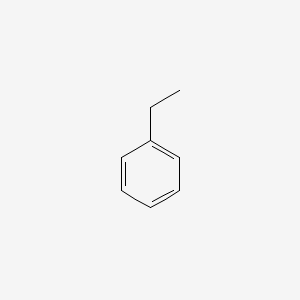
Ethylbenzene
Ethylbenzene is an alkylbenzene carrying an ethyl substituent. It is a constituent of coal tar and petroleum. — ChEBI
- IUPAC 명칭
- ethylbenzene
- 분자식
- C8H10
- 분자량
- 106.16 g/mol
- 정확한 질량
- 106.078250319 Da
- XLogP3
- 3.1
- 위상 극성 표면적
- 0.0 Ų
- 수소 결합 공여체
- 0
- 수소 결합 수용체
- 0
- 공유결합 단위
- 1
- 정의된 입체중심
- 0
다른 이름
보고된 명칭 16개 더 보기
외부 데이터베이스 식별자
- ChEBI:CHEBI:16101
- ChEMBL:CHEMBL371561
- EPA DTXSID:DTXSID3020596
- PubMed:38070821
- PubMed:33785322
- PubMed:33438815
- PubMed:29217486
- PubMed:28003437
- PubMed:26505805
- PubMed:26018793
- PubMed:25518993
- PubMed:24053957
- PubMed:23138419
- PubMed:23112641
- PubMed:23109595
추가 과학 데이터베이스의 근거
EMBL-EBI ChEBI
ethylbenzene
An alkylbenzene carrying an ethyl substituent. It is a constituent of coal tar and petroleum.
- 처방
- C8H10
- 평균 질량
- 106.168 g/mol
- 단일 동위원소 질량
- 106.07825 Da
- 형식 전하
- 0
- alkylbenzene — is a (CHEBI:38976)
- plastic filler — has role (CHEBI:747333)
- plastic filler — has role (CHEBI:747333)
- alkylbenzene — is a (CHEBI:38976)
추가 선별 명칭
이 출처의 상호 참조
- CAS: 100-41-4 — KEGG COMPOUND
- CAS: 100-41-4 — NIST Chemistry WebBook
- REGISTRY_NUMBER: 1901871 — Reaxys
- REGISTRY_NUMBER: 2990 — Gmelin
- MANUAL_X_REF: c0116 — UM-BBD
- MANUAL_X_REF: C07111 — KEGG COMPOUND
- MANUAL_X_REF: DB01722 — DrugBank
- MANUAL_X_REF: Ethylbenzene — Wikipedia
- MANUAL_X_REF: ETHYLBENZENE — MetaCyc
- MANUAL_X_REF: HMDB0059905 — HMDB
매핑 기준: Exact CAS cross-reference in the ChEBI compound record. 출처 업데이트: 2017-11-13. 가져온 시각: 2026-08-31. 출처 기록 열기
NIH PubChem PUG-View
Attributed physical-property, hazard, environmental and use annotations.
- Autoignition Temperature: 860 °F (USCG, 1999) 출처: CAMEO Chemicals
- Autoignition Temperature: 810 °F 출처: Hazardous Substances Data Bank (HSDB)
- Autoignition Temperature: 432 °C 출처: ILO-WHO International Chemical Safety Cards (ICSCs)
- Boiling Point: 277.2 °F at 760 mmHg (NTP, 1992) 출처: CAMEO Chemicals
- Boiling Point: 136.2 °C 출처: Hazardous Substances Data Bank (HSDB)
- Boiling Point: 136 °C 출처: ILO-WHO International Chemical Safety Cards (ICSCs)
- Boiling Point: 277 °F 출처: Occupational Safety and Health Administration (OSHA)
- Boiling Point: 136.2 °C @760 [mm Hg] 출처: PAC Chemical Database, U.S. Department of Energy
- Boiling Point: 277 °F 출처: The National Institute for Occupational Safety and Health (NIOSH)
- Color/Form: Colorless liquid 출처: Hazardous Substances Data Bank (HSDB)
- Density: 0.867 at 68 °F (USCG, 1999) - Less dense than water; will float 출처: CAMEO Chemicals
- Density: 0.8626 g/cu cm at 25 °C 출처: Hazardous Substances Data Bank (HSDB)
- Density: Density of saturated vapor-air mixture at 760 mm Hg (air= 1): 1.03 (26 °C); specific dispersion: 174.6 출처: Hazardous Substances Data Bank (HSDB)
- Density: Cricital density: 2.67 mmol/cu m; critical volume: 374.0 cu m/mol 출처: Hazardous Substances Data Bank (HSDB)
- Density: Relative density (water = 1): 0.9 출처: ILO-WHO International Chemical Safety Cards (ICSCs)
- Density: 0.87 출처: Occupational Safety and Health Administration (OSHA)
- Density: 0.8669 @25 °C 출처: PAC Chemical Database, U.S. Department of Energy
- Density: 0.87 출처: The National Institute for Occupational Safety and Health (NIOSH)
- Flash Point: 59 °F (NTP, 1992) 출처: CAMEO Chemicals
- Flash Point: 12.8 °C 출처: Haz-Map, Information on Hazardous Chemicals and Occupational Diseases
- Flash Point: 15.0 °C (59.0 °F) - closed cup 출처: Hazardous Substances Data Bank (HSDB)
- Flash Point: 64 °F (18 °C) - closed cup 출처: Hazardous Substances Data Bank (HSDB)
- Flash Point: 70 °F (21 °C) - closed cup 출처: Hazardous Substances Data Bank (HSDB)
- Flash Point: 18 °C c.c. 출처: ILO-WHO International Chemical Safety Cards (ICSCs)
- Flash Point: 55 °F 출처: Occupational Safety and Health Administration (OSHA)
- Flash Point: 55 °F 출처: The National Institute for Occupational Safety and Health (NIOSH)
- LogP: log Kow = 3.15 출처: Hazardous Substances Data Bank (HSDB)
- LogP: 3.1 출처: ILO-WHO International Chemical Safety Cards (ICSCs)
- Melting Point: -139 °F (NTP, 1992) 출처: CAMEO Chemicals
- Melting Point: -94.95 °C 출처: Hazardous Substances Data Bank (HSDB)
- Melting Point: -95 °C 출처: ILO-WHO International Chemical Safety Cards (ICSCs)
- Melting Point: -139 °F 출처: Occupational Safety and Health Administration (OSHA)
- Melting Point: -94.9 °C 출처: PAC Chemical Database, U.S. Department of Energy
- Melting Point: -139 °F 출처: The National Institute for Occupational Safety and Health (NIOSH)
- Odor: Aromatic odor 출처: Hazardous Substances Data Bank (HSDB)
- Odor: Pungent odor 출처: Hazardous Substances Data Bank (HSDB)
- Odor: Sweet, gasoline-like odor 출처: Hazardous Substances Data Bank (HSDB)
- Physical Description: Ethylbenzene appears as a clear colorless liquid with an aromatic odor. Flash point 59 °F. Less dense than water (at 7.2 lb / gal) and insoluble in water. Hence floats on water. Vapors heavier than air. Used as a solvent and to make other chemicals. 출처: CAMEO Chemicals
- Physical Description: Liquid; Gas Vapor; Wet Solid; CBI 출처: EPA Chemical Data Reporting (CDR)
- Physical Description: Colorless liquid with an aromatic odor; [NIOSH] 출처: Haz-Map, Information on Hazardous Chemicals and Occupational Diseases
- Physical Description: COLOURLESS LIQUID WITH AROMATIC ODOUR. 출처: ILO-WHO International Chemical Safety Cards (ICSCs)
- Physical Description: Colorless liquid with an aromatic odor. 출처: Occupational Safety and Health Administration (OSHA)
- Physical Description: Colorless liquid with an aromatic odor. 출처: The National Institute for Occupational Safety and Health (NIOSH)
- Refractive Index: Index of refraction: 1.4959 at 20 °C/D 출처: Hazardous Substances Data Bank (HSDB)
- Solubility: less than 1 mg/mL at 73 °F (NTP, 1992) 출처: CAMEO Chemicals
- Solubility: In water, 170 mg/L at 25 °C (average of 16 literature ranging from 131-212 mg/L at 25 °C) 출처: Hazardous Substances Data Bank (HSDB)
- Solubility: In water, 169 mg/L at 25 °C 출처: Hazardous Substances Data Bank (HSDB)
- Solubility: In water, 0.014 g/100 mL at 15 °C 출처: Hazardous Substances Data Bank (HSDB)
- Solubility: Soluble in all proportions in ethyl alcohol and ethyl ether 출처: Hazardous Substances Data Bank (HSDB)
- Solubility: For more Solubility (Complete) data for ETHYLBENZENE (8 total), please visit the HSDB record page. 출처: Hazardous Substances Data Bank (HSDB)
- Solubility: Solubility in water, g/100ml at 20 °C: 0.015 출처: ILO-WHO International Chemical Safety Cards (ICSCs)
- Solubility: 0.01% 출처: The National Institute for Occupational Safety and Health (NIOSH)
- Vapor Pressure: 10 mmHg at 85.1 °F ; 5 mmHg at 57.0 °F; 760 mmHg at 277.2 °F (NTP, 1992) 출처: CAMEO Chemicals
- Vapor Pressure: 9.6 [mmHg] 출처: Haz-Map, Information on Hazardous Chemicals and Occupational Diseases
- Vapor Pressure: 9.6 mm Hg at 25 °C 출처: Hazardous Substances Data Bank (HSDB)
- Vapor Pressure: Vapor pressure, kPa at 20 °C: 0.9 출처: ILO-WHO International Chemical Safety Cards (ICSCs)
- Vapor Pressure: 7 mmHg 출처: Occupational Safety and Health Administration (OSHA)
- Vapor Pressure: 10 [mm Hg] @26 °C 출처: PAC Chemical Database, U.S. Department of Energy
- Vapor Pressure: 7 mmHg 출처: The National Institute for Occupational Safety and Health (NIOSH)
- Viscosity: 0.64 cP at 25 °C 출처: Hazardous Substances Data Bank (HSDB)
- Viscosity: 0.6 mm²/s at 25 °C 출처: ILO-WHO International Chemical Safety Cards (ICSCs)
- IARC Carcinogenic Agent: Ethylbenzene 출처: International Agency for Research on Cancer (IARC)
- IARC Carcinogenic Classes: Group 2B: Possibly carcinogenic to humans 출처: International Agency for Research on Cancer (IARC)
- IARC Monographs: Volume 77: (2000) Some Industrial Chemicals 출처: International Agency for Research on Cancer (IARC)
- Publication Year: 2000 출처: International Agency for Research on Cancer (IARC)
- Evaluation Year: 2000 출처: International Agency for Research on Cancer (IARC)
- Substance: Ethylbenzene 출처: NTP Technical Reports
- NTP Technical Report: TR-466: Toxicology and Carcinogenesis Studies of Ethylbenzene (CASRN 100-41-4) in F344/N Rats and B6C3F1 Mice (Inhalation Studies) (1999 ) 출처: NTP Technical Reports
- Peer Review Date: 12/11/96 출처: NTP Technical Reports
- Conclusion for Male Rat: Clear Evidence 출처: NTP Technical Reports
- Conclusion for Female Rat: Some Evidence 출처: NTP Technical Reports
- Conclusion for Male Mice: Some Evidence 출처: NTP Technical Reports
- Conclusion for Female Mice: Some Evidence 출처: NTP Technical Reports
- Exposure Routes: The substance can be absorbed into the body by inhalation of its vapour and by ingestion. 출처: ILO-WHO International Chemical Safety Cards (ICSCs)
- Exposure Routes: inhalation, ingestion, skin and/or eye contact 출처: The National Institute for Occupational Safety and Health (NIOSH)
- Exposure Routes: Oral (L311); inhalation (L311) ; dermal (L311). 출처: Toxin and Toxin Target Database (T3DB)
- First Aid: EYES: First check the victim for contact lenses and remove if present. Flush victim's eyes with water or normal saline solution for 20 to 30 minutes while simultaneously calling a hospital or poison control center. Do not put any ointments, oils, or medication in the victim's eyes without specific instructions from a physician. IMMEDIATELY transport the victim after flushing eyes to a hospital even if no symptoms (such as redness or irritation) develop.; SKIN: IMMEDIATELY flood affected skin with water while removing and isolating all contaminated clothing. Gently wash all affected skin areas thoroughly with soap and water. If symptoms such as redness or irritation develop, IMMEDIATELY call a physician and be prepared to transport the victim to a hospital for treatment.; INHALATION: IMMEDIATELY leave the contaminated area; take deep breaths of fresh air. If symptoms (such as wheezing, coughing, shortness of breath, or burning in the mouth, throat, or chest) develop, call a physician and be prepared to transport the victim to a hospital. Provide proper respiratory protection to rescuers entering an unknown atmosphere. Whenever possible, Self-Contained Breathing Apparatus (SCBA) shou 출처: CAMEO Chemicals
- ERG2024, Guide 130 (Ethylbenzene): General First Aid:; · Call 911 or emergency medical service.; · Ensure that medical personnel are aware of the material(s) involved, take precautions to protect themselves and avoid contamination.; · Move victim to fresh air if it can be done safely.; · Administer oxygen if breathing is difficult.; · If victim is not breathing:; -- DO NOT perform mouth-to-mouth resuscitation; the victim may have ingested or inhaled the substance.; -- If equipped and pulse detected, wash face and mouth, then give artificial respiration using a proper respiratory medical device (bag-valve mask, pocket mask equipped with a one-way valve or other device).; -- If no pulse detected or no respiratory medical device available, provide continuous compressions. Conduct a pulse check every two minutes or monitor for any signs of spontaneous respirations.; · Remove and isolate contaminated clothing and shoes.; · For minor skin contact, avoid spreading material on unaffected skin.; · In case of contact with substance, remove immediately by flushing skin or eyes with running water for at least 20 minutes.; · For severe burns, immediate medical attention is required.; · Effects of exposure (inhalation, ingestion, 출처: Emergency Response Guidebook (ERG)
- First Aid: (General first aid procedures); Eye: Irrigate immediately - If this chemical contacts the eyes, immediately wash (irrigate) the eyes with large amounts of water, occasionally lifting the lower and upper lids. Get medical attention immediately.; Skin: Water flush promptly - If this chemical contacts the skin, flush the contaminated skin with water promptly. If this chemical penetrates the clothing, immediately remove the clothing and flush the skin with water promptly. If irritation persists after washing, get medical attention.; Breathing: Respiratory support; Swallow: Medical attention immediately - If this chemical has been swallowed, get medical attention immediately. 출처: The National Institute for Occupational Safety and Health (NIOSH)
- Signal: Danger 출처: Regulation (EC) No 1272/2008 of the European Parliament and of the Council
- GHS Hazard Statements: H225: Highly Flammable liquid and vapor [Danger Flammable liquids]; H304: May be fatal if swallowed and enters airways [Danger Aspiration hazard]; H332: Harmful if inhaled [Warning Acute toxicity, inhalation]; H373: May causes damage to organs through prolonged or repeated exposure [Warning Specific target organ toxicity, repeated exposure] 출처: Regulation (EC) No 1272/2008 of the European Parliament and of the Council
- Precautionary Statement Codes: P210, P233, P240, P241, P242, P243, P260, P261, P271, P280, P301+P316, P303+P361+P353, P304+P340, P317, P319, P331, P370+P378, P403+P235, P405, and P501 (click each P-code to see the statement) 출처: Regulation (EC) No 1272/2008 of the European Parliament and of the Council
- Note: This chemical does not meet GHS hazard criteria for < 0.1% (2 of 7017) of reports. 출처: European Chemicals Agency (ECHA)
- Signal: Danger 출처: European Chemicals Agency (ECHA)
- GHS Hazard Statements: H225 (> 99.9%): Highly Flammable liquid and vapor [Danger Flammable liquids]; H304 (17.3%): May be fatal if swallowed and enters airways [Danger Aspiration hazard]; H332 (99.9%): Harmful if inhaled [Warning Acute toxicity, inhalation]; H373 (17.2%): May causes damage to organs through prolonged or repeated exposure [Warning Specific target organ toxicity, repeated exposure] 출처: European Chemicals Agency (ECHA)
- Precautionary Statement Codes: P210, P233, P240, P241, P242, P243, P260, P261, P271, P280, P301+P316, P303+P361+P353, P304+P340, P317, P319, P331, P370+P378, P403+P235, P405, and P501 (click each P-code to see the statement) 출처: European Chemicals Agency (ECHA)
- ECHA C&L Notifications Summary: Aggregated GHS information provided per 7017 reports by companies from 72 notifications to the ECHA C&L Inventory. Each notification may be associated with multiple companies.; Reported as not meeting GHS hazard criteria per 2 of 7017 reports by companies.; There are 71 notifications provided by 7015 of 7017 reports by companies with hazard statement code(s).; Information may vary between notifications depending on impurities, additives, and other factors. The percentage value in parenthesis indicates the notified classification ratio from companies that provide hazard codes. Only hazard codes with percentage values above 10% are shown. For more detailed information, please visit ECHA C&L website. 출처: European Chemicals Agency (ECHA)
- Signal: Danger 출처: NITE-CMC
- GHS Hazard Statements: H225: Highly Flammable liquid and vapor [Danger Flammable liquids]; H304: May be fatal if swallowed and enters airways [Danger Aspiration hazard]; H320: Causes eye irritation [Warning Serious eye damage/eye irritation]; H332: Harmful if inhaled [Warning Acute toxicity, inhalation]; H335: May cause respiratory irritation [Warning Specific target organ toxicity, single exposure; Respiratory tract irritation]; H336: May cause drowsiness or dizziness [Warning Specific target organ toxicity, single exposure; Narcotic effects]; H351: Suspected of causing cancer [Warning Carcinogenicity]; H360: May damage fertility or the unborn child [Danger Reproductive toxicity]; H372: Causes damage to organs through prolonged or repeated exposure [Danger Specific target organ toxicity, repeated exposure] 출처: NITE-CMC
- Precautionary Statement Codes: P203, P210, P233, P240, P241, P242, P243, P260, P261, P264, P264+P265, P270, P271, P280, P301+P316, P303+P361+P353, P304+P340, P305+P351+P338, P317, P318, P319, P331, P337+P317, P370+P378, P403+P233, P403+P235, P405, and P501 (click each P-code to see the statement) 출처: NITE-CMC
- GHS Hazard Statements: H225: Highly Flammable liquid and vapor [Danger Flammable liquids]; H304: May be fatal if swallowed and enters airways [Danger Aspiration hazard]; H320: Causes eye irritation [Warning Serious eye damage/eye irritation]; H332: Harmful if inhaled [Warning Acute toxicity, inhalation]; H335: May cause respiratory irritation [Warning Specific target organ toxicity, single exposure; Respiratory tract irritation]; H336: May cause drowsiness or dizziness [Warning Specific target organ toxicity, single exposure; Narcotic effects]; H351: Suspected of causing cancer [Warning Carcinogenicity]; H360: May damage fertility or the unborn child [Danger Reproductive toxicity]; H373: May causes damage to organs through prolonged or repeated exposure [Warning Specific target organ toxicity, repeated exposure]; H400: Very toxic to aquatic life [Warning Hazardous to the aquatic environment, acute hazard]; H411: Toxic to aquatic life with long lasting effects [Hazardous to the aquatic environment, long-term hazard] 출처: NITE-CMC
- Health Effects: Chronic exposure to etylbenzene can lead to an increase in the mean number of lymphocytes and a decrease in hemoglobin levels. Acute duration and intermediate duration studies suggest that the auditory system is a sensitive target of ethylbenzene toxicity. Exposure ethylbenzene can lead to functional and organic disturbances (nervous system disturbances, toxic hepatitis and upper respiratory tract complaints). Metabolites of ethylbenzene have been shown to produce oxidative damage to DNA. (L311, T52) 출처: Toxin and Toxin Target Database (T3DB)
- NFPA Health Rating: 2 - Materials that, under emergency conditions, can cause temporary incapacitation or residual injury. 출처: Hazardous Substances Data Bank (HSDB)
- NFPA Fire Rating: 3 - Liquids and solids that can be ignited under almost all ambient temperature conditions. Materials produce hazardous atmospheres with air under almost all ambient temperatures or, though unaffected by ambient temperatures, are readily ignited under almost all conditions. 출처: Hazardous Substances Data Bank (HSDB)
- NFPA Instability Rating: 0 - Materials that in themselves are normally stable, even under fire conditions. 출처: Hazardous Substances Data Bank (HSDB)
- Target Organs: Developmental (effects during periods when organs are developing) , Hepatic (Liver), Neurological (Nervous System), Renal (Urinary System or Kidneys) 출처: Agency for Toxic Substances and Disease Registry (ATSDR)
- Target Organs: Developmental; Hepatic; Urinary 출처: EPA Integrated Risk Information System (IRIS)
- Target Organs: Eyes, skin, respiratory system, central nervous system 출처: The National Institute for Occupational Safety and Health (NIOSH)
- Toxicity Summary: IDENTIFICATION AND USE: Ethylbenzene is a colorless liquid with aromatic odor. It is used as an intermediate for the manufacture of the styrene monomer and as a resin solvent. It is also used as a component of automotive and aviation fuels. HUMAN EXPOSURE AND TOXICITY: Human exposure to ethylbenzene occurs mainly by inhalation. Ethylbenzene has low acute and chronic toxicity for humans. It is toxic to the central nervous system and is an irritant of mucous membranes and the eyes. Ethylbenzene vapor has a transient irritant effect on human eyes at 200 ppm in air. At 1000 ppm on the first exposure it is very irritating and causes tearing, but tolerance rapidly develops. At 2000 ppm eye irritation and lacrimation are immediate and severe; 5000 ppm causes intolerable irritation of the eyes and nose. Volunteers reported irritation and chest constriction after acute-duration exposures to 2,000 ppm ethylbenzene. These symptoms worsened as the concentration was increased to 5,000 ppm. Human exposures in the range of 2,000-5,000 ppm ethylbenzene were associated with dizziness and vertigo. Complete recovery occurs if exposure is not prolonged. Ethylbenzene exposure might be associated with h 출처: Hazardous Substances Data Bank (HSDB)
- Toxicity Summary: Changes in the integrity of the cell membrane after partitioning of ethylbenzene into the lipid bilayer may subsequently affect the function of membrane, particularly as a barrier and in energy transduction, and in the formation of a matrix for proteins and enzymes. Ethybenzene inhibits the activity of the astrocytic membrane ATPases, which helps regulate adequate intercellular levels of ions, nutrients, metabolic intermediates and precursors in the central nervous system. Thus, this may disturb the ability of the cells to maintain homeostasis. (L311, A186) 출처: Toxin and Toxin Target Database (T3DB)
- Environmental Bioconcentration: A BCF of 15 (log BCF of 1.19) was measured for ethylbenzene in goldfish(1). Ethylbenzene did not bioaccumulate in Coho salmon (Oncorhynchus kisutch) and starry flounder (Platichthys stellatus), BCF approximated as 1, in tests using 0.005 mg/L ethylbenzene(2). According to a classification scheme(2), these BCF values suggest the potential for bioconcentration in aquatic organisms is low. In a shellfish study, the ethylbenzene concentration in clam tissue was 5 times higher than that measured in water after an 8-day continuous-flow exposure to the water-soluble fraction of Cook Inlet crude oil(4). 출처: Hazardous Substances Data Bank (HSDB)
- Environmental Fate: TERRESTRIAL FATE: Based on a classification scheme(1), measured Koc values of 224 to 257(2-4), indicate that ethylbenzene is expected to have moderate mobility in soil(SRC). Volatilization of ethylbenzene from moist soil surfaces is expected to be an important fate process(SRC) given a Henry's Law constant of 7.88X10⁻³ atm-cu m/mole(5). Ethylbenzene is expected to volatilize from dry soil surfaces(SRC) based upon a vapor pressure of 9.6 mm Hg at 25 °C(6). Based on results of biodegradation screening studies, ethylbenzene is considered to be inherently biodegradable in soil under aerobic conditions, and not rapidly biodegradable in anaerobic conditions(7). As an example, ethylbenzene, present at 50 mg/L, reached 81% of its theoretical BOD in 14 days during a 28-day BOD test indicating it may be readily biodegradable under the right conditions(7). The kinetics of biodegradation appear to be site specific, and depend upon factors such as the type and population of microbes present, the environmental temperature, the concentration of ethylbenzene, the presence of other compounds that may act as a substrate, and the amount of oxygen and electron acceptors present(3). 출처: Hazardous Substances Data Bank (HSDB)
- Environmental Fate: AQUATIC FATE: Based on a classification scheme(1), measured Koc values of 224 to 257(2-4, indicate that ethylbenzene is not expected to adsorb to suspended solids and sediment(SRC). One sediment study concluded that the marine sediment compartment is not an important sink for ethylbenzene(5). Volatilization from water surfaces is expected(6) based upon a Henry's Law constant of 7.88X10⁻³ atm-cu m/mole(7). Using this Henry's Law constant and an estimation method(5), volatilization half-lives for a model river and model lake are 3.1 hours and 4.1 days, respectively(SRC). According to a classification scheme(8), experimental BCF values of 15(9) and 1(10) suggests the potential for bioconcentration in aquatic organisms is low. Based on results of biodegradation screening studies, ethylbenzene is considered to be inherently biodegradable in water under aerobic conditions, and not rapidly biodegradable in anaerobic conditions(11). The kinetics of biodegradation appear to be site specific, and depend upon factors such as the type and population of microbes present, the environmental temperature, the concentration of ethylbenzene, the presence of other compounds that may act as a substrate 출처: Hazardous Substances Data Bank (HSDB)
- Environmental Fate: ATMOSPHERIC FATE: According to a model of gas/particle partitioning of semivolatile organic compounds in the atmosphere(1), ethylbenzene, which has a vapor pressure of 9.6 mm Hg at 25 °C(2), is expected to exist solely as a vapor in the ambient atmosphere. Vapor-phase ethylbenzene is degraded in the atmosphere by reaction with photochemically-produced hydroxyl radicals(SRC); the half-life for this reaction in air is estimated to be 2.3 days(SRC), calculated from its rate constant of 7.0X10⁻¹² cu cm/molecule-sec at 25 °C(3). Vapor-phase ethylbenzene is also degraded in the atmosphere by reaction with night-time nitrate radicals(SRC); the half-life for this reaction in air is estimated to be 56 days(SRC), calculated from its rate constant of 5.71X10⁻¹⁶ cu cm/molecule-sec at 25 °C(4). Ethylbenzene has been detected in rainwater and snow(5,6), and therefore, it may be removed from the air by wet deposition(SRC). Ethylbenzene does not absorb at wavelengths >290 nm(7) and, therefore, is not expected to be susceptible to direct photolysis by sunlight(SRC). 출처: Hazardous Substances Data Bank (HSDB)
- Consumer Uses: Solvent; Dispersing agent; Binder; Other; Processing aids not otherwise specified; Fuel; Fuel agents; Cleaning agent; Filler; Not Known or Reasonably Ascertainable; Catalyst; Intermediate; Hardener; Adhesion/cohesion promoter; Surface modifier 출처: EPA Chemical Data Reporting (CDR)
- Industry Uses: Sealant (barrier); Diluent; Not Known or Reasonably Ascertainable; Catalyst; Cleaning agent; Surface modifier; Laboratory chemicals; Anti-static agent; Adhesion/cohesion promoter; Intermediate; Binder; Other; Solvent; Chemical reaction regulator; Fuel; Fuel agents; Processing aids not otherwise specified 출처: EPA Chemical Data Reporting (CDR)
- Uses: Ethylbenzene is used primarily in the production of styrene. It is also used as a solvent, as a constituent of asphalt and naphtha, and in fuels. 출처: EPA Hazardous Air Pollutants
- Sources/Uses: Used as a solvent and an intermediate in the production of styrene (90%) and other organic chemicals; The general population may be exposed after contact with gasoline, automobile emissions, domestic products containing solvents, and cigarette smoke. [ACGIH] Used as a solvent for resins and coatings; [HSDB] 출처: Haz-Map, Information on Hazardous Chemicals and Occupational Diseases
- Industrial Processes with risk of exposure: Painting (Solvents) [Category: Paint]; Plastic Composites Manufacturing [Category: Industry] 출처: Haz-Map, Information on Hazardous Chemicals and Occupational Diseases
- Activities with risk of exposure: Smoking cigarettes [Category: Food & Drugs] 출처: Haz-Map, Information on Hazardous Chemicals and Occupational Diseases
- Uses: Essentially all commercial ethylbenzene production is captively consumed for the manufacture of styrene monomer or in the co-production of styrene monomer with propylene oxide. Styrene is used in the production of polystyrene and a wide variety of other plastics. Of the minor uses, the most significant is in the paint industry as a solvent, which accounts for <1% of production capacity. Even smaller volumes go toward the production of acetophenone, diethylbenzene, and ethylanthraquinone. 출처: Hazardous Substances Data Bank (HSDB)
- Uses: ... Component for automotive and aviation fuels. 출처: Hazardous Substances Data Bank (HSDB)
- Uses: As a resin solvent. 출처: Hazardous Substances Data Bank (HSDB)
- Uses: Catalytic oxidation of ethylbenzene with air in the presence of heavy-metal oxides yields acetophenone and phenylmethylcarbinol. It also improves the antiknock properties of fuels for Otto engines. 출처: Hazardous Substances Data Bank (HSDB)
- Uses: Intermediate in production of styrene, solvent. 출처: Hazardous Substances Data Bank (HSDB)
- Uses: Ethylbenzene is used in the petrochemical industry as an intermediate in the production of styrene, which in turn is used for making polystyrene, a commonly used plastic material. Exposure may occur from breathing contaminated air, drinking or eating food prepared with ethylbenzene-contaminated water, and through skin contact with products containing ethylbenzene, such as gasoline. (L311) 출처: Toxin and Toxin Target Database (T3DB)
매핑 기준: Existing checksum-valid CAS to unique PubChem CID match. 가져온 시각: 2026-08-31. 출처 기록 열기
과학적 분류와 유해성 주석은 맥락을 제공할 뿐이며, 위에 표시된 시장별 규제 판단을 대체하지 않습니다.
추가 출처 적용 범위 및 일치 상태
| 출처 | 결과 | 확인됨 |
|---|---|---|
| EMBL-EBI ChEBI | 정확히 일치 | 2026-08-31 |
| NIH PubChem PUG-View | 정확히 일치 | 2026-08-31 |
기록된 불일치는 출처를 확인했다는 유용한 근거이며, 해당 물질이 다른 곳에 존재하지 않는다는 주장이 아닙니다.
체크섬이 유효한 CAS 일치를 통해 2026-08-31에 NIH PubChem에서 가져왔습니다. 화학적 특성은 이 페이지의 규제 판단을 대체하지 않습니다.