
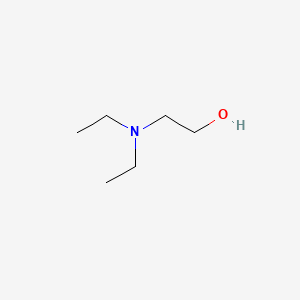
Diethylethanolamine
2-diethylaminoethanol is a member of the class of ethanolamines that is aminoethanol in which the hydrogens of the amino group are replaced by ethyl groups. It is a primary alcohol, a member of ethanolamines and a tertiary amino compound. It is functionally related to an ethanolamine. It derives from a hydride of a triethylamine. — ChEBI
- IUPAC 명칭
- 2-(diethylamino)ethanol
- 분자식
- C6H15NO
- 분자량
- 117.19 g/mol
- 정확한 질량
- 117.115364102 Da
- XLogP3
- 0.3
- 위상 극성 표면적
- 23.5 Ų
- 수소 결합 공여체
- 1
- 수소 결합 수용체
- 2
- 공유결합 단위
- 1
- 정의된 입체중심
- 0
다른 이름
보고된 명칭 16개 더 보기
외부 데이터베이스 식별자
- ChEBI:CHEBI:52153
- ChEMBL:CHEMBL1183
- EPA DTXSID:DTXSID5021837
- PubMed:22934827
- PubMed:22683026
- PubMed:22588291
- PubMed:22558796
- PubMed:22325017
- PubMed:22308719
- PubMed:21966668
- PubMed:21908655
- PubMed:21591931
- PubMed:21581773
- PubMed:21299793
- PubMed:21248790
추가 과학 데이터베이스의 근거
EMBL-EBI ChEBI
2-diethylaminoethanol
A member of the class of ethanolamines that is aminoethanol in which the hydrogens of the amino group are replaced by ethyl groups.
- 처방
- C6H15NO
- 평균 질량
- 117.192 g/mol
- 단일 동위원소 질량
- 117.11536 Da
- 형식 전하
- 0
- tertiary amino compound — is a (CHEBI:50996)
- primary alcohol — is a (CHEBI:15734)
- ethanolamines — is a (CHEBI:23981)
- plastic light stabilizer — has role (CHEBI:747339)
- polymerization initiator — has role (CHEBI:747342)
- ethanolamine — has functional parent (CHEBI:16000)
- triethylamine — has parent hydride (CHEBI:35026)
- plastic light stabilizer — has role (CHEBI:747339)
- polymerization initiator — has role (CHEBI:747342)
- tertiary amino compound — is a (CHEBI:50996)
- primary alcohol — is a (CHEBI:15734)
- ethanolamines — is a (CHEBI:23981)
- 22325017 출처: PubMed
추가 선별 명칭
이 출처의 상호 참조
- CAS: 100-37-8 — ChemIDplus
- CAS: 100-37-8 — NIST Chemistry WebBook
- MANUAL_X_REF: 2-Diethylaminoethanol — Wikipedia
- MANUAL_X_REF: HMDB0033971 — HMDB
- REGISTRY_NUMBER: 741863 — Reaxys
매핑 기준: Exact CAS cross-reference in the ChEBI compound record. 출처 업데이트: 2026-02-11. 가져온 시각: 2026-08-31. 출처 기록 열기
NIH PubChem PUG-View
Attributed physical-property, hazard, environmental and use annotations.
- Autoignition Temperature: 608 °F (320 °C) 출처: Hazardous Substances Data Bank (HSDB)
- Autoignition Temperature: 250 °C 출처: ILO-WHO International Chemical Safety Cards (ICSCs)
- Boiling Point: 325 °F at 760 mmHg (NTP, 1992) 출처: CAMEO Chemicals
- Boiling Point: 163 °C @ 760 MM HG 출처: Hazardous Substances Data Bank (HSDB)
- Boiling Point: 163.00 °C. @ 760.00 mm Hg 출처: Human Metabolome Database (HMDB)
- Boiling Point: 163 °C 출처: ILO-WHO International Chemical Safety Cards (ICSCs)
- Boiling Point: 325 °F 출처: Occupational Safety and Health Administration (OSHA)
- Boiling Point: 162 °C @760 [mm Hg] 출처: PAC Chemical Database, U.S. Department of Energy
- Boiling Point: 325 °F 출처: The National Institute for Occupational Safety and Health (NIOSH)
- Color/Form: COLORLESS LIQUID 출처: Hazardous Substances Data Bank (HSDB)
- Color/Form: Colorless liquid. 출처: Hazardous Substances Data Bank (HSDB)
- Density: 0.8921 at 77 °F (USCG, 1999) - Less dense than water; will float 출처: CAMEO Chemicals
- Density: 0.8921 @ 20 °C/4 °C 출처: Hazardous Substances Data Bank (HSDB)
- Density: Relative density (water = 1): 0.88 출처: ILO-WHO International Chemical Safety Cards (ICSCs)
- Density: 0.89 출처: Occupational Safety and Health Administration (OSHA)
- Density: 0.8851 @ 20°C 출처: PAC Chemical Database, U.S. Department of Energy
- Density: 0.89 출처: The National Institute for Occupational Safety and Health (NIOSH)
- Dissociation Constants: pKa = 9.87 at 20 °C (conjugate acid) 출처: Hazardous Substances Data Bank (HSDB)
- Flash Point: 140 °F (NTP, 1992) 출처: CAMEO Chemicals
- Flash Point: 49 °C 출처: Haz-Map, Information on Hazardous Chemicals and Occupational Diseases
- Flash Point: 140 °F (OPEN CUP) 출처: Hazardous Substances Data Bank (HSDB)
- Flash Point: 125 °F (closed cup) 출처: Hazardous Substances Data Bank (HSDB)
- Flash Point: 52 °C c.c. 출처: ILO-WHO International Chemical Safety Cards (ICSCs)
- Flash Point: 140 °F 출처: Occupational Safety and Health Administration (OSHA)
- Flash Point: 126 °F 출처: The National Institute for Occupational Safety and Health (NIOSH)
- LogP: 0.46 출처: ILO-WHO International Chemical Safety Cards (ICSCs)
- Melting Point: -94 °F (NTP, 1992) 출처: CAMEO Chemicals
- Melting Point: FREEZING POINT: -70 °C 출처: Hazardous Substances Data Bank (HSDB)
- Melting Point: -70 °C 출처: ILO-WHO International Chemical Safety Cards (ICSCs)
- Melting Point: -94 °F 출처: Occupational Safety and Health Administration (OSHA)
- Melting Point: -70 °C 출처: PAC Chemical Database, U.S. Department of Energy
- Melting Point: -94 °F 출처: The National Institute for Occupational Safety and Health (NIOSH)
- Odor: NAUSEATING ODOR 출처: Hazardous Substances Data Bank (HSDB)
- Odor: Nauseating, ammonia-like odor. 출처: Hazardous Substances Data Bank (HSDB)
- Physical Description: 2-diethylaminoethanol appears as a colorless liquid. Flash point 103-140 °F. Less dense than water. Vapors heavier than air. Produces toxic oxides of nitrogen during combustion. Causes burns to the skin, eyes and mucous membranes. 출처: CAMEO Chemicals
- Physical Description: Liquid 출처: EPA Chemical Data Reporting (CDR)
- Physical Description: Colorless liquid with a nauseating, ammonia-like odor; [NIOSH] 출처: Haz-Map, Information on Hazardous Chemicals and Occupational Diseases
- Physical Description: COLOURLESS HYGROSCOPIC LIQUID WITH CHARACTERISTIC ODOUR. 출처: ILO-WHO International Chemical Safety Cards (ICSCs)
- Physical Description: Colorless liquid with a nauseating, ammonia-like odor. 출처: Occupational Safety and Health Administration (OSHA)
- Physical Description: Colorless liquid with a nauseating, ammonia-like odor. 출처: The National Institute for Occupational Safety and Health (NIOSH)
- Refractive Index: SADTLER REFERENCE NUMBER: 143 (IR, PRISM); INDEX OF REFRACTION: 1.4412 @ 20 °C/D 출처: Hazardous Substances Data Bank (HSDB)
- Solubility: Very soluble (NTP, 1992) 출처: CAMEO Chemicals
- Solubility: SOL IN ALL PROPORTIONS IN WATER; SOL IN ALC, ETHER, ACETONE, BENZENE, PETROLEUM ETHER 출처: Hazardous Substances Data Bank (HSDB)
- Solubility: 1000000 mg/L @ 25 °C (exp) 출처: Human Metabolome Database (HMDB)
- Solubility: Solubility in water: miscible 출처: ILO-WHO International Chemical Safety Cards (ICSCs)
- Solubility: Miscible 출처: The National Institute for Occupational Safety and Health (NIOSH)
- Vapor Pressure: 21 mmHg at 68 °F (NTP, 1992) 출처: CAMEO Chemicals
- Vapor Pressure: 21.0 [mmHg] 출처: Haz-Map, Information on Hazardous Chemicals and Occupational Diseases
- Vapor Pressure: 21 MM HG @ 20 °C 출처: Hazardous Substances Data Bank (HSDB)
- Vapor Pressure: Vapor pressure, kPa at 20 °C: 2.8 출처: ILO-WHO International Chemical Safety Cards (ICSCs)
- Vapor Pressure: 1 mmHg 출처: Occupational Safety and Health Administration (OSHA)
- Vapor Pressure: 1.4 [mm Hg] @20 °C 출처: PAC Chemical Database, U.S. Department of Energy
- Vapor Pressure: 1 mmHg 출처: The National Institute for Occupational Safety and Health (NIOSH)
- Viscosity: 5 mPa-s at 20 °C 출처: Hazardous Substances Data Bank (HSDB)
- Exposure Routes: The substance can be absorbed into the body by inhalation, through the skin and by ingestion. 출처: ILO-WHO International Chemical Safety Cards (ICSCs)
- Exposure Routes: inhalation, skin absorption, ingestion, skin and/or eye contact 출처: The National Institute for Occupational Safety and Health (NIOSH)
- First Aid: EYES: First check the victim for contact lenses and remove if present. Flush victim's eyes with water or normal saline solution for 20 to 30 minutes while simultaneously calling a hospital or poison control center. Do not put any ointments, oils, or medication in the victim's eyes without specific instructions from a physician. IMMEDIATELY transport the victim after flushing eyes to a hospital even if no symptoms (such as redness or irritation) develop.; SKIN: IMMEDIATELY flood affected skin with water while removing and isolating all contaminated clothing. Gently wash all affected skin areas thoroughly with soap and water. IMMEDIATELY call a hospital or poison control center even if no symptoms (such as redness or irritation) develop. IMMEDIATELY transport the victim to a hospital for treatment after washing the affected areas.; INHALATION: IMMEDIATELY leave the contaminated area; take deep breaths of fresh air. If symptoms (such as wheezing, coughing, shortness of breath, or burning in the mouth, throat, or chest) develop, call a physician and be prepared to transport the victim to a hospital. Provide proper respiratory protection to rescuers entering an unknown atmosphere. Whene 출처: CAMEO Chemicals
- ERG2024, Guide 132 (2-Diethylaminoethanol): General First Aid:; · Call 911 or emergency medical service.; · Ensure that medical personnel are aware of the material(s) involved, take precautions to protect themselves and avoid contamination.; · Move victim to fresh air if it can be done safely.; · Administer oxygen if breathing is difficult.; · If victim is not breathing:; -- DO NOT perform mouth-to-mouth resuscitation; the victim may have ingested or inhaled the substance.; -- If equipped and pulse detected, wash face and mouth, then give artificial respiration using a proper respiratory medical device (bag-valve mask, pocket mask equipped with a one-way valve or other device).; -- If no pulse detected or no respiratory medical device available, provide continuous compressions. Conduct a pulse check every two minutes or monitor for any signs of spontaneous respirations.; · Remove and isolate contaminated clothing and shoes.; · For minor skin contact, avoid spreading material on unaffected skin.; · In case of contact with substance, remove immediately by flushing skin or eyes with running water for at least 20 minutes.; · For severe burns, immediate medical attention is required.; · Effects of exposure (inhalation, ingestion, 출처: Emergency Response Guidebook (ERG)
- First Aid: (General first aid procedures); Eye: Irrigate immediately - If this chemical contacts the eyes, immediately wash (irrigate) the eyes with large amounts of water, occasionally lifting the lower and upper lids. Get medical attention immediately.; Skin: Water flush immediately - If this chemical contacts the skin, immediately flush the contaminated skin with water. If this chemical penetrates the clothing, immediately remove the clothing and flush the skin with water. Get medical attention promptly.; Breathing: Respiratory support; Swallow: Medical attention immediately - If this chemical has been swallowed, get medical attention immediately. 출처: The National Institute for Occupational Safety and Health (NIOSH)
- Signal: Danger 출처: Regulation (EC) No 1272/2008 of the European Parliament and of the Council
- GHS Hazard Statements: H226: Flammable liquid and vapor [Warning Flammable liquids]; H302: Harmful if swallowed [Warning Acute toxicity, oral]; H312: Harmful in contact with skin [Warning Acute toxicity, dermal]; H314: Causes severe skin burns and eye damage [Danger Skin corrosion/irritation]; H332: Harmful if inhaled [Warning Acute toxicity, inhalation] 출처: Regulation (EC) No 1272/2008 of the European Parliament and of the Council
- Precautionary Statement Codes: P210, P233, P240, P241, P242, P243, P260, P261, P264, P270, P271, P280, P301+P317, P301+P330+P331, P302+P352, P302+P361+P354, P303+P361+P353, P304+P340, P305+P354+P338, P316, P317, P321, P330, P362+P364, P363, P370+P378, P403+P235, P405, and P501 (click each P-code to see the statement) 출처: Regulation (EC) No 1272/2008 of the European Parliament and of the Council
- Signal: Danger 출처: European Chemicals Agency (ECHA)
- GHS Hazard Statements: H226 (100%): Flammable liquid and vapor [Warning Flammable liquids]; H290 (40.2%): May be corrosive to metals [Warning Corrosive to Metals]; H302+H312+H332 (40.2%): Harmful if swallowed, in contact with skin or if inhaled [Warning Acute toxicity, oral; acute toxicity, dermal; acute toxicity, inhalation]; H302 (100%): Harmful if swallowed [Warning Acute toxicity, oral]; H311 (22.2%): Toxic in contact with skin [Danger Acute toxicity, dermal]; H312 (77.8%): Harmful in contact with skin [Warning Acute toxicity, dermal]; H314 (100%): Causes severe skin burns and eye damage [Danger Skin corrosion/irritation]; H318 (63.5%): Causes serious eye damage [Danger Serious eye damage/eye irritation]; H331 (23.4%): Toxic if inhaled [Danger Acute toxicity, inhalation]; H332 (76.6%): Harmful if inhaled [Warning Acute toxicity, inhalation]; H335 (46.9%): May cause respiratory irritation [Warning Specific target organ toxicity, single exposure; Respiratory tract irritation] 출처: European Chemicals Agency (ECHA)
- Precautionary Statement Codes: P210, P233, P234, P240, P241, P242, P243, P260, P261, P262, P264, P264+P265, P270, P271, P280, P301+P317, P301+P330+P331, P302+P352, P302+P361+P354, P303+P361+P353, P304+P340, P305+P354+P338, P316, P317, P319, P321, P330, P361+P364, P362+P364, P363, P370+P378, P390, P403+P233, P403+P235, P405, P406, and P501 (click each P-code to see the statement) 출처: European Chemicals Agency (ECHA)
- ECHA C&L Notifications Summary: Aggregated GHS information provided per 1097 reports by companies from 27 notifications to the ECHA C&L Inventory. Each notification may be associated with multiple companies.; Information may vary between notifications depending on impurities, additives, and other factors. The percentage value in parenthesis indicates the notified classification ratio from companies that provide hazard codes. Only hazard codes with percentage values above 10% are shown. For more detailed information, please visit ECHA C&L website. 출처: European Chemicals Agency (ECHA)
- Signal: Danger 출처: NITE-CMC
- GHS Hazard Statements: H226: Flammable liquid and vapor [Warning Flammable liquids]; H302: Harmful if swallowed [Warning Acute toxicity, oral]; H312: Harmful in contact with skin [Warning Acute toxicity, dermal]; H314: Causes severe skin burns and eye damage [Danger Skin corrosion/irritation]; H318: Causes serious eye damage [Danger Serious eye damage/eye irritation]; H331: Toxic if inhaled [Danger Acute toxicity, inhalation]; H335: May cause respiratory irritation [Warning Specific target organ toxicity, single exposure; Respiratory tract irritation]; H370: Causes damage to organs [Danger Specific target organ toxicity, single exposure]; H373: May causes damage to organs through prolonged or repeated exposure [Warning Specific target organ toxicity, repeated exposure] 출처: NITE-CMC
- Precautionary Statement Codes: P210, P233, P240, P241, P242, P243, P260, P261, P264, P264+P265, P270, P271, P280, P301+P317, P301+P330+P331, P302+P352, P302+P361+P354, P303+P361+P353, P304+P340, P305+P354+P338, P308+P316, P316, P317, P319, P321, P330, P362+P364, P363, P370+P378, P403+P233, P403+P235, P405, and P501 (click each P-code to see the statement) 출처: NITE-CMC
- GHS Hazard Statements: H226: Flammable liquid and vapor [Warning Flammable liquids]; H302: Harmful if swallowed [Warning Acute toxicity, oral]; H312: Harmful in contact with skin [Warning Acute toxicity, dermal]; H314: Causes severe skin burns and eye damage [Danger Skin corrosion/irritation]; H318: Causes serious eye damage [Danger Serious eye damage/eye irritation]; H331: Toxic if inhaled [Danger Acute toxicity, inhalation]; H370: Causes damage to organs [Danger Specific target organ toxicity, single exposure]; H373: May causes damage to organs through prolonged or repeated exposure [Warning Specific target organ toxicity, repeated exposure] 출처: NITE-CMC
- Signal: Danger 출처: Hazardous Chemical Information System (HCIS), Safe Work Australia
- NFPA Health Rating: 3 - Materials that, under emergency conditions, can cause serious or permanent injury. 출처: Hazardous Substances Data Bank (HSDB)
- NFPA Fire Rating: 2 - Materials that must be moderately heated or exposed to relatively high ambient temperatures before ignition can occur. Materials would not under normal conditions form hazardous atmospheres with air, but under high ambient temperatures or under moderate heating could release vapor in sufficient quantities to produce hazardous atmospheres with air. 출처: Hazardous Substances Data Bank (HSDB)
- NFPA Instability Rating: 0 - Materials that in themselves are normally stable, even under fire conditions. 출처: Hazardous Substances Data Bank (HSDB)
- Target Organs: Eyes, skin, respiratory system 출처: The National Institute for Occupational Safety and Health (NIOSH)
- Consumer Uses: Not Known or Reasonably Ascertainable 출처: EPA Chemical Data Reporting (CDR)
- Industry Uses: Intermediate; Anti-scaling agent; Not Known or Reasonably Ascertainable; Anti-condensation agent 출처: EPA Chemical Data Reporting (CDR)
- Sources/Uses: Used as an isocyanate curing agent; [Sullivan, Table 34-2, p. 471] Used as a chemical intermediate for pharmaceuticals, cosmetics, flocculants, emulsifiers, surface coatings, and other organic chemicals (in the chemical, agricultural, plastics, paper, and leather industries); [HSDB] 출처: Haz-Map, Information on Hazardous Chemicals and Occupational Diseases
- Industrial Processes with risk of exposure: Pulp and Paper Processing [Category: Industry]; Plastic Composites Manufacturing [Category: Industry] 출처: Haz-Map, Information on Hazardous Chemicals and Occupational Diseases
- Uses: MFR OF EMULSIFYING AGENTS AND SPECIAL SOAPS 출처: Hazardous Substances Data Bank (HSDB)
- Uses: CHEM INT FOR PETROLEUM & GAS PROCESSING CHEMS, COSMETICS, SURFACE COATINGS, TEXTILES & FIBERS, PROCAINE, CHLOROQUINE 출처: Hazardous Substances Data Bank (HSDB)
- Uses: WATER-SOL SALTS; FATTY ACID DERIVATIVES; TEXTILES SOFTNERS; PHARMACEUTICALS; ANTIRUST COMPOSITIONS; EMULSIFYING AGENTS IN ACID MEDIA; DERIVATIVES CONTAINING TERTIARY AMINE GROUPS; CURING AGENT FOR RESINS 출처: Hazardous Substances Data Bank (HSDB)
- Uses: Intermediate in production of pharmaceuticals, crop protection agents, and flocculants. Preparation of chemicals for the paper and leather industries; production of plastics. 출처: Hazardous Substances Data Bank (HSDB)
매핑 기준: Existing checksum-valid CAS to unique PubChem CID match. 가져온 시각: 2026-08-31. 출처 기록 열기
과학적 분류와 유해성 주석은 맥락을 제공할 뿐이며, 위에 표시된 시장별 규제 판단을 대체하지 않습니다.
추가 출처 적용 범위 및 일치 상태
| 출처 | 결과 | 확인됨 |
|---|---|---|
| EMBL-EBI ChEBI | 정확히 일치 | 2026-08-31 |
| NIH PubChem PUG-View | 정확히 일치 | 2026-08-31 |
기록된 불일치는 출처를 확인했다는 유용한 근거이며, 해당 물질이 다른 곳에 존재하지 않는다는 주장이 아닙니다.
체크섬이 유효한 CAS 일치를 통해 2026-08-31에 NIH PubChem에서 가져왔습니다. 화학적 특성은 이 페이지의 규제 판단을 대체하지 않습니다.