
Chloromethyl methyl ether
Chloromethyl methyl ether은(는) EU 시장에 출시되는 화장품에 사용이 금지된 물질로 부속서 II에 등재되어 있습니다.
기록 세부 정보
화학명
Chloromethyl methyl ether
규제 정보
SCCS 의견
- Opinion concerning Chemical Ingredients in Cosmetic Products classified as Carcinogenic, Mutagenic or Toxic to Reproduction according to the Chemicals Directive 67/548/EECC
- Opinion concerning Chemical Ingredients in Cosmetic Products classified as Carcinogenic, Mutagenic or Toxic to Reproduction according to the Chemicals Directive 67/548/EEC
CMR
| 카테고리 | Carcinogenic | Mutagenic | Reprotoxic |
|---|---|---|---|
| Cat. 1A | ✓ | — | — |
주요 데이터
화학적 정체 및 특성
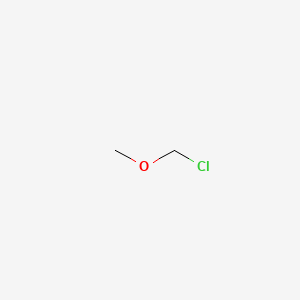
- IUPAC 명칭
- chloro(methoxy)methane
- 분자식
- C2H5ClO
- 분자량
- 80.51 g/mol
- 정확한 질량
- 80.0028925 Da
- XLogP3
- 0.8
- 위상 극성 표면적
- 9.2 Ų
- 수소 결합 공여체
- 0
- 수소 결합 수용체
- 1
- 공유결합 단위
- 1
- 정의된 입체중심
- 0
다른 이름
보고된 명칭 16개 더 보기
외부 데이터베이스 식별자
- ChEBI:CHEBI:82271
- ChEMBL:CHEMBL3185256
- EPA DTXSID:DTXSID6020307
- PubMed:33049310
- PubMed:22590255
- PubMed:22219962
- PubMed:22208749
- PubMed:22058976
- PubMed:21850114
- PubMed:21589598
- PubMed:21589597
- PubMed:21580653
- PubMed:21578395
- PubMed:21089828
- PubMed:19938844
추가 과학 데이터베이스의 근거
EMBL-EBI ChEBI
Chloromethyl methyl ether
- 처방
- C2H5ClO
- 평균 질량
- 80.514 g/mol
- 단일 동위원소 질량
- 80.00289 Da
- 형식 전하
- 0
- ether — is a (CHEBI:25698)
- ether — is a (CHEBI:25698)
이 출처의 상호 참조
- CAS: 107-30-2 — KEGG COMPOUND
- MANUAL_X_REF: C19160 — KEGG COMPOUND
- MANUAL_X_REF: HMDB0031332 — HMDB
매핑 기준: Exact CAS cross-reference in the ChEBI compound record. 가져온 시각: 2026-08-31. 출처 기록 열기
NIH PubChem PUG-View
Attributed physical-property, hazard, environmental and use annotations.
- Boiling Point: 138 °F at 760 mmHg (EPA, 1998) 출처: CAMEO Chemicals
- Boiling Point: 59.5 °C 출처: Hazardous Substances Data Bank (HSDB)
- Boiling Point: 59.00 to 60.00 °C. @ 760.00 mm Hg 출처: Human Metabolome Database (HMDB)
- Boiling Point: 59 °C 출처: ILO-WHO International Chemical Safety Cards (ICSCs)
- Boiling Point: 138 °F 출처: Occupational Safety and Health Administration (OSHA)
- Boiling Point: 59.5 °C @760 [mm Hg] 출처: PAC Chemical Database, U.S. Department of Energy
- Boiling Point: 138 °F 출처: The National Institute for Occupational Safety and Health (NIOSH)
- Color/Form: COLORLESS LIQ 출처: Hazardous Substances Data Bank (HSDB)
- Color/Form: Colorless liquid. 출처: Hazardous Substances Data Bank (HSDB)
- Color/Form: Colorless liquid 출처: Hazardous Substances Data Bank (HSDB)
- Density: 1.0605 at 68 °F (EPA, 1998) - Denser than water; will sink 출처: CAMEO Chemicals
- Density: 1.0603 @ 20 °C/4 °C 출처: Hazardous Substances Data Bank (HSDB)
- Density: Relative density (water = 1): 1.06 출처: ILO-WHO International Chemical Safety Cards (ICSCs)
- Density: 1.06 출처: Occupational Safety and Health Administration (OSHA)
- Density: 1.063 @ 10°C 출처: PAC Chemical Database, U.S. Department of Energy
- Density: 1.06 출처: The National Institute for Occupational Safety and Health (NIOSH)
- Flash Point: 32 °F (EPA, 1998) 출처: CAMEO Chemicals
- Flash Point: 0 °C 출처: Haz-Map, Information on Hazardous Chemicals and Occupational Diseases
- Flash Point: 0 °C (open cup). 출처: Hazardous Substances Data Bank (HSDB)
- Flash Point: -8 °C c.c. 출처: ILO-WHO International Chemical Safety Cards (ICSCs)
- Flash Point: 32 °F (open cup) 출처: Occupational Safety and Health Administration (OSHA)
- Flash Point: (oc) 32 °F 출처: The National Institute for Occupational Safety and Health (NIOSH)
- LogP: 0.320 출처: Human Metabolome Database (HMDB)
- Melting Point: -154.3 °F (EPA, 1998) 출처: CAMEO Chemicals
- Melting Point: -103.5 °C 출처: Hazardous Substances Data Bank (HSDB)
- Melting Point: -103.5 °C 출처: Human Metabolome Database (HMDB)
- Melting Point: -104 °C 출처: ILO-WHO International Chemical Safety Cards (ICSCs)
- Melting Point: -154 °F 출처: Occupational Safety and Health Administration (OSHA)
- Melting Point: -103.5 °C 출처: PAC Chemical Database, U.S. Department of Energy
- Melting Point: -154 °F 출처: The National Institute for Occupational Safety and Health (NIOSH)
- Odor: Irritating odor 출처: Hazardous Substances Data Bank (HSDB)
- Odor: Irritating odor. 출처: Hazardous Substances Data Bank (HSDB)
- Physical Description: Methyl chloromethyl ether appears as a clear colorless liquid. Flash point -4 °F. Irritates the eyes and respiratory system. Very toxic by inhalation and may be toxic by ingestion or skin absorption. Vapors are heavier than air. 출처: CAMEO Chemicals
- Physical Description: Liquid 출처: EPA Chemical Data Reporting (CDR)
- Physical Description: Colorless liquid with an irritating odor; [NIOSH] 출처: Haz-Map, Information on Hazardous Chemicals and Occupational Diseases
- Physical Description: Liquid 출처: Human Metabolome Database (HMDB)
- Physical Description: COLOURLESS LIQUID WITH CHARACTERISTIC ODOUR. 출처: ILO-WHO International Chemical Safety Cards (ICSCs)
- Physical Description: Colorless liquid with an irritating odor. 출처: Occupational Safety and Health Administration (OSHA)
- Physical Description: Colorless liquid with an irritating odor. 출처: The National Institute for Occupational Safety and Health (NIOSH)
- Refractive Index: INDEX OF REFRACTION: 1.3974 @ 20 °C/D 출처: Hazardous Substances Data Bank (HSDB)
- Solubility: Reacts with water (NIOSH, 2024) 출처: CAMEO Chemicals
- Solubility: MISCIBLE WITH ETHANOL & ETHER & MANY OTHER ORG SOLVENTS 출처: Hazardous Substances Data Bank (HSDB)
- Solubility: SOL IN ACETONE, CHLOROFORM, ETHYL ETHER, ETHYL ALCOHOL 출처: Hazardous Substances Data Bank (HSDB)
- Solubility: Soluble in oxygenated solvents 출처: Hazardous Substances Data Bank (HSDB)
- Solubility: Solubility in water: decomposes 출처: ILO-WHO International Chemical Safety Cards (ICSCs)
- Solubility: Reacts 출처: The National Institute for Occupational Safety and Health (NIOSH)
- Vapor Pressure: 192 mmHg at 70 °F (NIOSH, 2024) 출처: CAMEO Chemicals
- Vapor Pressure: 30.0 [mmHg] 출처: Haz-Map, Information on Hazardous Chemicals and Occupational Diseases
- Vapor Pressure: Vapor pressure: 3.705 lb/sq inch at 70 °F 출처: Hazardous Substances Data Bank (HSDB)
- Vapor Pressure: 30 mm Hg at 22 °C 출처: Hazardous Substances Data Bank (HSDB)
- Vapor Pressure: Vapor pressure, kPa at 20 °C: 21.6 출처: ILO-WHO International Chemical Safety Cards (ICSCs)
- Vapor Pressure: 192 mmHg at 70 °F 출처: Occupational Safety and Health Administration (OSHA)
- Vapor Pressure: 75 [mm Hg] @6 °C 출처: PAC Chemical Database, U.S. Department of Energy
- Vapor Pressure: (70 °F): 192 mmHg 출처: The National Institute for Occupational Safety and Health (NIOSH)
- Carcinogen Classification: 1, carcinogenic to humans. (L135) 출처: Toxin and Toxin Target Database (T3DB)
- Exposure Routes: Serious local effects by all routes of exposure. 출처: ILO-WHO International Chemical Safety Cards (ICSCs)
- Exposure Routes: inhalation, skin absorption, ingestion, skin and/or eye contact 출처: The National Institute for Occupational Safety and Health (NIOSH)
- First Aid: Signs and Symptoms of Chloromethyl Methyl Ether Exposure: Acute exposure to chloromethyl methyl ether may produce severe irritation and burning of the skin, eyes, and mucous membranes. Sore throat, fever, chills, dypsnea (difficulty breathing), chronic bronchitis, and pulmonary edema with productive cough may be noted.; Emergency Life-Support Procedures: Acute exposure to chloromethyl methyl ether may require decontamination and life support for the victims. Emergency personnel should wear protective clothing appropriate to the type and degree of contamination. Air-purifying or supplied-air respiratory equipment should also be worn, as necessary. Rescue vehicles should carry supplies such as plastic sheeting and disposable plastic bags to assist in preventing spread of contamination.; Inhalation Exposure:; 1. Move victims to fresh air. Emergency personnel should avoid self-exposure to chloromethyl methyl ether.; 2. Evaluate vital signs including pulse and respiratory rate, and note any trauma. If no pulse is detected, provide CPR. If not breathing, provide artificial respiration. If breathing is labored, administer 100% humidified oxygen or other respiratory support.; 3. Obtain aut 출처: CAMEO Chemicals
- ERG2024, Guide 131 (Methyl chloromethyl ether): General First Aid:; · Call 911 or emergency medical service.; · Ensure that medical personnel are aware of the material(s) involved, take precautions to protect themselves and avoid contamination.; · Move victim to fresh air if it can be done safely.; · Administer oxygen if breathing is difficult.; · If victim is not breathing:; -- DO NOT perform mouth-to-mouth resuscitation; the victim may have ingested or inhaled the substance.; -- If equipped and pulse detected, wash face and mouth, then give artificial respiration using a proper respiratory medical device (bag-valve mask, pocket mask equipped with a one-way valve or other device).; -- If no pulse detected or no respiratory medical device available, provide continuous compressions. Conduct a pulse check every two minutes or monitor for any signs of spontaneous respirations.; · Remove and isolate contaminated clothing and shoes.; · For minor skin contact, avoid spreading material on unaffected skin.; · In case of contact with substance, remove immediately by flushing skin or eyes with running water for at least 20 minutes.; · For severe burns, immediate medical attention is required.; · Effects of exposure (inhalation, ingestion, 출처: Emergency Response Guidebook (ERG)
- First Aid: (General first aid procedures); Eye: Irrigate immediately - If this chemical contacts the eyes, immediately wash (irrigate) the eyes with large amounts of water, occasionally lifting the lower and upper lids. Get medical attention immediately.; Skin: Soap wash immediately - If this chemical contacts the skin, immediately wash the contaminated skin with soap and water. If this chemical penetrates the clothing, immediately remove the clothing, wash the skin with soap and water, and get medical attention promptly.; Breathing: Respiratory support; Swallow: Medical attention immediately - If this chemical has been swallowed, get medical attention immediately. 출처: The National Institute for Occupational Safety and Health (NIOSH)
- Signal: Danger 출처: Regulation (EC) No 1272/2008 of the European Parliament and of the Council
- GHS Hazard Statements: H225: Highly Flammable liquid and vapor [Danger Flammable liquids]; H302: Harmful if swallowed [Warning Acute toxicity, oral]; H312: Harmful in contact with skin [Warning Acute toxicity, dermal]; H332: Harmful if inhaled [Warning Acute toxicity, inhalation]; H350: May cause cancer [Danger Carcinogenicity] 출처: Regulation (EC) No 1272/2008 of the European Parliament and of the Council
- Precautionary Statement Codes: P203, P210, P233, P240, P241, P242, P243, P261, P264, P270, P271, P280, P301+P317, P302+P352, P303+P361+P353, P304+P340, P317, P318, P321, P330, P362+P364, P370+P378, P403+P235, P405, and P501 (click each P-code to see the statement) 출처: Regulation (EC) No 1272/2008 of the European Parliament and of the Council
- Signal: Danger 출처: European Chemicals Agency (ECHA)
- GHS Hazard Statements: H225 (100%): Highly Flammable liquid and vapor [Danger Flammable liquids]; H302+H312+H332 (84.4%): Harmful if swallowed, in contact with skin or if inhaled [Warning Acute toxicity, oral; acute toxicity, dermal; acute toxicity, inhalation]; H302 (100%): Harmful if swallowed [Warning Acute toxicity, oral]; H312 (100%): Harmful in contact with skin [Warning Acute toxicity, dermal]; H319 (84.4%): Causes serious eye irritation [Warning Serious eye damage/eye irritation]; H332 (100%): Harmful if inhaled [Warning Acute toxicity, inhalation]; H350 (100%): May cause cancer [Danger Carcinogenicity] 출처: European Chemicals Agency (ECHA)
- Precautionary Statement Codes: P203, P210, P233, P240, P241, P242, P243, P261, P264, P264+P265, P270, P271, P280, P301+P317, P302+P352, P303+P361+P353, P304+P340, P305+P351+P338, P317, P318, P321, P330, P337+P317, P362+P364, P370+P378, P403+P235, P405, and P501 (click each P-code to see the statement) 출처: European Chemicals Agency (ECHA)
- ECHA C&L Notifications Summary: Aggregated GHS information provided per 45 reports by companies from 4 notifications to the ECHA C&L Inventory. Each notification may be associated with multiple companies.; Information may vary between notifications depending on impurities, additives, and other factors. The percentage value in parenthesis indicates the notified classification ratio from companies that provide hazard codes. Only hazard codes with percentage values above 10% are shown. For more detailed information, please visit ECHA C&L website. 출처: European Chemicals Agency (ECHA)
- Signal: Danger 출처: NITE-CMC
- GHS Hazard Statements: H225: Highly Flammable liquid and vapor [Danger Flammable liquids]; H302: Harmful if swallowed [Warning Acute toxicity, oral]; H314: Causes severe skin burns and eye damage [Danger Skin corrosion/irritation]; H318: Causes serious eye damage [Danger Serious eye damage/eye irritation]; H330: Fatal if inhaled [Danger Acute toxicity, inhalation]; H341: Suspected of causing genetic defects [Warning Germ cell mutagenicity]; H350: May cause cancer [Danger Carcinogenicity]; H370: Causes damage to organs [Danger Specific target organ toxicity, single exposure] 출처: NITE-CMC
- Precautionary Statement Codes: P203, P210, P233, P240, P241, P242, P243, P260, P264, P264+P265, P270, P271, P280, P284, P301+P317, P301+P330+P331, P302+P361+P354, P303+P361+P353, P304+P340, P305+P354+P338, P308+P316, P316, P317, P318, P320, P321, P330, P363, P370+P378, P403+P233, P403+P235, P405, and P501 (click each P-code to see the statement) 출처: NITE-CMC
- GHS Hazard Statements: H225: Highly Flammable liquid and vapor [Danger Flammable liquids]; H301: Toxic if swallowed [Danger Acute toxicity, oral]; H314: Causes severe skin burns and eye damage [Danger Skin corrosion/irritation]; H318: Causes serious eye damage [Danger Serious eye damage/eye irritation]; H330: Fatal if inhaled [Danger Acute toxicity, inhalation]; H350: May cause cancer [Danger Carcinogenicity]; H370: Causes damage to organs [Danger Specific target organ toxicity, single exposure]; H373: May causes damage to organs through prolonged or repeated exposure [Warning Specific target organ toxicity, repeated exposure] 출처: NITE-CMC
- Precautionary Statement Codes: P203, P210, P233, P240, P241, P242, P243, P260, P264, P264+P265, P270, P271, P280, P284, P301+P316, P301+P330+P331, P302+P361+P354, P303+P361+P353, P304+P340, P305+P354+P338, P308+P316, P316, P317, P318, P319, P320, P321, P330, P363, P370+P378, P403+P233, P403+P235, P405, and P501 (click each P-code to see the statement) 출처: NITE-CMC
- Target Organs: Eyes, skin, respiratory system 출처: The National Institute for Occupational Safety and Health (NIOSH)
- Toxicity Summary: ... Based upon the lack of persistence of BCME /bis(chloromethyl) ether/ and CMME /chloromethyl methyl ether/ in the environment, average human exposure to these compounds is likely to be very low. ... General population exposure to BCME and CMME occurs where they are produced by the widespread burning of this synergist in mosquito coils. ...Quantitative information on the kinetics and metabolism ... in humans is not available. However, it is anticipated that although in vivo BCME and CMME would be rapidly hydrolyzed in tissues to formaldehyde and hydrogen chloride, and methanol, formaldehyde and hydrogen chloride, respectively, there should be alkylation activity. ... BCME and CMME are acutely toxic by inhalation or ingestion. ...During inhalation of BCME /in laboratory animal studies/, irritation of the eyes and respiratory tract were noted as well as necrotizing bronchitis. Skin application resulted in erythema and necrosis, and application to the eye resulted in corneal necrosis. Similar effects were noted after exposure to CMME. Increased mortality and tracheal hyperplasia were observed in rats and hamsters following multiple inhalation exposure to ... BCME ... Similar results 출처: Hazardous Substances Data Bank (HSDB)
- Environmental Bioconcentration: Hydrolysis half-lives are sufficiently fast (hydrolysis occurs in pure water with a half-life <1 sec(1)) to preclude any possibility of bioconcentration in the food chain(SRC). 출처: Hazardous Substances Data Bank (HSDB)
- Environmental Fate: TERRESTRIAL FATE: The fate of chloromethyl methyl ether in moist soil is unknown. However, since it hydrolyzes so rapidly in pure water(1), it is expected to disappear rapidly from moist soil(SRC). 출처: Hazardous Substances Data Bank (HSDB)
- Environmental Fate: AQUATIC FATE: Chloromethyl methyl ether will hydrolyze instantaneously in water (half-life <1 sec)(1). Reaction products include methanol, formaldehyde, HCl, and chloromethylformate(1,2). 출처: Hazardous Substances Data Bank (HSDB)
- Environmental Fate: ATMOSPHERIC FATE: Chloromethyl methyl ether will hydrolyze in humid air (half-life 3.5 min to 6.5 hr)(1,2). However, results suggest that the hydrolysis is surface catalyzed and therefore may not represent the true half-life in atmospheric room air or outside air(SRC). The half-life of chloromethyl methyl ether with photochemically-produced hydroxyl radicals has been determined to be approximately 7 days(3,SRC). 출처: Hazardous Substances Data Bank (HSDB)
- Industry Uses: Monomers 출처: EPA Chemical Data Reporting (CDR)
- Uses: Chloromethyl methyl ether is used in the synthesis of chloromethylated compounds and as an alkylating agent and solvent used in the manufacture of water repellents, ion-exchange resins, and industrial polymers. 출처: EPA Hazardous Air Pollutants
- Sources/Uses: Used as a methylating agent; [ACGIH] 출처: Haz-Map, Information on Hazardous Chemicals and Occupational Diseases
- Restricted Notes: Carcinogen--see 29 CFR 1910.1003; 출처: Haz-Map, Information on Hazardous Chemicals and Occupational Diseases
- Uses: CHEM INT, EG, FOR DODECYLBENZYL CHLORIDE 출처: Hazardous Substances Data Bank (HSDB)
- Uses: An alkylating agent & solvent used in the manufacture of water repellants, ion-exchange resins, & indust polymers 출처: Hazardous Substances Data Bank (HSDB)
- Uses: In synthesis of chloromethylated compounds. 출처: Hazardous Substances Data Bank (HSDB)
- Uses: Chloromethylation reagent 출처: Hazardous Substances Data Bank (HSDB)
매핑 기준: Existing checksum-valid CAS to unique PubChem CID match. 가져온 시각: 2026-08-31. 출처 기록 열기
과학적 분류와 유해성 주석은 맥락을 제공할 뿐이며, 위에 표시된 시장별 규제 판단을 대체하지 않습니다.
추가 출처 적용 범위 및 일치 상태
| 출처 | 결과 | 확인됨 |
|---|---|---|
| EMBL-EBI ChEBI | 정확히 일치 | 2026-08-31 |
| NIH PubChem PUG-View | 정확히 일치 | 2026-08-31 |
기록된 불일치는 출처를 확인했다는 유용한 근거이며, 해당 물질이 다른 곳에 존재하지 않는다는 주장이 아닙니다.
체크섬이 유효한 CAS 일치를 통해 2026-08-31에 NIH PubChem에서 가져왔습니다. 화학적 특성은 이 페이지의 규제 판단을 대체하지 않습니다.
Chloromethyl methyl ether의 관련 기록
이 기록에 직접 일치하는 항목이 제한적이어서, 부속서 II의 인접 항목도 함께 표시합니다.
(2RS,3RS)-3-(2-Chlorophenyl)-2-(4-fluorophenyl)-[1H-1,2,4-triazol-1-yl)methyl]oxirane; Epoxiconazole
2-Methoxyethanol [1] and its acetate (2-Methoxyethyl acetate) [2]
2-Ethoxyethanol and its acetate (2-Ethoxyethyl acetate)
1,2-Epoxy-3-phenoxypropane (Phenylglycidyl ether)
Chloromethyl methyl ether에 대한 부속서 II의 의미
Chloromethyl methyl ether은(는) EU 화장품 규정 1223/2009 부속서 II에 따라 사용금지 물질로 등재되어 있으며 의도적으로 첨가해서는 안 됩니다. 제17조는 별도로, 우수화장품제조관리기준(GMP)에 따라 기술적으로 피할 수 없고 제3조의 안전 요건에 부합하는 비의도적 미량에 대해 다룹니다.
처방 개발자는 원료와 원재료를 선별하여 이 물질이 들어 있지 않은지 확인해야 합니다. 공급업체는 요청 시 부재를 확인하는 문서를 제공해야 합니다.
또한 이 페이지에는 식별자, 부속서 논리 또는 명칭 패턴이 겹치는 관련 부속서 기록 12건이 표시됩니다.
규제 준수 체크리스트
- 이 물질이 모든 원료와 완제품 처방에 없는지 확인하세요.
- 원료 공급업체에 부재 확인서 또는 CoA를 요청하세요.
- 선별 결과를 제품정보파일(PIF)에 기록하세요.
- 이 물질은 CMR로 분류되어 있습니다. 사용 전에 위의 CMR 표를 검토하고 현재 부속서 II/III 상태를 확인하세요.