
Tetrachloroethylene
Tetrachloroethylene은(는) EU 시장에 출시되는 화장품에 사용이 금지된 물질로 부속서 II에 등재되어 있습니다.
기록 세부 정보
화학명
Tetrachloroethylene
규제 정보
CMR
| 카테고리 | Carcinogenic | Mutagenic | Reprotoxic |
|---|---|---|---|
| Cat. 2 | ✓ | — | — |
주요 데이터
화학적 정체 및 특성
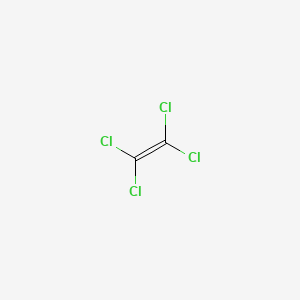
Tetrachloroethylene
Tetrachloroethene is a chlorocarbon that is tetrachloro substituted ethene. It has a role as a nephrotoxic agent. It is a member of chloroethenes and a chlorocarbon. — ChEBI
- IUPAC 명칭
- 1,1,2,2-tetrachloroethene
- 분자식
- C2Cl4
- 분자량
- 165.8 g/mol
- 정확한 질량
- 165.872461 Da
- XLogP3
- 3.4
- 위상 극성 표면적
- 0.0 Ų
- 수소 결합 공여체
- 0
- 수소 결합 수용체
- 0
- 공유결합 단위
- 1
- 정의된 입체중심
- 0
다른 이름
보고된 명칭 16개 더 보기
외부 데이터베이스 식별자
- ChEBI:CHEBI:17300
- ChEMBL:CHEMBL114062
- EPA DTXSID:DTXSID2021319
- PubMed:23077798
- PubMed:23062436
- PubMed:23019529
- PubMed:22995997
- PubMed:22989309
- PubMed:22955594
- PubMed:22939126
- PubMed:22939091
- PubMed:22868086
- PubMed:22814410
- PubMed:22806146
- PubMed:22784657
추가 과학 데이터베이스의 근거
NIH PubChem PUG-View
Attributed physical-property, hazard, environmental and use annotations.
- Autoignition Temperature: Not flammable (USCG, 1999) 출처: CAMEO Chemicals
- Autoignition Temperature: Fully encapsulating, vapor-protective clothing should be worn for spills and leaks with no fire. Do not touch damaged containers or spilled material unless wearing appropriate protective clothing. Stop leak if you can do it without risk. Use water spray to reduce vapors; do not put water directly on leak, spill area or inside container. Keep combustibles (wood, paper, oil, etc.) away from spilled material. SMALL SPILL: Cover with DRY earth, DRY sand or other non-combustible material followed with plastic sheet to minimize spreading or contact with rain. Use clean, non-sparking tools to collect material and place it into loosely covered plastic containers for later disposal. Prevent entry into waterways, sewers, basements or confined areas. 출처: Hazardous Substances Data Bank (HSDB)
- Autoignition Temperature: > 650 °C 출처: ILO-WHO International Chemical Safety Cards (ICSCs)
- Boiling Point: 250 °F at 760 mmHg (NTP, 1992) 출처: CAMEO Chemicals
- Boiling Point: 121.2 °C 출처: Hazardous Substances Data Bank (HSDB)
- Boiling Point: 121 °C 출처: ILO-WHO International Chemical Safety Cards (ICSCs)
- Boiling Point: 250 °F 출처: Occupational Safety and Health Administration (OSHA)
- Boiling Point: 121.3 °C @760 [mm Hg] 출처: PAC Chemical Database, U.S. Department of Energy
- Boiling Point: 250 °F 출처: The National Institute for Occupational Safety and Health (NIOSH)
- Color/Form: Colorless liquid 출처: Hazardous Substances Data Bank (HSDB)
- Density: 1.63 at 68 °F (USCG, 1999) - Denser than water; will sink 출처: CAMEO Chemicals
- Density: 1.6230 g/cu cm at 20 °C 출처: Hazardous Substances Data Bank (HSDB)
- Density: Density (at 20 °C): 1.62 g/cm³ 출처: ILO-WHO International Chemical Safety Cards (ICSCs)
- Density: Relative density of the vapour/air-mixture at 20 °C (air = 1): 1.09 출처: ILO-WHO International Chemical Safety Cards (ICSCs)
- Density: 1.62 출처: Occupational Safety and Health Administration (OSHA)
- Density: 1.623 @ 20°C 출처: PAC Chemical Database, U.S. Department of Energy
- Density: 1.62 출처: The National Institute for Occupational Safety and Health (NIOSH)
- Flash Point: No flash point in conventional closed tester. 출처: Hazardous Substances Data Bank (HSDB)
- LogP: log Kow = 3.40 출처: Hazardous Substances Data Bank (HSDB)
- LogP: 3.40 출처: Human Metabolome Database (HMDB)
- LogP: 3.4 출처: ILO-WHO International Chemical Safety Cards (ICSCs)
- Melting Point: -2 °F (NTP, 1992) 출처: CAMEO Chemicals
- Melting Point: -22.2 °C 출처: Hazardous Substances Data Bank (HSDB)
- Melting Point: -22.3 °C 출처: Human Metabolome Database (HMDB)
- Melting Point: -22 °C 출처: ILO-WHO International Chemical Safety Cards (ICSCs)
- Melting Point: -2 °F 출처: Occupational Safety and Health Administration (OSHA)
- Melting Point: -22.3 °C 출처: PAC Chemical Database, U.S. Department of Energy
- Melting Point: -2 °F 출처: The National Institute for Occupational Safety and Health (NIOSH)
- Odor: Ether-like odor 출처: Hazardous Substances Data Bank (HSDB)
- Odor: Mild, chloroform-like odor 출처: Hazardous Substances Data Bank (HSDB)
- Odor: Chlorinated solvent odor 출처: Hazardous Substances Data Bank (HSDB)
- Physical Description: Perchloroethylene appears as a clear colorless volatile liquid having an ether-like odor. Noncombustible. Insoluble in water. Vapors heavier than air. Density approximately 13.5 lb / gal. Used as dry cleaning solvent, a degreasing solvent, a drying agent for metals, and in the manufacture of other chemicals. 출처: CAMEO Chemicals
- Physical Description: Liquid 출처: EPA Chemical Data Reporting (CDR)
- Physical Description: Colorless liquid with a mild, chloroform-like odor; [NIOSH] 출처: Haz-Map, Information on Hazardous Chemicals and Occupational Diseases
- Physical Description: Liquid 출처: Human Metabolome Database (HMDB)
- Physical Description: COLOURLESS LIQUID WITH CHARACTERISTIC ODOUR. 출처: ILO-WHO International Chemical Safety Cards (ICSCs)
- Physical Description: Colorless liquid with a mild, chloroform-like odor. 출처: Occupational Safety and Health Administration (OSHA)
- Physical Description: Colorless liquid with a mild, chloroform-like odor. 출처: The National Institute for Occupational Safety and Health (NIOSH)
- Refractive Index: Index of refraction: 1.5053 at 20 °C/D 출처: Hazardous Substances Data Bank (HSDB)
- Solubility: less than 0.1 mg/mL at 63 °F (NTP, 1992) 출처: CAMEO Chemicals
- Solubility: In water, 206 mg/L at 25 °C 출처: Hazardous Substances Data Bank (HSDB)
- Solubility: Insoluble in water 출처: Hazardous Substances Data Bank (HSDB)
- Solubility: Miscible with alcohol, ether, chloroform, benzene 출처: Hazardous Substances Data Bank (HSDB)
- Solubility: Miscible with ethanol, ethyl ether, benzene 출처: Hazardous Substances Data Bank (HSDB)
- Solubility: Miscible with solvent hexane; dissolves in most of the fixed and volatile oils 출처: Hazardous Substances Data Bank (HSDB)
- Solubility: 0.206 mg/mL at 25 °C 출처: Human Metabolome Database (HMDB)
- Solubility: Solubility in water, g/100ml at 20 °C: 0.015 출처: ILO-WHO International Chemical Safety Cards (ICSCs)
- Solubility: 0.02% 출처: The National Institute for Occupational Safety and Health (NIOSH)
- Vapor Pressure: 14 mmHg at 68 °F ; 15.8 mmHg at 72 °F (NTP, 1992) 출처: CAMEO Chemicals
- Vapor Pressure: 18.5 [mmHg] 출처: Haz-Map, Information on Hazardous Chemicals and Occupational Diseases
- Vapor Pressure: 18.5 mm Hg at 25 °C 출처: Hazardous Substances Data Bank (HSDB)
- Vapor Pressure: Vapor pressure, kPa at 20 °C: 1.9 출처: ILO-WHO International Chemical Safety Cards (ICSCs)
- Vapor Pressure: 14 mmHg 출처: Occupational Safety and Health Administration (OSHA)
- Vapor Pressure: 7.5 [mm Hg] @10 °C 출처: PAC Chemical Database, U.S. Department of Energy
- Vapor Pressure: 14 mmHg 출처: The National Institute for Occupational Safety and Health (NIOSH)
- Viscosity: Liquid (cP): 0.932 at 15 °C; 0.839 at 25 °C; 0.657 at 50 °C; 0.534 at 75 °C. Vapor: 9900 cP at 60 °C 출처: Hazardous Substances Data Bank (HSDB)
- IARC Carcinogenic Agent: Tetrachloroethylene (Perchloroethylene) 출처: International Agency for Research on Cancer (IARC)
- IARC Carcinogenic Classes: Group 2A: Probably carcinogenic to humans 출처: International Agency for Research on Cancer (IARC)
- IARC Monographs: Volume Sup 7: Overall Evaluations of Carcinogenicity: An Updating of IARC Monographs Volumes 1 to 42, 1987; 440 pages; ISBN 92-832-1411-0 (out of print); Volume 63: (1995) Dry Cleaning, Some Chlorinated Solvents and Other Industrial Chemicals; Volume 106: (2014) Trichloroethylene, Tetrachloroethylene, and Some Other Chlorinated Agents 출처: International Agency for Research on Cancer (IARC)
- Publication Year: 2014 출처: International Agency for Research on Cancer (IARC)
- Evaluation Year: 2012 출처: International Agency for Research on Cancer (IARC)
- Substance: Tetrachloroethylene 출처: NTP Technical Reports
- NTP Technical Report: TR-311: Toxicology and Carcinogenesis Studies of Tetrachloroethylene (Perchloroethylene) (CASRN 127-18-4) in F344/N Rats and B6C3F1 Mice (Inhalation Studies) (1986 ) 출처: NTP Technical Reports
- Peer Review Date: 08/14/85 출처: NTP Technical Reports
- Conclusion for Male Rat: Clear Evidence 출처: NTP Technical Reports
- Conclusion for Female Rat: Some Evidence 출처: NTP Technical Reports
- Conclusion for Male Mice: Clear Evidence 출처: NTP Technical Reports
- Conclusion for Female Mice: Clear Evidence 출처: NTP Technical Reports
- Exposure Routes: The substance can be absorbed into the body by inhalation, by ingestion and through the skin. 출처: ILO-WHO International Chemical Safety Cards (ICSCs)
- Exposure Routes: inhalation, skin absorption, ingestion, skin and/or eye contact 출처: The National Institute for Occupational Safety and Health (NIOSH)
- Exposure Routes: Oral (L116) ; inhalation (L116) ; dermal (L116) 출처: Toxin and Toxin Target Database (T3DB)
- First Aid: EYES: First check the victim for contact lenses and remove if present. Flush victim's eyes with water or normal saline solution for 20 to 30 minutes while simultaneously calling a hospital or poison control center. Do not put any ointments, oils, or medication in the victim's eyes without specific instructions from a physician. IMMEDIATELY transport the victim after flushing eyes to a hospital even if no symptoms (such as redness or irritation) develop.; SKIN: IMMEDIATELY flood affected skin with water while removing and isolating all contaminated clothing. Gently wash all affected skin areas thoroughly with soap and water. IMMEDIATELY call a hospital or poison control center even if no symptoms (such as redness or irritation) develop. IMMEDIATELY transport the victim to a hospital for treatment after washing the affected areas.; INHALATION: IMMEDIATELY leave the contaminated area; take deep breaths of fresh air. IMMEDIATELY call a physician and be prepared to transport the victim to a hospital even if no symptoms (such as wheezing, coughing, shortness of breath, or burning in the mouth, throat, or chest) develop. Provide proper respiratory protection to rescuers entering an unknow 출처: CAMEO Chemicals
- ERG2024, Guide 160 (Perchloroethylene): General First Aid:; · Call 911 or emergency medical service.; · Ensure that medical personnel are aware of the material(s) involved, take precautions to protect themselves and avoid contamination.; · Move victim to fresh air if it can be done safely.; · Administer oxygen if breathing is difficult.; · If victim is not breathing:; -- DO NOT perform mouth-to-mouth resuscitation; the victim may have ingested or inhaled the substance.; -- If equipped and pulse detected, wash face and mouth, then give artificial respiration using a proper respiratory medical device (bag-valve mask, pocket mask equipped with a one-way valve or other device).; -- If no pulse detected or no respiratory medical device available, provide continuous compressions. Conduct a pulse check every two minutes or monitor for any signs of spontaneous respirations.; · Remove and isolate contaminated clothing and shoes.; · For minor skin contact, avoid spreading material on unaffected skin.; · In case of contact with substance, remove immediately by flushing skin or eyes with running water for at least 20 minutes.; · For severe burns, immediate medical attention is required.; · Effects of exposure (inhalation, ingestion, 출처: Emergency Response Guidebook (ERG)
- ERG2024, Guide 160 (Tetrachloroethylene): General First Aid:; · Call 911 or emergency medical service.; · Ensure that medical personnel are aware of the material(s) involved, take precautions to protect themselves and avoid contamination.; · Move victim to fresh air if it can be done safely.; · Administer oxygen if breathing is difficult.; · If victim is not breathing:; -- DO NOT perform mouth-to-mouth resuscitation; the victim may have ingested or inhaled the substance.; -- If equipped and pulse detected, wash face and mouth, then give artificial respiration using a proper respiratory medical device (bag-valve mask, pocket mask equipped with a one-way valve or other device).; -- If no pulse detected or no respiratory medical device available, provide continuous compressions. Conduct a pulse check every two minutes or monitor for any signs of spontaneous respirations.; · Remove and isolate contaminated clothing and shoes.; · For minor skin contact, avoid spreading material on unaffected skin.; · In case of contact with substance, remove immediately by flushing skin or eyes with running water for at least 20 minutes.; · For severe burns, immediate medical attention is required.; · Effects of exposure (inhalation, ingestion, 출처: Emergency Response Guidebook (ERG)
- First Aid: (General first aid procedures); Eye: Irrigate immediately - If this chemical contacts the eyes, immediately wash (irrigate) the eyes with large amounts of water, occasionally lifting the lower and upper lids. Get medical attention immediately.; Skin: Soap wash promptly - If this chemical contacts the skin, promptly wash the contaminated skin with soap and water. If this chemical penetrates the clothing, promptly remove the clothing and wash the skin with soap and water. Get medical attention promptly.; Breathing: Respiratory support; Swallow: Medical attention immediately - If this chemical has been swallowed, get medical attention immediately. 출처: The National Institute for Occupational Safety and Health (NIOSH)
- Signal: Warning 출처: Regulation (EC) No 1272/2008 of the European Parliament and of the Council
- GHS Hazard Statements: H351: Suspected of causing cancer [Warning Carcinogenicity]; H411: Toxic to aquatic life with long lasting effects [Hazardous to the aquatic environment, long-term hazard] 출처: Regulation (EC) No 1272/2008 of the European Parliament and of the Council
- Precautionary Statement Codes: P203, P273, P280, P318, P391, P405, and P501 (click each P-code to see the statement) 출처: Regulation (EC) No 1272/2008 of the European Parliament and of the Council
- Signal: Warning 출처: European Chemicals Agency (ECHA)
- GHS Hazard Statements: H315 (46.7%): Causes skin irritation [Warning Skin corrosion/irritation]; H317 (45.3%): May cause an allergic skin reaction [Warning Sensitization, Skin]; H319 (45.8%): Causes serious eye irritation [Warning Serious eye damage/eye irritation]; H336 (45.5%): May cause drowsiness or dizziness [Warning Specific target organ toxicity, single exposure; Narcotic effects]; H351 (99.8%): Suspected of causing cancer [Warning Carcinogenicity]; H411 (100%): Toxic to aquatic life with long lasting effects [Hazardous to the aquatic environment, long-term hazard] 출처: European Chemicals Agency (ECHA)
- Precautionary Statement Codes: P203, P261, P264, P264+P265, P271, P272, P273, P280, P302+P352, P304+P340, P305+P351+P338, P318, P319, P321, P332+P317, P333+P317, P337+P317, P362+P364, P391, P403+P233, P405, and P501 (click each P-code to see the statement) 출처: European Chemicals Agency (ECHA)
- ECHA C&L Notifications Summary: Aggregated GHS information provided per 574 reports by companies from 22 notifications to the ECHA C&L Inventory. Each notification may be associated with multiple companies.; Information may vary between notifications depending on impurities, additives, and other factors. The percentage value in parenthesis indicates the notified classification ratio from companies that provide hazard codes. Only hazard codes with percentage values above 10% are shown. For more detailed information, please visit ECHA C&L website. 출처: European Chemicals Agency (ECHA)
- Signal: Danger 출처: NITE-CMC
- GHS Hazard Statements: H315: Causes skin irritation [Warning Skin corrosion/irritation]; H320: Causes eye irritation [Warning Serious eye damage/eye irritation]; H332: Harmful if inhaled [Warning Acute toxicity, inhalation]; H336: May cause drowsiness or dizziness [Warning Specific target organ toxicity, single exposure; Narcotic effects]; H350: May cause cancer [Danger Carcinogenicity]; H361: Suspected of damaging fertility or the unborn child [Warning Reproductive toxicity]; H362: May cause harm to breast-fed children [Reproductive toxicity, effects on or via lactation]; H370: Causes damage to organs [Danger Specific target organ toxicity, single exposure]; H372: Causes damage to organs through prolonged or repeated exposure [Danger Specific target organ toxicity, repeated exposure]; H373: May causes damage to organs through prolonged or repeated exposure [Warning Specific target organ toxicity, repeated exposure] 출처: NITE-CMC
- Precautionary Statement Codes: P203, P260, P261, P263, P264, P264+P265, P270, P271, P280, P302+P352, P304+P340, P305+P351+P338, P308+P316, P317, P318, P319, P321, P332+P317, P337+P317, P362+P364, P403+P233, P405, and P501 (click each P-code to see the statement) 출처: NITE-CMC
- GHS Hazard Statements: H305: May be harmful if swallowed and enters airways [Warning Aspiration hazard]; H313: May be harmful in contact with skin [Warning Acute toxicity, dermal]; H314: Causes severe skin burns and eye damage [Danger Skin corrosion/irritation]; H319: Causes serious eye irritation [Warning Serious eye damage/eye irritation]; H336: May cause drowsiness or dizziness [Warning Specific target organ toxicity, single exposure; Narcotic effects]; H350: May cause cancer [Danger Carcinogenicity]; H361: Suspected of damaging fertility or the unborn child [Warning Reproductive toxicity]; H370: Causes damage to organs [Danger Specific target organ toxicity, single exposure]; H372: Causes damage to organs through prolonged or repeated exposure [Danger Specific target organ toxicity, repeated exposure] 출처: NITE-CMC
- Precautionary Statement Codes: P203, P260, P261, P264, P264+P265, P270, P271, P280, P301+P316, P301+P330+P331, P302+P317, P302+P361+P354, P304+P340, P305+P351+P338, P305+P354+P338, P308+P316, P316, P318, P319, P321, P331, P337+P317, P363, P403+P233, P405, and P501 (click each P-code to see the statement) 출처: NITE-CMC
- Health Effects: Tetrachloroethylene is a central nervous system depressant. It is also known to cause liver and kidney damage, and is a probably carcinogen. (L116) 출처: Toxin and Toxin Target Database (T3DB)
- NFPA Health Rating: 2 - Materials that, under emergency conditions, can cause temporary incapacitation or residual injury. 출처: Hazardous Substances Data Bank (HSDB)
- NFPA Fire Rating: 0 - Materials that will not burn under typical fire conditions, including intrinsically noncombustible materials such as concrete, stone, and sand. 출처: Hazardous Substances Data Bank (HSDB)
- NFPA Instability Rating: 0 - Materials that in themselves are normally stable, even under fire conditions. 출처: Hazardous Substances Data Bank (HSDB)
- Target Organs: Cancer, Hepatic (Liver), Neurological (Nervous System), Renal (Urinary System or Kidneys) 출처: Agency for Toxic Substances and Disease Registry (ATSDR)
- Target Organs: Nervous; Ocular 출처: EPA Integrated Risk Information System (IRIS)
- Target Organs: Eyes, skin, respiratory system, liver, kidneys, central nervous system 출처: The National Institute for Occupational Safety and Health (NIOSH)
- Toxicity Summary: IDENTIFICATION AND USE: Teterachloroethylene (PCE) is a colorless liquid. It is used in the textile industry for dry-cleaning and for processing and finishing. PCE is used in both cold cleaning and vapor degreasing of metals, it is also used as a chemical intermediate in the synthesis of fluorocarbons, and as a heat-exchange fluid. It is used as anthelmintic in veterinary medicine. HUMAN STUDIES: Potential symptoms of overexposure are irritation of eyes, nose and throat, nausea, flushing of face and neck, vertigo, dizziness, incoordination, headache, somnolence, skin erythema, and liver damage. Liver and kidney toxicity have been reported as effects of acute exposures to very high doses. In dry cleaners chronically exposed to PCE, increased levels of markers of early renal damage or dysfunction were attributed to the exposure. In children, estimated intakes of 1.6-4.8 g/kg bw have produced vomiting, gastrointestinal bleeding, shock, and even death in one case. Epidemiology studies suggest that the risk of epilepsy and certain types of cancer such as cervical cancer may be increased among adults who were exposed to PCE-contaminated drinking water exposure during gestation and early 출처: Hazardous Substances Data Bank (HSDB)
- Toxicity Summary: Tetrachloroethylene is believed to affect the central nervous system by altering the fatty acid pattern of brain phospholipids and amino acids, or being incorporated into brain membranes, which may alter neural conduction velocity. Tetrachloroethylene's liver toxicity is caused mainly by its metabolite, trichloroacetic acid (TCA), which induces hepatocellular peroxisomes, causing DNA damage and leading to liver cancer. It is also thought to interfere specifically with energy-dependent hepatic transport functions by inhibiting cell membrane ATPases and decreasing hepatocyte ATP levels. (L116, A63) 출처: Toxin and Toxin Target Database (T3DB)
- Environmental Bioconcentration: The BCF of tetrachloroethylene in rainbow trout (Salmo gairdneri) was 39.6(1). The BCF for bluegill sunfish (Lepomis macrochirus) was 49(2). BCFs of 28.4-75.7 and 25.8-77.1 were measured in carp (Cyprinus carpio) which were exposed to respective concentrations of 0.01 and 0.1 ppm of tetrachloroethylene over an 8-week period(3). A log BCF 1.69 was reported for bluegill sunfish (Lepomis macrochirus) and a log BCF range of 1.59-2.06 for rainbow trout (Salmo gairdneri)(4), corresponding to BCFs of 49 and 36-115, respectively(SRC). According to a classification scheme(5), BCF values of 0-30 are low and from 100-1000 are high. 출처: Hazardous Substances Data Bank (HSDB)
- Environmental Bioconcentration: The bioconcentration factor for tetrachloroethylene analyzed at different exposure concentrations in dab (Limanda limanda) was as follows(1):; Table: Accumulation Factors [Table#367] 출처: Hazardous Substances Data Bank (HSDB)
- Environmental Fate: TERRESTRIAL FATE: Based on a classification scheme(1), Koc values in the range of 200-237(2-4) indicate that tetrachloroethylene is expected to have moderate mobility in soil(SRC). Volatilization of tetrachloroethylene from moist soil surfaces is expected to be an important fate process(SRC) given a Henry's Law constant of 0.0177 atm-cu m/mole(5). Tetrachloroethylene may volatilize from dry soil surfaces based on a vapor pressure of 18.5 mm Hg at 25 °C(6). Volatilization half-lives in the range of 1.2-5.4 hrs were measured for tetrachloroethylene from a sandy loam soil surface and volatilization half-lives of 1.9-5.2 hrs were measured from an organic topsoil(7). Using soil microcosms (60% municipal solid, 40% bulk, industrial, and sewage treatment sludge), tetrachloroethylene, present at 5 ug/L, exhibited no degradation when incubated at 20 °C(8) indicating that biodegradation is not a fast environmental fate process in soil(SRC). There is evidence that slow biodegradation of tetrachloroethylene occurs under anaerobic conditions when the microorganisms have been acclimated, yielding trichloroethylene as a product(9,10). 출처: Hazardous Substances Data Bank (HSDB)
- Environmental Fate: AQUATIC FATE: Based on a classification scheme(1), measured Koc values of 200-237(2-4), indicate that tetrachloroethylene is expected to adsorb to suspended solids and sediment(SRC). Volatilization from water surfaces is expected(5) based upon a Henry's Law constant of 0.0177 atm-cu m/mole(6). Using this Henry's Law constant and an estimation method(5), volatilization half-lives for a model river and model lake are 4 hours and 5 days, respectively(SRC). Measured hydrolysis half-lives of 9 months to 3.34X10+11 years indicate hydrolysis is not an environmentally relevant process(7). According to a classification scheme(8), BCFs of 26-115(7, 9-11) measured in fish, suggest bioconcentration in aquatic organisms is low to high. Tetrachloroethylene may undergo indirect photolysis in natural waters when photosensitizers such as humic acids are present(12). This process is only expected to be important in sunlit surface waters containing humic material. The biodegradation half-lives of tetrachloroethylene in aerobic and anaerobic waters were reported as 180 and 98 days, respectively(13). In anaerobic microcosms established with surface sediments from tidal flats, tetrachloroethylene dechlo 출처: Hazardous Substances Data Bank (HSDB)
- Environmental Fate: ATMOSPHERIC FATE: According to a model of gas/particle partitioning of semivolatile organic compounds in the atmosphere(1), tetrachloroethylene, which has a vapor pressure of 18.5 mm Hg at 25 °C(2), is expected to exist solely as a vapor in the ambient atmosphere. Vapor-phase tetrachloroethylene is degraded in the atmosphere by reaction with photochemically-produced hydroxyl radicals(SRC); the half-life for this reaction in air is estimated to be 96 days(SRC), calculated from its rate constant of 1.67X10⁻¹³ cu cm/molecule-sec at 25 °C(3). Tetrachloroethylene may also be degraded in the atmosphere by reaction with ozone, but the rate of this reaction is too slow to be environmentally important(4). Direct photolysis is not expected to be an important environmental fate process since tetrachloroethylene only absorbs light weakly in the environmental UV spectrum(5). 출처: Hazardous Substances Data Bank (HSDB)
- Consumer Uses: Cleaning agent; Not Known or Reasonably Ascertainable; Adhesion/cohesion promoter; Solvent 출처: EPA Chemical Data Reporting (CDR)
- Industry Uses: Cleaning agent; Refrigerants; Not Known or Reasonably Ascertainable; Adhesion/cohesion promoter; Intermediate; Processing aids, specific to petroleum production; Laboratory chemicals; Solvent; Other; Processing aids not otherwise specified 출처: EPA Chemical Data Reporting (CDR)
- Sources/Uses: Primary dry cleaning solvent being used today; [Ladou, p. 552] Used in dry cleaning, metal degreasing, as a chemical intermediate, and in typewriter correction fluids; [HSDB] Dry cleaning operators who transferred wet garments to a dryer had mean levels of 150 ppm. Other job tasks with substantial exposure were degreasing (95 ppm), cleaning mining equipment, testing coal, cleaning animal coats (taxidermy), and cleaning/duplicating film. [PMID 18949603] 출처: Haz-Map, Information on Hazardous Chemicals and Occupational Diseases
- Restricted Notes: Sales of perchloroethylene in Sweden dropped about 95% between the early 1970s and 30 years later due to regulations and changes in dry-cleaning operations. [PMID 20886350] 출처: Haz-Map, Information on Hazardous Chemicals and Occupational Diseases
- Industrial Processes with risk of exposure: Metal Degreasing [Category: Clean]; Working with Glues and Adhesives [Category: Other]; Dry Cleaning [Category: Clean]; Mining [Category: Industry] 출처: Haz-Map, Information on Hazardous Chemicals and Occupational Diseases
- Activities with risk of exposure: Preparing and mounting animal skins (taxidermy) [Category: Hobbies] 출처: Haz-Map, Information on Hazardous Chemicals and Occupational Diseases
- Uses: For tetrachloroethylene (USEPA/OPP Pesticide Code: 078501) there are 0 labels match. /SRP: Not registered for current use in the U.S., but approved pesticide uses may change periodically and so federal, state and local authorities must be consulted for currently approved uses./ 출처: Hazardous Substances Data Bank (HSDB)
- Uses: The active ingredient is no longer contained in any registered /pesticide/ products ... "cancelled." 출처: Hazardous Substances Data Bank (HSDB)
- Uses: Dry cleaning; textile processing; degreasing metals; solvent; chemical intermediate in production of fluorocarbons. Insulating fluid and cooling gas in electric transformers 출처: Hazardous Substances Data Bank (HSDB)
- Uses: The major use for tetrachloroethylene is as a chemical intermediate for fluorocarbons, such as HFC-134a and HFC-125. Another important application is the use as a solvent for dry cleaning. ... Other uses are textile finishing and dyeing and extraction processes. In smaller quantities, tetrachloroethylene is used to formulate various types of adhesives, sealants, and coatings. 출처: Hazardous Substances Data Bank (HSDB)
- Uses: For more Uses (Complete) data for Tetrachloroethylene (11 total), please visit the HSDB record page. 출처: Hazardous Substances Data Bank (HSDB)
- Uses: Tetrachloroethylene is used for dry cleaning of fabrics and for metal-degreasing. It is also used to make other chemicals and is used in some consumer products, such as paint strippers and spot removers. (L116) 출처: Toxin and Toxin Target Database (T3DB)
매핑 기준: Existing checksum-valid CAS to unique PubChem CID match. 가져온 시각: 2026-08-31. 출처 기록 열기
과학적 분류와 유해성 주석은 맥락을 제공할 뿐이며, 위에 표시된 시장별 규제 판단을 대체하지 않습니다.
추가 출처 적용 범위 및 일치 상태
| 출처 | 결과 | 확인됨 |
|---|---|---|
| NIH PubChem PUG-View | 정확히 일치 | 2026-08-31 |
기록된 불일치는 출처를 확인했다는 유용한 근거이며, 해당 물질이 다른 곳에 존재하지 않는다는 주장이 아닙니다.
체크섬이 유효한 CAS 일치를 통해 2026-09-02에 NIH PubChem에서 가져왔습니다. 화학적 특성은 이 페이지의 규제 판단을 대체하지 않습니다.
Tetrachloroethylene의 관련 기록
이 기록에 직접 일치하는 항목이 제한적이어서, 부속서 II의 인접 항목도 함께 표시합니다.
Pilocarpus jaborandi Holmes and its galenical preparations
Tetrachloroethylene에 대한 부속서 II의 의미
Tetrachloroethylene은(는) EU 화장품 규정 1223/2009 부속서 II에 따라 사용금지 물질로 등재되어 있으며 의도적으로 첨가해서는 안 됩니다. 제17조는 별도로, 우수화장품제조관리기준(GMP)에 따라 기술적으로 피할 수 없고 제3조의 안전 요건에 부합하는 비의도적 미량에 대해 다룹니다.
처방 개발자는 원료와 원재료를 선별하여 이 물질이 들어 있지 않은지 확인해야 합니다. 공급업체는 요청 시 부재를 확인하는 문서를 제공해야 합니다.
또한 이 페이지에는 식별자, 부속서 논리 또는 명칭 패턴이 겹치는 관련 부속서 기록 12건이 표시됩니다.
규제 준수 체크리스트
- 이 물질이 모든 원료와 완제품 처방에 없는지 확인하세요.
- 원료 공급업체에 부재 확인서 또는 CoA를 요청하세요.
- 선별 결과를 제품정보파일(PIF)에 기록하세요.
- 이 물질은 CMR로 분류되어 있습니다. 사용 전에 위의 CMR 표를 검토하고 현재 부속서 II/III 상태를 확인하세요.