
Trioxymethylene (1,3,5-Trioxan)
Trioxymethylene (1,3,5-Trioxan)은(는) EU 시장에 출시되는 화장품에 사용이 금지된 물질로 부속서 II에 등재되어 있습니다.
기록 세부 정보
화학명
Trioxymethylene (1,3,5-Trioxan)
규제 정보
SCCS 의견
- Opinion concerning Request for Confirmation of the SCCNFP Opinion 0474/01 on Chemical Ingredients in Cosmetic Products Classified as Carcinogenic, Mutagenic or Toxic to Reproduction according to Council Directive 67/548/EEC
- Opinion concerning Request for Confirmation of the SCCNFP Opinion 0474/01 on Chemical Ingredients in Cosmetic Products Classified as Carcinogenic, Mutagenic or Toxic to Reproduction according to Council Directive 67/548/EEC
CMR
| 카테고리 | Carcinogenic | Mutagenic | Reprotoxic |
|---|---|---|---|
| Cat. 2 | — | — | ✓ |
주요 데이터
화학적 정체 및 특성
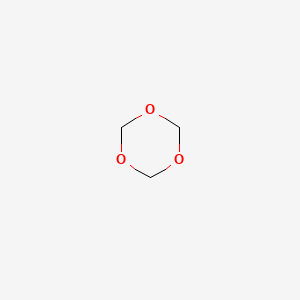
1,3,5-Trioxane
1,3,5-trioxane is a saturated organic heteromonocyclic parent that is cyclohexane in which the carbon atoms at positions 1, 3 and 5 are replaced by oxygen atoms. It is a saturated organic heteromonocyclic parent and a trioxane. — ChEBI
- IUPAC 명칭
- 1,3,5-trioxane
- 분자식
- C3H6O3
- 분자량
- 90.08 g/mol
- 정확한 질량
- 90.031694049 Da
- XLogP3
- -0.4
- 위상 극성 표면적
- 27.7 Ų
- 수소 결합 공여체
- 0
- 수소 결합 수용체
- 3
- 공유결합 단위
- 1
- 정의된 입체중심
- 0
다른 이름
보고된 명칭 16개 더 보기
외부 데이터베이스 식별자
- ChEBI:CHEBI:38043
- ChEMBL:CHEMBL1495792
- EPA DTXSID:DTXSID4021925
- PubMed:22900670
- PubMed:22891714
- PubMed:22508175
- PubMed:22412563
- PubMed:22348155
- PubMed:22272074
- PubMed:22242847
- PubMed:22228647
- PubMed:22174561
- PubMed:22122827
- PubMed:22029231
- PubMed:21904628
추가 과학 데이터베이스의 근거
NIH PubChem PUG-View
Attributed physical-property, hazard, environmental and use annotations.
- Autoignition Temperature: 777 °F (NTP, 1992) 출처: CAMEO Chemicals
- Autoignition Temperature: 777 °F 출처: Hazardous Substances Data Bank (HSDB)
- Boiling Point: 238.1 °F at 759 mmHg (NTP, 1992) 출처: CAMEO Chemicals
- Boiling Point: 114.5 °C @ 759 MM HG 출처: Hazardous Substances Data Bank (HSDB)
- Color/Form: CRYSTALLINE SOLID 출처: Hazardous Substances Data Bank (HSDB)
- Color/Form: RHOMBIC NEEDLES FROM ETHER 출처: Hazardous Substances Data Bank (HSDB)
- Color/Form: WHITE 출처: Hazardous Substances Data Bank (HSDB)
- Density: 1.17 at 149 °F (NTP, 1992) - Denser than water; will sink 출처: CAMEO Chemicals
- Density: 1.17 @ 65 °C 출처: Hazardous Substances Data Bank (HSDB)
- Flash Point: 113 °F (NTP, 1992) 출처: CAMEO Chemicals
- Flash Point: 45 °C 출처: Haz-Map, Information on Hazardous Chemicals and Occupational Diseases
- Flash Point: 45 °C 출처: Hazardous Substances Data Bank (HSDB)
- Melting Point: 147 °F (NTP, 1992) 출처: CAMEO Chemicals
- Melting Point: 64 °C 출처: Hazardous Substances Data Bank (HSDB)
- Odor: CHARACTERISTIC CHLOROFORM-LIKE ODOR 출처: Hazardous Substances Data Bank (HSDB)
- Physical Description: Transparent crystals or white crystalline solid with a pleasant odor resembling the odor of chloroform. Melts at 62 °C; boils at 115 °C without polymerization. The cyclic trimer of formaldehyde. 출처: CAMEO Chemicals
- Physical Description: Large Crystals; Other Solid 출처: EPA Chemical Data Reporting (CDR)
- Physical Description: White solid with a chloroform-like odor; [HSDB] White crystalline powder; [MSDSonline] 출처: Haz-Map, Information on Hazardous Chemicals and Occupational Diseases
- Solubility: greater than or equal to 100 mg/mL at 68 °F (NTP, 1992) 출처: CAMEO Chemicals
- Solubility: SOL IN WATER: 17.2 G/100 ML @ 18 °C, 21.2 @ 25 °C; EASILY SOL IN ALC, KETONES, ETHER, ACETONE, ORG SOLVENTS, CHLORINATED & AROMATIC HYDROCARBONS; SLIGHTLY SOL IN PENTANE, PETROLEUM ETHER, LOWER PARAFFINS 출처: Hazardous Substances Data Bank (HSDB)
- Solubility: SOL IN BENZENE, CARBON TETRACHLORIDE, CHLOROFORM, CARBON DISULFIDE 출처: Hazardous Substances Data Bank (HSDB)
- Vapor Pressure: 13 mmHg at 77 °F (NTP, 1992) 출처: CAMEO Chemicals
- Vapor Pressure: 13.0 [mmHg] 출처: Haz-Map, Information on Hazardous Chemicals and Occupational Diseases
- First Aid: EYES: First check the victim for contact lenses and remove if present. Flush victim's eyes with water or normal saline solution for 20 to 30 minutes while simultaneously calling a hospital or poison control center. Do not put any ointments, oils, or medication in the victim's eyes without specific instructions from a physician. IMMEDIATELY transport the victim after flushing eyes to a hospital even if no symptoms (such as redness or irritation) develop.; SKIN: IMMEDIATELY flood affected skin with water while removing and isolating all contaminated clothing. Gently wash all affected skin areas thoroughly with soap and water. If symptoms such as redness or irritation develop, IMMEDIATELY call a physician and be prepared to transport the victim to a hospital for treatment.; INHALATION: IMMEDIATELY leave the contaminated area; take deep breaths of fresh air. If symptoms (such as wheezing, coughing, shortness of breath, or burning in the mouth, throat, or chest) develop, call a physician and be prepared to transport the victim to a hospital. Provide proper respiratory protection to rescuers entering an unknown atmosphere. Whenever possible, Self-Contained Breathing Apparatus (SCBA) shou 출처: CAMEO Chemicals
- Signal: Danger 출처: Regulation (EC) No 1272/2008 of the European Parliament and of the Council
- GHS Hazard Statements: H228: Flammable solid [Danger Flammable solids]; H335: May cause respiratory irritation [Warning Specific target organ toxicity, single exposure; Respiratory tract irritation]; H361d ***: Suspected of damaging the unborn child [Warning Reproductive toxicity] 출처: Regulation (EC) No 1272/2008 of the European Parliament and of the Council
- Precautionary Statement Codes: P203, P210, P240, P241, P261, P271, P280, P304+P340, P318, P319, P370+P378, P403+P233, P405, and P501 (click each P-code to see the statement) 출처: Regulation (EC) No 1272/2008 of the European Parliament and of the Council
- Signal: Danger 출처: European Chemicals Agency (ECHA)
- GHS Hazard Statements: H228 (100%): Flammable solid [Danger Flammable solids]; H335 (100%): May cause respiratory irritation [Warning Specific target organ toxicity, single exposure; Respiratory tract irritation]; H361 (99.3%): Suspected of damaging fertility or the unborn child [Warning Reproductive toxicity] 출처: European Chemicals Agency (ECHA)
- Precautionary Statement Codes: P203, P210, P240, P241, P261, P271, P280, P304+P340, P318, P319, P370+P378, P403+P233, P405, and P501 (click each P-code to see the statement) 출처: European Chemicals Agency (ECHA)
- ECHA C&L Notifications Summary: Aggregated GHS information provided per 285 reports by companies from 14 notifications to the ECHA C&L Inventory. Each notification may be associated with multiple companies.; Information may vary between notifications depending on impurities, additives, and other factors. The percentage value in parenthesis indicates the notified classification ratio from companies that provide hazard codes. Only hazard codes with percentage values above 10% are shown. For more detailed information, please visit ECHA C&L website. 출처: European Chemicals Agency (ECHA)
- Signal: Danger 출처: NITE-CMC
- GHS Hazard Statements: H228: Flammable solid [Danger Flammable solids]; H370: Causes damage to organs [Danger Specific target organ toxicity, single exposure]; H372: Causes damage to organs through prolonged or repeated exposure [Danger Specific target organ toxicity, repeated exposure] 출처: NITE-CMC
- Precautionary Statement Codes: P210, P240, P241, P260, P264, P270, P280, P308+P316, P319, P321, P370+P378, P405, and P501 (click each P-code to see the statement) 출처: NITE-CMC
- GHS Hazard Statements: H336: May cause drowsiness or dizziness [Warning Specific target organ toxicity, single exposure; Narcotic effects]; H360: May damage fertility or the unborn child [Danger Reproductive toxicity]; H373: May causes damage to organs through prolonged or repeated exposure [Warning Specific target organ toxicity, repeated exposure] 출처: NITE-CMC
- Precautionary Statement Codes: P203, P260, P261, P271, P280, P304+P340, P318, P319, P403+P233, P405, and P501 (click each P-code to see the statement) 출처: NITE-CMC
- NFPA Health Rating: 2 - Materials that, under emergency conditions, can cause temporary incapacitation or residual injury. 출처: Hazardous Substances Data Bank (HSDB)
- NFPA Fire Rating: 2 - Materials that must be moderately heated or exposed to relatively high ambient temperatures before ignition can occur. Materials would not under normal conditions form hazardous atmospheres with air, but under high ambient temperatures or under moderate heating could release vapor in sufficient quantities to produce hazardous atmospheres with air. 출처: Hazardous Substances Data Bank (HSDB)
- NFPA Instability Rating: 0 - Materials that in themselves are normally stable, even under fire conditions. 출처: Hazardous Substances Data Bank (HSDB)
- Consumer Uses: Intermediate 출처: EPA Chemical Data Reporting (CDR)
- Industry Uses: Monomers; Intermediate 출처: EPA Chemical Data Reporting (CDR)
- Sources/Uses: Used for organic synthesis, as a disinfectant, and in fuel; [Hawley] 출처: Haz-Map, Information on Hazardous Chemicals and Occupational Diseases
- Industrial Processes with risk of exposure: Using Disinfectants or Biocides [Category: Clean] 출처: Haz-Map, Information on Hazardous Chemicals and Occupational Diseases
- Uses: ORG SYNTHESIS; DISINFECTANT; NONLUMINOUS, ODORLESS FUEL 출처: Hazardous Substances Data Bank (HSDB)
매핑 기준: Existing checksum-valid CAS to unique PubChem CID match. 가져온 시각: 2026-08-31. 출처 기록 열기
과학적 분류와 유해성 주석은 맥락을 제공할 뿐이며, 위에 표시된 시장별 규제 판단을 대체하지 않습니다.
추가 출처 적용 범위 및 일치 상태
| 출처 | 결과 | 확인됨 |
|---|---|---|
| NIH PubChem PUG-View | 정확히 일치 | 2026-08-31 |
기록된 불일치는 출처를 확인했다는 유용한 근거이며, 해당 물질이 다른 곳에 존재하지 않는다는 주장이 아닙니다.
체크섬이 유효한 CAS 일치를 통해 2026-09-02에 NIH PubChem에서 가져왔습니다. 화학적 특성은 이 페이지의 규제 판단을 대체하지 않습니다.
Trioxymethylene (1,3,5-Trioxan)의 관련 기록
이 기록에 직접 일치하는 항목이 제한적이어서, 부속서 II의 인접 항목도 함께 표시합니다.
N,N-Dimethylanilinium tetrakis(pentafluorophenyl)borate
Trioxymethylene (1,3,5-Trioxan)에 대한 부속서 II의 의미
Trioxymethylene (1,3,5-Trioxan)은(는) EU 화장품 규정 1223/2009 부속서 II에 따라 사용금지 물질로 등재되어 있으며 의도적으로 첨가해서는 안 됩니다. 제17조는 별도로, 우수화장품제조관리기준(GMP)에 따라 기술적으로 피할 수 없고 제3조의 안전 요건에 부합하는 비의도적 미량에 대해 다룹니다.
처방 개발자는 원료와 원재료를 선별하여 이 물질이 들어 있지 않은지 확인해야 합니다. 공급업체는 요청 시 부재를 확인하는 문서를 제공해야 합니다.
또한 이 페이지에는 식별자, 부속서 논리 또는 명칭 패턴이 겹치는 관련 부속서 기록 12건이 표시됩니다.
규제 준수 체크리스트
- 이 물질이 모든 원료와 완제품 처방에 없는지 확인하세요.
- 원료 공급업체에 부재 확인서 또는 CoA를 요청하세요.
- 선별 결과를 제품정보파일(PIF)에 기록하세요.
- 이 물질은 CMR로 분류되어 있습니다. 사용 전에 위의 CMR 표를 검토하고 현재 부속서 II/III 상태를 확인하세요.