
Methylphenidate (INN) and its salts
Listed by the Saudi Food and Drug Authority as prohibited in cosmetic products.
Décision réglementaire et conditions complètes
- Statut
- Prohibited
- Rôle juridique
- Binding rule
- Résumé réglementaire
- Listed by the Saudi Food and Drug Authority as prohibited in cosmetic products.
- Conditions et restrictions
- A prohibition entry may contain no separate condition text because the regulatory outcome is the prohibition itself. Ouvrez la source citée et appliquez les exigences applicables à l’ensemble du marché ci-dessous.
Identité de la substance
- Nom dans la source officielle
- Methylphenidate (INN) and its salts
- CAS
- 113-45-1
- EC
- Not supplied in this source row
- Correspondance d’identité
- standalone:official_sfda_record
Aperçu multi-marchés pour cette identité
Fiches exactes associées actuellement présentes sur ce site. L’absence d’un marché signifie qu’aucune correspondance exacte n’a été importée, et non une autorisation d’utiliser la substance.
European Union
1 fiche associée
Ouvrir la fiche justificativeGreat Britain
1 fiche associée
Ouvrir la fiche justificativeCanada
1 fiche associée
Ouvrir la fiche justificativeNew Zealand
1 fiche associée
Ouvrir la fiche justificativeASEAN
1 fiche associée
Ouvrir la fiche justificativeChina
1 fiche associée · 1 avec conditions spécifiques
Ouvrir la fiche justificativeSouth Korea
1 fiche associée · 1 avec conditions spécifiques
Ouvrir la fiche justificativeBrazil
1 fiche associée · 1 avec conditions spécifiques
Ouvrir la fiche justificativeIndia
1 fiche associée · 1 avec conditions spécifiques
Ouvrir la fiche justificativeSaudi Arabia
Fiche actuelle1 fiche associée
Ouvrir la fiche justificative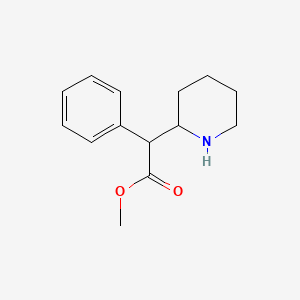
Chimie vérifiée pour le CAS 113-45-1
Methylphenidate
Methyl phenyl(piperidin-2-yl)acetate is a amino acid ester that is methyl phenylacetate in which one of the hydrogens alpha to the carbonyl group is replaced by a piperidin-2-yl group. It is a methyl ester, a member of piperidines and a beta-amino acid ester. — ChEBI
- Nom IUPAC
- methyl 2-phenyl-2-piperidin-2-ylacetate
- Formule moléculaire
- C14H19NO2
- Masse moléculaire
- 233.31 g/mol
- Masse exacte
- 233.141578849 Da
- Masse monoisotopique
- 233.141578849 Da
- XLogP3
- 0,2
- Surface polaire topologique
- 38,3 Ų
- Complexité moléculaire
- 249,0
- Charge formelle
- 0
- Donneurs de liaisons hydrogène
- 1
- Accepteurs de liaisons hydrogène
- 3
- Liaisons rotatives
- 4
- Atomes lourds
- 17
- Unités covalentes
- 1
Noms et synonymes signalés à PubChem
16 autres noms signalés
Identifiants de bases de données externes
Statistiques de structure avancées
- Stéréocentres atomiques définis
- 0
- Stéréocentres atomiques non définis
- 2
- Stéréocentres de liaison définis
- 0
- Stéréocentres de liaison non définis
- 0
- Caractéristiques pharmacophoriques 3D
- 5
- Cycles 3D
- 2
- Groupes hydrophobes 3D
- 0
- Caractéristiques d’accepteur 3D
- 1
- Caractéristiques de donneur 3D
- 1
- Centres anioniques 3D
- 0
- Centres cationiques 3D
- 1
- Conformères 3D
- 10
- Rotors 3D effectifs
- 5,2
Identifiants de structure lisibles par machine
- SMILES
COC(=O)C(C1CCCCN1)C2=CC=CC=C2- InChI
InChI=1S/C14H19NO2/c1-17-14(16)13(11-7-3-2-4-8-11)12-9-5-6-10-15-12/h2-4,7-8,12-13,15H,5-6,9-10H2,1H3- InChIKey
DUGOZIWVEXMGBE-UHFFFAOYSA-N
Preuves issues de bases de données scientifiques complémentaires
NIH PubChem PUG-View
Attributed physical-property, hazard, environmental and use annotations.
- Boiling Point: BP: 135 to 137 °C at 0.6 mm Hg Source: Hazardous Substances Data Bank (HSDB)
- Color/Form: Crystals from ethanol (aqueous) Source: Hazardous Substances Data Bank (HSDB)
- Dissociation Constants: pKa = 8.9 Source: Hazardous Substances Data Bank (HSDB)
- Dissociation Constants: pKa = 8.77 Source: Hazardous Substances Data Bank (HSDB)
- LogP: log Kow = 0.20 at pH 7.2 Source: Hazardous Substances Data Bank (HSDB)
- LogP: 2.1 Source: Human Metabolome Database (HMDB)
- Melting Point: 74-75 °C Source: Hazardous Substances Data Bank (HSDB)
- Melting Point: 224 - 226 °C Source: Human Metabolome Database (HMDB)
- Physical Description: Solid Source: Human Metabolome Database (HMDB)
- Solubility: 1255mg/L Source: DrugBank
- Solubility: Practically insoluble in water Source: Hazardous Substances Data Bank (HSDB)
- Solubility: Soluble in alcohol, ethyl acetate, ether; practically insoluble in petroleum ether Source: Hazardous Substances Data Bank (HSDB)
- Solubility: 1.82e-01 g/L Source: Human Metabolome Database (HMDB)
- Carcinogen Classification: No indication of carcinogenicity to humans (not listed by IARC). Source: Toxin and Toxin Target Database (T3DB)
- Exposure Routes: Oral. Readily absorbed in a biphasic manner when orally administered (tablets) to children diagnosed with ADHD and to healthy adults. In children and adults males, after administration of a single oral dose of Ritalin LA and Ritalin given in two doses 4 hours apart, peak plasma concentration is reached approximately 2 hours for the first phase and 5-6 hours for the second phase. The absolute oral bioavailability of methylphenidate in children was 22±8% for d-methylphenidate and 5±3% for l-methylphenidate. These low values suggest that methylphenidate is highly metabolized presystemically. Source: Toxin and Toxin Target Database (T3DB)
- Signal: Warning Source: European Chemicals Agency (ECHA)
- GHS Hazard Statements: H302 (100%): Harmful if swallowed [Warning Acute toxicity, oral]; H315 (100%): Causes skin irritation [Warning Skin corrosion/irritation]; H319 (100%): Causes serious eye irritation [Warning Serious eye damage/eye irritation]; H341 (100%): Suspected of causing genetic defects [Warning Germ cell mutagenicity] Source: European Chemicals Agency (ECHA)
- Precautionary Statement Codes: P203, P264, P264+P265, P270, P280, P301+P317, P302+P352, P305+P351+P338, P318, P321, P330, P332+P317, P337+P317, P362+P364, P405, and P501 (click each P-code to see the statement) Source: European Chemicals Agency (ECHA)
- ECHA C&L Notifications Summary: The GHS information provided by 1 company from 1 notification to the ECHA C&L Inventory. Source: European Chemicals Agency (ECHA)
- Signal: Danger Source: Hazardous Substances Data Bank (HSDB)
- GHS Hazard Statements: H302: Harmful if swallowed [Warning Acute toxicity, oral]; H334: May cause allergy or asthma symptoms or breathing difficulties if inhaled [Danger Sensitization, respiratory] Source: Hazardous Substances Data Bank (HSDB)
- Precautionary Statement Codes: P233, P260, P264, P270, P271, P284, P301+P317, P304+P340, P330, P342+P316, P403, and P501 (click each P-code to see the statement) Source: Hazardous Substances Data Bank (HSDB)
- Health Effects: Using large amounts of these drugs can result in a condition known as amphetamine psychosis -- which can result in auditory, visual and tactile hallucinations, intense paranoia, irrational thoughts and beliefs, delusions, and mental confusion. Source: Toxin and Toxin Target Database (T3DB)
- Toxicity Summary: IDENTIFICATION AND USE: Methylphenidate Hydrochloride is a psychostimulant used to treat different behavioral disorders. Indications: Used to treat narcolepsy and hyperkinetic states in children (as an adjunct to psychological, educational and social measures) for amphetamine, dextroamphetamine and ethylphenidate. It is misused for performance enhancement and relief of fatigue. Abuse either orally or by injection is extremely common. HUMAN EXPOSURE AND TOXICITY: Main risks include: Acute central nervous system (CNS) stimulation, cardiotoxicity causing tachycardia, arrhythmias, hypertension and cardiovascular collapse. High risk of dependency and abuse. Cardiovascular effects include: palpitation, chest pain, tachycardia, arrhythmias and hypertension; cardiovascular collapse can occur in severe poisoning. Myocardial ischemia, infarction and ventricular dysfunction are described. CNS effects include: stimulation of CNS, tremor, restlessness, agitation, insomnia, increased motor activity, headache, convulsions, coma and hyperreflexia. Stroke and cerebral vasculitis have been observed. Gastrointestinal effects include: vomiting, diarrhea and cramps. Genitourinary effects include: incre Source: Hazardous Substances Data Bank (HSDB)
- Toxicity Summary: The first step in a medication overdose is to immediately contact a poison control center for the appropriate management steps. Doses that exceed 60 mg of the immediate-release formulation or 120 mg of the extended-release formulation can be considered toxic. If the overdosed quantity is unknown, the patient should be assessed for signs and symptoms such as tremors, hyperreflexia, convulsions, euphoria, confusion, hallucinations, delirium, flushing, and fever, in addition to the common adverse effects mentioned above. Supportive care with supplemental oxygen, intravenous fluids, and external cooling methods is the mainstay of treatment. Multiple studies have shown that benzodiazepines are an option, especially if dystonia, agitation, or convulsions are present. Source: StatPearls
- Toxicity Summary: Methylphenidate blocks dopamine uptake in central adrenergic neurons by blocking dopamine transport or carrier proteins. Methylphenidate acts at the brain stem arousal system and the cerebral cortex and causes increased sympathomimetic activity in the central nervous system. Alteration of serotonergic pathways via changes in dopamine transport may result. Source: Toxin and Toxin Target Database (T3DB)
- Environmental Bioconcentration: An estimated BCF of 3 was calculated in fish for methylphenidate(SRC), using a log Kow of 0.20(1) and a regression-derived equation(2). According to a classification scheme(2), this BCF suggests the potential for bioconcentration in aquatic organisms is low(SRC). Source: Hazardous Substances Data Bank (HSDB)
- Environmental Fate: TERRESTRIAL FATE: Based on a classification scheme(1), an estimated Koc value of 1600(SRC), determined from a structure estimation method(2), indicates that methylphenidate is expected to have low mobility in soil(SRC). The pKa of methylphenidate is 8.9(3), indicating that this compound will exist partially in the cation form in the environment and cations generally adsorb more strongly to soils containing organic carbon and clay than their neutral counterparts(4). Volatilization of the neutral species of methylphenidate from moist soil surfaces is not expected to be an important fate process(SRC) given an estimated Henry's Law constant of 4.4X10⁻⁹ atm-cu m/mole(SRC), using a fragment constant estimation method(5). Methylphenidate is not expected to volatilize from dry soil surfaces(SRC) based upon an estimated vapor pressure of 5.9X10⁻⁵ mm Hg at 25 °C(SRC), determined from a fragment constant method(2). Biodegradation data in soil were not available(SRC, 2015). Source: Hazardous Substances Data Bank (HSDB)
- Environmental Fate: AQUATIC FATE: Based on a classification scheme(1), an estimated Koc value of 1600(SRC), determined from a structure estimation method(2), indicates that methylphenidate is expected to adsorb to suspended solids and sediment(SRC). Volatilization of the neutral species from water surfaces is not expected(3) based upon an estimated Henry's Law constant of 4.4X10⁻⁹ atm-cu m/mole(SRC), developed using a fragment constant estimation method(4). A pKa of 8.9(5) indicates methylphenidate will exist partially in the cation form at pH values of 5 to 9 and, therefore, volatilization from water surfaces is not expected to be an important fate process(SRC). According to a classification scheme(6), an estimated BCF of 3(SRC), from its log Kow of 0.20(7) and a regression-derived equation(2), suggests the potential for bioconcentration in aquatic organisms is low(SRC). Base-catalyzed second-order hydrolysis rate constant half-lives of 23 and 2.3 years at pH values of 7 and 8, respectively(2), suggest that hydrolysis may be a slow environmental fate process. Biodegradation data in water were not available(SRC, 2015). Source: Hazardous Substances Data Bank (HSDB)
- Environmental Fate: ATMOSPHERIC FATE: According to a model of gas/particle partitioning of semivolatile organic compounds in the atmosphere(1), methylphenidate, which has an estimated vapor pressure of 5.9X10⁻⁵ mm Hg at 25 °C(SRC), determined from a fragment constant method(2), will exist in both the vapor and particulate phases in the ambient atmosphere. Vapor-phase methylphenidate is degraded in the atmosphere by reaction with photochemically-produced hydroxyl radicals(SRC); the half-life for this reaction in air is estimated to be 1 hr(SRC), calculated from its rate constant of 1.1X10⁻¹⁰ cu cm/molecule-sec at 25 °C(SRC) that was derived using a structure estimation method(3). Particulate-phase methylphenidate may be removed from the air by wet and dry deposition(SRC). Methylphenidate contains chromophores that absorb at wavelengths >290 nm(4) and, therefore, may be susceptible to direct photolysis by sunlight(SRC). Source: Hazardous Substances Data Bank (HSDB)
- Uses: Methylphenidate (DEA Code Number: 1724) is a Schedule II controlled substance. Source: Hazardous Substances Data Bank (HSDB)
- Uses: Schedule II Controlled Substance: (A) The drug or other substance has a high potential for abuse; (B) The drug or other substance has a currently accepted medical use in treatment in the United States or a currently accepted medical use with severe restrictions; and (C) Abuse of the drug or other substances may lead to severe psychological or physical dependence. Source: Hazardous Substances Data Bank (HSDB)
- Uses: MEDICATION (VET) Source: Hazardous Substances Data Bank (HSDB)
- Uses: MEDICATION Source: Hazardous Substances Data Bank (HSDB)
- Uses: Central Nervous System Stimulants; Dopamine Uptake Inhibitors Source: Hazardous Substances Data Bank (HSDB)
- Uses: Use (kg) in Switzerland (2009): >250; Use (kg; approx.) in Germany (2009): >1000; Use (kg) in USA (2002): 9090; Consumption (g per capita) in Switzerland (2009): 0.032; Consumption (g per capita; approx.) in Germany (2009): 0.012; Consumption (g per capita) in the USA (2002): 0.032; Excretion rate: 0.1; Calculated removal (%): 92.1 Source: NORMAN Suspect List Exchange
- Uses: For use as an integral part of a total treatment program which typically includes other remedial measures (psychological, educational, social) for a stabilizing effect in children with a behavioral syndrome characterized by the following group of developmentally inappropriate symptoms: moderate-to-severe distractibility, short attention span, hyperactivity, emotional lability, and impulsivity. Source: Toxin and Toxin Target Database (T3DB)
Mis en correspondance par: Existing checksum-valid CAS to unique PubChem CID match. Récupéré le: 2026-08-31. Ouvrir la fiche source
Les classifications scientifiques et les annotations de danger apportent du contexte et ne remplacent pas la décision réglementaire propre au marché indiquée ci-dessus.
Couverture des sources complémentaires et état des correspondances
| Source | Résultat | Vérifié |
|---|---|---|
| NIH PubChem PUG-View | Correspondance exacte | 2026-08-31 |
Une absence de correspondance enregistrée est une preuve utile que la source a été vérifiée ; ce n’est pas l’affirmation que la substance n’existe pas ailleurs.
Récupéré depuis NIH PubChem le 2026-09-02 par correspondance CAS à somme de contrôle valide. Les propriétés chimiques ne remplacent pas la décision réglementaire de cette page.
Source officielle et provenance
- Source enregistrée
- Saudi SFDA prohibited and restricted ingredient lists
- Référence de la source
- SFDA prohibited list, page 18, row 7
- Identifiant de la fiche source
prohibited-17-7- Version de la source
- live-snapshot-2026-08-30
- Langue de la source
- English
- État de la traduction
- Original is English
- Instantané vérifié le
- 2026-08-30 05:18 UTC
- Méthode de validation
- complete SFDA paginated HTML snapshot; strict page/row counts
- SHA-256
ceb6cc636e6b1f4b3013f88ce0297217b49d6194342c6ece5c03b1e04256d71a
Notes du jeu de données enregistré
- Couverture du jeu de données
- Prohibited and restricted substances with CAS, EC and conditions
- Note sur l’autorité
- Official SFDA dated lists; version and hash each release
Place de cette fiche dans le jeu de données du marché
Répartition des statuts
Un texte de conditions est présent pour 0 des 2090 fiches actuelles. Un champ de conditions vide est interprété selon le type de fiche ci-dessus ; il n’est jamais converti en une affirmation d’utilisation sans restriction.
Saudi Arabia contexte du marché
Complete official list index
Version de la couverture : SFDA live prohibited/restricted lists, snapshot 30 August 2026
Every page and entry in the public SFDA prohibited and restricted ingredient indexes; restricted detail pages remain the source for conditions.
Liste de contrôle de vérification
- Search names and CAS across both SFDA lists.
- Open the cited restricted-entry detail and apply every condition.
- Check current SFDA/GSO technical regulations and updates.
- Complete eCosma notification, label and responsible-party requirements.
Sources officielles du marché
- Saudi SFDA prohibited and restricted ingredient listsOfficial SFDA dated lists; version and hash each release
Procédure de vérification et exhaustivité de la fiche
Avant d’utiliser ce résultat dans une décision de conformité
- Confirmez que « Methylphenidate (INN) and its salts » et chaque identifiant CAS/CE correspondent à la matière de votre spécification fournisseur.
- Search names and CAS across both SFDA lists.
- Open the cited restricted-entry detail and apply every condition.
- Check current SFDA/GSO technical regulations and updates.
- Complete eCosma notification, label and responsible-party requirements.
- Consignez la version de la source et revérifiez auprès de l’autorité de réglementation avant la fabrication, la notification ou la mise sur le marché.
Champs disponibles dans cette fiche
- Nom officiel de la substanceDisponible
- CASDisponible
- ECNon fourni
- Texte de condition distinctAbsent de la ligne source
- Date d’effetNon fourni
- Empreinte de l’instantané et méthodeDisponible
Questions auxquelles cette page répond
Citation stable
Methylphenidate (INN) and its salts. SFDA prohibited list, page 18, row 7. Saudi Arabia. Source version live-snapshot-2026-08-30. CosIng Checker regulatory record: https://cosingchecker.com/fr/regulations/sa/records/9776/
Citez l’autorité de réglementation comme autorité juridique. Cette page est un index structuré de preuves et une aide à la vérification, et non un substitut au texte officiel ni à une évaluation juridique professionnelle.
Interprétation et limites pour Saudi Arabia
This official record identifies the substance as prohibited for cosmetic use in the stated market scope.
Do not rely on a formulation containing this identity until the cited source, effective date and exact substance match have been verified.
Comment interpréter le rôle juridique
The cited row forms part of a binding rule or legally incorporated list for this market.
Preuves sur cette page
- Résultat enregistré : Prohibited
- Rôle juridique : Binding rule
- Version de la source : live-snapshot-2026-08-30
Ce que cela ne prouve pas
No list match is not permission; Gulf/SFDA product, claim, notification and technical requirements still apply.
Recherche complémentaire sur la substance auprès de sources faisant autorité
Aucune de ces sources ne prévaut sur la décision de marché ci-dessus.
Cosmetic Ingredient Review safety assessments
Expert Panel conclusions, assessed ingredient groups, use conditions, dates and report documents
Independent expert review considered by FDA; not a government approval or binding market rule
Rechercher cette identité à la sourceFDA Global Substance Registration System
UNII identifiers, preferred names, substance types, codes and public substance relationships
Identity registry only; UNII availability does not imply FDA review or approval
Rechercher cette identité à la sourceILO/WHO International Chemical Safety Cards
Hazards, symptoms, first aid, storage, incompatibilities and physical properties for covered chemicals
International occupational chemical-safety reference; not cosmetic-use approval
Rechercher cette identité à la sourceJapan NITE-CHRIP
Chemical identity, Japanese and foreign legal lists, GHS hazards and exposure-related information
Chemical-management evidence; cosmetic status remains governed by the applicable MHLW standard and market rules
Rechercher cette identité à la sourceNIOSH Pocket Guide to Chemical Hazards
REL, PEL, IDLH, properties, exposure routes, symptoms, target organs, first aid and measurement methods for covered workplace chemicals
US occupational-health guidance and limits; not a cosmetic ingredient decision
Rechercher cette identité à la sourceOECD eChemPortal
Gateway to authority-owned physical-property, fate, ecotoxicity, toxicity, exposure and GHS records
Discovery gateway; each linked authority remains responsible for its data
Rechercher cette identité à la sourceUS EPA CompTox CTX APIs
Clé d’API requise pour l’importDTXSID identity, experimental and predicted properties, toxicity, bioactivity, exposure and environmental data
Scientific and computational evidence; predictions must remain labelled and do not determine cosmetic legality
Rechercher cette identité à la source