
Pentachlorophenol [1]; Sodium pentachlorophenolate [2]; Potassium pentachlorophenolate [3]
Listed by the Saudi Food and Drug Authority as prohibited in cosmetic products.
Décision réglementaire et conditions complètes
- Statut
- Prohibited
- Rôle juridique
- Binding rule
- Résumé réglementaire
- Listed by the Saudi Food and Drug Authority as prohibited in cosmetic products.
- Conditions et restrictions
- A prohibition entry may contain no separate condition text because the regulatory outcome is the prohibition itself. Ouvrez la source citée et appliquez les exigences applicables à l’ensemble du marché ci-dessous.
Identité de la substance
- Nom dans la source officielle
- Pentachlorophenol [1]; Sodium pentachlorophenolate [2]; Potassium pentachlorophenolate [3]
- CAS
- 87-86-5; 131-52-2; 7778-73-6
- EC
- Not supplied in this source row
- Correspondance d’identité
- standalone:official_sfda_record
Aperçu multi-marchés pour cette identité
Fiches exactes associées actuellement présentes sur ce site. L’absence d’un marché signifie qu’aucune correspondance exacte n’a été importée, et non une autorisation d’utiliser la substance.
European Union
1 fiche associée
Ouvrir la fiche justificativeGreat Britain
1 fiche associée
Ouvrir la fiche justificativeNew Zealand
3 fiches associées
Ouvrir la fiche justificativeASEAN
2 fiches associées
Ouvrir la fiche justificativeChina
1 fiche associée · 1 avec conditions spécifiques
Ouvrir la fiche justificativeSouth Korea
1 fiche associée · 1 avec conditions spécifiques
Ouvrir la fiche justificativeBrazil
2 fiches associées · 2 avec conditions spécifiques
Ouvrir la fiche justificativeIndia
1 fiche associée · 1 avec conditions spécifiques
Ouvrir la fiche justificativeSaudi Arabia
Fiche actuelle1 fiche associée
Ouvrir la fiche justificative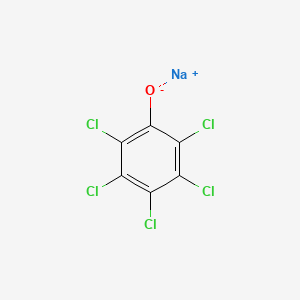
Chimie vérifiée pour le CAS 131-52-2
Sodium pentachlorophenolate
Sodium pentachlorophenate is a white or tan, powdered solid. It is soluble in water and may burn, but it is not easily ignited. It may be toxic by ingestion, inhalation and skin absorption. It is used as a fungicide, herbicide and as a disinfectant. — CAMEO Chemicals
- Nom IUPAC
- sodium 2,3,4,5,6-pentachlorophenolate
- Formule moléculaire
- C6Cl5NaO
- Masse moléculaire
- 288.3 g/mol
- Masse exacte
- 287.825997 Da
- Masse monoisotopique
- 285.828947 Da
- Surface polaire topologique
- 23,1 Ų
- Complexité moléculaire
- 155,0
- Charge formelle
- 0
- Donneurs de liaisons hydrogène
- 0
- Accepteurs de liaisons hydrogène
- 1
- Liaisons rotatives
- 0
- Atomes lourds
- 13
- Unités covalentes
- 2
Noms et synonymes signalés à PubChem
16 autres noms signalés
Identifiants de bases de données externes
- ChEMBL:CHEMBL3560394
- EPA DTXSID:DTXSID4040264
Statistiques de structure avancées
- Stéréocentres atomiques définis
- 0
- Stéréocentres atomiques non définis
- 0
- Stéréocentres de liaison définis
- 0
- Stéréocentres de liaison non définis
- 0
- Conformères 3D
- 0
Identifiants de structure lisibles par machine
- SMILES
C1(=C(C(=C(C(=C1Cl)Cl)Cl)Cl)Cl)[O-].[Na+]- InChI
InChI=1S/C6HCl5O.Na/c7-1-2(8)4(10)6(12)5(11)3(1)9;/h12H;/q;+1/p-1- InChIKey
HCJLVWUMMKIQIM-UHFFFAOYSA-M
Preuves issues de bases de données scientifiques complémentaires
NIH PubChem PUG-View
Attributed physical-property, hazard, environmental and use annotations.
- Boiling Point: Decomposes. (USCG, 1999) Source: CAMEO Chemicals
- Color/Form: White crystalline solid Source: Hazardous Substances Data Bank (HSDB)
- Color/Form: Tan powder, pellets Source: Hazardous Substances Data Bank (HSDB)
- Color/Form: Buff-colored flakes Source: Hazardous Substances Data Bank (HSDB)
- Density: 2.0 mg/L at 22 °C/4 °C Source: Hazardous Substances Data Bank (HSDB)
- LogP: log Kow = 1.3 at pH 10 Source: Hazardous Substances Data Bank (HSDB)
- Odor: Phenolic odor Source: Hazardous Substances Data Bank (HSDB)
- Physical Description: Sodium pentachlorophenate is a white or tan, powdered solid. It is soluble in water and may burn, but it is not easily ignited. It may be toxic by ingestion, inhalation and skin absorption. It is used as a fungicide, herbicide and as a disinfectant. Source: CAMEO Chemicals
- Physical Description: White or tan solid; [Hawley] Small slightly brown beads; [MSDSonline] Source: Haz-Map, Information on Hazardous Chemicals and Occupational Diseases
- Physical Description: WHITE OR TAN FLAKES OR POWDER WITH CHARACTERISTIC ODOUR. Source: ILO-WHO International Chemical Safety Cards (ICSCs)
- Solubility: In water, 3.30X10+5 mg/L at 25 °C Source: Hazardous Substances Data Bank (HSDB)
- Solubility: Solubility in water (g/L): 22.4 at 20 °C; 33 at 30 °C Source: Hazardous Substances Data Bank (HSDB)
- Solubility: Solubility at 25 °C (g/L): methanol 22; acetone 37 Source: Hazardous Substances Data Bank (HSDB)
- Solubility: 21% (wt/vol) at 5 °C (water), 29% (wt/vol) at 40 °C (water), 33% (wt/vol at 25 °C (water) Source: Hazardous Substances Data Bank (HSDB)
- Solubility: Soluble in ethanol and acetone; insoluble in benzene and petroleum oils Source: Hazardous Substances Data Bank (HSDB)
- Solubility: Solubility in water, g/100ml at 25 °C: 33 Source: ILO-WHO International Chemical Safety Cards (ICSCs)
- pH: Aqueous solution has alkaline reaction Source: Hazardous Substances Data Bank (HSDB)
- Carcinogen Classification: 2B, possibly carcinogenic to humans. (L135) Source: Toxin and Toxin Target Database (T3DB)
- Exposure Routes: The substance can be absorbed into the body by inhalation, through the skin and by ingestion. Source: ILO-WHO International Chemical Safety Cards (ICSCs)
- Exposure Routes: Oral (L127) ; inhalation (L127) ; dermal (L127) Source: Toxin and Toxin Target Database (T3DB)
- First Aid: Signs and Symptoms of Sodium Pentachlorophenate Exposure: Signs and symptoms of sodium pentachlorophenate exposure include skin irritation, irritation and burning of eyes, numbness and opacity of the cornea, upper respiratory tract irritation, pain in chest, coughing, sneezing, rapid breathing, difficulty in breathing, and bronchitis. Contact dermatitis may be observed after severe exposure. Profuse sweating, headache, weakness, loss of appetite, abdominal pain, nausea, cardiac dilatation, tachycardia (rapid heart beat), and cardiac failure may occur. High fever may be present, and exposed individual may experience an intense thirst, although this may be masked by nausea and vomiting. Declining alertness may progress to stupor, convulsions, and coma. Ingestion may be followed by delayed scar tissue formation, which may later cause problems with swallowing and stomach filling and emptying.; Emergency Life-Support Procedures: Acute exposure to sodium pentachlorophenate may require decontamination and life support for the victims. Emergency personnel should wear protective clothing appropriate to the type and degree of contamination. Air-purifying or supplied-air respiratory equipment Source: CAMEO Chemicals
- ERG2024, Guide 154 (Sodium pentachlorophenate): General First Aid:; · Call 911 or emergency medical service.; · Ensure that medical personnel are aware of the material(s) involved, take precautions to protect themselves and avoid contamination.; · Move victim to fresh air if it can be done safely.; · Administer oxygen if breathing is difficult.; · If victim is not breathing:; -- DO NOT perform mouth-to-mouth resuscitation; the victim may have ingested or inhaled the substance.; -- If equipped and pulse detected, wash face and mouth, then give artificial respiration using a proper respiratory medical device (bag-valve mask, pocket mask equipped with a one-way valve or other device).; -- If no pulse detected or no respiratory medical device available, provide continuous compressions. Conduct a pulse check every two minutes or monitor for any signs of spontaneous respirations.; · Remove and isolate contaminated clothing and shoes.; · For minor skin contact, avoid spreading material on unaffected skin.; · In case of contact with substance, remove immediately by flushing skin or eyes with running water for at least 20 minutes.; · For severe burns, immediate medical attention is required.; · Effects of exposure (inhalation, ingestion, Source: Emergency Response Guidebook (ERG)
- Signal: Danger Source: Regulation (EC) No 1272/2008 of the European Parliament and of the Council
- GHS Hazard Statements: H301: Toxic if swallowed [Danger Acute toxicity, oral]; H311: Toxic in contact with skin [Danger Acute toxicity, dermal]; H315: Causes skin irritation [Warning Skin corrosion/irritation]; H319: Causes serious eye irritation [Warning Serious eye damage/eye irritation]; H330: Fatal if inhaled [Danger Acute toxicity, inhalation]; H335: May cause respiratory irritation [Warning Specific target organ toxicity, single exposure; Respiratory tract irritation]; H351: Suspected of causing cancer [Warning Carcinogenicity]; H400: Very toxic to aquatic life [Warning Hazardous to the aquatic environment, acute hazard]; H410: Very toxic to aquatic life with long lasting effects [Warning Hazardous to the aquatic environment, long-term hazard] Source: Regulation (EC) No 1272/2008 of the European Parliament and of the Council
- Precautionary Statement Codes: P203, P260, P261, P262, P264, P264+P265, P270, P271, P273, P280, P284, P301+P316, P302+P352, P304+P340, P305+P351+P338, P316, P318, P319, P320, P321, P330, P332+P317, P337+P317, P361+P364, P362+P364, P391, P403+P233, P405, and P501 (click each P-code to see the statement) Source: Regulation (EC) No 1272/2008 of the European Parliament and of the Council
- Signal: Danger Source: European Chemicals Agency (ECHA)
- GHS Hazard Statements: H301+H311 (61.8%): Toxic if swallowed or in contact with skin [Danger Acute toxicity, oral; acute toxicity, dermal]; H301 (100%): Toxic if swallowed [Danger Acute toxicity, oral]; H311 (100%): Toxic in contact with skin [Danger Acute toxicity, dermal]; H315 (100%): Causes skin irritation [Warning Skin corrosion/irritation]; H319 (100%): Causes serious eye irritation [Warning Serious eye damage/eye irritation]; H330 (100%): Fatal if inhaled [Danger Acute toxicity, inhalation]; H335 (100%): May cause respiratory irritation [Warning Specific target organ toxicity, single exposure; Respiratory tract irritation]; H351 (100%): Suspected of causing cancer [Warning Carcinogenicity]; H400 (100%): Very toxic to aquatic life [Warning Hazardous to the aquatic environment, acute hazard]; H410 (100%): Very toxic to aquatic life with long lasting effects [Warning Hazardous to the aquatic environment, long-term hazard] Source: European Chemicals Agency (ECHA)
- Precautionary Statement Codes: P203, P260, P261, P262, P264, P264+P265, P270, P271, P273, P280, P284, P301+P316, P302+P352, P304+P340, P305+P351+P338, P316, P318, P319, P320, P321, P330, P332+P317, P337+P317, P361+P364, P362+P364, P391, P403+P233, P405, and P501 (click each P-code to see the statement) Source: European Chemicals Agency (ECHA)
- ECHA C&L Notifications Summary: Aggregated GHS information provided per 170 reports by companies from 4 notifications to the ECHA C&L Inventory. Each notification may be associated with multiple companies.; Information may vary between notifications depending on impurities, additives, and other factors. The percentage value in parenthesis indicates the notified classification ratio from companies that provide hazard codes. Only hazard codes with percentage values above 10% are shown. For more detailed information, please visit ECHA C&L website. Source: European Chemicals Agency (ECHA)
- Signal: Danger Source: NITE-CMC
- GHS Hazard Statements: H301: Toxic if swallowed [Danger Acute toxicity, oral]; H310: Fatal in contact with skin [Danger Acute toxicity, dermal]; H315: Causes skin irritation [Warning Skin corrosion/irritation]; H318: Causes serious eye damage [Danger Serious eye damage/eye irritation]; H330: Fatal if inhaled [Danger Acute toxicity, inhalation]; H350: May cause cancer [Danger Carcinogenicity]; H360: May damage fertility or the unborn child [Danger Reproductive toxicity]; H370: Causes damage to organs [Danger Specific target organ toxicity, single exposure]; H372: Causes damage to organs through prolonged or repeated exposure [Danger Specific target organ toxicity, repeated exposure] Source: NITE-CMC
- Precautionary Statement Codes: P203, P260, P262, P264, P264+P265, P270, P271, P280, P284, P301+P316, P302+P352, P304+P340, P305+P354+P338, P308+P316, P316, P317, P318, P319, P320, P321, P330, P332+P317, P361+P364, P362+P364, P403+P233, P405, and P501 (click each P-code to see the statement) Source: NITE-CMC
- GHS Hazard Statements: H301: Toxic if swallowed [Danger Acute toxicity, oral]; H310: Fatal in contact with skin [Danger Acute toxicity, dermal]; H315: Causes skin irritation [Warning Skin corrosion/irritation]; H319: Causes serious eye irritation [Warning Serious eye damage/eye irritation]; H330: Fatal if inhaled [Danger Acute toxicity, inhalation]; H351: Suspected of causing cancer [Warning Carcinogenicity]; H361: Suspected of damaging fertility or the unborn child [Warning Reproductive toxicity]; H371: May cause damage to organs [Warning Specific target organ toxicity, single exposure]; H372: Causes damage to organs through prolonged or repeated exposure [Danger Specific target organ toxicity, repeated exposure]; H373: May causes damage to organs through prolonged or repeated exposure [Warning Specific target organ toxicity, repeated exposure] Source: NITE-CMC
- Precautionary Statement Codes: P203, P260, P262, P264, P264+P265, P270, P271, P280, P284, P301+P316, P302+P352, P304+P340, P305+P351+P338, P308+P316, P316, P318, P319, P320, P321, P330, P332+P317, P337+P317, P361+P364, P362+P364, P403+P233, P405, and P501 (click each P-code to see the statement) Source: NITE-CMC
- Health Effects: Acute exposure to cholinesterase inhibitors can cause a cholinergic crisis characterized by severe nausea/vomiting, salivation, sweating, bradycardia, hypotension, collapse, and convulsions. Increasing muscle weakness is a possibility and may result in death if respiratory muscles are involved. Accumulation of ACh at motor nerves causes overstimulation of nicotinic expression at the neuromuscular junction. When this occurs symptoms such as muscle weakness, fatigue, muscle cramps, fasciculation, and paralysis can be seen. When there is an accumulation of ACh at autonomic ganglia this causes overstimulation of nicotinic expression in the sympathetic system. Symptoms associated with this are hypertension, and hypoglycemia. Overstimulation of nicotinic acetylcholine receptors in the central nervous system, due to accumulation of ACh, results in anxiety, headache, convulsions, ataxia, depression of respiration and circulation, tremor, general weakness, and potentially coma. When there is expression of muscarinic overstimulation due to excess acetylcholine at muscarinic acetylcholine receptors symptoms of visual disturbances, tightness in chest, wheezing due to bronchoconstriction, incre Source: Toxin and Toxin Target Database (T3DB)
- Toxicity Summary: Pentachlorophenol is a cholinesterase or acetylcholinesterase (AChE) inhibitor. A cholinesterase inhibitor (or 'anticholinesterase') suppresses the action of acetylcholinesterase. Because of its essential function, chemicals that interfere with the action of acetylcholinesterase are potent neurotoxins, causing excessive salivation and eye-watering in low doses, followed by muscle spasms and ultimately death. Nerve gases and many substances used in insecticides have been shown to act by binding a serine in the active site of acetylcholine esterase, inhibiting the enzyme completely. Acetylcholine esterase breaks down the neurotransmitter acetylcholine, which is released at nerve and muscle junctions, in order to allow the muscle or organ to relax. The result of acetylcholine esterase inhibition is that acetylcholine builds up and continues to act so that any nerve impulses are continually transmitted and muscle contractions do not stop. Among the most common acetylcholinesterase inhibitors are phosphorus-based compounds, which are designed to bind to the active site of the enzyme. The structural requirements are a phosphorus atom bearing two lipophilic groups, a leaving group (such a Source: Toxin and Toxin Target Database (T3DB)
- Environmental Bioconcentration: Rainbow trout exposed to waterborne sodium pentachlorophenate averaging 35 and 660 ng/L for about 115 days accumulated levels of pentachlorophenate that were related to the concentration and duration of exposure. Pentachlorophenate levels in organs (liver and gall bladder), the remaining fish, and the percent of total pentachlorophenate in the organs remained relatively uniform among the control fish over the 115 day period. Fish exposed to 35 ng/L contained slightly higher pentachlorophenate levels with a higher percentage found in the organs. The highest levels of pentachlorophenate occurred in fish exposed to 660 ng/L where concentration in the organs averaged 2200 ug/kg after 115 days. Thus, uptake from water is an important pathway for the accumulation of pentachlorophenate by rainbow trout. Source: Hazardous Substances Data Bank (HSDB)
- Environmental Fate: Pentachlorophenate disappeared from the water of microcosms simulating some of the characteristics of littoral zones during the first 6 wk after exposure to a single application of 41 ug/l (14)C-labeled sodium pentachlorophenate. Concn of inorganic (14)C in water samples increased during this period and subsequently declined. The total (14)C residues in the water declined approx 2% per day throughout the experiment and radioactive residues in macrophytes increased linearly between days 1 and 35, reaching concn greater than 700 times the initial concn in water. Concn of (14)C residues in macrophytes dropped rapidly after the 8th week of the experiment. Some (14)C pentachlorophenate was degraded to (14)C carbon dioxide and photosynthetic fixation of (14)C carbon dioxide occurred. At the end of the experiment, 40-43% of the radioactivity was present in benthic sediments and approx 5% was recovered in scrapings of mineral precipitates and algae from the walls of the microcosms. About 40% of the applied radioactivity was not detected in microcosm components and was presumably lost to the atmosphere during the 180 day exposure period. Source: Hazardous Substances Data Bank (HSDB)
- Sources/Uses: Used as bactericide, fungicide, and disinfectant (cooling towers, adhesives, construction materials, leather tanning, paints, petroleum drilling muds, photographic solutions, pulp and paper processing, textiles, water treatment, and industrial re-circulating water); [HSDB] Used as herbicide; [Hawley] Source: Haz-Map, Information on Hazardous Chemicals and Occupational Diseases
- Restricted Notes: Not currently registered as pesticide with the EPA for use in the US; [HSDB] Banned in the EU as pesticide for plant protection; Use severely restricted as a biocide; [eChemPortal: ESIS] Source: Haz-Map, Information on Hazardous Chemicals and Occupational Diseases
- Industrial Processes with risk of exposure: Petroleum Production and Refining [Category: Industry]; Pulp and Paper Processing [Category: Industry]; Textiles (Fiber & Fabric Manufacturing) [Category: Industry]; Painting (Pigments, Binders, and Biocides) [Category: Paint]; Working with Glues and Adhesives [Category: Other]; Using Disinfectants or Biocides [Category: Clean]; Farming (Pesticides) [Category: Industry]; Sewer and Wastewater Treatment [Category: Industry]; Leather Tanning and Processing [Category: Industry]; Photographic Processing [Category: Other] Source: Haz-Map, Information on Hazardous Chemicals and Occupational Diseases
- Uses: For pentachlorophenol, sodium salt (USEPA/OPP Pesticide Code: 063003) there are 0 labels match. /SRP: Not registered for current use in the U.S., but approved pesticide uses may change periodically and so federal, state and local authorities must be consulted for currently approved uses./ Source: Hazardous Substances Data Bank (HSDB)
- Uses: The active ingredient is no longer contained in any registered pesticide products ... "cancelled." Source: Hazardous Substances Data Bank (HSDB)
- Uses: Fungicide /non-USA/ Source: Hazardous Substances Data Bank (HSDB)
- Uses: PCP or its sodium salt have also been used as a herbicide and dessicant for forage seed crops, a herbicide for non-food vegetation control, a biocide in the post-harvest washing of fruit, and as an insecticide for use in beehives, seed plots, and greenhouses. PCP was formerly used as a herbicide in paddy and upland rice fields, particularly in Japan. /Former/ Source: Hazardous Substances Data Bank (HSDB)
- Uses: For more Uses (Complete) data for PENTACHLOROPHENOL, SODIUM SALT (8 total), please visit the HSDB record page. Source: Hazardous Substances Data Bank (HSDB)
- Uses: Pentachlorophenol is a restrictively used pesticide and is used industrially as a wood preservative for utility poles, railroad ties, and wharf pilings. (L127) Source: Toxin and Toxin Target Database (T3DB)
Mis en correspondance par: Existing checksum-valid CAS to unique PubChem CID match. Récupéré le: 2026-08-31. Ouvrir la fiche source
Les classifications scientifiques et les annotations de danger apportent du contexte et ne remplacent pas la décision réglementaire propre au marché indiquée ci-dessus.
Couverture des sources complémentaires et état des correspondances
| Source | Résultat | Vérifié |
|---|---|---|
| NIH PubChem PUG-View | Correspondance exacte | 2026-08-31 |
Une absence de correspondance enregistrée est une preuve utile que la source a été vérifiée ; ce n’est pas l’affirmation que la substance n’existe pas ailleurs.
Récupéré depuis NIH PubChem le 2026-09-02 par correspondance CAS à somme de contrôle valide. Les propriétés chimiques ne remplacent pas la décision réglementaire de cette page.
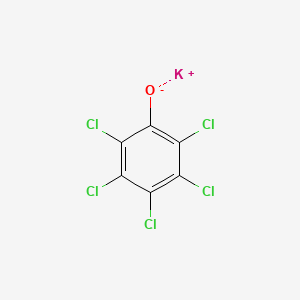
Chimie vérifiée pour le CAS 7778-73-6
Potassium pentachlorophenolate
- Nom IUPAC
- potassium 2,3,4,5,6-pentachlorophenolate
- Formule moléculaire
- C6Cl5KO
- Masse moléculaire
- 304.4 g/mol
- Masse exacte
- 303.799934 Da
- Masse monoisotopique
- 301.802885 Da
- Surface polaire topologique
- 23,1 Ų
- Complexité moléculaire
- 155,0
- Charge formelle
- 0
- Donneurs de liaisons hydrogène
- 0
- Accepteurs de liaisons hydrogène
- 1
- Liaisons rotatives
- 0
- Atomes lourds
- 13
- Unités covalentes
- 2
Noms et synonymes signalés à PubChem
6 autres noms signalés
Identifiants de bases de données externes
- EPA DTXSID:DTXSID3064801
Statistiques de structure avancées
- Stéréocentres atomiques définis
- 0
- Stéréocentres atomiques non définis
- 0
- Stéréocentres de liaison définis
- 0
- Stéréocentres de liaison non définis
- 0
- Conformères 3D
- 0
Identifiants de structure lisibles par machine
- SMILES
C1(=C(C(=C(C(=C1Cl)Cl)Cl)Cl)Cl)[O-].[K+]- InChI
InChI=1S/C6HCl5O.K/c7-1-2(8)4(10)6(12)5(11)3(1)9;/h12H;/q;+1/p-1- InChIKey
WYQQGYULUDOPRU-UHFFFAOYSA-M
Récupéré depuis NIH PubChem le 2026-09-02 par correspondance CAS à somme de contrôle valide. Les propriétés chimiques ne remplacent pas la décision réglementaire de cette page.
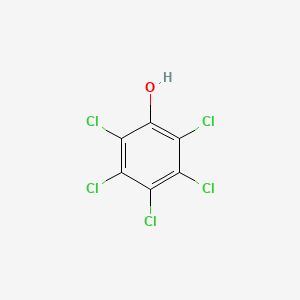
Chimie vérifiée pour le CAS 87-86-5
Pentachlorophenol
Pentachlorophenol is a chlorophenol that is phenol substituted by 5 chloro groups. It has a role as a human xenobiotic metabolite. It is a chlorophenol, an organochlorine pesticide, a member of pentachlorobenzenes and an aromatic fungicide. It is functionally related to a pentachlorobenzene. It is a conjugate acid of a pentachlorophenolate. — ChEBI
- Nom IUPAC
- 2,3,4,5,6-pentachlorophenol
- Formule moléculaire
- C6HCl5O
- Masse moléculaire
- 266.3 g/mol
- Masse exacte
- 265.844053 Da
- Masse monoisotopique
- 263.847003 Da
- XLogP3
- 5,1
- Surface polaire topologique
- 20,2 Ų
- Complexité moléculaire
- 150,0
- Charge formelle
- 0
- Donneurs de liaisons hydrogène
- 1
- Accepteurs de liaisons hydrogène
- 1
- Liaisons rotatives
- 0
- Atomes lourds
- 12
- Unités covalentes
- 1
Noms et synonymes signalés à PubChem
16 autres noms signalés
Identifiants de bases de données externes
- ChEBI:CHEBI:17642
- ChEMBL:CHEMBL75967
- EPA DTXSID:DTXSID7021106
- PubMed:23062977
- PubMed:23029295
- PubMed:23016294
- PubMed:22989423
- PubMed:22969335
- PubMed:22967521
- PubMed:22964389
- PubMed:22946166
- PubMed:22912977
- PubMed:22887158
- PubMed:22883160
- PubMed:22868905
Statistiques de structure avancées
- Stéréocentres atomiques définis
- 0
- Stéréocentres atomiques non définis
- 0
- Stéréocentres de liaison définis
- 0
- Stéréocentres de liaison non définis
- 0
- Caractéristiques pharmacophoriques 3D
- 2
- Cycles 3D
- 1
- Groupes hydrophobes 3D
- 0
- Caractéristiques d’accepteur 3D
- 0
- Caractéristiques de donneur 3D
- 1
- Centres anioniques 3D
- 0
- Centres cationiques 3D
- 0
- Conformères 3D
- 1
- Rotors 3D effectifs
- 0,0
Identifiants de structure lisibles par machine
- SMILES
C1(=C(C(=C(C(=C1Cl)Cl)Cl)Cl)Cl)O- InChI
InChI=1S/C6HCl5O/c7-1-2(8)4(10)6(12)5(11)3(1)9/h12H- InChIKey
IZUPBVBPLAPZRR-UHFFFAOYSA-N
Récupéré depuis NIH PubChem le 2026-08-31 par correspondance CAS à somme de contrôle valide. Les propriétés chimiques ne remplacent pas la décision réglementaire de cette page.
Source officielle et provenance
- Source enregistrée
- Saudi SFDA prohibited and restricted ingredient lists
- Référence de la source
- SFDA prohibited list, page 101, row 10
- Identifiant de la fiche source
prohibited-100-10- Version de la source
- live-snapshot-2026-08-30
- Langue de la source
- English
- État de la traduction
- Original is English
- Instantané vérifié le
- 2026-08-30 05:18 UTC
- Méthode de validation
- complete SFDA paginated HTML snapshot; strict page/row counts
- SHA-256
ceb6cc636e6b1f4b3013f88ce0297217b49d6194342c6ece5c03b1e04256d71a
Notes du jeu de données enregistré
- Couverture du jeu de données
- Prohibited and restricted substances with CAS, EC and conditions
- Note sur l’autorité
- Official SFDA dated lists; version and hash each release
Place de cette fiche dans le jeu de données du marché
Répartition des statuts
Un texte de conditions est présent pour 0 des 2090 fiches actuelles. Un champ de conditions vide est interprété selon le type de fiche ci-dessus ; il n’est jamais converti en une affirmation d’utilisation sans restriction.
Saudi Arabia contexte du marché
Complete official list index
Version de la couverture : SFDA live prohibited/restricted lists, snapshot 30 August 2026
Every page and entry in the public SFDA prohibited and restricted ingredient indexes; restricted detail pages remain the source for conditions.
Liste de contrôle de vérification
- Search names and CAS across both SFDA lists.
- Open the cited restricted-entry detail and apply every condition.
- Check current SFDA/GSO technical regulations and updates.
- Complete eCosma notification, label and responsible-party requirements.
Sources officielles du marché
- Saudi SFDA prohibited and restricted ingredient listsOfficial SFDA dated lists; version and hash each release
Procédure de vérification et exhaustivité de la fiche
Avant d’utiliser ce résultat dans une décision de conformité
- Confirmez que « Pentachlorophenol [1]; Sodium pentachlorophenolate [2]; Potassium pentachlorophenolate [3] » et chaque identifiant CAS/CE correspondent à la matière de votre spécification fournisseur.
- Search names and CAS across both SFDA lists.
- Open the cited restricted-entry detail and apply every condition.
- Check current SFDA/GSO technical regulations and updates.
- Complete eCosma notification, label and responsible-party requirements.
- Consignez la version de la source et revérifiez auprès de l’autorité de réglementation avant la fabrication, la notification ou la mise sur le marché.
Champs disponibles dans cette fiche
- Nom officiel de la substanceDisponible
- CASDisponible
- ECNon fourni
- Texte de condition distinctAbsent de la ligne source
- Date d’effetNon fourni
- Empreinte de l’instantané et méthodeDisponible
Questions auxquelles cette page répond
Citation stable
Pentachlorophenol [1]; Sodium pentachlorophenolate [2]; Potassium pentachlorophenolate [3]. SFDA prohibited list, page 101, row 10. Saudi Arabia. Source version live-snapshot-2026-08-30. CosIng Checker regulatory record: https://cosingchecker.com/fr/regulations/sa/records/10609/
Citez l’autorité de réglementation comme autorité juridique. Cette page est un index structuré de preuves et une aide à la vérification, et non un substitut au texte officiel ni à une évaluation juridique professionnelle.
Interprétation et limites pour Saudi Arabia
This official record identifies the substance as prohibited for cosmetic use in the stated market scope.
Do not rely on a formulation containing this identity until the cited source, effective date and exact substance match have been verified.
Comment interpréter le rôle juridique
The cited row forms part of a binding rule or legally incorporated list for this market.
Preuves sur cette page
- Résultat enregistré : Prohibited
- Rôle juridique : Binding rule
- Version de la source : live-snapshot-2026-08-30
Ce que cela ne prouve pas
No list match is not permission; Gulf/SFDA product, claim, notification and technical requirements still apply.
Recherche complémentaire sur la substance auprès de sources faisant autorité
Aucune de ces sources ne prévaut sur la décision de marché ci-dessus.
Cosmetic Ingredient Review safety assessments
Expert Panel conclusions, assessed ingredient groups, use conditions, dates and report documents
Independent expert review considered by FDA; not a government approval or binding market rule
Rechercher cette identité à la sourceFDA Global Substance Registration System
UNII identifiers, preferred names, substance types, codes and public substance relationships
Identity registry only; UNII availability does not imply FDA review or approval
Rechercher cette identité à la sourceILO/WHO International Chemical Safety Cards
Hazards, symptoms, first aid, storage, incompatibilities and physical properties for covered chemicals
International occupational chemical-safety reference; not cosmetic-use approval
Rechercher cette identité à la sourceJapan NITE-CHRIP
Chemical identity, Japanese and foreign legal lists, GHS hazards and exposure-related information
Chemical-management evidence; cosmetic status remains governed by the applicable MHLW standard and market rules
Rechercher cette identité à la sourceNIOSH Pocket Guide to Chemical Hazards
REL, PEL, IDLH, properties, exposure routes, symptoms, target organs, first aid and measurement methods for covered workplace chemicals
US occupational-health guidance and limits; not a cosmetic ingredient decision
Rechercher cette identité à la sourceOECD eChemPortal
Gateway to authority-owned physical-property, fate, ecotoxicity, toxicity, exposure and GHS records
Discovery gateway; each linked authority remains responsible for its data
Rechercher cette identité à la sourceUS EPA CompTox CTX APIs
Clé d’API requise pour l’importDTXSID identity, experimental and predicted properties, toxicity, bioactivity, exposure and environmental data
Scientific and computational evidence; predictions must remain labelled and do not determine cosmetic legality
Rechercher cette identité à la source