
Hexane
Listed by the Saudi Food and Drug Authority as prohibited in cosmetic products.
Décision réglementaire et conditions complètes
- Statut
- Prohibited
- Rôle juridique
- Binding rule
- Résumé réglementaire
- Listed by the Saudi Food and Drug Authority as prohibited in cosmetic products.
- Conditions et restrictions
- A prohibition entry may contain no separate condition text because the regulatory outcome is the prohibition itself. Ouvrez la source citée et appliquez les exigences applicables à l’ensemble du marché ci-dessous.
Identité de la substance
- Nom dans la source officielle
- Hexane
- CAS
- 110-54-3
- EC
- 203-777-6
- Correspondance d’identité
- cas_number
- Ingrédient associé
- HEXANE
Données d’identité CosIng associées
Noms et alias
Note de restriction de l’inventaire de l’UE : II/999
Fonction cosmétique enregistrée : SOLVENT, VISCOSITY CONTROLLING
Pages de fonctions :SOLVENT, VISCOSITY CONTROLLING
Voir le profil complet de l’ingrédientAperçu multi-marchés pour cette identité
Fiches exactes associées actuellement présentes sur ce site. L’absence d’un marché signifie qu’aucune correspondance exacte n’a été importée, et non une autorisation d’utiliser la substance.
European Union
1 fiche associée
Ouvrir la fiche justificativeGreat Britain
1 fiche associée
Ouvrir la fiche justificativeNew Zealand
1 fiche associée
Ouvrir la fiche justificativeASEAN
1 fiche associée
Ouvrir la fiche justificativeChina
1 fiche associée · 1 avec conditions spécifiques
Ouvrir la fiche justificativeSouth Korea
1 fiche associée
Ouvrir la fiche justificativeBrazil
1 fiche associée · 1 avec conditions spécifiques
Ouvrir la fiche justificativeIndia
1 fiche associée · 1 avec conditions spécifiques
Ouvrir la fiche justificativeSaudi Arabia
Fiche actuelle1 fiche associée
Ouvrir la fiche justificative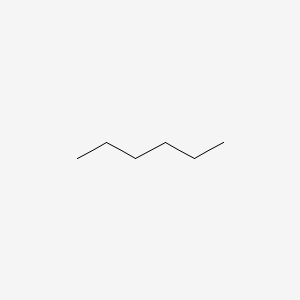
Chimie vérifiée pour le CAS 110-54-3
Hexane
Hexane is an unbranched alkane containing six carbon atoms. It has a role as a non-polar solvent and a neurotoxin. It is a volatile organic compound and an alkane. — ChEBI
- Nom IUPAC
- hexane
- Formule moléculaire
- C6H14
- Masse moléculaire
- 86.18 g/mol
- Masse exacte
- 86.109550447 Da
- Masse monoisotopique
- 86.109550447 Da
- XLogP3
- 3,9
- Surface polaire topologique
- 0,0 Ų
- Complexité moléculaire
- 12,0
- Charge formelle
- 0
- Donneurs de liaisons hydrogène
- 0
- Accepteurs de liaisons hydrogène
- 0
- Liaisons rotatives
- 3
- Atomes lourds
- 6
- Unités covalentes
- 1
Noms et synonymes signalés à PubChem
16 autres noms signalés
Identifiants de bases de données externes
- ChEBI:CHEBI:29021
- ChEMBL:CHEMBL15939
- EPA DTXSID:DTXSID0021917
- PubMed:33064461
- PubMed:30503853
- PubMed:28115069
- PubMed:28003437
- PubMed:26410608
- PubMed:23740543
- PubMed:23680158
- PubMed:23353815
- PubMed:23124557
- PubMed:23122161
- PubMed:23122155
- PubMed:23120914
Statistiques de structure avancées
- Stéréocentres atomiques définis
- 0
- Stéréocentres atomiques non définis
- 0
- Stéréocentres de liaison définis
- 0
- Stéréocentres de liaison non définis
- 0
- Caractéristiques pharmacophoriques 3D
- 3
- Cycles 3D
- 0
- Groupes hydrophobes 3D
- 3
- Caractéristiques d’accepteur 3D
- 0
- Caractéristiques de donneur 3D
- 0
- Centres anioniques 3D
- 0
- Centres cationiques 3D
- 0
- Conformères 3D
- 10
- Rotors 3D effectifs
- 3,0
Identifiants de structure lisibles par machine
- SMILES
CCCCCC- InChI
InChI=1S/C6H14/c1-3-5-6-4-2/h3-6H2,1-2H3- InChIKey
VLKZOEOYAKHREP-UHFFFAOYSA-N
Preuves issues de bases de données scientifiques complémentaires
NIH PubChem PUG-View
Attributed physical-property, hazard, environmental and use annotations.
- Autoignition Temperature: 437 °F (USCG, 1999) Source: CAMEO Chemicals
- Autoignition Temperature: 437 °F (225 °C) Source: Hazardous Substances Data Bank (HSDB)
- Autoignition Temperature: 225 °C Source: ILO-WHO International Chemical Safety Cards (ICSCs)
- Boiling Point: 156 °F at 760 mmHg (NTP, 1992) Source: CAMEO Chemicals
- Boiling Point: 68.73 °C Source: Hazardous Substances Data Bank (HSDB)
- Boiling Point: 68.70 °C. @ 760.00 mm Hg Source: Human Metabolome Database (HMDB)
- Boiling Point: 69 °C Source: ILO-WHO International Chemical Safety Cards (ICSCs)
- Boiling Point: 156 °F Source: Occupational Safety and Health Administration (OSHA)
- Boiling Point: 68.73 °C @760 [mm Hg] Source: PAC Chemical Database, U.S. Department of Energy
- Boiling Point: 156 °F Source: The National Institute for Occupational Safety and Health (NIOSH)
- Color/Form: Liquid Source: Hazardous Substances Data Bank (HSDB)
- Color/Form: Colorless, very volatile liquid Source: Hazardous Substances Data Bank (HSDB)
- Density: 0.659 at 68 °F (USCG, 1999) - Less dense than water; will float Source: CAMEO Chemicals
- Density: 0.6606 g/cu cm at 25 °C Source: Hazardous Substances Data Bank (HSDB)
- Density: Relative density (water = 1): 0.7 Source: ILO-WHO International Chemical Safety Cards (ICSCs)
- Density: 0.66 Source: Occupational Safety and Health Administration (OSHA)
- Density: 0.6606 @25 °C Source: PAC Chemical Database, U.S. Department of Energy
- Density: 0.66 Source: The National Institute for Occupational Safety and Health (NIOSH)
- Flash Point: -9.4 °F (NTP, 1992) Source: CAMEO Chemicals
- Flash Point: -7 °F Source: Haz-Map, Information on Hazardous Chemicals and Occupational Diseases
- Flash Point: -7 °F (-22 °C) (Closed cup) Source: Hazardous Substances Data Bank (HSDB)
- Flash Point: -22 °C c.c. Source: ILO-WHO International Chemical Safety Cards (ICSCs)
- Flash Point: -7 °F Source: Occupational Safety and Health Administration (OSHA)
- Flash Point: -7 °F Source: The National Institute for Occupational Safety and Health (NIOSH)
- LogP: log Kow = 3.90 Source: Hazardous Substances Data Bank (HSDB)
- LogP: 3.90 Source: Human Metabolome Database (HMDB)
- LogP: 3.9 Source: ILO-WHO International Chemical Safety Cards (ICSCs)
- Melting Point: -139 °F (NTP, 1992) Source: CAMEO Chemicals
- Melting Point: -95.35 °C Source: Hazardous Substances Data Bank (HSDB)
- Melting Point: -93.5 °C Source: Human Metabolome Database (HMDB)
- Melting Point: -95 °C Source: ILO-WHO International Chemical Safety Cards (ICSCs)
- Melting Point: -139 °F Source: Occupational Safety and Health Administration (OSHA)
- Melting Point: -95.35 °C Source: PAC Chemical Database, U.S. Department of Energy
- Melting Point: -219 °F Source: The National Institute for Occupational Safety and Health (NIOSH)
- Odor: Gasoline-like odor Source: Hazardous Substances Data Bank (HSDB)
- Physical Description: N-hexane is a clear colorless liquids with a petroleum-like odor. Flash points -9 °F. Less dense than water and insoluble in water. Vapors heavier than air. Used as a solvent, paint thinner, and chemical reaction medium. Source: CAMEO Chemicals
- Physical Description: Gas Vapor; Liquid; Liquid; Large Crystals Source: EPA Chemical Data Reporting (CDR)
- Physical Description: Colorless liquid with a gasoline-like odor; [NIOSH] Source: Haz-Map, Information on Hazardous Chemicals and Occupational Diseases
- Physical Description: Liquid Source: Human Metabolome Database (HMDB)
- Physical Description: VOLATILE COLOURLESS LIQUID WITH CHARACTERISTIC ODOUR. Source: ILO-WHO International Chemical Safety Cards (ICSCs)
- Physical Description: Colorless liquid with a gasoline-like odor. Source: Occupational Safety and Health Administration (OSHA)
- Physical Description: Colorless liquid with a gasoline-like odor. Source: The National Institute for Occupational Safety and Health (NIOSH)
- Refractive Index: Index of refraction: 1.3727 at 25 °C Source: Hazardous Substances Data Bank (HSDB)
- Solubility: less than 1 mg/mL at 61.7 °F (NTP, 1992) Source: CAMEO Chemicals
- Solubility: In water, 9.5 mg/L at 25 °C Source: Hazardous Substances Data Bank (HSDB)
- Solubility: 9.5 to 13 mg/L at 20 °C in distilled water, 75.5 mg/L at 20 °C in salt water Source: Hazardous Substances Data Bank (HSDB)
- Solubility: Very soluble in ethanol; soluble in ethyl ether, chloroform Source: Hazardous Substances Data Bank (HSDB)
- Solubility: Miscible with alcohol, chloroform, and ether Source: Hazardous Substances Data Bank (HSDB)
- Solubility: 0.0095 mg/mL at 25 °C Source: Human Metabolome Database (HMDB)
- Solubility: Solubility in water, g/100ml at 20 °C: 0.0013 (practically insoluble) Source: ILO-WHO International Chemical Safety Cards (ICSCs)
- Solubility: 0.002% Source: The National Institute for Occupational Safety and Health (NIOSH)
- Vapor Pressure: 120 mmHg at 68 °F ; 180 mmHg at 77 °F (NTP, 1992) Source: CAMEO Chemicals
- Vapor Pressure: 153.0 [mmHg] Source: Haz-Map, Information on Hazardous Chemicals and Occupational Diseases
- Vapor Pressure: Vapor pressure: 120 mm Hg at 20 °C, 190 mm Hg at 30 °C Source: Hazardous Substances Data Bank (HSDB)
- Vapor Pressure: 153 mm Hg at 25 °C Source: Hazardous Substances Data Bank (HSDB)
- Vapor Pressure: Vapor pressure, kPa at 20 °C: 17 Source: ILO-WHO International Chemical Safety Cards (ICSCs)
- Vapor Pressure: 124 mmHg Source: Occupational Safety and Health Administration (OSHA)
- Vapor Pressure: 75 [mm Hg] @9.8000000000000007 °C Source: PAC Chemical Database, U.S. Department of Energy
- Vapor Pressure: 124 mmHg Source: The National Institute for Occupational Safety and Health (NIOSH)
- Viscosity: 0.377 cP at 15 °C Source: Hazardous Substances Data Bank (HSDB)
- Viscosity: 3.26X10⁻⁴ Pa-s at 20 °C Source: Hazardous Substances Data Bank (HSDB)
- Viscosity: 1.4 mm²/s Source: ILO-WHO International Chemical Safety Cards (ICSCs)
- Carcinogen Classification: Hexane is found in gasoline, which is possibly carcinogenic to humans (Group 2B). (L135) Source: Toxin and Toxin Target Database (T3DB)
- Exposure Routes: The substance can be absorbed into the body by inhalation of its vapour and by ingestion. Source: ILO-WHO International Chemical Safety Cards (ICSCs)
- Exposure Routes: inhalation, ingestion, skin and/or eye contact Source: The National Institute for Occupational Safety and Health (NIOSH)
- Exposure Routes: Oral (L175) ; inhalation (L175) ;dermal (L175) Source: Toxin and Toxin Target Database (T3DB)
- First Aid: EYES: First check the victim for contact lenses and remove if present. Flush victim's eyes with water or normal saline solution for 20 to 30 minutes while simultaneously calling a hospital or poison control center. Do not put any ointments, oils, or medication in the victim's eyes without specific instructions from a physician. IMMEDIATELY transport the victim after flushing eyes to a hospital even if no symptoms (such as redness or irritation) develop.; SKIN: IMMEDIATELY flood affected skin with water while removing and isolating all contaminated clothing. Gently wash all affected skin areas thoroughly with soap and water. If symptoms such as redness or irritation develop, IMMEDIATELY call a physician and be prepared to transport the victim to a hospital for treatment.; INHALATION: IMMEDIATELY leave the contaminated area; take deep breaths of fresh air. If symptoms (such as wheezing, coughing, shortness of breath, or burning in the mouth, throat, or chest) develop, call a physician and be prepared to transport the victim to a hospital. Provide proper respiratory protection to rescuers entering an unknown atmosphere. Whenever possible, Self-Contained Breathing Apparatus (SCBA) shou Source: CAMEO Chemicals
- ERG2024, Guide 128 (Hexanes): General First Aid:; · Call 911 or emergency medical service.; · Ensure that medical personnel are aware of the material(s) involved, take precautions to protect themselves and avoid contamination.; · Move victim to fresh air if it can be done safely.; · Administer oxygen if breathing is difficult.; · If victim is not breathing:; -- DO NOT perform mouth-to-mouth resuscitation; the victim may have ingested or inhaled the substance.; -- If equipped and pulse detected, wash face and mouth, then give artificial respiration using a proper respiratory medical device (bag-valve mask, pocket mask equipped with a one-way valve or other device).; -- If no pulse detected or no respiratory medical device available, provide continuous compressions. Conduct a pulse check every two minutes or monitor for any signs of spontaneous respirations.; · Remove and isolate contaminated clothing and shoes.; · For minor skin contact, avoid spreading material on unaffected skin.; · In case of contact with substance, remove immediately by flushing skin or eyes with running water for at least 20 minutes.; · For severe burns, immediate medical attention is required.; · Effects of exposure (inhalation, ingestion, Source: Emergency Response Guidebook (ERG)
- First Aid: (General first aid procedures); Eye: Irrigate immediately - If this chemical contacts the eyes, immediately wash (irrigate) the eyes with large amounts of water, occasionally lifting the lower and upper lids. Get medical attention immediately.; Skin: Soap wash immediately - If this chemical contacts the skin, immediately wash the contaminated skin with soap and water. If this chemical penetrates the clothing, immediately remove the clothing, wash the skin with soap and water, and get medical attention promptly.; Breathing: Respiratory support; Swallow: Medical attention immediately - If this chemical has been swallowed, get medical attention immediately. Source: The National Institute for Occupational Safety and Health (NIOSH)
- Signal: Danger Source: Regulation (EC) No 1272/2008 of the European Parliament and of the Council
- GHS Hazard Statements: H225: Highly Flammable liquid and vapor [Danger Flammable liquids]; H304: May be fatal if swallowed and enters airways [Danger Aspiration hazard]; H315: Causes skin irritation [Warning Skin corrosion/irritation]; H336: May cause drowsiness or dizziness [Warning Specific target organ toxicity, single exposure; Narcotic effects]; H361f ***: Suspected of damaging fertility [Warning Reproductive toxicity]; H372: Causes damage to organs through prolonged or repeated exposure [Danger Specific target organ toxicity, repeated exposure]; H411: Toxic to aquatic life with long lasting effects [Hazardous to the aquatic environment, long-term hazard] Source: Regulation (EC) No 1272/2008 of the European Parliament and of the Council
- Precautionary Statement Codes: P203, P210, P233, P240, P241, P242, P243, P260, P261, P264, P270, P271, P273, P280, P301+P316, P302+P352, P303+P361+P353, P304+P340, P318, P319, P321, P331, P332+P317, P362+P364, P370+P378, P391, P403+P233, P403+P235, P405, and P501 (click each P-code to see the statement) Source: Regulation (EC) No 1272/2008 of the European Parliament and of the Council
- Note: This chemical does not meet GHS hazard criteria for < 0.1% (2 of 4001) of reports. Source: European Chemicals Agency (ECHA)
- Signal: Danger Source: European Chemicals Agency (ECHA)
- GHS Hazard Statements: H225 (98.2%): Highly Flammable liquid and vapor [Danger Flammable liquids]; H304 (98.2%): May be fatal if swallowed and enters airways [Danger Aspiration hazard]; H315 (98.1%): Causes skin irritation [Warning Skin corrosion/irritation]; H319 (11.5%): Causes serious eye irritation [Warning Serious eye damage/eye irritation]; H336 (97.4%): May cause drowsiness or dizziness [Warning Specific target organ toxicity, single exposure; Narcotic effects]; H361 (93.7%): Suspected of damaging fertility or the unborn child [Warning Reproductive toxicity]; H373 (95.4%): May causes damage to organs through prolonged or repeated exposure [Warning Specific target organ toxicity, repeated exposure]; H411 (99.9%): Toxic to aquatic life with long lasting effects [Hazardous to the aquatic environment, long-term hazard] Source: European Chemicals Agency (ECHA)
- Precautionary Statement Codes: P203, P210, P233, P240, P241, P242, P243, P260, P261, P264, P264+P265, P271, P273, P280, P301+P316, P302+P352, P303+P361+P353, P304+P340, P305+P351+P338, P318, P319, P321, P331, P332+P317, P337+P317, P362+P364, P370+P378, P391, P403+P233, P403+P235, P405, and P501 (click each P-code to see the statement) Source: European Chemicals Agency (ECHA)
- ECHA C&L Notifications Summary: Aggregated GHS information provided per 4001 reports by companies from 80 notifications to the ECHA C&L Inventory. Each notification may be associated with multiple companies.; Reported as not meeting GHS hazard criteria per 2 of 4001 reports by companies.; There are 79 notifications provided by 3999 of 4001 reports by companies with hazard statement code(s).; Information may vary between notifications depending on impurities, additives, and other factors. The percentage value in parenthesis indicates the notified classification ratio from companies that provide hazard codes. Only hazard codes with percentage values above 10% are shown. For more detailed information, please visit ECHA C&L website. Source: European Chemicals Agency (ECHA)
- Note: This chemical does not meet GHS hazard criteria for 0.4% (1 of 224) of reports. Source: European Chemicals Agency (ECHA)
- GHS Hazard Statements: H225 (53.1%): Highly Flammable liquid and vapor [Danger Flammable liquids]; H304 (36.6%): May be fatal if swallowed and enters airways [Danger Aspiration hazard]; H315 (79.5%): Causes skin irritation [Warning Skin corrosion/irritation]; H317 (46.9%): May cause an allergic skin reaction [Warning Sensitization, Skin]; H319 (17.4%): Causes serious eye irritation [Warning Serious eye damage/eye irritation]; H336 (36.6%): May cause drowsiness or dizziness [Warning Specific target organ toxicity, single exposure; Narcotic effects]; H361 (36.6%): Suspected of damaging fertility or the unborn child [Warning Reproductive toxicity]; H373 (27.7%): May causes damage to organs through prolonged or repeated exposure [Warning Specific target organ toxicity, repeated exposure]; H411 (32.6%): Toxic to aquatic life with long lasting effects [Hazardous to the aquatic environment, long-term hazard]; H412 (46.4%): Harmful to aquatic life with long lasting effects [Hazardous to the aquatic environment, long-term hazard] Source: European Chemicals Agency (ECHA)
- Precautionary Statement Codes: P203, P210, P233, P240, P241, P242, P243, P260, P261, P264, P264+P265, P271, P272, P273, P280, P301+P316, P302+P352, P303+P361+P353, P304+P340, P305+P351+P338, P318, P319, P321, P331, P332+P317, P333+P317, P337+P317, P362+P364, P370+P378, P391, P403+P233, P403+P235, P405, and P501 (click each P-code to see the statement) Source: European Chemicals Agency (ECHA)
- ECHA C&L Notifications Summary: Aggregated GHS information provided per 224 reports by companies from 14 notifications to the ECHA C&L Inventory. Each notification may be associated with multiple companies.; Reported as not meeting GHS hazard criteria per 1 of 224 reports by companies.; There are 13 notifications provided by 223 of 224 reports by companies with hazard statement code(s).; Information may vary between notifications depending on impurities, additives, and other factors. The percentage value in parenthesis indicates the notified classification ratio from companies that provide hazard codes. Only hazard codes with percentage values above 10% are shown. For more detailed information, please visit ECHA C&L website. Source: European Chemicals Agency (ECHA)
- Health Effects: Hexane mainly affects the nervous system. It causes degeneration of the peripheral nervous system (and eventually the central nervous system), starting with damage to the nerve axons. Exposure to hexane may also damage the lungs and reproductive system. (L977, L978) Source: Toxin and Toxin Target Database (T3DB)
- NFPA Health Rating: 0 - Materials that, under emergency conditions, would offer no hazard beyond that of ordinary combustible materials. Source: Hazardous Substances Data Bank (HSDB)
- NFPA Fire Rating: 3 - Liquids and solids that can be ignited under almost all ambient temperature conditions. Materials produce hazardous atmospheres with air under almost all ambient temperatures or, though unaffected by ambient temperatures, are readily ignited under almost all conditions. Source: Hazardous Substances Data Bank (HSDB)
- NFPA Instability Rating: 0 - Materials that in themselves are normally stable, even under fire conditions. Source: Hazardous Substances Data Bank (HSDB)
- Target Organs: Neurological (Nervous System), Respiratory (From the Nose to the Lungs) Source: Agency for Toxic Substances and Disease Registry (ATSDR)
- Target Organs: Nervous Source: EPA Integrated Risk Information System (IRIS)
- Target Organs: Eyes, skin, respiratory system, central nervous system, peripheral nervous system Source: The National Institute for Occupational Safety and Health (NIOSH)
- Toxicity Summary: IDENTIFICATION: n-Hexane is a straight chain saturated hydrocarbon obtained from certain petroleum fractions after various thermal or catalytic cracking steps. Commercial hexane may contain from 20%-85& n-Hexane and various amounts of hexane isomer, 2-methylpentane, 3-methylpentane, 2-3-dimethylbutene, cyclopentane, cyclohexane and small quantities of pentane and heptane isomers, acetone, methyl ethyl ketone, dichloromethane and trichloroethylene. Trace amounts of benzene may be present. N-Hexane is a colorless liquid and solubility in water is low. It is miscible with alcohol, chloroform and ether. Main uses are: rubber and adhesive solvent in shoe factories; extraction of soybean oil, callous seed oil and flaxseed oil. It is used in the pharmaceutical and cosmetic industries and is a cleaning agent for textiles, furniture and leather products. N-Hexane is also used for: determination of the refractive index of minerals, filling for thermometers and denaturant. HUMAN EXPOSURE: The target organs are: central nervous system and peripheral nervous system, respiratory system, heart, skin and eyes. Chemical pneumonia can occur after ingestion and and aspiration to the lungs. CNS depres Source: Hazardous Substances Data Bank (HSDB)
- Toxicity Summary: Hexane's toxicity is caused by it neurotoxic metabolite, 2,5-hexanedione. It damages the central and peripheral nervous system by causing axonal swelling and degeneration. 2,5-Hexanedione also reacts with lysine side-chain amino groups in axonal cytoskeletal proteins to form pyrroles. This results in neurofilament cross-linking and loss of function. (L175) Source: Toxin and Toxin Target Database (T3DB)
- Environmental Bioconcentration: An estimated BCF of 170 was calculated in fish for n-hexane(SRC), using a log Kow of 3.90(1) and a regression-derived equation(2). According to a classification scheme(3), this BCF suggests the potential for bioconcentration in aquatic organisms is high(SRC), provided the compound is not metabolized by the organism(SRC). Source: Hazardous Substances Data Bank (HSDB)
- Environmental Fate: TERRESTRIAL FATE: Based on a classification scheme(1), an estimated Koc value of 130(SRC), determined from a structure estimation method(2), indicates that n-hexane is expected to have high mobility in soil(SRC). Volatilization of n-hexane from moist soil surfaces is expected to be an important fate process(SRC) given an estimated Henry's Law constant of 1.80 atm-cu m/mole(SRC), based upon its vapor pressure, 153 mm Hg(3), and water solubility, 9.5 mg/L(4). n-Hexane is expected to volatilize from dry soil surfaces(SRC) based upon its vapor pressure(3). Utilizing the Japanese MITI test, 100% of the Theoretical BOD was reached in 4 weeks(5) suggesting that biodegradation is an important environmental fate process in soil(SRC). Source: Hazardous Substances Data Bank (HSDB)
- Environmental Fate: AQUATIC FATE: Based on a classification scheme(1), an estimated Koc value of 130(SRC), determined from a structure estimation method(2), indicates that n-hexane is not expected to adsorb to suspended solids and sediment(SRC). Volatilization from water surfaces is expected(3) based upon an estimated Henry's Law constant of 1.80 atm-cu m/mole(SRC), derived from its vapor pressure, 153 mm Hg(4), and water solubility, 9.6 mg/L(5). Using this Henry's Law constant and an estimation method(3), volatilization half-lives for a model river and model lake are 2.7 hours and 3.7 days, respectively(SRC). According to a classification scheme(6), an estimated BCF of 170(SRC), from its log Kow of 3.90(7) and a regression-derived equation(8), suggests the potential for bioconcentration in aquatic organisms is high, provided the compound is not metabolized by the organism(SRC). Utilizing the Japanese MITI test, 100% of the Theoretical BOD was reached in 4 weeks(9) suggesting that biodegradation is an important environmental fate process in water(SRC). Source: Hazardous Substances Data Bank (HSDB)
- Environmental Fate: ATMOSPHERIC FATE: According to a model of gas/particle partitioning of semivolatile organic compounds in the atmosphere(1), n-hexane, which has a vapor pressure of 153 mm Hg at 25 °C(2), is expected to exist solely as a vapor in the ambient atmosphere. Vapor-phase n-hexane is degraded in the atmosphere by reaction with photochemically-produced hydroxyl radicals(SRC); the half-life for this reaction in air is estimated to be 24 hours(SRC), calculated from its rate constant of 5.61X10⁻¹² cu cm/molecule-sec at 25 °C(3). n-Hexane does not contain chromophores that absorb at wavelengths >290 nm(4) and, therefore, is not expected to be susceptible to direct photolysis by sunlight(SRC). Source: Hazardous Substances Data Bank (HSDB)
- Consumer Uses: Intermediate; Propellants, non-motive (blowing agents); Laboratory chemicals; Not Known or Reasonably Ascertainable; Monomers; Fuel; Fuel agents; Solvent; Flavoring and nutrient; Lubricating agent Source: EPA Chemical Data Reporting (CDR)
- Industry Uses: Intermediate; Propellants, non-motive (blowing agents); Laboratory chemicals; Not Known or Reasonably Ascertainable; Soil amendments (fertilizers); Monomers; Fuel agents; Fuel; Solvent; Flavoring and nutrient; Other; Lubricating agent Source: EPA Chemical Data Reporting (CDR)
- Uses: The main use of hexane is as a solvent to extract edible oils from seed and vegetable crops (e.g., soybeans, peanuts, corn). Hexane is also used as a cleaning agent (degreaser) in the printing industry. Source: EPA Hazardous Air Pollutants
- Sources/Uses: Used as a solvent, especially in the adhesive and shoe industries; abused by glue sniffers for its euphoric effects; [LaDou, p. 430] Used in shoe and furniture manufacture to dissolve glue; also used in adhesive tape manufacturing; [Sullivan, p. 1211] Fuels made from petroleum contain n-hexane. Modern blends of US gasoline contain about 3% n-hexane. [ATSDR ToxProfiles] Used as a solvent for vegetable oils, polymers, and paints; [Hawley] Used as a degreaser by vehicle repair technicians in a commercially available aerosol containing toluene, acetone, and hexane (50% n-hexane); [Reference #2] Used for determining refractive index of minerals, filling for thermometers (instead of mercury), for calibrations, as reaction medium for polymerizations and pharmaceutical manufacture, alcohol denaturant, as cleaning agent in textile, furniture, and leather industries, and as laboratory reagent; [HSDB] Source: Haz-Map, Information on Hazardous Chemicals and Occupational Diseases
- Industrial Processes with risk of exposure: Textiles (Fiber & Fabric Manufacturing) [Category: Industry]; Painting (Solvents) [Category: Paint]; Working with Glues and Adhesives [Category: Other]; Leather Tanning and Processing [Category: Industry] Source: Haz-Map, Information on Hazardous Chemicals and Occupational Diseases
- Activities with risk of exposure: Leather crafting [Category: Hobbies]; Painting [Category: Hobbies]; Sculpturing plastics [Category: Hobbies] Source: Haz-Map, Information on Hazardous Chemicals and Occupational Diseases
- Uses: Determining refractive index of minerals; filling for thermometers instead of mercury, usually with a blue or red dye; extraction solvent for oilseed processing. Source: Hazardous Substances Data Bank (HSDB)
- Uses: Solvent, especially for vegetable oils; low temperature thermometers; calibrations; polymerization reaction medium; paint diluent; alcohol denaturant. Source: Hazardous Substances Data Bank (HSDB)
- Uses: It is used for the extraction of vegetable oils (e.g., from soybeans), as a solvent in chemical reactions (e.g., for coordination complex catalyzed polymerization of olefins) and in adhesive formulations. Source: Hazardous Substances Data Bank (HSDB)
- Uses: Reaction medium in manufacture of pharmaceuticals; component of numerous formulated products. Source: Hazardous Substances Data Bank (HSDB)
- Uses: For more Uses (Complete) data for N-HEXANE (8 total), please visit the HSDB record page. Source: Hazardous Substances Data Bank (HSDB)
- Uses: Pure n-hexane is used in laboratories. Most of the n-hexane used in industry is mixed with similar chemicals called solvents. The major use for solvents containing n-hexane is to extract vegetable oils from crops such as soybeans. These solvents are also used as cleaning agents in the printing, textile, furniture, and shoemaking industries. Certain kinds of special glues used in the roofing and shoe and leather industries also contain n-hexane. Several consumer products contain n-hexane, such as gasoline, quick-drying glues used in various hobbies, and rubber cement. (L175) Source: Toxin and Toxin Target Database (T3DB)
Mis en correspondance par: Existing checksum-valid CAS to unique PubChem CID match. Récupéré le: 2026-08-31. Ouvrir la fiche source
Les classifications scientifiques et les annotations de danger apportent du contexte et ne remplacent pas la décision réglementaire propre au marché indiquée ci-dessus.
Couverture des sources complémentaires et état des correspondances
| Source | Résultat | Vérifié |
|---|---|---|
| NIH PubChem PUG-View | Correspondance exacte | 2026-08-31 |
Une absence de correspondance enregistrée est une preuve utile que la source a été vérifiée ; ce n’est pas l’affirmation que la substance n’existe pas ailleurs.
Récupéré depuis NIH PubChem le 2026-08-31 par correspondance CAS à somme de contrôle valide. Les propriétés chimiques ne remplacent pas la décision réglementaire de cette page.
Source officielle et provenance
- Source enregistrée
- Saudi SFDA prohibited and restricted ingredient lists
- Référence de la source
- SFDA prohibited list, page 100, row 7
- Identifiant de la fiche source
prohibited-99-7- Version de la source
- live-snapshot-2026-08-30
- Langue de la source
- English
- État de la traduction
- Original is English
- Instantané vérifié le
- 2026-08-30 05:18 UTC
- Méthode de validation
- complete SFDA paginated HTML snapshot; strict page/row counts
- SHA-256
ceb6cc636e6b1f4b3013f88ce0297217b49d6194342c6ece5c03b1e04256d71a
Notes du jeu de données enregistré
- Couverture du jeu de données
- Prohibited and restricted substances with CAS, EC and conditions
- Note sur l’autorité
- Official SFDA dated lists; version and hash each release
Place de cette fiche dans le jeu de données du marché
Répartition des statuts
Un texte de conditions est présent pour 0 des 2090 fiches actuelles. Un champ de conditions vide est interprété selon le type de fiche ci-dessus ; il n’est jamais converti en une affirmation d’utilisation sans restriction.
Saudi Arabia contexte du marché
Complete official list index
Version de la couverture : SFDA live prohibited/restricted lists, snapshot 30 August 2026
Every page and entry in the public SFDA prohibited and restricted ingredient indexes; restricted detail pages remain the source for conditions.
Liste de contrôle de vérification
- Search names and CAS across both SFDA lists.
- Open the cited restricted-entry detail and apply every condition.
- Check current SFDA/GSO technical regulations and updates.
- Complete eCosma notification, label and responsible-party requirements.
Sources officielles du marché
- Saudi SFDA prohibited and restricted ingredient listsOfficial SFDA dated lists; version and hash each release
Procédure de vérification et exhaustivité de la fiche
Avant d’utiliser ce résultat dans une décision de conformité
- Confirmez que « Hexane » et chaque identifiant CAS/CE correspondent à la matière de votre spécification fournisseur.
- Search names and CAS across both SFDA lists.
- Open the cited restricted-entry detail and apply every condition.
- Check current SFDA/GSO technical regulations and updates.
- Complete eCosma notification, label and responsible-party requirements.
- Consignez la version de la source et revérifiez auprès de l’autorité de réglementation avant la fabrication, la notification ou la mise sur le marché.
Champs disponibles dans cette fiche
- Nom officiel de la substanceDisponible
- CASDisponible
- ECDisponible
- Texte de condition distinctAbsent de la ligne source
- Date d’effetNon fourni
- Empreinte de l’instantané et méthodeDisponible
Questions auxquelles cette page répond
Citation stable
Hexane. SFDA prohibited list, page 100, row 7. Saudi Arabia. Source version live-snapshot-2026-08-30. CosIng Checker regulatory record: https://cosingchecker.com/fr/regulations/sa/records/10596/
Citez l’autorité de réglementation comme autorité juridique. Cette page est un index structuré de preuves et une aide à la vérification, et non un substitut au texte officiel ni à une évaluation juridique professionnelle.
Interprétation et limites pour Saudi Arabia
This official record identifies the substance as prohibited for cosmetic use in the stated market scope.
Do not rely on a formulation containing this identity until the cited source, effective date and exact substance match have been verified.
Comment interpréter le rôle juridique
The cited row forms part of a binding rule or legally incorporated list for this market.
Preuves sur cette page
- Résultat enregistré : Prohibited
- Rôle juridique : Binding rule
- Version de la source : live-snapshot-2026-08-30
Ce que cela ne prouve pas
No list match is not permission; Gulf/SFDA product, claim, notification and technical requirements still apply.
Recherche complémentaire sur la substance auprès de sources faisant autorité
Aucune de ces sources ne prévaut sur la décision de marché ci-dessus.
Cosmetic Ingredient Review safety assessments
Expert Panel conclusions, assessed ingredient groups, use conditions, dates and report documents
Independent expert review considered by FDA; not a government approval or binding market rule
Rechercher cette identité à la sourceFDA Global Substance Registration System
UNII identifiers, preferred names, substance types, codes and public substance relationships
Identity registry only; UNII availability does not imply FDA review or approval
Rechercher cette identité à la sourceILO/WHO International Chemical Safety Cards
Hazards, symptoms, first aid, storage, incompatibilities and physical properties for covered chemicals
International occupational chemical-safety reference; not cosmetic-use approval
Rechercher cette identité à la sourceJapan NITE-CHRIP
Chemical identity, Japanese and foreign legal lists, GHS hazards and exposure-related information
Chemical-management evidence; cosmetic status remains governed by the applicable MHLW standard and market rules
Rechercher cette identité à la sourceNIOSH Pocket Guide to Chemical Hazards
REL, PEL, IDLH, properties, exposure routes, symptoms, target organs, first aid and measurement methods for covered workplace chemicals
US occupational-health guidance and limits; not a cosmetic ingredient decision
Rechercher cette identité à la sourceOECD eChemPortal
Gateway to authority-owned physical-property, fate, ecotoxicity, toxicity, exposure and GHS records
Discovery gateway; each linked authority remains responsible for its data
Rechercher cette identité à la sourceUS EPA CompTox CTX APIs
Clé d’API requise pour l’importDTXSID identity, experimental and predicted properties, toxicity, bioactivity, exposure and environmental data
Scientific and computational evidence; predictions must remain labelled and do not determine cosmetic legality
Rechercher cette identité à la source