
N,N-디메칠아닐린
Listed by the Korean MFDS as a substance that may not be used in cosmetics.
Décision réglementaire et conditions complètes
- Statut
- Prohibited
- Rôle juridique
- Binding rule
- Résumé réglementaire
- Listed by the Korean MFDS as a substance that may not be used in cosmetics.
- Conditions et restrictions
- A prohibition entry may contain no separate condition text because the regulatory outcome is the prohibition itself. Ouvrez la source citée et appliquez les exigences applicables à l’ensemble du marché ci-dessous.
Identité de la substance
- Nom dans la source officielle
- N,N-디메칠아닐린
- CAS
- 121-69-7
- EC
- Not supplied in this source row
- Correspondance d’identité
- standalone:official_korean_name
Aperçu multi-marchés pour cette identité
Fiches exactes associées actuellement présentes sur ce site. L’absence d’un marché signifie qu’aucune correspondance exacte n’a été importée, et non une autorisation d’utiliser la substance.
European Union
1 fiche associée
Ouvrir la fiche justificativeGreat Britain
1 fiche associée
Ouvrir la fiche justificativeNew Zealand
1 fiche associée
Ouvrir la fiche justificativeASEAN
1 fiche associée
Ouvrir la fiche justificativeChina
1 fiche associée · 1 avec conditions spécifiques
Ouvrir la fiche justificativeSouth Korea
Fiche actuelle1 fiche associée
Ouvrir la fiche justificativeBrazil
1 fiche associée · 1 avec conditions spécifiques
Ouvrir la fiche justificativeIndia
1 fiche associée · 1 avec conditions spécifiques
Ouvrir la fiche justificativeSaudi Arabia
1 fiche associée
Ouvrir la fiche justificative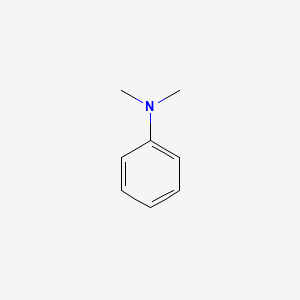
Chimie vérifiée pour le CAS 121-69-7
N,N-Dimethylaniline
N,N-dimethylaniline is a tertiary amine that is aniline in which the amino hydrogens are replaced by two methyl groups. It is a dimethylaniline and a tertiary amine. — ChEBI
- Nom IUPAC
- N,N-dimethylaniline
- Formule moléculaire
- C8H11N
- Masse moléculaire
- 121.18 g/mol
- Masse exacte
- 121.089149355 Da
- Masse monoisotopique
- 121.089149355 Da
- XLogP3
- 2,3
- Surface polaire topologique
- 3,2 Ų
- Complexité moléculaire
- 72,0
- Charge formelle
- 0
- Donneurs de liaisons hydrogène
- 0
- Accepteurs de liaisons hydrogène
- 1
- Liaisons rotatives
- 1
- Atomes lourds
- 9
- Unités covalentes
- 1
Noms et synonymes signalés à PubChem
16 autres noms signalés
Identifiants de bases de données externes
- ChEBI:CHEBI:16269
- ChEMBL:CHEMBL371654
- EPA DTXSID:DTXSID2020507
- PubMed:23034533
- PubMed:23009668
- PubMed:22942678
- PubMed:22932316
- PubMed:22907846
- PubMed:22894167
- PubMed:22886928
- PubMed:22782066
- PubMed:22747097
- PubMed:22738376
- PubMed:22681573
- PubMed:22677897
Statistiques de structure avancées
- Stéréocentres atomiques définis
- 0
- Stéréocentres atomiques non définis
- 0
- Stéréocentres de liaison définis
- 0
- Stéréocentres de liaison non définis
- 0
- Caractéristiques pharmacophoriques 3D
- 2
- Cycles 3D
- 1
- Groupes hydrophobes 3D
- 0
- Caractéristiques d’accepteur 3D
- 0
- Caractéristiques de donneur 3D
- 0
- Centres anioniques 3D
- 0
- Centres cationiques 3D
- 1
- Conformères 3D
- 2
- Rotors 3D effectifs
- 1,0
Identifiants de structure lisibles par machine
- SMILES
CN(C)C1=CC=CC=C1- InChI
InChI=1S/C8H11N/c1-9(2)8-6-4-3-5-7-8/h3-7H,1-2H3- InChIKey
JLTDJTHDQAWBAV-UHFFFAOYSA-N
Preuves issues de bases de données scientifiques complémentaires
NIH PubChem PUG-View
Attributed physical-property, hazard, environmental and use annotations.
- Autoignition Temperature: 700 °F (NTP, 1992) Source: CAMEO Chemicals
- Autoignition Temperature: 700 °F (371 °C) Source: Hazardous Substances Data Bank (HSDB)
- Autoignition Temperature: 371 °C Source: ILO-WHO International Chemical Safety Cards (ICSCs)
- Boiling Point: 381 °F at 760 mmHg (NTP, 1992) Source: CAMEO Chemicals
- Boiling Point: 193 °C Source: Hazardous Substances Data Bank (HSDB)
- Boiling Point: 192-194 °C Source: ILO-WHO International Chemical Safety Cards (ICSCs)
- Boiling Point: 378 °F Source: Occupational Safety and Health Administration (OSHA)
- Boiling Point: 193.1 °C @760 [mm Hg] Source: PAC Chemical Database, U.S. Department of Energy
- Boiling Point: 378 °F Source: The National Institute for Occupational Safety and Health (NIOSH)
- Color/Form: Pale-yellow, oily liquid [Note: A solid below 36 degrees F] Source: Hazardous Substances Data Bank (HSDB)
- Color/Form: Yellowish to brownish, oily liquid Source: Hazardous Substances Data Bank (HSDB)
- Density: 0.9557 at 68 °F (NTP, 1992) - Less dense than water; will float Source: CAMEO Chemicals
- Density: 0.9537 g/cu cm at 20 °C Source: Hazardous Substances Data Bank (HSDB)
- Density: Relative density (water = 1): 0.96 Source: ILO-WHO International Chemical Safety Cards (ICSCs)
- Density: 0.96 Source: Occupational Safety and Health Administration (OSHA)
- Density: 0.9557 @ 20°C Source: PAC Chemical Database, U.S. Department of Energy
- Density: 0.96 Source: The National Institute for Occupational Safety and Health (NIOSH)
- Dissociation Constants: pKa = 5.07 at 25 °C Source: Hazardous Substances Data Bank (HSDB)
- Flash Point: 145 °F (NTP, 1992) Source: CAMEO Chemicals
- Flash Point: 63 °C Source: Haz-Map, Information on Hazardous Chemicals and Occupational Diseases
- Flash Point: 145 °F (63 °C) (closed cup) Source: Hazardous Substances Data Bank (HSDB)
- Flash Point: 62 °C Source: ILO-WHO International Chemical Safety Cards (ICSCs)
- Flash Point: 142 °F Source: Occupational Safety and Health Administration (OSHA)
- Flash Point: 142 °F Source: The National Institute for Occupational Safety and Health (NIOSH)
- LogP: log Kow = 2.31 Source: Hazardous Substances Data Bank (HSDB)
- LogP: 2.31 Source: Human Metabolome Database (HMDB)
- LogP: 2.3 Source: ILO-WHO International Chemical Safety Cards (ICSCs)
- Melting Point: 36.4 °F (NTP, 1992) Source: CAMEO Chemicals
- Melting Point: 2.1 °C Source: Hazardous Substances Data Bank (HSDB)
- Melting Point: 2.5 °C Source: Human Metabolome Database (HMDB)
- Melting Point: 2.5 °C Source: ILO-WHO International Chemical Safety Cards (ICSCs)
- Melting Point: 36 °F Source: Occupational Safety and Health Administration (OSHA)
- Melting Point: 2.5 °C Source: PAC Chemical Database, U.S. Department of Energy
- Melting Point: 36 °F Source: The National Institute for Occupational Safety and Health (NIOSH)
- Odor: Amine-like odor Source: Hazardous Substances Data Bank (HSDB)
- Physical Description: N,n-dimethylaniline appears as a yellow to brown colored oily liquid with a fishlike odor. Less dense than water and insoluble in water. Flash point 150 °F. Toxic by ingestion, inhalation, and skin absorption. Used to make dyes and as a solvent. Source: CAMEO Chemicals
- Physical Description: Liquid Source: EPA Chemical Data Reporting (CDR)
- Physical Description: Pale yellow, oily liquid with an amine-like odor; Note: A solid below 36 degrees F; [NIOSH] Source: Haz-Map, Information on Hazardous Chemicals and Occupational Diseases
- Physical Description: Liquid Source: Human Metabolome Database (HMDB)
- Physical Description: YELLOW OILY LIQUID WITH CHARACTERISTIC ODOUR. TURNS BROWN ON EXPOSURE TO AIR. Source: ILO-WHO International Chemical Safety Cards (ICSCs)
- Physical Description: Pale yellow, oily liquid with an amine-like odor. Source: Occupational Safety and Health Administration (OSHA)
- Physical Description: Pale yellow, oily liquid with an amine-like odor. [Note: A solid below 36 °F.] Source: The National Institute for Occupational Safety and Health (NIOSH)
- Refractive Index: Index of refraction: 1.5582 at 20 °C/D Source: Hazardous Substances Data Bank (HSDB)
- Solubility: less than 1 mg/mL at 70 °F (NTP, 1992) Source: CAMEO Chemicals
- Solubility: In water, 1,454 mg/L at 25 °C Source: Hazardous Substances Data Bank (HSDB)
- Solubility: Freely soluble in alcohol, chloroform, ether Source: Hazardous Substances Data Bank (HSDB)
- Solubility: Soluble in acetone, benzene, organic solvents Source: Hazardous Substances Data Bank (HSDB)
- Solubility: Soluble in oxygenated and chlorinated solvents Source: Hazardous Substances Data Bank (HSDB)
- Solubility: Soluble in ethanol, ethyl ether, acetone, benzene; very soluble in chloroform Source: Hazardous Substances Data Bank (HSDB)
- Solubility: 1.45 mg/mL Source: Human Metabolome Database (HMDB)
- Solubility: Solubility in water: none Source: ILO-WHO International Chemical Safety Cards (ICSCs)
- Solubility: 2% Source: The National Institute for Occupational Safety and Health (NIOSH)
- Vapor Pressure: 1 mmHg at 85.1 °F (NTP, 1992) Source: CAMEO Chemicals
- Vapor Pressure: 0.7 [mmHg] Source: Haz-Map, Information on Hazardous Chemicals and Occupational Diseases
- Vapor Pressure: Vapor pressure: 1 mm Hg at 29.5 °C Source: Hazardous Substances Data Bank (HSDB)
- Vapor Pressure: 0.70 mm Hg at 25 °C Source: Hazardous Substances Data Bank (HSDB)
- Vapor Pressure: Vapor pressure, Pa at 20 °C: 67 Source: ILO-WHO International Chemical Safety Cards (ICSCs)
- Vapor Pressure: 1 mmHg Source: Occupational Safety and Health Administration (OSHA)
- Vapor Pressure: 0.7 [mm Hg] @25 °C Source: PAC Chemical Database, U.S. Department of Energy
- Vapor Pressure: 1 mmHg Source: The National Institute for Occupational Safety and Health (NIOSH)
- Viscosity: 1.300 mPa.s at 25 °C Source: Hazardous Substances Data Bank (HSDB)
- IARC Carcinogenic Agent: N,N-Dimethylaniline Source: International Agency for Research on Cancer (IARC)
- IARC Carcinogenic Classes: Group 3: Not classifiable as to its carcinogenicity to humans Source: International Agency for Research on Cancer (IARC)
- IARC Monographs: Volume 57: (1993) Occupational Exposures of Hairdressers and Barbers and Personal Use of Hair Colourants; Some Hair Dyes, Cosmetic Colourants, Industrial Dyestuffs and Aromatic Amines Source: International Agency for Research on Cancer (IARC)
- Publication Year: 1993 Source: International Agency for Research on Cancer (IARC)
- Evaluation Year: 1992 Source: International Agency for Research on Cancer (IARC)
- Substance: N,N-Dimethylaniline Source: NTP Technical Reports
- NTP Technical Report: TR-360: Toxicology and Carcinogenesis Studies of N,N-Dimethylaniline (CASRN 121-69-7) in F344/N Rats and B6C3F1 Mice (Gavage Studies) (1989 ) Source: NTP Technical Reports
- Peer Review Date: 03/13/89 Source: NTP Technical Reports
- Conclusion for Male Rat: Some Evidence Source: NTP Technical Reports
- Conclusion for Female Rat: No Evidence Source: NTP Technical Reports
- Conclusion for Male Mice: No Evidence Source: NTP Technical Reports
- Conclusion for Female Mice: Equivocal Evidence Source: NTP Technical Reports
- Exposure Routes: The substance can be absorbed into the body by inhalation, through the skin and by ingestion. Source: ILO-WHO International Chemical Safety Cards (ICSCs)
- Exposure Routes: inhalation, skin absorption, ingestion, skin and/or eye contact Source: The National Institute for Occupational Safety and Health (NIOSH)
- First Aid: EYES: First check the victim for contact lenses and remove if present. Flush victim's eyes with water or normal saline solution for 20 to 30 minutes while simultaneously calling a hospital or poison control center. Do not put any ointments, oils, or medication in the victim's eyes without specific instructions from a physician. IMMEDIATELY transport the victim after flushing eyes to a hospital even if no symptoms (such as redness or irritation) develop.; SKIN: IMMEDIATELY flood affected skin with water while removing and isolating all contaminated clothing. Gently wash all affected skin areas thoroughly with soap and water. IMMEDIATELY call a hospital or poison control center even if no symptoms (such as redness or irritation) develop. IMMEDIATELY transport the victim to a hospital for treatment after washing the affected areas.; INHALATION: IMMEDIATELY leave the contaminated area; take deep breaths of fresh air. IMMEDIATELY call a physician and be prepared to transport the victim to a hospital even if no symptoms (such as wheezing, coughing, shortness of breath, or burning in the mouth, throat, or chest) develop. Provide proper respiratory protection to rescuers entering an unknow Source: CAMEO Chemicals
- ERG2024, Guide 153 (N,N-Dimethylaniline): General First Aid:; · Call 911 or emergency medical service.; · Ensure that medical personnel are aware of the material(s) involved, take precautions to protect themselves and avoid contamination.; · Move victim to fresh air if it can be done safely.; · Administer oxygen if breathing is difficult.; · If victim is not breathing:; -- DO NOT perform mouth-to-mouth resuscitation; the victim may have ingested or inhaled the substance.; -- If equipped and pulse detected, wash face and mouth, then give artificial respiration using a proper respiratory medical device (bag-valve mask, pocket mask equipped with a one-way valve or other device).; -- If no pulse detected or no respiratory medical device available, provide continuous compressions. Conduct a pulse check every two minutes or monitor for any signs of spontaneous respirations.; · Remove and isolate contaminated clothing and shoes.; · For minor skin contact, avoid spreading material on unaffected skin.; · In case of contact with substance, remove immediately by flushing skin or eyes with running water for at least 20 minutes.; · For severe burns, immediate medical attention is required.; · Effects of exposure (inhalation, ingestion, Source: Emergency Response Guidebook (ERG)
- First Aid: (General first aid procedures); Eye: Irrigate immediately - If this chemical contacts the eyes, immediately wash (irrigate) the eyes with large amounts of water, occasionally lifting the lower and upper lids. Get medical attention immediately.; Skin: Soap wash immediately - If this chemical contacts the skin, immediately wash the contaminated skin with soap and water. If this chemical penetrates the clothing, immediately remove the clothing, wash the skin with soap and water, and get medical attention promptly.; Breathing: Respiratory support; Swallow: Medical attention immediately - If this chemical has been swallowed, get medical attention immediately. Source: The National Institute for Occupational Safety and Health (NIOSH)
- Signal: Danger Source: Regulation (EC) No 1272/2008 of the European Parliament and of the Council
- GHS Hazard Statements: H301: Toxic if swallowed [Danger Acute toxicity, oral]; H311: Toxic in contact with skin [Danger Acute toxicity, dermal]; H331: Toxic if inhaled [Danger Acute toxicity, inhalation]; H351: Suspected of causing cancer [Warning Carcinogenicity]; H411: Toxic to aquatic life with long lasting effects [Hazardous to the aquatic environment, long-term hazard] Source: Regulation (EC) No 1272/2008 of the European Parliament and of the Council
- Precautionary Statement Codes: P203, P261, P262, P264, P270, P271, P273, P280, P301+P316, P302+P352, P304+P340, P316, P318, P321, P330, P361+P364, P391, P403+P233, P405, and P501 (click each P-code to see the statement) Source: Regulation (EC) No 1272/2008 of the European Parliament and of the Council
- Signal: Danger Source: European Chemicals Agency (ECHA)
- GHS Hazard Statements: H301+H311+H331 (11.3%): Toxic if swallowed, in contact with skin or if inhaled [Danger Acute toxicity, oral; acute toxicity, dermal; acute toxicity, inhalation]; H301 (100%): Toxic if swallowed [Danger Acute toxicity, oral]; H311 (100%): Toxic in contact with skin [Danger Acute toxicity, dermal]; H319 (27.8%): Causes serious eye irritation [Warning Serious eye damage/eye irritation]; H331 (99.9%): Toxic if inhaled [Danger Acute toxicity, inhalation]; H351 (100%): Suspected of causing cancer [Warning Carcinogenicity]; H411 (100%): Toxic to aquatic life with long lasting effects [Hazardous to the aquatic environment, long-term hazard] Source: European Chemicals Agency (ECHA)
- Precautionary Statement Codes: P203, P261, P262, P264, P264+P265, P270, P271, P273, P280, P301+P316, P302+P352, P304+P340, P305+P351+P338, P316, P318, P321, P330, P337+P317, P361+P364, P391, P403+P233, P405, and P501 (click each P-code to see the statement) Source: European Chemicals Agency (ECHA)
- ECHA C&L Notifications Summary: Aggregated GHS information provided per 799 reports by companies from 17 notifications to the ECHA C&L Inventory. Each notification may be associated with multiple companies.; Information may vary between notifications depending on impurities, additives, and other factors. The percentage value in parenthesis indicates the notified classification ratio from companies that provide hazard codes. Only hazard codes with percentage values above 10% are shown. For more detailed information, please visit ECHA C&L website. Source: European Chemicals Agency (ECHA)
- Note: This chemical does not meet GHS hazard criteria for 4.8% (9 of 189) of reports. Source: European Chemicals Agency (ECHA)
- GHS Hazard Statements: H252 (59.8%): Self-heating in large quantities; may catch fire [Warning Self-heating substances and mixtures]; H317 (59.8%): May cause an allergic skin reaction [Warning Sensitization, Skin]; H318 (75.7%): Causes serious eye damage [Danger Serious eye damage/eye irritation]; H400 (94.2%): Very toxic to aquatic life [Warning Hazardous to the aquatic environment, acute hazard]; H410 (95.2%): Very toxic to aquatic life with long lasting effects [Warning Hazardous to the aquatic environment, long-term hazard] Source: European Chemicals Agency (ECHA)
- Precautionary Statement Codes: P235, P261, P264+P265, P272, P273, P280, P302+P352, P305+P354+P338, P317, P321, P333+P317, P362+P364, P391, P407, P410, P413, P420, and P501 (click each P-code to see the statement) Source: European Chemicals Agency (ECHA)
- ECHA C&L Notifications Summary: Aggregated GHS information provided per 189 reports by companies from 10 notifications to the ECHA C&L Inventory. Each notification may be associated with multiple companies.; Reported as not meeting GHS hazard criteria per 9 of 189 reports by companies.; There are 9 notifications provided by 180 of 189 reports by companies with hazard statement code(s).; Information may vary between notifications depending on impurities, additives, and other factors. The percentage value in parenthesis indicates the notified classification ratio from companies that provide hazard codes. Only hazard codes with percentage values above 10% are shown. For more detailed information, please visit ECHA C&L website. Source: European Chemicals Agency (ECHA)
- Signal: Danger Source: NITE-CMC
- NFPA Health Rating: 3 - Materials that, under emergency conditions, can cause serious or permanent injury. Source: Hazardous Substances Data Bank (HSDB)
- NFPA Fire Rating: 2 - Materials that must be moderately heated or exposed to relatively high ambient temperatures before ignition can occur. Materials would not under normal conditions form hazardous atmospheres with air, but under high ambient temperatures or under moderate heating could release vapor in sufficient quantities to produce hazardous atmospheres with air. Source: Hazardous Substances Data Bank (HSDB)
- NFPA Instability Rating: 0 - Materials that in themselves are normally stable, even under fire conditions. Source: Hazardous Substances Data Bank (HSDB)
- Target Organs: Hematologic; Immune Source: EPA Integrated Risk Information System (IRIS)
- Target Organs: Blood, kidneys, liver, cardiovascular system Source: The National Institute for Occupational Safety and Health (NIOSH)
- Toxicity Summary: IDENTIFICATION AND USE: N,N-Dimethylaniline is a pale-yellow, oily liquid with amine-like odor that solidifies below 36 degrees F. It is used as a solvent; an intermediate in the manufacture of vanilin, methyl violet, other dyes, and Michler's ketone; as a reagent; as a catalytic hardener in certain fiberglass resins; and as an acid scavenger or acceptor in the manufacture of semisynthetic penicillins and cephalosporins. HUMAN EXPOSURE AND TOXICITY: N,N-Dimethylaniline has been reported to be quantitatively less toxic than aniline but produces a very similar effect notably, methemoglobinemia. The human lethal oral dose is 50 mg/kg. Short-term exposure: contact may irritate or burn the eyes, and may irritate the nose and throat. It can be absorbed through the skin, thereby increasing exposure. Swallowing the liquid may cause aspiration into the lungs with the risk of chemical pneumonia. The chemical may affect the blood, resulting in formation of methemoglobin. Symptoms of anoxia, cyanosis, weakness, dizziness, ataxia. Symptoms may be delayed. Long term exposure: repeated or prolonged contact with skin may cause dermatitis. While this chemical has not been identified as a reproducti Source: Hazardous Substances Data Bank (HSDB)
- Environmental Bioconcentration: A BCF of 5.4 was measured in fish for N,N-dimethylaniline, at a concentration of 0.5 ppm, using carp (Cyprinus carpio) which were exposed over a 6-week period(1). According to a classification scheme(2), this BCF suggests that bioconcentration in aquatic organisms is low(SRC). Source: Hazardous Substances Data Bank (HSDB)
- Environmental Fate: TERRESTRIAL FATE: Based on a classification scheme(1), a Koc value of 182(2), indicates that N,N-dimethylaniline is expected to have moderate mobility in soil(SRC). The pKa of N,N-dimethylaniline is 5.15(3), indicating that this compound will exist partially in the cation form in the environment and cations generally adsorb more strongly to soils containing organic carbon and clay than their neutral counterparts(4). Volatilization of N,N-dimethylaniline from moist soil surfaces is not expected to be an important fate process(SRC) given an estimated Henry's Law constant of 5.7X10⁻⁵ atm-cu m/mole(SRC), based upon its vapor pressure, 0.76 mm Hg(5), and water solubility, 1,450 mg/L(6). N,N-Dimethylaniline is not expected to volatilize from dry soil surfaces(SRC) based upon its vapor pressure(5). Utilizing the Japanese MITI test, 1.9% of the Theoretical BOD was reached in 2 weeks(7) indicating that biodegradation is not an important environmental fate process in soil(SRC). Source: Hazardous Substances Data Bank (HSDB)
- Environmental Fate: AQUATIC FATE: Based on a classification scheme(1), a Koc value of 182(2), indicates that N,N-dimethylaniline is expected to adsorb to suspended solids and sediment(SRC). Volatilization from water surfaces is expected(3) based upon an estimated Henry's Law constant of 5.7X10⁻⁵ atm-cu m/mole(SRC), derived from its vapor pressure, 0.7 mm Hg(4), and water solubility, 1,450 mg/L(5). Using this Henry's Law constant and an estimation method(3), volatilization half-lives of the neutral species for a model river and model lake are 20 hrs and 10 days, respectively(SRC). N,N-Dimethylaniline is degraded in aqueous environments by reaction with photochemically-produced hydroxyl radicals(SRC); the half-life for this reaction in water is estimated to be 34 days(SRC), calculated from its rate constant of 1.4X10+10 cu cm/molecule-sec(6). According to a classification scheme(7), a measured BCF of 5.4(8) suggests the potential for bioconcentration in aquatic organisms is low(SRC). Utilizing the Japanese MITI test, 1.9% of the Theoretical BOD was reached in 2 weeks(8) indicating that biodegradation is not an important environmental fate process in water(SRC). Source: Hazardous Substances Data Bank (HSDB)
- Environmental Fate: ATMOSPHERIC FATE: According to a model of gas/particle partitioning of semivolatile organic compounds in the atmosphere(1), N,N-dimethylaniline, which has a vapor pressure of 0.7 mm Hg at 25 °C(2), is expected to exist solely as a vapor in the ambient atmosphere. Vapor-phase N,N-dimethylaniline is degraded in the atmosphere by reaction with photochemically-produced hydroxyl radicals(SRC); the half-life for this reaction in air is estimated to be 2 hrs(SRC), calculated from its rate constant of 1.48X10⁻¹⁰ cu cm/molecule-sec at 25 °C(3). Vapor-phase N,N-dimethylaniline is degraded in the atmosphere by reaction with photochemically-produced ozone radicals(SRC); the half-life for this reaction in air is estimated to be 29 hrs(SRC), calculated from the rate constant of 9.1X10⁻¹⁸ cu cm/molecule-sec at 25 °C(4). Night-time reaction with nitrate radicals may also contribute to the atmospheric transformation of N,N-dimethylaniline(4). A dilute aqueous solution of N,N-dimethylaniline exposed to fluorescent lamps having a continuous spectrum from 300-400 nm resulted in a 50% degradation in approximately 14 min(5); therefore, N,N-dimethylaniline may be susceptible to direct photolysis by sunli Source: Hazardous Substances Data Bank (HSDB)
- Industry Uses: Surface modifier Source: EPA Chemical Data Reporting (CDR)
- Uses: N,N-Dimethylaniline is used as an intermediate in the manufacture of vanillin, Michler's ketone, methyl violet, and other dyes and also as a solvent, an alkylating agent, and a stabilizer. Source: EPA Hazardous Air Pollutants
- Sources/Uses: Used in the synthesis of vanillin, methyl violet, and Michler's ketone; also used as a hardener for plastic resins and a acid scavenger in the manufacture of semisynthetic penicillins and cephalosporins; [ACGIH] Source: Haz-Map, Information on Hazardous Chemicals and Occupational Diseases
- Industrial Processes with risk of exposure: Plastic Composites Manufacturing [Category: Industry] Source: Haz-Map, Information on Hazardous Chemicals and Occupational Diseases
- Activities with risk of exposure: Sculpturing plastics [Category: Hobbies] Source: Haz-Map, Information on Hazardous Chemicals and Occupational Diseases
- Uses: Unsaturated polyester resin curing accelerator; extraction solvent (sulphur dioxide refining); acylation reagent Source: Hazardous Substances Data Bank (HSDB)
- Uses: Dimethylaniline is used as a solvent; an intermediate in the manufacture of vanillin, methyl violet, other dyes, and Michler's ketone; as a reagent for methanol, methyl furfural, hydrogen peroxide, nitrate, alcohol, and formaldehyde; as a catalytic hardener in certain fiberglass resins; and as an acid scavenger or acceptor in the manufacture of semisynthetic penicillins and cephalosporins. Source: Hazardous Substances Data Bank (HSDB)
- Uses: It is used as a polymerization catalyst and as an intermediate for pharmaceuticals and dyes. Source: Hazardous Substances Data Bank (HSDB)
- Uses: Basic Blue 1; Basic Blue 9; Basic Blue 54; Basic Green 4; Basic Red 22; Basic Violet 1; Basic Violet 3; 4,4'-bis(dimethylamino)benzophenone; bis(p-dimethylaminophenyl)methane; p-dimethylaminobenzaldehyde; N,N-dimethyl-p-nitrosoaniline; tetryl Source: Hazardous Substances Data Bank (HSDB)
Mis en correspondance par: Existing checksum-valid CAS to unique PubChem CID match. Récupéré le: 2026-08-31. Ouvrir la fiche source
Les classifications scientifiques et les annotations de danger apportent du contexte et ne remplacent pas la décision réglementaire propre au marché indiquée ci-dessus.
Couverture des sources complémentaires et état des correspondances
| Source | Résultat | Vérifié |
|---|---|---|
| NIH PubChem PUG-View | Correspondance exacte | 2026-08-31 |
Une absence de correspondance enregistrée est une preuve utile que la source a été vérifiée ; ce n’est pas l’affirmation que la substance n’existe pas ailleurs.
Récupéré depuis NIH PubChem le 2026-08-31 par correspondance CAS à somme de contrôle valide. Les propriétés chimiques ne remplacent pas la décision réglementaire de cette page.
Source officielle et provenance
- Source enregistrée
- South Korea MFDS cosmetic ingredient data
- Référence de la source
- 화장품 안전기준 등에 관한 규정, 별표 1, record 1-129
- Identifiant de la fiche source
1-129- Version de la source
- 2026-19
- Langue de la source
- Korean
- État de la traduction
- No English translation
- Date d’effet
- 2026-03-18
- Source mise à jour le
- 2026-03-18
- Instantané vérifié le
- 2026-08-30 04:33 UTC
- Méthode de validation
- MFDS JSON appendices 1–2 parse; 1077 prohibited, 243 restricted
- SHA-256
056de35b843a5e31f709073f9e79d5e6e18f7c9164eb537bb099b185a37ef7d8
Notes du jeu de données enregistré
- Couverture du jeu de données
- Ingredient identity and separate restriction/regulation data endpoints
- Note sur l’autorité
- Korean source is canonical; English materials alone are not complete enough for certification
Place de cette fiche dans le jeu de données du marché
Répartition des statuts
Un texte de conditions est présent pour 638 des 1320 fiches actuelles. Un champ de conditions vide est interprété selon le type de fiche ci-dessus ; il n’est jamais converti en une affirmation d’utilisation sans restriction.
South Korea contexte du marché
Complete current appendix dataset
Version de la couverture : MFDS Notice 2026-19, effective 18 March 2026
All rows in official Appendix 1 (prohibited) and Appendix 2 (restricted) of the Safety Standards for Cosmetics.
Liste de contrôle de vérification
- Match the Korean canonical substance name and identifiers.
- Review all Appendix 1 and 2 matches and conditions.
- Check functional-cosmetic and positive-list requirements where applicable.
- Confirm current MFDS notice, responsible seller and label obligations.
Sources officielles du marché
- South Korea MFDS cosmetic ingredient dataKorean source is canonical; English materials alone are not complete enough for certification
Procédure de vérification et exhaustivité de la fiche
Avant d’utiliser ce résultat dans une décision de conformité
- Confirmez que « N,N-디메칠아닐린 » et chaque identifiant CAS/CE correspondent à la matière de votre spécification fournisseur.
- Match the Korean canonical substance name and identifiers.
- Review all Appendix 1 and 2 matches and conditions.
- Check functional-cosmetic and positive-list requirements where applicable.
- Confirm current MFDS notice, responsible seller and label obligations.
- Consignez la version de la source et revérifiez auprès de l’autorité de réglementation avant la fabrication, la notification ou la mise sur le marché.
Champs disponibles dans cette fiche
- Nom officiel de la substanceDisponible
- CASDisponible
- ECNon fourni
- Texte de condition distinctAbsent de la ligne source
- Date d’effetDisponible
- Empreinte de l’instantané et méthodeDisponible
Questions auxquelles cette page répond
Citation stable
N,N-디메칠아닐린. 화장품 안전기준 등에 관한 규정, 별표 1, record 1-129. South Korea. Source version 2026-19. CosIng Checker regulatory record: https://cosingchecker.com/fr/regulations/kr/records/915/
Citez l’autorité de réglementation comme autorité juridique. Cette page est un index structuré de preuves et une aide à la vérification, et non un substitut au texte officiel ni à une évaluation juridique professionnelle.
Interprétation et limites pour South Korea
This official record identifies the substance as prohibited for cosmetic use in the stated market scope.
Do not rely on a formulation containing this identity until the cited source, effective date and exact substance match have been verified.
Comment interpréter le rôle juridique
The cited row forms part of a binding rule or legally incorporated list for this market.
Preuves sur cette page
- Résultat enregistré : Prohibited
- Rôle juridique : Binding rule
- Version de la source : 2026-19
- Date d’effet : 2026-03-18
Ce que cela ne prouve pas
Korean source wording is canonical and other positive lists/notices may still apply to the formulation.
Recherche complémentaire sur la substance auprès de sources faisant autorité
Aucune de ces sources ne prévaut sur la décision de marché ci-dessus.
Cosmetic Ingredient Review safety assessments
Expert Panel conclusions, assessed ingredient groups, use conditions, dates and report documents
Independent expert review considered by FDA; not a government approval or binding market rule
Rechercher cette identité à la sourceFDA Global Substance Registration System
UNII identifiers, preferred names, substance types, codes and public substance relationships
Identity registry only; UNII availability does not imply FDA review or approval
Rechercher cette identité à la sourceILO/WHO International Chemical Safety Cards
Hazards, symptoms, first aid, storage, incompatibilities and physical properties for covered chemicals
International occupational chemical-safety reference; not cosmetic-use approval
Rechercher cette identité à la sourceJapan NITE-CHRIP
Chemical identity, Japanese and foreign legal lists, GHS hazards and exposure-related information
Chemical-management evidence; cosmetic status remains governed by the applicable MHLW standard and market rules
Rechercher cette identité à la sourceNIOSH Pocket Guide to Chemical Hazards
REL, PEL, IDLH, properties, exposure routes, symptoms, target organs, first aid and measurement methods for covered workplace chemicals
US occupational-health guidance and limits; not a cosmetic ingredient decision
Rechercher cette identité à la sourceOECD eChemPortal
Gateway to authority-owned physical-property, fate, ecotoxicity, toxicity, exposure and GHS records
Discovery gateway; each linked authority remains responsible for its data
Rechercher cette identité à la sourceUS EPA CompTox CTX APIs
Clé d’API requise pour l’importDTXSID identity, experimental and predicted properties, toxicity, bioactivity, exposure and environmental data
Scientific and computational evidence; predictions must remain labelled and do not determine cosmetic legality
Rechercher cette identité à la source