
Leucomalachite green;N,N,N′,N′-tetramethyl-4,4′-benzylidenedianiline
The consolidated GB Cosmetics Regulation lists this record in Annex II.
Décision réglementaire et conditions complètes
- Statut
- Prohibited
- Rôle juridique
- Binding rule
- Résumé réglementaire
- The consolidated GB Cosmetics Regulation lists this record in Annex II.
- Conditions et restrictions
- A prohibition entry may contain no separate condition text because the regulatory outcome is the prohibition itself. Ouvrez la source citée et appliquez les exigences applicables à l’ensemble du marché ci-dessous.
Identité de la substance
- Nom dans la source officielle
- Leucomalachite green;N,N,N′,N′-tetramethyl-4,4′-benzylidenedianiline
- CAS
- 129-73-7
- EC
- 204-961-9
- Correspondance d’identité
- standalone:official_gb_annex
Aperçu multi-marchés pour cette identité
Fiches exactes associées actuellement présentes sur ce site. L’absence d’un marché signifie qu’aucune correspondance exacte n’a été importée, et non une autorisation d’utiliser la substance.
European Union
1 fiche associée
Ouvrir la fiche justificativeGreat Britain
Fiche actuelle1 fiche associée
Ouvrir la fiche justificativeNew Zealand
1 fiche associée
Ouvrir la fiche justificativeASEAN
1 fiche associée
Ouvrir la fiche justificativeIndia
1 fiche associée · 1 avec conditions spécifiques
Ouvrir la fiche justificativeSaudi Arabia
1 fiche associée
Ouvrir la fiche justificative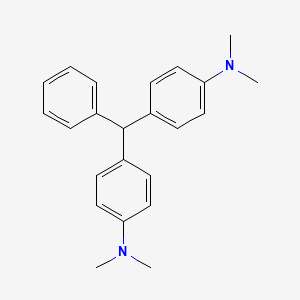
Chimie vérifiée pour le CAS 129-73-7
Leucomalachite green
Leucomalachite green is a benzenoid aromatic compound. — ChEBI
- Nom IUPAC
- 4-[[4-(dimethylamino)phenyl]-phenylmethyl]-N,N-dimethylaniline
- Formule moléculaire
- C23H26N2
- Masse moléculaire
- 330.5 g/mol
- Masse exacte
- 330.209598838 Da
- Masse monoisotopique
- 330.209598838 Da
- XLogP3
- 5,3
- Surface polaire topologique
- 6,5 Ų
- Complexité moléculaire
- 342,0
- Charge formelle
- 0
- Donneurs de liaisons hydrogène
- 0
- Accepteurs de liaisons hydrogène
- 2
- Liaisons rotatives
- 5
- Atomes lourds
- 25
- Unités covalentes
- 1
Noms et synonymes signalés à PubChem
16 autres noms signalés
Identifiants de bases de données externes
- ChEBI:CHEBI:181416
- ChEMBL:CHEMBL1898627
- EPA DTXSID:DTXSID7031531
- PubMed:26558467
- PubMed:21578770
- PubMed:16904259
- PubMed:12351145
- PubMed:9760285
Statistiques de structure avancées
- Stéréocentres atomiques définis
- 0
- Stéréocentres atomiques non définis
- 0
- Stéréocentres de liaison définis
- 0
- Stéréocentres de liaison non définis
- 0
- Caractéristiques pharmacophoriques 3D
- 5
- Cycles 3D
- 3
- Groupes hydrophobes 3D
- 0
- Caractéristiques d’accepteur 3D
- 0
- Caractéristiques de donneur 3D
- 0
- Centres anioniques 3D
- 0
- Centres cationiques 3D
- 2
- Conformères 3D
- 4
- Rotors 3D effectifs
- 5,0
Identifiants de structure lisibles par machine
- SMILES
CN(C)C1=CC=C(C=C1)C(C2=CC=CC=C2)C3=CC=C(C=C3)N(C)C- InChI
InChI=1S/C23H26N2/c1-24(2)21-14-10-19(11-15-21)23(18-8-6-5-7-9-18)20-12-16-22(17-13-20)25(3)4/h5-17,23H,1-4H3- InChIKey
WZKXBGJNNCGHIC-UHFFFAOYSA-N
Preuves issues de bases de données scientifiques complémentaires
NIH PubChem PUG-View
Attributed physical-property, hazard, environmental and use annotations.
- Color/Form: Off-white to light-brown powder Source: Hazardous Substances Data Bank (HSDB)
- Color/Form: Needles or leaflets from alcohol, benzene Source: Hazardous Substances Data Bank (HSDB)
- Melting Point: 102 °C Source: Hazardous Substances Data Bank (HSDB)
- Physical Description: Reduced form of malachite green; [Merck Index] Source: Haz-Map, Information on Hazardous Chemicals and Occupational Diseases
- Solubility: Very soluble in benzene, ethyl ether Source: Hazardous Substances Data Bank (HSDB)
- Solubility: Solubilities (mg/mL): 30 ethyleneglycol monomethyl ether; 4 ethanol Source: Hazardous Substances Data Bank (HSDB)
- IARC Carcinogenic Agent: Leucomalachite green Source: International Agency for Research on Cancer (IARC)
- IARC Carcinogenic Classes: Group 2B: Possibly carcinogenic to humans Source: International Agency for Research on Cancer (IARC)
- IARC Monographs: Volume 129: (2022) Gentian Violet, Leucogentian Violet, Malachite Green, Leucomalachite Green, and CI Direct Blue 218 Source: International Agency for Research on Cancer (IARC)
- Publication Year: 2022 online Source: International Agency for Research on Cancer (IARC)
- Evaluation Year: 2021 Source: International Agency for Research on Cancer (IARC)
- Substance: Leucomalachite Green Source: NTP Technical Reports
- NTP Technical Report: TR-527: Toxicology and Carcinogenesis Studies of Malachite Green Chloride and Leucomalachite Green (CASRNs 569-64-2 and 129-73-7) in F344/N Rats and B6C3F1 Mice (Feed Studies) (2005 ) Source: NTP Technical Reports
- Peer Review Date: 02/17/04 Source: NTP Technical Reports
- Conclusion for Male Rat: Equivocal Evidence Source: NTP Technical Reports
- Conclusion for Female Rat: Equivocal Evidence Source: NTP Technical Reports
- Conclusion for Male Mice: Chemical Not Tested in Species/Sex Source: NTP Technical Reports
- Conclusion for Female Mice: Some Evidence Source: NTP Technical Reports
- Signal: Warning Source: Regulation (EC) No 1272/2008 of the European Parliament and of the Council
- GHS Hazard Statements: H341: Suspected of causing genetic defects [Warning Germ cell mutagenicity]; H351: Suspected of causing cancer [Warning Carcinogenicity] Source: Regulation (EC) No 1272/2008 of the European Parliament and of the Council
- Precautionary Statement Codes: P203, P280, P318, P405, and P501 (click each P-code to see the statement) Source: Regulation (EC) No 1272/2008 of the European Parliament and of the Council
- Signal: Danger Source: European Chemicals Agency (ECHA)
- GHS Hazard Statements: H302 (96.2%): Harmful if swallowed [Warning Acute toxicity, oral]; H311 (15.4%): Toxic in contact with skin [Danger Acute toxicity, dermal]; H315 (15.4%): Causes skin irritation [Warning Skin corrosion/irritation]; H331 (15.4%): Toxic if inhaled [Danger Acute toxicity, inhalation]; H332 (15.4%): Harmful if inhaled [Warning Acute toxicity, inhalation]; H400 (96.2%): Very toxic to aquatic life [Warning Hazardous to the aquatic environment, acute hazard] Source: European Chemicals Agency (ECHA)
- Precautionary Statement Codes: P261, P262, P264, P270, P271, P273, P280, P301+P317, P302+P352, P304+P340, P316, P317, P321, P330, P332+P317, P361+P364, P362+P364, P391, P403+P233, P405, and P501 (click each P-code to see the statement) Source: European Chemicals Agency (ECHA)
- ECHA C&L Notifications Summary: Aggregated GHS information provided per 52 reports by companies from 6 notifications to the ECHA C&L Inventory. Each notification may be associated with multiple companies.; Information may vary between notifications depending on impurities, additives, and other factors. The percentage value in parenthesis indicates the notified classification ratio from companies that provide hazard codes. Only hazard codes with percentage values above 10% are shown. For more detailed information, please visit ECHA C&L website. Source: European Chemicals Agency (ECHA)
- Signal: Danger Source: NITE-CMC
- GHS Hazard Statements: H341: Suspected of causing genetic defects [Warning Germ cell mutagenicity]; H351: Suspected of causing cancer [Warning Carcinogenicity]; H361: Suspected of damaging fertility or the unborn child [Warning Reproductive toxicity]; H372: Causes damage to organs through prolonged or repeated exposure [Danger Specific target organ toxicity, repeated exposure]; H373: May causes damage to organs through prolonged or repeated exposure [Warning Specific target organ toxicity, repeated exposure] Source: NITE-CMC
- Precautionary Statement Codes: P203, P260, P264, P270, P280, P318, P319, P405, and P501 (click each P-code to see the statement) Source: NITE-CMC
- Signal: Warning Source: Hazardous Chemical Information System (HCIS), Safe Work Australia
- GHS Hazard Statements: H341: Suspected of causing genetic defects [Warning Germ cell mutagenicity]; H351: Suspected of causing cancer [Warning Carcinogenicity] Source: Hazardous Chemical Information System (HCIS), Safe Work Australia
- Environmental Bioconcentration: An estimated BCF of 2800 was calculated in fish for leucomalachite green(SRC), using an estimated log Kow of 5.72(1) and a regression-derived equation(2). According to a classification scheme(3), this BCF suggests the potential for bioconcentration in aquatic organisms is very high(SRC), provided the compound is not metabolized by the organism(SRC). Source: Hazardous Substances Data Bank (HSDB)
- Environmental Fate: TERRESTRIAL FATE: Based on a classification scheme(1), an estimated Koc value of 9.8X10+4(SRC), determined from a structure estimation method(2), indicates that leucomalachite green is expected to be immobile in soil(SRC). The estimated pKa of leucomalachite green is 5.46(3), indicating that this compound will exist partially in the cation form in the environment and cations generally adsorb more strongly to soils containing organic carbon and clay than their neutral counterparts(4). Volatilization of the neutral species from moist soil surfaces is not expected to be an important fate process(SRC) given an estimated Henry's Law constant of 9.8X10⁻⁹ atm-cu m/mole(SRC), using a fragment constant estimation method(5). Leucomalachite green is not expected to volatilize from dry soil surfaces(SRC) based upon an estimated vapor pressure of 1.9X10⁻⁷ mm Hg at 25 °C(SRC), determined from a fragment constant method(6). Biodegradation data in soil were not available(SRC, 2012). Source: Hazardous Substances Data Bank (HSDB)
- Environmental Fate: AQUATIC FATE: Based on a classification scheme(1), an estimated Koc value of 9.8X10+4(SRC), determined from a structure estimation method(2), indicates that leucomalachite green is expected to adsorb to suspended solids and sediment(SRC). Volatilization of the neutral species from water surfaces is not expected(3) based upon an estimated Henry's Law constant of 9.8X10⁻⁹ atm-cu m/mole(SRC), developed using a fragment constant estimation method(4). The estimated pKa of 5.72(5) indicates leucomalachite green will exist partially in the cation form at pH values of 5 to 9 and, therefore, volatilization from water surfaces is not expected to be an important fate process(SRC). According to a classification scheme(6), an estimated BCF of 2800(SRC), from an estimated log Kow of 5.72(7) and a regression-derived equation(8), suggests the potential for bioconcentration in aquatic organisms is very high, provided the compound is not metabolized by the organism(SRC). Biodegradation data in water were not available(SRC, 2012). Source: Hazardous Substances Data Bank (HSDB)
- Environmental Fate: ATMOSPHERIC FATE: According to a model of gas/particle partitioning of semivolatile organic compounds in the atmosphere(1), leucomalachite green, which has an estimated vapor pressure of 1.9X10⁻⁷ mm Hg at 25 °C(SRC), determined from a fragment constant method(2), will exist in both the vapor and particulate phases in the ambient atmosphere. Vapor-phase leucomalachite green is degraded in the atmosphere by reaction with photochemically-produced hydroxyl radicals(SRC); the half-life for this reaction in air is estimated to be 0.6 hours(SRC), calculated from its rate constant of 2.1X10⁻¹⁰ cu cm/molecule-sec at 25 °C(SRC) that was derived using a structure estimation method(3). Particulate-phase leucomalachite green may be removed from the air by wet or dry deposition(SRC). Leucomalachite green contains chromophores that absorb at wavelengths >290 nm(4) and, therefore, may be susceptible to direct photolysis by sunlight(SRC). Source: Hazardous Substances Data Bank (HSDB)
- Sources/Uses: Used to dye silk, wool, jute, leather, and cotton (after mordanting); Also used as a biological stain, reagent, pH indicator, fungicide, and parasiticide; [Merck Index] Source: Haz-Map, Information on Hazardous Chemicals and Occupational Diseases
- Industrial Processes with risk of exposure: Textiles (Printing, Dyeing, or Finishing) [Category: Industry] Source: Haz-Map, Information on Hazardous Chemicals and Occupational Diseases
- Uses: Reagent for the quantitative colorimetric microdetermination of hemoglobin and other heme compounds Source: Hazardous Substances Data Bank (HSDB)
Mis en correspondance par: Existing checksum-valid CAS to unique PubChem CID match. Récupéré le: 2026-08-31. Ouvrir la fiche source
Les classifications scientifiques et les annotations de danger apportent du contexte et ne remplacent pas la décision réglementaire propre au marché indiquée ci-dessus.
Couverture des sources complémentaires et état des correspondances
| Source | Résultat | Vérifié |
|---|---|---|
| NIH PubChem PUG-View | Correspondance exacte | 2026-08-31 |
Une absence de correspondance enregistrée est une preuve utile que la source a été vérifiée ; ce n’est pas l’affirmation que la substance n’existe pas ailleurs.
Récupéré depuis NIH PubChem le 2026-09-02 par correspondance CAS à somme de contrôle valide. Les propriétés chimiques ne remplacent pas la décision réglementaire de cette page.
Source officielle et provenance
- Source enregistrée
- Great Britain Cosmetics Regulation — consolidated Annexes II–VI and amendments
- Référence de la source
- GB Cosmetics Regulation, Annex II, entry 1550
- Identifiant de la fiche source
II-1550- Version de la source
- 2026-08-15
- Langue de la source
- English
- État de la traduction
- Original is English
- Date d’effet
- 2026-08-15
- Source mise à jour le
- 2026-08-19
- Instantané vérifié le
- 2026-08-30 04:51 UTC
- Méthode de validation
- legislation.gov.uk XML table parse; {'II': 1758, 'III': 326, 'IV': 154, 'V': 57, 'VI': 34}
- SHA-256
e3a386d950f54c6e7a7f9e784d1bd46e52de725137e89d5630709824475215d8
Notes du jeu de données enregistré
- Couverture du jeu de données
- Complete consolidated GB Annexes II–VI, with later amendments versioned separately
- Note sur l’autorité
- Binding GB schedules and versioned amendments to retained Regulation 1223/2009; applies to England, Wales and Scotland, not Northern Ireland
- Licence de la source
- Open Government Licence v3.0 / Crown copyright
- Attribution
- Contains public sector information licensed under the Open Government Licence v3.0.
Place de cette fiche dans le jeu de données du marché
Répartition des statuts
Un texte de conditions est présent pour 517 des 2329 fiches actuelles. Un champ de conditions vide est interprété selon le type de fiche ci-dessus ; il n’est jamais converti en une affirmation d’utilisation sans restriction.
Great Britain contexte du marché
Complete consolidated annex dataset
Version de la couverture : GB retained Regulation 1223/2009 schedules, effective 15 August 2026
Current consolidated Annexes II–VI for England, Scotland and Wales.
Liste de contrôle de vérification
- Confirm INCI/CAS/EC identity.
- Review every current GB Annex II–VI match.
- Check commencement dates and later statutory instruments.
- Verify SCPN, responsible-person, safety-report and labelling duties.
Sources officielles du marché
- Great Britain Cosmetics Regulation — consolidated Annexes II–VI and amendmentsBinding GB schedules and versioned amendments to retained Regulation 1223/2009; applies to England, Wales and Scotland, not Northern Ireland
Procédure de vérification et exhaustivité de la fiche
Avant d’utiliser ce résultat dans une décision de conformité
- Confirmez que « Leucomalachite green;N,N,N′,N′-tetramethyl-4,4′-benzylidenedianiline » et chaque identifiant CAS/CE correspondent à la matière de votre spécification fournisseur.
- Confirm INCI/CAS/EC identity.
- Review every current GB Annex II–VI match.
- Check commencement dates and later statutory instruments.
- Verify SCPN, responsible-person, safety-report and labelling duties.
- Consignez la version de la source et revérifiez auprès de l’autorité de réglementation avant la fabrication, la notification ou la mise sur le marché.
Champs disponibles dans cette fiche
- Nom officiel de la substanceDisponible
- CASDisponible
- ECDisponible
- Texte de condition distinctAbsent de la ligne source
- Date d’effetDisponible
- Empreinte de l’instantané et méthodeDisponible
Questions auxquelles cette page répond
Citation stable
Leucomalachite green;N,N,N′,N′-tetramethyl-4,4′-benzylidenedianiline. GB Cosmetics Regulation, Annex II, entry 1550. Great Britain. Source version 2026-08-15. CosIng Checker regulatory record: https://cosingchecker.com/fr/regulations/gb/records/5905/
Citez l’autorité de réglementation comme autorité juridique. Cette page est un index structuré de preuves et une aide à la vérification, et non un substitut au texte officiel ni à une évaluation juridique professionnelle.
Interprétation et limites pour Great Britain
This official record identifies the substance as prohibited for cosmetic use in the stated market scope.
Do not rely on a formulation containing this identity until the cited source, effective date and exact substance match have been verified.
Comment interpréter le rôle juridique
The cited row forms part of a binding rule or legally incorporated list for this market.
Preuves sur cette page
- Résultat enregistré : Prohibited
- Rôle juridique : Binding rule
- Version de la source : 2026-08-15
- Date d’effet : 2026-08-15
Ce que cela ne prouve pas
No annex match is not approval and does not cover Northern Ireland, which follows the applicable EU framework.
Recherche complémentaire sur la substance auprès de sources faisant autorité
Aucune de ces sources ne prévaut sur la décision de marché ci-dessus.
Cosmetic Ingredient Review safety assessments
Expert Panel conclusions, assessed ingredient groups, use conditions, dates and report documents
Independent expert review considered by FDA; not a government approval or binding market rule
Rechercher cette identité à la sourceFDA Global Substance Registration System
UNII identifiers, preferred names, substance types, codes and public substance relationships
Identity registry only; UNII availability does not imply FDA review or approval
Rechercher cette identité à la sourceILO/WHO International Chemical Safety Cards
Hazards, symptoms, first aid, storage, incompatibilities and physical properties for covered chemicals
International occupational chemical-safety reference; not cosmetic-use approval
Rechercher cette identité à la sourceJapan NITE-CHRIP
Chemical identity, Japanese and foreign legal lists, GHS hazards and exposure-related information
Chemical-management evidence; cosmetic status remains governed by the applicable MHLW standard and market rules
Rechercher cette identité à la sourceNIOSH Pocket Guide to Chemical Hazards
REL, PEL, IDLH, properties, exposure routes, symptoms, target organs, first aid and measurement methods for covered workplace chemicals
US occupational-health guidance and limits; not a cosmetic ingredient decision
Rechercher cette identité à la sourceOECD eChemPortal
Gateway to authority-owned physical-property, fate, ecotoxicity, toxicity, exposure and GHS records
Discovery gateway; each linked authority remains responsible for its data
Rechercher cette identité à la sourceUS EPA CompTox CTX APIs
Clé d’API requise pour l’importDTXSID identity, experimental and predicted properties, toxicity, bioactivity, exposure and environmental data
Scientific and computational evidence; predictions must remain labelled and do not determine cosmetic legality
Rechercher cette identité à la source