
CROTONALDEHYDE
CROTONALDEHYDE est lié à 1 fiche d’annexe de l’UE sur cette page. Note d’inventaire : II/1065.
En un coup d’œil
- Fonction
- Antioxidant, fragrance, perfuming
- CAS
- 123-73-9 / 4170-30-3
- EC
- 204-647-1 / 224-030-0
- Annexes de l’UE
- Annexe II/1065
- Annexe II/1065: interdit dans les produits cosmétiques
Base scientifique : 2 avis du CSSC
Le comité scientifique européen pour la sécurité des consommateurs (CSSC) a évalué cette substance. Ses avis sont la base scientifique de l’entrée de l’annexe.
- Opinion concerning Chemical Ingredients in Cosmetic Products classified as Carcinogenic, Mutagenic or Toxic to Reproduction according to the Chemicals Directiv…
- Opinion concerning Chemical Ingredients in Cosmetic Products classified as Carcinogenic, Mutagenic or Toxic to Reproduction according to the Chemicals Directiv…
Preuves réglementaires par marché
Cette matrice distingue les règles d’ingrédients vérifiées des sources cartographiées mais pas encore importées. L’absence de règle importée ne signifie pas que l’ingrédient est autorisé.
Balayez ou faites défiler horizontalement pour voir toutes les colonnes.
| Marché | Statut des preuves | Fiches | Langue de la source |
|---|---|---|---|
| European Union | Preuves associées Prohibited entry found Ouvrir cette preuve | 1 | English and EU languages |
| Great Britain | Preuves associées Prohibited Ouvrir cette preuve | 1 | English |
| Canada | Source cartographiée Official source mapped; ingredient rule not imported | 0 | English and French |
| New Zealand | Preuves associées Prohibited Ouvrir cette preuve | 1 | English |
| ASEAN | Preuves associées Prohibited Ouvrir cette preuve | 1 | English and national languages |
| China | Preuves associées Prohibited Ouvrir cette preuve | 1 | Chinese with selected English material |
| Japan | Source cartographiée Official source mapped; ingredient rule not imported | 0 | Japanese; official English translation available |
| South Korea | Preuves associées Prohibited Ouvrir cette preuve | 1 | Korean with some English names |
| United States | Source cartographiée Official source mapped; ingredient rule not imported | 0 | English |
| Australia | Source cartographiée Official source mapped; ingredient rule not imported | 0 | English |
| Brazil | Preuves associées Prohibited Ouvrir cette preuve | 1 | Portuguese with INCI crosswalks |
| India | Preuves associées Prohibited Ouvrir cette preuve | 1 | English and Hindi |
| Saudi Arabia | Preuves associées Prohibited Ouvrir cette preuve | 1 | Arabic and English |
Détails d’inventaire pour CROTONALDEHYDE
Nom INCI
CROTONALDEHYDE
Provenance de la fiche
- Référence d’inventaire
- 85042
- Identité importée
- CROTONALDEHYDE
- Mise à jour de la source
- 15/10/2010
Fiches d’annexe pour CROTONALDEHYDE
Crotonaldehyde [1]; (E)-crotonaldehyde [2]
Données clés
- ANTIOXIDANT
Inhibiting reactions promoted by oxygen, thus avoiding oxidation and rancidity.
- FRAGRANCE
Imparting an odour or taste. Creating a perceivable pleasant smell and/or masking a bad smell.
- PERFUMING
Used for perfume and aromatic raw materials.
Identité et propriétés chimiques
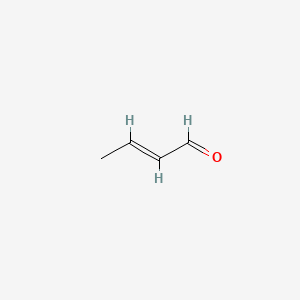
Crotonaldehyde
Crotonaldehyde is an enal consisting of propene having a formyl group at the 1-position. — ChEBI
- Nom IUPAC
- (E)-but-2-enal
- Formule moléculaire
- C4H6O
- Masse moléculaire
- 70.09 g/mol
- Masse exacte
- 70.041864811 Da
- XLogP3
- 0,5
- Surface polaire topologique
- 17,1 Ų
- Donneurs de liaisons hydrogène
- 0
- Accepteurs de liaisons hydrogène
- 1
- Unités covalentes
- 1
- Stéréocentres définis
- 0
Également connu sous le nom de
16 autres noms signalés
Identifiants de bases de données externes
- ChEBI:CHEBI:41607
- ChEMBL:CHEMBL1086445
- EPA DTXSID:DTXSID6020351
- PubMed:33749501
- PubMed:32634517
- PubMed:31345100
- PubMed:30426860
- PubMed:28947239
- PubMed:24849683
- PubMed:23535401
- PubMed:23000924
- PubMed:21329684
- PubMed:21238556
- PubMed:20955755
- PubMed:20471460
Preuves issues de bases de données scientifiques complémentaires
NIH PubChem PUG-View
Attributed physical-property, hazard, environmental and use annotations.
- Autoignition Temperature: 450 °F (USCG, 1999) Source: CAMEO Chemicals
- Autoignition Temperature: 232.2 °C (450 °F) Source: Hazardous Substances Data Bank (HSDB)
- Autoignition Temperature: 450 °F Source: Hazardous Substances Data Bank (HSDB)
- Autoignition Temperature: 232 °C Source: ILO-WHO International Chemical Safety Cards (ICSCs)
- Boiling Point: 219 °F at 760 mmHg (EPA, 1998) Source: CAMEO Chemicals
- Boiling Point: 219.2 °F at 760 mmHg (EPA, 1998) Source: CAMEO Chemicals
- Boiling Point: 102.2 °C Source: Hazardous Substances Data Bank (HSDB)
- Boiling Point: 104.00 °C. @ 760.00 mm Hg Source: Human Metabolome Database (HMDB)
- Boiling Point: 104 °C Source: ILO-WHO International Chemical Safety Cards (ICSCs)
- Boiling Point: 219 °F Source: Occupational Safety and Health Administration (OSHA)
- Boiling Point: 102.2 °C @760 [mm Hg] Source: PAC Chemical Database, U.S. Department of Energy
- Boiling Point: 219 °F Source: The National Institute for Occupational Safety and Health (NIOSH)
- Color/Form: Water-white, mobile liquid Source: Hazardous Substances Data Bank (HSDB)
- Color/Form: Water-white to straw-colored liquid Source: Hazardous Substances Data Bank (HSDB)
- Color/Form: Water-white liquid. [Note: Turns pale-yellow on contact with air.] Source: Hazardous Substances Data Bank (HSDB)
- Color/Form: Liquid Source: Hazardous Substances Data Bank (HSDB)
- Density: 0.853 at 68 °F (EPA, 1998) - Less dense than water; will float Source: CAMEO Chemicals
- Density: 0.853 at 20 °C/20 °C Source: Hazardous Substances Data Bank (HSDB)
- Density: 0.8516 g/cu cm at 20 °C Source: Hazardous Substances Data Bank (HSDB)
- Density: Relative density (water = 1): 0.85 Source: ILO-WHO International Chemical Safety Cards (ICSCs)
- Density: 0.87 Source: Occupational Safety and Health Administration (OSHA)
- Density: 0.8516 @ 20°C Source: PAC Chemical Database, U.S. Department of Energy
- Density: 0.853 @25 °C Source: PAC Chemical Database, U.S. Department of Energy
- Density: 0.87 Source: The National Institute for Occupational Safety and Health (NIOSH)
- Flash Point: 55 °F (EPA, 1998) Source: CAMEO Chemicals
- Flash Point: 55.4 °F (EPA, 1998) Source: CAMEO Chemicals
- Flash Point: The Guide from the Emergency Response Guidebook is for "crotonaldehyde, inhibited." 13 °C Source: Haz-Map, Information on Hazardous Chemicals and Occupational Diseases
- Flash Point: 13 °C (55 °F) Closed cup Source: Hazardous Substances Data Bank (HSDB)
- Flash Point: 9 °C (48 °F) - closed cup Source: Hazardous Substances Data Bank (HSDB)
- Flash Point: 13 °C c.c. Source: ILO-WHO International Chemical Safety Cards (ICSCs)
- Flash Point: 55 °F Source: Occupational Safety and Health Administration (OSHA)
- Flash Point: 45 °F Source: The National Institute for Occupational Safety and Health (NIOSH)
- LogP: 0.63 (calculated) Source: ILO-WHO International Chemical Safety Cards (ICSCs)
- Melting Point: -105 °F (EPA, 1998) Source: CAMEO Chemicals
- Melting Point: -101 °F (EPA, 1998) Source: CAMEO Chemicals
- Melting Point: -69 °C Source: Hazardous Substances Data Bank (HSDB)
- Melting Point: -76.6 °C Source: Hazardous Substances Data Bank (HSDB)
- Melting Point: -69 °C Source: Human Metabolome Database (HMDB)
- Melting Point: -76.5 °C (trans), -69 °C (cis) Source: ILO-WHO International Chemical Safety Cards (ICSCs)
- Melting Point: -101 °F Source: Occupational Safety and Health Administration (OSHA)
- Melting Point: -76 °C Source: PAC Chemical Database, U.S. Department of Energy
- Melting Point: -69 °C Source: PAC Chemical Database, U.S. Department of Energy
- Melting Point: -101 °F Source: The National Institute for Occupational Safety and Health (NIOSH)
- Odor: Pungent, suffocating odor Source: Hazardous Substances Data Bank (HSDB)
- Physical Description: Crotonaldehyde, stabilized appears as a clear colorless to straw colored liquid with a penetrating pungent odor. Flash point 55 °F. Density 7.1 lb / gal. Very toxic by inhalation. May polymerize with the release of heat under exposure to heat or contamination. If polymerization takes place inside a container, the container may rupture violently. Less dense than water. Vapors heavier than air. Source: CAMEO Chemicals
- Physical Description: (e)-crotonaldehyde is a water-white to straw-colored liquid with a pungent, suffocating odor. Used as a chemical intermediate in a variety of industrial processes (surfactants, textiles, paper, fuels, insecticides, leather tanning, etc.). Used in chemical warfare. (EPA, 1998) Source: CAMEO Chemicals
- Physical Description: Liquid Source: EPA Chemical Data Reporting (CDR)
- Physical Description: Water-white liquid with a suffocating odor; Note: Turns pale-yellow on contact with air; [NIOSH] Source: Haz-Map, Information on Hazardous Chemicals and Occupational Diseases
- Physical Description: Water-white liquid with a pungent suffocating odor; [HSDB] Source: Haz-Map, Information on Hazardous Chemicals and Occupational Diseases
- Physical Description: Liquid Source: Human Metabolome Database (HMDB)
- Physical Description: COLOURLESS LIQUID WITH PUNGENT ODOUR. TURNS PALE YELLOW ON EXPOSURE TO LIGHT AND AIR. Source: ILO-WHO International Chemical Safety Cards (ICSCs)
- Physical Description: Colorless to straw-colored liquid with a suffocating odor. Source: Occupational Safety and Health Administration (OSHA)
- Physical Description: Water-white liquid with a suffocating odor. [Note: Turns pale-yellow on contact with air.] Source: The National Institute for Occupational Safety and Health (NIOSH)
- Refractive Index: Index of refraction: 1.4384 at 17.7 °C Source: Hazardous Substances Data Bank (HSDB)
- Refractive Index: Index of refraction: 1.4366 at 20 °C/D Source: Hazardous Substances Data Bank (HSDB)
- Solubility: less than 0.1 mg/mL at 65.3 °F (NTP, 1992) Source: CAMEO Chemicals
- Solubility: Heat capacity: 0.7 ca/g ... Dimerizes under strong acid conditions, slowly oxidizes to crotonic acid. Solubility of water in crotonaldehyde (g/100g) at 20 °C: 9.5; at 5 °C: 19.2 Source: Hazardous Substances Data Bank (HSDB)
- Solubility: In water (g/100 g): 18.1 at 20 °C; 19.2 at 5 °C Source: Hazardous Substances Data Bank (HSDB)
- Solubility: In water, 1.81X10+5 mg/L at 20 °C Source: Hazardous Substances Data Bank (HSDB)
- Solubility: Soluble in chloroform; very soluble in ethanol, ethyl ether, acetone; miscible in benzene Source: Hazardous Substances Data Bank (HSDB)
- Solubility: Miscible with all proportions with alcohol, ether, toluene, kerosesne, gasolene, solvent naphtha Source: Hazardous Substances Data Bank (HSDB)
- Solubility: In water, 1.5X10+5 mg/L at 20 °C Source: Hazardous Substances Data Bank (HSDB)
- Solubility: In water, 1.56X10+5 mg/L at 25 °C Source: Hazardous Substances Data Bank (HSDB)
- Solubility: Soluble in water Source: Hazardous Substances Data Bank (HSDB)
- Solubility: In water, 181,000 ppm at 20 °C Source: Hazardous Substances Data Bank (HSDB)
- Solubility: Soluble in chloroform; very soluble in ethanol, ethyl ether, acetone; miscible with benzene Source: Hazardous Substances Data Bank (HSDB)
- Solubility: 150 mg/mL at 2 °C Source: Human Metabolome Database (HMDB)
- Vapor Pressure: 19 mmHg at 68 °F (EPA, 1998) Source: CAMEO Chemicals
- Vapor Pressure: 30.0 [mmHg] Source: Haz-Map, Information on Hazardous Chemicals and Occupational Diseases
- Vapor Pressure: 30 mm Hg at 25 °C Source: Hazardous Substances Data Bank (HSDB)
- Vapor Pressure: 38 mm Hg at 25 °C Source: Hazardous Substances Data Bank (HSDB)
- Vapor Pressure: Vapor pressure, kPa at 20 °C: 4.0 Source: ILO-WHO International Chemical Safety Cards (ICSCs)
- Vapor Pressure: 19 mmHg Source: Occupational Safety and Health Administration (OSHA)
- Vapor Pressure: 30 [mm Hg] @25 °C Source: PAC Chemical Database, U.S. Department of Energy
- Vapor Pressure: 19 mmHg Source: The National Institute for Occupational Safety and Health (NIOSH)
- IARC Carcinogenic Agent: Crotonaldehyde Source: International Agency for Research on Cancer (IARC)
- IARC Carcinogenic Classes: Group 2B: Possibly carcinogenic to humans Source: International Agency for Research on Cancer (IARC)
- IARC Monographs: Volume 63: (1995) Dry Cleaning, Some Chlorinated Solvents and Other Industrial Chemicals; Volume 128: (2021) Acrolein, Crotonaldehyde, and Arecoline Source: International Agency for Research on Cancer (IARC)
- Publication Year: 2021 online Source: International Agency for Research on Cancer (IARC)
- Evaluation Year: 2020 Source: International Agency for Research on Cancer (IARC)
- Exposure Routes: The substance can be absorbed into the body by inhalation of its vapour, through the skin and by ingestion. Source: ILO-WHO International Chemical Safety Cards (ICSCs)
- Exposure Routes: inhalation, ingestion, skin and/or eye contact Source: The National Institute for Occupational Safety and Health (NIOSH)
- First Aid: Warning: Effects may be delayed. Caution is advised.; Signs and Symptoms of Crotonaldehyde Exposure: Acute exposure to crotonaldehyde may produce tearing and extreme irritation to skin, eyes and, upper respiratory tract. Corneal damage may occur. Respiratory signs may include delayed pulmonary edema.; Emergency Life-Support Procedures: Acute exposure to crotonaldehyde may require decontamination and life support for the victims. Emergency personnel should wear protective clothing appropriate to the type and degree of contamination. Air-purifying or supplied-air respiratory equipment should also be worn, as necessary. Rescue vehicles should carry supplies such as plastic sheeting and disposable plastic bags to assist in preventing spread of contamination.; Inhalation Exposure:; 1. Move victims to fresh air. Emergency personnel should avoid self-exposure to crotonaldehyde.; 2. Evaluate vital signs including pulse and respiratory rate, and note any trauma. If no pulse is detected, provide CPR. If not breathing, provide artificial respiration. If breathing is labored, administer 100% humidified oxygen or other respiratory support.; 3. Obtain authorization and/or further instructions fr Source: CAMEO Chemicals
- First Aid: Warning: Crotonaldehyde, (E)- is an extreme eye, respiratory, and skin irritant and can cause corneal damage. Caution is advised.; Signs and Symptoms of Crotonaldehyde, (E)- Exposure: Signs and symptoms of acute exposure to crotonaldehyde, (E)- may include irritation of the eyes, skin, mucous membranes, nose, throat and upper respiratory tract. Delayed onset of pulmonary edema is possible following inhalation. Corneal damage may occur as may allergic contact dermatitis. Seizures may also be observed.; Emergency Life-Support Procedures: Acute exposure to crotonaldehyde, (E)- may require decontamination and life support for the victims. Emergency personnel should wear protective clothing appropriate to the type and degree of contami-nation. Air-purifying or supplied-air respiratory equipment should also be worn, as necessary. Rescue vehicles should carry supplies such as plastic sheeting and disposable plastic bags to assist in preventing spread of contamination.; Inhalation Exposure:; 1. Move victims to fresh air. Emergency personnel should avoid self-exposure to crotonaldehyde, (E)-.; 2. Evaluate vital signs including pulse and respiratory rate, and note any trauma. If no pulse is Source: CAMEO Chemicals
- ERG2024, Guide 131P (Crotonaldehyde; Crotonaldehyde, stabilized): General First Aid:; · Call 911 or emergency medical service.; · Ensure that medical personnel are aware of the material(s) involved, take precautions to protect themselves and avoid contamination.; · Move victim to fresh air if it can be done safely.; · Administer oxygen if breathing is difficult.; · If victim is not breathing:; -- DO NOT perform mouth-to-mouth resuscitation; the victim may have ingested or inhaled the substance.; -- If equipped and pulse detected, wash face and mouth, then give artificial respiration using a proper respiratory medical device (bag-valve mask, pocket mask equipped with a one-way valve or other device).; -- If no pulse detected or no respiratory medical device available, provide continuous compressions. Conduct a pulse check every two minutes or monitor for any signs of spontaneous respirations.; · Remove and isolate contaminated clothing and shoes.; · For minor skin contact, avoid spreading material on unaffected skin.; · In case of contact with substance, remove immediately by flushing skin or eyes with running water for at least 20 minutes.; · For severe burns, immediate medical attention is required.; · Effects of exposure (inhalation, ingestion, Source: Emergency Response Guidebook (ERG)
- First Aid: (General first aid procedures); Eye: Irrigate immediately - If this chemical contacts the eyes, immediately wash (irrigate) the eyes with large amounts of water, occasionally lifting the lower and upper lids. Get medical attention immediately.; Skin: Water flush immediately - If this chemical contacts the skin, immediately flush the contaminated skin with water. If this chemical penetrates the clothing, immediately remove the clothing and flush the skin with water. Get medical attention promptly.; Breathing: Respiratory support; Swallow: Medical attention immediately - If this chemical has been swallowed, get medical attention immediately. Source: The National Institute for Occupational Safety and Health (NIOSH)
- Signal: Danger Source: Regulation (EC) No 1272/2008 of the European Parliament and of the Council
- GHS Hazard Statements: H225: Highly Flammable liquid and vapor [Danger Flammable liquids]; H301: Toxic if swallowed [Danger Acute toxicity, oral]; H311: Toxic in contact with skin [Danger Acute toxicity, dermal]; H315: Causes skin irritation [Warning Skin corrosion/irritation]; H318: Causes serious eye damage [Danger Serious eye damage/eye irritation]; H330: Fatal if inhaled [Danger Acute toxicity, inhalation]; H335: May cause respiratory irritation [Warning Specific target organ toxicity, single exposure; Respiratory tract irritation]; H341: Suspected of causing genetic defects [Warning Germ cell mutagenicity]; H373 **: May causes damage to organs through prolonged or repeated exposure [Warning Specific target organ toxicity, repeated exposure]; H400: Very toxic to aquatic life [Warning Hazardous to the aquatic environment, acute hazard] Source: Regulation (EC) No 1272/2008 of the European Parliament and of the Council
- Precautionary Statement Codes: P203, P210, P233, P240, P241, P242, P243, P260, P261, P262, P264, P264+P265, P270, P271, P273, P280, P284, P301+P316, P302+P352, P303+P361+P353, P304+P340, P305+P354+P338, P316, P317, P318, P319, P320, P321, P330, P332+P317, P361+P364, P362+P364, P370+P378, P391, P403+P233, P403+P235, P405, and P501 (click each P-code to see the statement) Source: Regulation (EC) No 1272/2008 of the European Parliament and of the Council
- Signal: Danger Source: European Chemicals Agency (ECHA)
- GHS Hazard Statements: H225 (100%): Highly Flammable liquid and vapor [Danger Flammable liquids]; H301 (100%): Toxic if swallowed [Danger Acute toxicity, oral]; H311 (91.8%): Toxic in contact with skin [Danger Acute toxicity, dermal]; H315 (99.1%): Causes skin irritation [Warning Skin corrosion/irritation]; H318 (99.7%): Causes serious eye damage [Danger Serious eye damage/eye irritation]; H330 (100%): Fatal if inhaled [Danger Acute toxicity, inhalation]; H335 (100%): May cause respiratory irritation [Warning Specific target organ toxicity, single exposure; Respiratory tract irritation]; H341 (> 99.9%): Suspected of causing genetic defects [Warning Germ cell mutagenicity]; H373 (> 99.9%): May causes damage to organs through prolonged or repeated exposure [Warning Specific target organ toxicity, repeated exposure]; H400 (100%): Very toxic to aquatic life [Warning Hazardous to the aquatic environment, acute hazard] Source: European Chemicals Agency (ECHA)
- Precautionary Statement Codes: P203, P210, P233, P240, P241, P242, P243, P260, P261, P262, P264, P264+P265, P270, P271, P273, P280, P284, P301+P316, P302+P352, P303+P361+P353, P304+P340, P305+P354+P338, P316, P317, P318, P319, P320, P321, P330, P332+P317, P361+P364, P362+P364, P370+P378, P391, P403+P233, P403+P235, P405, and P501 (click each P-code to see the statement) Source: European Chemicals Agency (ECHA)
- ECHA C&L Notifications Summary: Aggregated GHS information provided per 1784 reports by companies from 27 notifications to the ECHA C&L Inventory. Each notification may be associated with multiple companies.; Information may vary between notifications depending on impurities, additives, and other factors. The percentage value in parenthesis indicates the notified classification ratio from companies that provide hazard codes. Only hazard codes with percentage values above 10% are shown. For more detailed information, please visit ECHA C&L website. Source: European Chemicals Agency (ECHA)
- GHS Hazard Statements: H225 (100%): Highly Flammable liquid and vapor [Danger Flammable liquids]; H300 (10.8%): Fatal if swallowed [Danger Acute toxicity, oral]; H301 (100%): Toxic if swallowed [Danger Acute toxicity, oral]; H310 (11.2%): Fatal in contact with skin [Danger Acute toxicity, dermal]; H311 (99.6%): Toxic in contact with skin [Danger Acute toxicity, dermal]; H315 (100%): Causes skin irritation [Warning Skin corrosion/irritation]; H318 (94.2%): Causes serious eye damage [Danger Serious eye damage/eye irritation]; H330 (100%): Fatal if inhaled [Danger Acute toxicity, inhalation]; H335 (100%): May cause respiratory irritation [Warning Specific target organ toxicity, single exposure; Respiratory tract irritation]; H341 (100%): Suspected of causing genetic defects [Warning Germ cell mutagenicity]; H373 (99.6%): May causes damage to organs through prolonged or repeated exposure [Warning Specific target organ toxicity, repeated exposure]; H400 (96.9%): Very toxic to aquatic life [Warning Hazardous to the aquatic environment, acute hazard] Source: European Chemicals Agency (ECHA)
- ECHA C&L Notifications Summary: Aggregated GHS information provided per 223 reports by companies from 11 notifications to the ECHA C&L Inventory. Each notification may be associated with multiple companies.; Information may vary between notifications depending on impurities, additives, and other factors. The percentage value in parenthesis indicates the notified classification ratio from companies that provide hazard codes. Only hazard codes with percentage values above 10% are shown. For more detailed information, please visit ECHA C&L website. Source: European Chemicals Agency (ECHA)
- Signal: Danger Source: NITE-CMC
- GHS Hazard Statements: H225: Highly Flammable liquid and vapor [Danger Flammable liquids]; H340: May cause genetic defects [Danger Germ cell mutagenicity]; H350: May cause cancer [Danger Carcinogenicity]; H401: Toxic to aquatic life [Hazardous to the aquatic environment, acute hazard] Source: NITE-CMC
- Precautionary Statement Codes: P203, P210, P233, P240, P241, P242, P243, P273, P280, P303+P361+P353, P318, P370+P378, P403+P235, P405, and P501 (click each P-code to see the statement) Source: NITE-CMC
- NFPA Health Rating: 4 - Materials that, under emergency conditions, can be lethal. Source: Hazardous Substances Data Bank (HSDB)
- NFPA Fire Rating: 3 - Liquids and solids that can be ignited under almost all ambient temperature conditions. Materials produce hazardous atmospheres with air under almost all ambient temperatures or, though unaffected by ambient temperatures, are readily ignited under almost all conditions. Source: Hazardous Substances Data Bank (HSDB)
- NFPA Instability Rating: 2 - Materials that readily undergo violent chemical changes at elevated temperatures and pressures. Source: Hazardous Substances Data Bank (HSDB)
- NFPA Specific Notice: W - No water: Materials that react violently or explosively with water. Source: Hazardous Substances Data Bank (HSDB)
- Target Organs: Eyes, skin, respiratory system Source: The National Institute for Occupational Safety and Health (NIOSH)
- Toxicity Summary: IDENTIFICATION AND USE: Crotonaldehyde is a water-white, mobile liquid. Crotonaldehyde was formerly used in the manufacture of n-butanol, but currently, the most extensive use of crotonaldehyde is in the manufacture of sorbic acid. Crotonaldehyde has also been used as a warning agent in fuel gases, in the preparation of rubber accelerators, in leather tanning, as an alcohol denaturant, and as a stabilizer for tetraethyl-lead. HUMAN STUDIES: A 15-minute exposure to crotonaldehyde at 4.1 ppm was highly irritating to the nose and upper respiratory tract and produced lacrimation in human volunteers in 30 seconds. Crotonaldehyde is highly toxic by the dermal route. Direct contact with liquid crotonaldehyde causes rapid and severe eye and skin irritation or burns. Exposure to vapor produces inflammation of mucous membranes. Clinical cases of sensitization have occurred. Crotonaldehyde vapors may produce pulmonary edema at high concentrations. Crotonaldehyde, a mutagen and carcinogen, reacts with deoxyguanosine (dGuo) in DNA to generate a pair of diastereomeric adducts (Cro-dGuo). Cro-dGuo adducts inhibit DNA synthesis and induce miscoding in human cells. DNA from human liver, lung, and b Source: Hazardous Substances Data Bank (HSDB)
- Toxicity Summary: IDENTIFICATION AND USE: (E)-Crotonaldehyde is a liquid. It is used in the manufacture of butyl alcohol, butyraldehyde, methoxybutyraldehyde, sorbic acid, maleic acid, crotonic acid, crotyl alcohol. In polymer chemistry, it is used in the manufacture of resins and polyvinyl acetals, as a solvent for polyvinyl chloride, as a rubber antioxidant, and it increases rubber strength with ketones. It is also used in preparation of insecticides and fertilizers, and in production of flavors. HUMAN STUDIES: (E)-Crotonaldehyde is a lacrymating material that is very dangerous to the eyes. It is a human skin and respiratory system irritant. Individuals with chronic respiratory disease, impaired pulmonary function, obstructive airway diseases, or skin disease may be at an increased risk from exposure to crotonaldehyde. ANIMAL STUDIES: Reported LD50 ranged from 140 mg/kg in rabbit to 1331 mg/kg in guinea pig, and LC50 for inhalation in rat was 4000 mg/cu m per 30 min exposure. Source: Hazardous Substances Data Bank (HSDB)
- Environmental Bioconcentration: An estimated BCF of 3 was calculated in fish for crotonaldehyde(SRC), using an estimated log Kow of 0.60(1) and a regression-derived equation(1). According to a classification scheme(2), this BCF suggests the potential for bioconcentration in aquatic organisms is low. Source: Hazardous Substances Data Bank (HSDB)
- Environmental Bioconcentration: An estimated BCF of 3 was calculated in fish for (E)-crotonaldehyde(SRC), using an estimated log Kow of 0.60(1) and a regression-derived equation(1). According to a classification scheme(2), this BCF suggests the potential for bioconcentration in aquatic organisms is low. Source: Hazardous Substances Data Bank (HSDB)
- Environmental Fate: TERRESTRIAL FATE: Based on a classification scheme(1), an estimated Koc value of 2(SRC), determined from a structure estimation method(2), indicates that crotonaldehyde is expected to have very high mobility in soil(SRC). Volatilization of crotonaldehyde from moist soil surfaces is expected(SRC) given an estimated Henry's Law constant of 1.5X10⁻⁵ atm-cu m/mole(SRC), based upon its vapor pressure, 30 mm Hg(3), and water solubility, 1.81X10+5 mg/L(4). Crotonaldehyde is expected to volatilize from dry soil surfaces(SRC) based upon its vapor pressure(3). A 73% of Theoretical BOD using activated sludge in the Japanese MITI test(5) suggests that biodegradation is an important environmental fate process in soil(SRC). Source: Hazardous Substances Data Bank (HSDB)
- Environmental Fate: AQUATIC FATE: Based on a classification scheme(1), an estimated Koc value of 2(SRC), determined from a structure estimation method(2), indicates that crotonaldehyde is not expected to adsorb to suspended solids and sediment(SRC). Volatilization from water surfaces is expected(3) based upon an estimated Henry's Law constant of 1.5X10⁻⁵ atm-cu m/mole(SRC), derived from its vapor pressure, 30 mm Hg(4), and water solubility, 1.81X10+5 mg/L(5). Using this Henry's Law constant and an estimation method(3), volatilization half-lives for a model river and model lake are 2.1 and 18 days, respectively(SRC). Crotonaldehyde is not expected to undergo hydrolysis in the environment due to the lack of functional groups that hydrolyze under environmental conditions(3). According to a classification scheme(6), an estimated BCF of 3(SRC), from an estimated log Kow of 0.60(2) and a regression-derived equation(2), suggests the potential for bioconcentration in aquatic organisms is low. The half-lives for olefinic structures (similar to crotonaldehyde) in sunlit natural waters are about 13 and 8 days with respect to reaction via hydroxyl radicals and singlet oxygen(7). Crotonaldehyde was observed to hav Source: Hazardous Substances Data Bank (HSDB)
- Environmental Fate: ATMOSPHERIC FATE: According to a model of gas/particle partitioning of semivolatile organic compounds in the atmosphere(1), crotonaldehyde, which has a vapor pressure of 30 mm Hg at 20 °C(2), is expected to exist solely as a vapor in the ambient atmosphere. Vapor-phase crotonaldehyde is degraded in the atmosphere by reaction with photochemically-produced hydroxyl radicals(SRC); the half-life for this reaction in air is estimated to be 11 hours(SRC), calculated from an experimental rate constant for trans-crotonaldehyde of 3.6X10⁻¹¹ cu cm/molecule-sec(3) and an estimated rate constant for cis-crotonaldehyde of 3.6X10⁻¹¹ cu cm/molecule-sec(SRC) that was derived using a structure estimation method(4). The atmospheric reaction half-life of crotonaldehyde with ozone is estimated to be 6.3 and 12 days for the trans- and cis-isomers, respectively, based on estimated reaction rates of 1.8X10⁻¹⁸ and 9.1X10⁻¹⁹ cu cm/molecule-sec at 25 °C(SRC), derived using a structure estimation method(4), and an atmospheric concentration of 7X10+11 ozone molecules per cu cm(5). Crotonaldehyde absorbs at wavelengths >290 nm(6) and, therefore, may be susceptible to direct photolysis by sunlight(SRC). Source: Hazardous Substances Data Bank (HSDB)
- Environmental Fate: TERRESTRIAL FATE: Based on a classification scheme(1), an estimated Koc value of 2(SRC), determined from a structure estimation method(2), indicates that (E)-crotonaldehyde is expected to have very high mobility in soil(SRC). Volatilization of (E)-crotonaldehyde from moist soil surfaces is expected(SRC) given a Henry's Law constant of 1.94X10⁻⁵ atm-cu m/mole(3). (E)-Crotonaldehyde is expected to volatilize from dry soil surfaces(SRC) based upon a vapor pressure of 38 mm Hg at 25 °C(4). A 73% of Theoretical BOD using activated sludge in the Japanese MITI test(5) suggests that biodegradation is an important environmental fate process in soil(SRC). Other biodegradation studies suggest that (E)-crotonaldehyde may be biodegradable in soil(6), especially in anaerobic conditions(7,8). Source: Hazardous Substances Data Bank (HSDB)
- Environmental Fate: AQUATIC FATE: Based on a classification scheme(1), an estimated Koc value of 2(SRC), determined from a structure estimation method(2), indicates that (E)-crotonaldehyde is not expected to adsorb to suspended solids and sediment(SRC). Volatilization from water surfaces is expected(3) based upon a Henry's Law constant of 1.94X10⁻⁵ atm-cu m/mole(4). Using this Henry's Law constant and an estimation method(3), volatilization half-lives for a model river and model lake are 40 hours and 15 days, respectively(SRC). (E)-Crotonaldehyde is not expected to undergo hydrolysis in the environment due to the lack of functional groups that hydrolyze under environmental conditions(3). According to a classification scheme(5), an estimated BCF of 3(SRC), from an estimated log Kow of 0.60(2) and a regression-derived equation(2), suggests the potential for bioconcentration in aquatic organisms is low. Biodegradation studies suggest that (E)-crotonaldehyde may be biodegradable in water(6), especially in anaerobic conditions(7,8). Source: Hazardous Substances Data Bank (HSDB)
- Environmental Fate: ATMOSPHERIC FATE: According to a model of gas/particle partitioning of semivolatile organic compounds in the atmosphere(1), (E)-crotonaldehyde, which has a vapor pressure of 38 mm Hg at 25 °C(2), is expected to exist solely as a vapor in the ambient atmosphere. Vapor-phase (E)-crotonaldehyde is degraded in the atmosphere by reaction with photochemically-produced hydroxyl radicals and ozone(SRC); the half-lives for these reactions in air are 11 hours and 15.5 days(SRC), calculated from respective rate constants of 3.6X10⁻¹¹(3) and 7.4X10⁻¹⁹(4) cu cm/molecule-sec. (E)-Crotonaldehyde contains chromophores that absorb at wavelengths >290 nm(5) and, therefore, may be susceptible to direct photolysis by sunlight(SRC). Source: Hazardous Substances Data Bank (HSDB)
- Industry Uses: Intermediate Source: EPA Chemical Data Reporting (CDR)
- Sources/Uses: Used in the synthesis of other organic chemicals; [ACGIH] Source: Haz-Map, Information on Hazardous Chemicals and Occupational Diseases
- Sources/Uses: Used to make other chemicals (n-butyl alcohol, quinaldine, crotonic acid, 2-ethylhexyl alcohol, butyraldehyde, surface-active agents, resins, rubber antioxidants, textile and paper sizes, insecticides, and flavoring agents); Also used as a fuel-gas warning agent, solvent for polyvinyl chloride and purification of mineral oils, alcohol denaturant, leather tanning agent, to locate breaks and leaks in pipes, and in chemical warfare; [HSDB] Source: Haz-Map, Information on Hazardous Chemicals and Occupational Diseases
- Industrial Processes with risk of exposure: Petroleum Production and Refining [Category: Industry]; Leather Tanning and Processing [Category: Industry] Source: Haz-Map, Information on Hazardous Chemicals and Occupational Diseases
- Uses: For crotonaldehyde (USEPA/OPP Pesticide Code: 202600) there are 0 labels match. /SRP: Not registered for current use in the U.S., but approved pesticide uses may change periodically and so federal, state and local authorities must be consulted for currently approved uses./ Source: Hazardous Substances Data Bank (HSDB)
- Uses: Crotonaldehyde was formerly used in the manufacture of n-butanol, but currently, the most extensive use of crotonaldehyde is in the manufacture of sorbic acid. Crotonaldehyde has also been used as a warning agent in fuel gases, in the preparation of rubber accelerators, in leather tanning, as an alcohol denaturant, and as a stabilizer for tetraethyl-lead. Source: Hazardous Substances Data Bank (HSDB)
- Uses: Manufacture of butyl alcohol, butyraldehyde, methoxybutyraldehyde, sorbic acid, maleic acid, crotonic acid, crotyl alcohol. In polymer chemistry: manufacture of resins and polyvinyl acetals, solvent for polyvinyl chloride, rubber antioxidant, increases rubber strength with ketones. In prepatation of insecticides and fertilizers. In production of flavors. Source: Hazardous Substances Data Bank (HSDB)
- Uses: Intermediate for n-butyl alcohol and 2-ethylhexyl alcohol, solvent, preparation of rubber accelerators, purification of lubricating oils, insecticides, tear gas, fuel-gas warning agent, organic synthesis, leather tanning, alcohol denaturant. Source: Hazardous Substances Data Bank (HSDB)
- Uses: CHEM INT FOR N-BUTYL ALCOHOL, QUINALDINE, CROTONIC ACID, SURFACE-ACTIVE AGENTS, TEXTILE & PAPER SIZES, INSECTICIDES & FLAVORING AGENTS; FUEL-GAS WARNING AGENT; SOLVENT FOR POLYVINYL CHLORIDE; ALCOHOL DENATURANT; LEATHER TANNING AGENT Source: Hazardous Substances Data Bank (HSDB)
- Uses: Manufacture of butyl alcohol, butyraldehyde, methoxybutyraldehyde, sorbic acid, maleic acid, crotonic acid, crotyl alcohol. In polymer chemistry: manufacture of resins and polyvinyl acetals, solvent for polyvinyl chloride, rubber antioxidant, increases rubber strength with ketones. In prepatation of insecticides and fertilizers. In production of flavors. /Crotonaldehyde/ Source: Hazardous Substances Data Bank (HSDB)
Mis en correspondance par: Existing checksum-valid CAS to unique PubChem CID match. Récupéré le: 2026-08-31. Ouvrir la fiche source
Les classifications scientifiques et les annotations de danger apportent du contexte et ne remplacent pas la décision réglementaire propre au marché indiquée ci-dessus.
Couverture des sources complémentaires et état des correspondances
| Source | Résultat | Vérifié |
|---|---|---|
| NIH PubChem PUG-View | Correspondance exacte | 2026-08-31 |
Une absence de correspondance enregistrée est une preuve utile que la source a été vérifiée ; ce n’est pas l’affirmation que la substance n’existe pas ailleurs.
Récupéré depuis NIH PubChem le 2026-09-02 par correspondance CAS à somme de contrôle valide. Les propriétés chimiques ne remplacent pas la décision réglementaire de cette page.
Preuves officielles sur le nom d’ingrédient de l’UE
Le nom de l’ingrédient correspond exactement au glossaire officiel 2025 de l’UE des dénominations communes d’ingrédients.
Preuves d’inventaire associées
Ingrédients ayant des fonctions de formulation communes
Sources officielles et scientifiques complémentaires
11 bases de données externes pour vérifier cette identité
Chaque lien lance une recherche de cette identité dans la source concernée. Ce qu’est chaque source et sa valeur juridique
Comment CROTONALDEHYDE apparaît dans l’inventaire CosIng
L’inventaire CosIng répertorie CROTONALDEHYDE comme ingrédient cosmétique et cette page l’associe à 1 fiche d’annexe. L’entrée d’inventaire reprend les noms et identifiants, tandis que la fiche d’annexe indique où la substance est interdite, soumise à restrictions ou inscrite sur une liste positive dans le droit de l’UE sur les cosmétiques.
CROTONALDEHYDE est aussi associé à 3 fonctions cosmétiques dans les données officielles. Les désignations de fonction décrivent l’usage prévu, mais ne remplacent pas l’examen réglementaire des fiches d’annexe associées avant un travail de formulation ou d’étiquetage.
Questions fréquentes
Note de source pour CROTONALDEHYDE
Cette page associe l’entrée d’inventaire CosIng de CROTONALDEHYDE à 1 fiche liée des annexes II à VI de notre jeu de données, construit à partir de documents publics de la Commission européenne sur les ingrédients cosmétiques.
Utilisez cette page d’inventaire pour étudier CROTONALDEHYDE et comparer les fiches associées, mais vérifiez les restrictions et le statut juridique auprès du texte officiel en vigueur et de la législation avant toute décision réglementaire.
Outils et étapes suivantes
Vérifiez votre formule
Analysez une liste INCI complète pour détecter CROTONALDEHYDE et les éventuelles restrictions d’annexes de l’UE ou signalements d’allergènes associés.
Vérificateur INCIRechercher des ingrédients similaires
Trouvez d’autres ingrédients de l’inventaire et entrées d’annexe liés à CROTONALDEHYDE, à ses identifiants ou à des variantes de nom proches.
Rechercher