
DIETHYL ETHANOLAMINE
Ethanol, 2-(diethylamino)
DIETHYL ETHANOLAMINE figure dans l’inventaire CosIng de l’UE, mais aucune fiche d’annexe directe n’est encore associée sur cette page.
En un coup d’œil
- Fonction
- Buffering
- CAS
- 100-37-8
- EC
- 202-845-2
- Annexes de l’UE
- Non répertoriéAucune fiche d’annexe de l’UE n’est associée. Ce n’est pas une autorisation.
Preuves réglementaires par marché
Aucune règle pour cet ingrédient n’a été importée pour aucun des 13 marchés suivis ici.
Cela décrit cet inventaire, et non le droit. L’absence de règle importée n’est pas la preuve qu’un ingrédient est autorisé : une règle peut exister sous un autre nom ou identifiant, ou dans un jeu de données pas encore importé ici.
Détails d’inventaire pour DIETHYL ETHANOLAMINE
Nom INCI
DIETHYL ETHANOLAMINE
Description
Ethanol, 2-(diethylamino)
Provenance de la fiche
- Référence d’inventaire
- 55841
- Identité importée
- DIETHYL ETHANOLAMINE
- Mise à jour de la source
- 15/10/2010
Fiches d’annexe pour DIETHYL ETHANOLAMINE
Données clés
Identité et propriétés chimiques
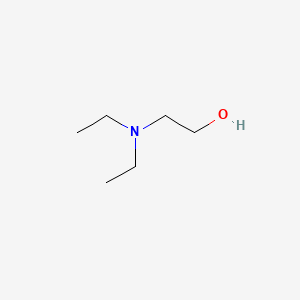
Diethylethanolamine
2-diethylaminoethanol is a member of the class of ethanolamines that is aminoethanol in which the hydrogens of the amino group are replaced by ethyl groups. It is a primary alcohol, a member of ethanolamines and a tertiary amino compound. It is functionally related to an ethanolamine. It derives from a hydride of a triethylamine. — ChEBI
- Nom IUPAC
- 2-(diethylamino)ethanol
- Formule moléculaire
- C6H15NO
- Masse moléculaire
- 117.19 g/mol
- Masse exacte
- 117.115364102 Da
- XLogP3
- 0,3
- Surface polaire topologique
- 23,5 Ų
- Donneurs de liaisons hydrogène
- 1
- Accepteurs de liaisons hydrogène
- 2
- Unités covalentes
- 1
- Stéréocentres définis
- 0
Également connu sous le nom de
16 autres noms signalés
Identifiants de bases de données externes
- ChEBI:CHEBI:52153
- ChEMBL:CHEMBL1183
- EPA DTXSID:DTXSID5021837
- PubMed:22934827
- PubMed:22683026
- PubMed:22588291
- PubMed:22558796
- PubMed:22325017
- PubMed:22308719
- PubMed:21966668
- PubMed:21908655
- PubMed:21591931
- PubMed:21581773
- PubMed:21299793
- PubMed:21248790
Preuves issues de bases de données scientifiques complémentaires
EMBL-EBI ChEBI
2-diethylaminoethanol
A member of the class of ethanolamines that is aminoethanol in which the hydrogens of the amino group are replaced by ethyl groups.
- Formule
- C6H15NO
- Masse moyenne
- 117.192 g/mol
- Masse monoisotopique
- 117.11536 Da
- Charge formelle
- 0
- tertiary amino compound — is a (CHEBI:50996)
- primary alcohol — is a (CHEBI:15734)
- ethanolamines — is a (CHEBI:23981)
- plastic light stabilizer — has role (CHEBI:747339)
- polymerization initiator — has role (CHEBI:747342)
- ethanolamine — has functional parent (CHEBI:16000)
- triethylamine — has parent hydride (CHEBI:35026)
- plastic light stabilizer — has role (CHEBI:747339)
- polymerization initiator — has role (CHEBI:747342)
- tertiary amino compound — is a (CHEBI:50996)
- primary alcohol — is a (CHEBI:15734)
- ethanolamines — is a (CHEBI:23981)
- 22325017 Source: PubMed
Noms supplémentaires validés
Références croisées de cette source
- CAS: 100-37-8 — ChemIDplus
- CAS: 100-37-8 — NIST Chemistry WebBook
- MANUAL_X_REF: 2-Diethylaminoethanol — Wikipedia
- MANUAL_X_REF: HMDB0033971 — HMDB
- REGISTRY_NUMBER: 741863 — Reaxys
Mis en correspondance par: Exact CAS cross-reference in the ChEBI compound record. Source mise à jour le: 2026-02-11. Récupéré le: 2026-08-31. Ouvrir la fiche source
NIH PubChem PUG-View
Attributed physical-property, hazard, environmental and use annotations.
- Autoignition Temperature: 608 °F (320 °C) Source: Hazardous Substances Data Bank (HSDB)
- Autoignition Temperature: 250 °C Source: ILO-WHO International Chemical Safety Cards (ICSCs)
- Boiling Point: 325 °F at 760 mmHg (NTP, 1992) Source: CAMEO Chemicals
- Boiling Point: 163 °C @ 760 MM HG Source: Hazardous Substances Data Bank (HSDB)
- Boiling Point: 163.00 °C. @ 760.00 mm Hg Source: Human Metabolome Database (HMDB)
- Boiling Point: 163 °C Source: ILO-WHO International Chemical Safety Cards (ICSCs)
- Boiling Point: 325 °F Source: Occupational Safety and Health Administration (OSHA)
- Boiling Point: 162 °C @760 [mm Hg] Source: PAC Chemical Database, U.S. Department of Energy
- Boiling Point: 325 °F Source: The National Institute for Occupational Safety and Health (NIOSH)
- Color/Form: COLORLESS LIQUID Source: Hazardous Substances Data Bank (HSDB)
- Color/Form: Colorless liquid. Source: Hazardous Substances Data Bank (HSDB)
- Density: 0.8921 at 77 °F (USCG, 1999) - Less dense than water; will float Source: CAMEO Chemicals
- Density: 0.8921 @ 20 °C/4 °C Source: Hazardous Substances Data Bank (HSDB)
- Density: Relative density (water = 1): 0.88 Source: ILO-WHO International Chemical Safety Cards (ICSCs)
- Density: 0.89 Source: Occupational Safety and Health Administration (OSHA)
- Density: 0.8851 @ 20°C Source: PAC Chemical Database, U.S. Department of Energy
- Density: 0.89 Source: The National Institute for Occupational Safety and Health (NIOSH)
- Dissociation Constants: pKa = 9.87 at 20 °C (conjugate acid) Source: Hazardous Substances Data Bank (HSDB)
- Flash Point: 140 °F (NTP, 1992) Source: CAMEO Chemicals
- Flash Point: 49 °C Source: Haz-Map, Information on Hazardous Chemicals and Occupational Diseases
- Flash Point: 140 °F (OPEN CUP) Source: Hazardous Substances Data Bank (HSDB)
- Flash Point: 125 °F (closed cup) Source: Hazardous Substances Data Bank (HSDB)
- Flash Point: 52 °C c.c. Source: ILO-WHO International Chemical Safety Cards (ICSCs)
- Flash Point: 140 °F Source: Occupational Safety and Health Administration (OSHA)
- Flash Point: 126 °F Source: The National Institute for Occupational Safety and Health (NIOSH)
- LogP: 0.46 Source: ILO-WHO International Chemical Safety Cards (ICSCs)
- Melting Point: -94 °F (NTP, 1992) Source: CAMEO Chemicals
- Melting Point: FREEZING POINT: -70 °C Source: Hazardous Substances Data Bank (HSDB)
- Melting Point: -70 °C Source: ILO-WHO International Chemical Safety Cards (ICSCs)
- Melting Point: -94 °F Source: Occupational Safety and Health Administration (OSHA)
- Melting Point: -70 °C Source: PAC Chemical Database, U.S. Department of Energy
- Melting Point: -94 °F Source: The National Institute for Occupational Safety and Health (NIOSH)
- Odor: NAUSEATING ODOR Source: Hazardous Substances Data Bank (HSDB)
- Odor: Nauseating, ammonia-like odor. Source: Hazardous Substances Data Bank (HSDB)
- Physical Description: 2-diethylaminoethanol appears as a colorless liquid. Flash point 103-140 °F. Less dense than water. Vapors heavier than air. Produces toxic oxides of nitrogen during combustion. Causes burns to the skin, eyes and mucous membranes. Source: CAMEO Chemicals
- Physical Description: Liquid Source: EPA Chemical Data Reporting (CDR)
- Physical Description: Colorless liquid with a nauseating, ammonia-like odor; [NIOSH] Source: Haz-Map, Information on Hazardous Chemicals and Occupational Diseases
- Physical Description: COLOURLESS HYGROSCOPIC LIQUID WITH CHARACTERISTIC ODOUR. Source: ILO-WHO International Chemical Safety Cards (ICSCs)
- Physical Description: Colorless liquid with a nauseating, ammonia-like odor. Source: Occupational Safety and Health Administration (OSHA)
- Physical Description: Colorless liquid with a nauseating, ammonia-like odor. Source: The National Institute for Occupational Safety and Health (NIOSH)
- Refractive Index: SADTLER REFERENCE NUMBER: 143 (IR, PRISM); INDEX OF REFRACTION: 1.4412 @ 20 °C/D Source: Hazardous Substances Data Bank (HSDB)
- Solubility: Very soluble (NTP, 1992) Source: CAMEO Chemicals
- Solubility: SOL IN ALL PROPORTIONS IN WATER; SOL IN ALC, ETHER, ACETONE, BENZENE, PETROLEUM ETHER Source: Hazardous Substances Data Bank (HSDB)
- Solubility: 1000000 mg/L @ 25 °C (exp) Source: Human Metabolome Database (HMDB)
- Solubility: Solubility in water: miscible Source: ILO-WHO International Chemical Safety Cards (ICSCs)
- Solubility: Miscible Source: The National Institute for Occupational Safety and Health (NIOSH)
- Vapor Pressure: 21 mmHg at 68 °F (NTP, 1992) Source: CAMEO Chemicals
- Vapor Pressure: 21.0 [mmHg] Source: Haz-Map, Information on Hazardous Chemicals and Occupational Diseases
- Vapor Pressure: 21 MM HG @ 20 °C Source: Hazardous Substances Data Bank (HSDB)
- Vapor Pressure: Vapor pressure, kPa at 20 °C: 2.8 Source: ILO-WHO International Chemical Safety Cards (ICSCs)
- Vapor Pressure: 1 mmHg Source: Occupational Safety and Health Administration (OSHA)
- Vapor Pressure: 1.4 [mm Hg] @20 °C Source: PAC Chemical Database, U.S. Department of Energy
- Vapor Pressure: 1 mmHg Source: The National Institute for Occupational Safety and Health (NIOSH)
- Viscosity: 5 mPa-s at 20 °C Source: Hazardous Substances Data Bank (HSDB)
- Exposure Routes: The substance can be absorbed into the body by inhalation, through the skin and by ingestion. Source: ILO-WHO International Chemical Safety Cards (ICSCs)
- Exposure Routes: inhalation, skin absorption, ingestion, skin and/or eye contact Source: The National Institute for Occupational Safety and Health (NIOSH)
- First Aid: EYES: First check the victim for contact lenses and remove if present. Flush victim's eyes with water or normal saline solution for 20 to 30 minutes while simultaneously calling a hospital or poison control center. Do not put any ointments, oils, or medication in the victim's eyes without specific instructions from a physician. IMMEDIATELY transport the victim after flushing eyes to a hospital even if no symptoms (such as redness or irritation) develop.; SKIN: IMMEDIATELY flood affected skin with water while removing and isolating all contaminated clothing. Gently wash all affected skin areas thoroughly with soap and water. IMMEDIATELY call a hospital or poison control center even if no symptoms (such as redness or irritation) develop. IMMEDIATELY transport the victim to a hospital for treatment after washing the affected areas.; INHALATION: IMMEDIATELY leave the contaminated area; take deep breaths of fresh air. If symptoms (such as wheezing, coughing, shortness of breath, or burning in the mouth, throat, or chest) develop, call a physician and be prepared to transport the victim to a hospital. Provide proper respiratory protection to rescuers entering an unknown atmosphere. Whene Source: CAMEO Chemicals
- ERG2024, Guide 132 (2-Diethylaminoethanol): General First Aid:; · Call 911 or emergency medical service.; · Ensure that medical personnel are aware of the material(s) involved, take precautions to protect themselves and avoid contamination.; · Move victim to fresh air if it can be done safely.; · Administer oxygen if breathing is difficult.; · If victim is not breathing:; -- DO NOT perform mouth-to-mouth resuscitation; the victim may have ingested or inhaled the substance.; -- If equipped and pulse detected, wash face and mouth, then give artificial respiration using a proper respiratory medical device (bag-valve mask, pocket mask equipped with a one-way valve or other device).; -- If no pulse detected or no respiratory medical device available, provide continuous compressions. Conduct a pulse check every two minutes or monitor for any signs of spontaneous respirations.; · Remove and isolate contaminated clothing and shoes.; · For minor skin contact, avoid spreading material on unaffected skin.; · In case of contact with substance, remove immediately by flushing skin or eyes with running water for at least 20 minutes.; · For severe burns, immediate medical attention is required.; · Effects of exposure (inhalation, ingestion, Source: Emergency Response Guidebook (ERG)
- First Aid: (General first aid procedures); Eye: Irrigate immediately - If this chemical contacts the eyes, immediately wash (irrigate) the eyes with large amounts of water, occasionally lifting the lower and upper lids. Get medical attention immediately.; Skin: Water flush immediately - If this chemical contacts the skin, immediately flush the contaminated skin with water. If this chemical penetrates the clothing, immediately remove the clothing and flush the skin with water. Get medical attention promptly.; Breathing: Respiratory support; Swallow: Medical attention immediately - If this chemical has been swallowed, get medical attention immediately. Source: The National Institute for Occupational Safety and Health (NIOSH)
- Signal: Danger Source: Regulation (EC) No 1272/2008 of the European Parliament and of the Council
- GHS Hazard Statements: H226: Flammable liquid and vapor [Warning Flammable liquids]; H302: Harmful if swallowed [Warning Acute toxicity, oral]; H312: Harmful in contact with skin [Warning Acute toxicity, dermal]; H314: Causes severe skin burns and eye damage [Danger Skin corrosion/irritation]; H332: Harmful if inhaled [Warning Acute toxicity, inhalation] Source: Regulation (EC) No 1272/2008 of the European Parliament and of the Council
- Precautionary Statement Codes: P210, P233, P240, P241, P242, P243, P260, P261, P264, P270, P271, P280, P301+P317, P301+P330+P331, P302+P352, P302+P361+P354, P303+P361+P353, P304+P340, P305+P354+P338, P316, P317, P321, P330, P362+P364, P363, P370+P378, P403+P235, P405, and P501 (click each P-code to see the statement) Source: Regulation (EC) No 1272/2008 of the European Parliament and of the Council
- Signal: Danger Source: European Chemicals Agency (ECHA)
- GHS Hazard Statements: H226 (100%): Flammable liquid and vapor [Warning Flammable liquids]; H290 (40.2%): May be corrosive to metals [Warning Corrosive to Metals]; H302+H312+H332 (40.2%): Harmful if swallowed, in contact with skin or if inhaled [Warning Acute toxicity, oral; acute toxicity, dermal; acute toxicity, inhalation]; H302 (100%): Harmful if swallowed [Warning Acute toxicity, oral]; H311 (22.2%): Toxic in contact with skin [Danger Acute toxicity, dermal]; H312 (77.8%): Harmful in contact with skin [Warning Acute toxicity, dermal]; H314 (100%): Causes severe skin burns and eye damage [Danger Skin corrosion/irritation]; H318 (63.5%): Causes serious eye damage [Danger Serious eye damage/eye irritation]; H331 (23.4%): Toxic if inhaled [Danger Acute toxicity, inhalation]; H332 (76.6%): Harmful if inhaled [Warning Acute toxicity, inhalation]; H335 (46.9%): May cause respiratory irritation [Warning Specific target organ toxicity, single exposure; Respiratory tract irritation] Source: European Chemicals Agency (ECHA)
- Precautionary Statement Codes: P210, P233, P234, P240, P241, P242, P243, P260, P261, P262, P264, P264+P265, P270, P271, P280, P301+P317, P301+P330+P331, P302+P352, P302+P361+P354, P303+P361+P353, P304+P340, P305+P354+P338, P316, P317, P319, P321, P330, P361+P364, P362+P364, P363, P370+P378, P390, P403+P233, P403+P235, P405, P406, and P501 (click each P-code to see the statement) Source: European Chemicals Agency (ECHA)
- ECHA C&L Notifications Summary: Aggregated GHS information provided per 1097 reports by companies from 27 notifications to the ECHA C&L Inventory. Each notification may be associated with multiple companies.; Information may vary between notifications depending on impurities, additives, and other factors. The percentage value in parenthesis indicates the notified classification ratio from companies that provide hazard codes. Only hazard codes with percentage values above 10% are shown. For more detailed information, please visit ECHA C&L website. Source: European Chemicals Agency (ECHA)
- Signal: Danger Source: NITE-CMC
- GHS Hazard Statements: H226: Flammable liquid and vapor [Warning Flammable liquids]; H302: Harmful if swallowed [Warning Acute toxicity, oral]; H312: Harmful in contact with skin [Warning Acute toxicity, dermal]; H314: Causes severe skin burns and eye damage [Danger Skin corrosion/irritation]; H318: Causes serious eye damage [Danger Serious eye damage/eye irritation]; H331: Toxic if inhaled [Danger Acute toxicity, inhalation]; H335: May cause respiratory irritation [Warning Specific target organ toxicity, single exposure; Respiratory tract irritation]; H370: Causes damage to organs [Danger Specific target organ toxicity, single exposure]; H373: May causes damage to organs through prolonged or repeated exposure [Warning Specific target organ toxicity, repeated exposure] Source: NITE-CMC
- Precautionary Statement Codes: P210, P233, P240, P241, P242, P243, P260, P261, P264, P264+P265, P270, P271, P280, P301+P317, P301+P330+P331, P302+P352, P302+P361+P354, P303+P361+P353, P304+P340, P305+P354+P338, P308+P316, P316, P317, P319, P321, P330, P362+P364, P363, P370+P378, P403+P233, P403+P235, P405, and P501 (click each P-code to see the statement) Source: NITE-CMC
- GHS Hazard Statements: H226: Flammable liquid and vapor [Warning Flammable liquids]; H302: Harmful if swallowed [Warning Acute toxicity, oral]; H312: Harmful in contact with skin [Warning Acute toxicity, dermal]; H314: Causes severe skin burns and eye damage [Danger Skin corrosion/irritation]; H318: Causes serious eye damage [Danger Serious eye damage/eye irritation]; H331: Toxic if inhaled [Danger Acute toxicity, inhalation]; H370: Causes damage to organs [Danger Specific target organ toxicity, single exposure]; H373: May causes damage to organs through prolonged or repeated exposure [Warning Specific target organ toxicity, repeated exposure] Source: NITE-CMC
- Signal: Danger Source: Hazardous Chemical Information System (HCIS), Safe Work Australia
- NFPA Health Rating: 3 - Materials that, under emergency conditions, can cause serious or permanent injury. Source: Hazardous Substances Data Bank (HSDB)
- NFPA Fire Rating: 2 - Materials that must be moderately heated or exposed to relatively high ambient temperatures before ignition can occur. Materials would not under normal conditions form hazardous atmospheres with air, but under high ambient temperatures or under moderate heating could release vapor in sufficient quantities to produce hazardous atmospheres with air. Source: Hazardous Substances Data Bank (HSDB)
- NFPA Instability Rating: 0 - Materials that in themselves are normally stable, even under fire conditions. Source: Hazardous Substances Data Bank (HSDB)
- Target Organs: Eyes, skin, respiratory system Source: The National Institute for Occupational Safety and Health (NIOSH)
- Consumer Uses: Not Known or Reasonably Ascertainable Source: EPA Chemical Data Reporting (CDR)
- Industry Uses: Intermediate; Anti-scaling agent; Not Known or Reasonably Ascertainable; Anti-condensation agent Source: EPA Chemical Data Reporting (CDR)
- Sources/Uses: Used as an isocyanate curing agent; [Sullivan, Table 34-2, p. 471] Used as a chemical intermediate for pharmaceuticals, cosmetics, flocculants, emulsifiers, surface coatings, and other organic chemicals (in the chemical, agricultural, plastics, paper, and leather industries); [HSDB] Source: Haz-Map, Information on Hazardous Chemicals and Occupational Diseases
- Industrial Processes with risk of exposure: Pulp and Paper Processing [Category: Industry]; Plastic Composites Manufacturing [Category: Industry] Source: Haz-Map, Information on Hazardous Chemicals and Occupational Diseases
- Uses: MFR OF EMULSIFYING AGENTS AND SPECIAL SOAPS Source: Hazardous Substances Data Bank (HSDB)
- Uses: CHEM INT FOR PETROLEUM & GAS PROCESSING CHEMS, COSMETICS, SURFACE COATINGS, TEXTILES & FIBERS, PROCAINE, CHLOROQUINE Source: Hazardous Substances Data Bank (HSDB)
- Uses: WATER-SOL SALTS; FATTY ACID DERIVATIVES; TEXTILES SOFTNERS; PHARMACEUTICALS; ANTIRUST COMPOSITIONS; EMULSIFYING AGENTS IN ACID MEDIA; DERIVATIVES CONTAINING TERTIARY AMINE GROUPS; CURING AGENT FOR RESINS Source: Hazardous Substances Data Bank (HSDB)
- Uses: Intermediate in production of pharmaceuticals, crop protection agents, and flocculants. Preparation of chemicals for the paper and leather industries; production of plastics. Source: Hazardous Substances Data Bank (HSDB)
Mis en correspondance par: Existing checksum-valid CAS to unique PubChem CID match. Récupéré le: 2026-08-31. Ouvrir la fiche source
Les classifications scientifiques et les annotations de danger apportent du contexte et ne remplacent pas la décision réglementaire propre au marché indiquée ci-dessus.
Couverture des sources complémentaires et état des correspondances
| Source | Résultat | Vérifié |
|---|---|---|
| EMBL-EBI ChEBI | Correspondance exacte | 2026-08-31 |
| NIH PubChem PUG-View | Correspondance exacte | 2026-08-31 |
Une absence de correspondance enregistrée est une preuve utile que la source a été vérifiée ; ce n’est pas l’affirmation que la substance n’existe pas ailleurs.
Récupéré depuis NIH PubChem le 2026-08-31 par correspondance CAS à somme de contrôle valide. Les propriétés chimiques ne remplacent pas la décision réglementaire de cette page.
Preuves officielles sur le nom d’ingrédient de l’UE
Le nom de l’ingrédient correspond exactement au glossaire officiel 2025 de l’UE des dénominations communes d’ingrédients.
Preuves d’inventaire associées
Ingrédients ayant des fonctions de formulation communes
Sources officielles et scientifiques complémentaires
11 bases de données externes pour vérifier cette identité
Chaque lien lance une recherche de cette identité dans la source concernée. Ce qu’est chaque source et sa valeur juridique
Comment DIETHYL ETHANOLAMINE apparaît dans l’inventaire CosIng
L’inventaire CosIng répertorie DIETHYL ETHANOLAMINE comme ingrédient cosmétique et cette page l’associe à 0 fiche d’annexe. L’entrée d’inventaire reprend les noms et identifiants, tandis que la fiche d’annexe indique où la substance est interdite, soumise à restrictions ou inscrite sur une liste positive dans le droit de l’UE sur les cosmétiques.
DIETHYL ETHANOLAMINE est aussi associé à 1 fonction cosmétique dans les données officielles. Les désignations de fonction décrivent l’usage prévu, mais ne remplacent pas l’examen réglementaire des fiches d’annexe associées avant un travail de formulation ou d’étiquetage.
Questions fréquentes
Note de source pour DIETHYL ETHANOLAMINE
Cette page reproduit l’entrée d’inventaire CosIng de DIETHYL ETHANOLAMINE issue de documents publics de la Commission européenne sur les ingrédients cosmétiques et affiche les identifiants associés, même si aucune correspondance directe avec une annexe n’est actuellement rattachée.
Utilisez cette page d’inventaire pour étudier DIETHYL ETHANOLAMINE et comparer les fiches associées, mais vérifiez les restrictions et le statut juridique auprès du texte officiel en vigueur et de la législation avant toute décision réglementaire.
Outils et étapes suivantes
Vérifiez votre formule
Analysez une liste INCI complète pour détecter DIETHYL ETHANOLAMINE et les éventuelles restrictions d’annexes de l’UE ou signalements d’allergènes associés.
Vérificateur INCIRechercher des ingrédients similaires
Trouvez d’autres ingrédients de l’inventaire et entrées d’annexe liés à DIETHYL ETHANOLAMINE, à ses identifiants ou à des variantes de nom proches.
Rechercher