
UREA PEROXIDE
Hydrogen peroxide-urea
UREA PEROXIDE est lié à 1 fiche d’annexe de l’UE sur cette page. Note d’inventaire : III/12.
En un coup d’œil
- Fonction
- Oxidising
- CAS
- 124-43-6
- EC
- 204-701-4
- Annexes de l’UE
- Annexe III/12
- Annexe III/12:
max. · (a) Hair products
(b) Skin products
(c) Nail hardening products
(d) Oral products, inc… · avertissement d'étiquetage :
(a) (f) Wear suitable gloves (a) (b) (c) (e) Contains hydrogen peroxide Avoid contact with eyes Rinse immediately …
Base scientifique : 6 avis du CSSC
Le comité scientifique européen pour la sécurité des consommateurs (CSSC) a évalué cette substance. Ses avis sont la base scientifique de l’entrée de l’annexe.
- Opinion on Hydrogen Peroxide in Tooth Whitening products
- Opinion concerning Hydrogen (Carbamide, Zinc) Peroxide in Tooth Bleaching/Whitening Products,Guidance document on Epidemiological and clinical studies on Tooth…
- Opinion of concerning Hydrogen (Carbamide) Peroxide in Tooth Whitening Products
- Clarification on Hydrogen (Carbamide) peroxide in Tooth Whitening Products
- Opinion concerning Hydrogen Peroxide and Hydrogen Peroxide releasing Substances used in Oral Care Products
- Opinion on Hydrogen peroxide, in its free form or when released, oral hygiene products
Preuves réglementaires par marché
Cette matrice distingue les règles d’ingrédients vérifiées des sources cartographiées mais pas encore importées. L’absence de règle importée ne signifie pas que l’ingrédient est autorisé.
Balayez ou faites défiler horizontalement pour voir toutes les colonnes.
| Marché | Statut des preuves | Fiches | Langue de la source |
|---|---|---|---|
| European Union | Preuves associées Restricted entry found Ouvrir cette preuve | 1 | English and EU languages |
| Great Britain | Source cartographiée Official source mapped; ingredient rule not imported | 0 | English |
| Canada | Preuves associées Restricted Ouvrir cette preuve | 2 | English and French |
| New Zealand | Source cartographiée Official source mapped; ingredient rule not imported | 0 | English |
| ASEAN | Source cartographiée Official source mapped; ingredient rule not imported | 0 | English and national languages |
| China | Source cartographiée Official source mapped; ingredient rule not imported | 0 | Chinese with selected English material |
| Japan | Source cartographiée Official source mapped; ingredient rule not imported | 0 | Japanese; official English translation available |
| South Korea | Source cartographiée Official source mapped; ingredient rule not imported | 0 | Korean with some English names |
| United States | Source cartographiée Official source mapped; ingredient rule not imported | 0 | English |
| Australia | Source cartographiée Official source mapped; ingredient rule not imported | 0 | English |
| Brazil | Source cartographiée Official source mapped; ingredient rule not imported | 0 | Portuguese with INCI crosswalks |
| India | Source cartographiée Official source mapped; ingredient rule not imported | 0 | English and Hindi |
| Saudi Arabia | Source cartographiée Official source mapped; ingredient rule not imported | 0 | Arabic and English |
Détails d’inventaire pour UREA PEROXIDE
Nom INCI
UREA PEROXIDE
Nom DCI
carbamide peroxide
Description
Hydrogen peroxide-urea
Provenance de la fiche
- Référence d’inventaire
- 38839
- Identité importée
- UREA PEROXIDE
- Mise à jour de la source
- 15/10/2010
Fiches d’annexe pour UREA PEROXIDE
Données clés
Identité et propriétés chimiques
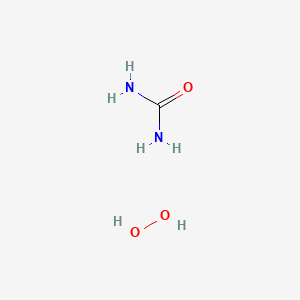
Carbamide Peroxide
Urea hydrogen peroxide is a mixture obtained by combining equimolar amounts of hydrogen peroxide and urea. It has a role as a reagent, a disinfectant and an oxidising agent. It contains a urea and a hydrogen peroxide. — ChEBI
- Nom IUPAC
- hydrogen peroxide;urea
- Formule moléculaire
- CH6N2O3
- Masse moléculaire
- 94.07 g/mol
- Masse exacte
- 94.03784206 Da
- Surface polaire topologique
- 110,0 Ų
- Donneurs de liaisons hydrogène
- 4
- Accepteurs de liaisons hydrogène
- 3
- Unités covalentes
- 2
- Stéréocentres définis
- 0
Également connu sous le nom de
16 autres noms signalés
Identifiants de bases de données externes
- ChEBI:CHEBI:75178
- ChEMBL:CHEMBL3184026
- EPA DTXSID:DTXSID9024726
- PubMed:25254197
- PubMed:22666835
- PubMed:22031060
- PubMed:15527615
Preuves issues de bases de données scientifiques complémentaires
NIH PubChem PUG-View
Attributed physical-property, hazard, environmental and use annotations.
- Autoignition Temperature: greater than 680 °F (USCG, 1999) Source: CAMEO Chemicals
- Density: 0.8 at 68 °F (USCG, 1999) - Less dense than water; will float Source: CAMEO Chemicals
- Density: 0.8 @ 20°C Source: PAC Chemical Database, U.S. Department of Energy
- Melting Point: 167 to 185 °F (decomposes) (NTP, 1992) Source: CAMEO Chemicals
- Melting Point: 75-85 Source: DrugBank
- Physical Description: Urea hydrogen peroxide appears as a solid or paste-like semisolid. Used to make plastics. Source: CAMEO Chemicals
- Physical Description: White solid; [Merck Index] Solid or paste-like semisolid; [CAMEO] Odorless; [CHRIS] White tablet; [Sigma-Aldrich MSDS] Source: Haz-Map, Information on Hazardous Chemicals and Occupational Diseases
- Solubility: greater than or equal to 100 mg/mL at 68 °F (NTP, 1992) Source: CAMEO Chemicals
- Solubility: 500 g/L at °C Source: DrugBank
- First Aid: EYES: First check the victim for contact lenses and remove if present. Flush victim's eyes with water or normal saline solution for 20 to 30 minutes while simultaneously calling a hospital or poison control center. Do not put any ointments, oils, or medication in the victim's eyes without specific instructions from a physician. IMMEDIATELY transport the victim after flushing eyes to a hospital even if no symptoms (such as redness or irritation) develop.; SKIN: IMMEDIATELY flood affected skin with water while removing and isolating all contaminated clothing. Gently wash all affected skin areas thoroughly with soap and water. If symptoms such as redness or irritation develop, IMMEDIATELY call a physician and be prepared to transport the victim to a hospital for treatment.; INHALATION: IMMEDIATELY leave the contaminated area; take deep breaths of fresh air. If symptoms (such as wheezing, coughing, shortness of breath, or burning in the mouth, throat, or chest) develop, call a physician and be prepared to transport the victim to a hospital. Provide proper respiratory protection to rescuers entering an unknown atmosphere. Whenever possible, Self-Contained Breathing Apparatus (SCBA) shou Source: CAMEO Chemicals
- ERG2024, Guide 140 (Urea hydrogen peroxide): General First Aid:; · Call 911 or emergency medical service.; · Ensure that medical personnel are aware of the material(s) involved, take precautions to protect themselves and avoid contamination.; · Move victim to fresh air if it can be done safely.; · Administer oxygen if breathing is difficult.; · If victim is not breathing:; -- DO NOT perform mouth-to-mouth resuscitation; the victim may have ingested or inhaled the substance.; -- If equipped and pulse detected, wash face and mouth, then give artificial respiration using a proper respiratory medical device (bag-valve mask, pocket mask equipped with a one-way valve or other device).; -- If no pulse detected or no respiratory medical device available, provide continuous compressions. Conduct a pulse check every two minutes or monitor for any signs of spontaneous respirations.; · Remove and isolate contaminated clothing and shoes.; · For minor skin contact, avoid spreading material on unaffected skin.; · In case of contact with substance, remove immediately by flushing skin or eyes with running water for at least 20 minutes.; · For severe burns, immediate medical attention is required.; · Effects of exposure (inhalation, ingestion, Source: Emergency Response Guidebook (ERG)
- Signal: Danger Source: European Chemicals Agency (ECHA)
- GHS Hazard Statements: H272 (94.9%): May intensify fire; oxidizer [Danger Oxidizing liquids; Oxidizing solids]; H314 (83.1%): Causes severe skin burns and eye damage [Danger Skin corrosion/irritation]; H315 (16.9%): Causes skin irritation [Warning Skin corrosion/irritation]; H318 (18.6%): Causes serious eye damage [Danger Serious eye damage/eye irritation] Source: European Chemicals Agency (ECHA)
- Precautionary Statement Codes: P210, P220, P260, P264, P264+P265, P280, P301+P330+P331, P302+P352, P302+P361+P354, P304+P340, P305+P354+P338, P316, P317, P321, P332+P317, P362+P364, P363, P370+P378, P405, and P501 (click each P-code to see the statement) Source: European Chemicals Agency (ECHA)
- ECHA C&L Notifications Summary: Aggregated GHS information provided per 59 reports by companies from 12 notifications to the ECHA C&L Inventory. Each notification may be associated with multiple companies.; Information may vary between notifications depending on impurities, additives, and other factors. The percentage value in parenthesis indicates the notified classification ratio from companies that provide hazard codes. Only hazard codes with percentage values above 10% are shown. For more detailed information, please visit ECHA C&L website. Source: European Chemicals Agency (ECHA)
- Signal: Danger Source: NITE-CMC
- GHS Hazard Statements: H272: May intensify fire; oxidizer [Danger Oxidizing liquids; Oxidizing solids]; H315: Causes skin irritation [Warning Skin corrosion/irritation]; H318: Causes serious eye damage [Danger Serious eye damage/eye irritation] Source: NITE-CMC
- Precautionary Statement Codes: P210, P220, P264, P264+P265, P280, P302+P352, P305+P354+P338, P317, P321, P332+P317, P362+P364, P370+P378, and P501 (click each P-code to see the statement) Source: NITE-CMC
- GHS Hazard Statements: H272: May intensify fire; oxidizer [Danger Oxidizing liquids; Oxidizing solids]; H314: Causes severe skin burns and eye damage [Danger Skin corrosion/irritation]; H318: Causes serious eye damage [Danger Serious eye damage/eye irritation]; H335: May cause respiratory irritation [Warning Specific target organ toxicity, single exposure; Respiratory tract irritation] Source: NITE-CMC
- Precautionary Statement Codes: P210, P220, P260, P261, P264, P264+P265, P271, P280, P301+P330+P331, P302+P361+P354, P304+P340, P305+P354+P338, P316, P317, P319, P321, P363, P370+P378, P403+P233, P405, and P501 (click each P-code to see the statement) Source: NITE-CMC
- Signal: Danger Source: Hazardous Chemical Information System (HCIS), Safe Work Australia
- GHS Hazard Statements: H302: Harmful if swallowed [Warning Acute toxicity, oral]; H315: Causes skin irritation [Warning Skin corrosion/irritation]; H318: Causes serious eye damage [Danger Serious eye damage/eye irritation]; H335: May cause respiratory irritation [Warning Specific target organ toxicity, single exposure; Respiratory tract irritation] Source: Hazardous Chemical Information System (HCIS), Safe Work Australia
- Precautionary Statement Codes: P261, P264, P264+P265, P270, P271, P280, P301+P317, P302+P352, P304+P340, P305+P354+P338, P317, P319, P321, P330, P332+P317, P362+P364, P403+P233, P405, and P501 (click each P-code to see the statement) Source: Hazardous Chemical Information System (HCIS), Safe Work Australia
- Sources/Uses: Used as an antiseptic, cerumenolytic, and dental bleach; [Merck Index] Used to make plastics; [CAMEO] Used for hair bleaching, oxidation of permanent waves, and hair relaxing; [ExPub: EC: SCCP] Used to develop blueprints and for the modification of starches; [NTP] Source: Haz-Map, Information on Hazardous Chemicals and Occupational Diseases
- Industrial Processes with risk of exposure: Using Disinfectants or Biocides [Category: Clean]; Dressing Hair [Category: Other] Source: Haz-Map, Information on Hazardous Chemicals and Occupational Diseases
Mis en correspondance par: Existing checksum-valid CAS to unique PubChem CID match. Récupéré le: 2026-08-31. Ouvrir la fiche source
Les classifications scientifiques et les annotations de danger apportent du contexte et ne remplacent pas la décision réglementaire propre au marché indiquée ci-dessus.
Couverture des sources complémentaires et état des correspondances
| Source | Résultat | Vérifié |
|---|---|---|
| NIH PubChem PUG-View | Correspondance exacte | 2026-08-31 |
Une absence de correspondance enregistrée est une preuve utile que la source a été vérifiée ; ce n’est pas l’affirmation que la substance n’existe pas ailleurs.
Récupéré depuis NIH PubChem le 2026-08-31 par correspondance CAS à somme de contrôle valide. Les propriétés chimiques ne remplacent pas la décision réglementaire de cette page.
Preuves officielles sur le nom d’ingrédient de l’UE
Le nom de l’ingrédient correspond exactement au glossaire officiel 2025 de l’UE des dénominations communes d’ingrédients.
Preuves d’inventaire associées
Ingrédients ayant des fonctions de formulation communes
Sources officielles et scientifiques complémentaires
11 bases de données externes pour vérifier cette identité
Chaque lien lance une recherche de cette identité dans la source concernée. Ce qu’est chaque source et sa valeur juridique
Comment UREA PEROXIDE apparaît dans l’inventaire CosIng
L’inventaire CosIng répertorie UREA PEROXIDE comme ingrédient cosmétique et cette page l’associe à 1 fiche d’annexe. L’entrée d’inventaire reprend les noms et identifiants, tandis que la fiche d’annexe indique où la substance est interdite, soumise à restrictions ou inscrite sur une liste positive dans le droit de l’UE sur les cosmétiques.
UREA PEROXIDE est aussi associé à 1 fonction cosmétique dans les données officielles. Les désignations de fonction décrivent l’usage prévu, mais ne remplacent pas l’examen réglementaire des fiches d’annexe associées avant un travail de formulation ou d’étiquetage.
Questions fréquentes
Note de source pour UREA PEROXIDE
Cette page associe l’entrée d’inventaire CosIng de UREA PEROXIDE à 1 fiche liée des annexes II à VI de notre jeu de données, construit à partir de documents publics de la Commission européenne sur les ingrédients cosmétiques.
Utilisez cette page d’inventaire pour étudier UREA PEROXIDE et comparer les fiches associées, mais vérifiez les restrictions et le statut juridique auprès du texte officiel en vigueur et de la législation avant toute décision réglementaire.
Outils et étapes suivantes
Vérifiez votre formule
Analysez une liste INCI complète pour détecter UREA PEROXIDE et les éventuelles restrictions d’annexes de l’UE ou signalements d’allergènes associés.
Vérificateur INCIRechercher des ingrédients similaires
Trouvez d’autres ingrédients de l’inventaire et entrées d’annexe liés à UREA PEROXIDE, à ses identifiants ou à des variantes de nom proches.
Rechercher