
METHYLAL
Dimethoxymethane
METHYLAL figure dans l’inventaire CosIng de l’UE, mais aucune fiche d’annexe directe n’est encore associée sur cette page.
En un coup d’œil
- Fonction
- Solvent
- CAS
- 109-87-5
- EC
- 203-714-2
- Annexes de l’UE
- Non répertoriéAucune fiche d’annexe de l’UE n’est associée. Ce n’est pas une autorisation.
Preuves réglementaires par marché
Aucune règle pour cet ingrédient n’a été importée pour aucun des 13 marchés suivis ici.
Cela décrit cet inventaire, et non le droit. L’absence de règle importée n’est pas la preuve qu’un ingrédient est autorisé : une règle peut exister sous un autre nom ou identifiant, ou dans un jeu de données pas encore importé ici.
Détails d’inventaire pour METHYLAL
Nom INCI
METHYLAL
Description
Dimethoxymethane
Provenance de la fiche
- Référence d’inventaire
- 35329
- Identité importée
- METHYLAL
- Mise à jour de la source
- 15/10/2010
Fiches d’annexe pour METHYLAL
Données clés
Identité et propriétés chimiques
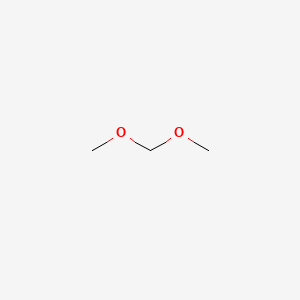
Dimethoxymethane
Dimethoxymethane is an acetal that is the dimethyl acetal derivative of formaldehyde. It is a diether and an acetal. It is functionally related to a methanediol. — ChEBI
- Nom IUPAC
- dimethoxymethane
- Formule moléculaire
- C3H8O2
- Masse moléculaire
- 76.09 g/mol
- Masse exacte
- 76.052429494 Da
- XLogP3
- 0,2
- Surface polaire topologique
- 18,5 Ų
- Donneurs de liaisons hydrogène
- 0
- Accepteurs de liaisons hydrogène
- 2
- Unités covalentes
- 1
- Stéréocentres définis
- 0
Également connu sous le nom de
16 autres noms signalés
Identifiants de bases de données externes
- ChEBI:CHEBI:48341
- ChEMBL:CHEMBL15537
- EPA DTXSID:DTXSID1025564
- PubMed:22606192
- PubMed:22520499
- PubMed:22272074
- PubMed:22242007
- PubMed:22237728
- PubMed:22090021
- PubMed:21850493
- PubMed:21766121
- PubMed:21686155
- PubMed:21589598
- PubMed:21589597
- PubMed:21369433
Preuves issues de bases de données scientifiques complémentaires
NIH PubChem PUG-View
Attributed physical-property, hazard, environmental and use annotations.
- Autoignition Temperature: 459 °F (USCG, 1999) Source: CAMEO Chemicals
- Autoignition Temperature: 459 °F (237 °C) Source: Hazardous Substances Data Bank (HSDB)
- Autoignition Temperature: 235 °C Source: ILO-WHO International Chemical Safety Cards (ICSCs)
- Boiling Point: 108 °F at 760 mmHg (USCG, 1999) Source: CAMEO Chemicals
- Boiling Point: 41.6 °C @ 760 MM HG Source: Hazardous Substances Data Bank (HSDB)
- Boiling Point: 42 °C Source: ILO-WHO International Chemical Safety Cards (ICSCs)
- Boiling Point: 111 °F Source: Occupational Safety and Health Administration (OSHA)
- Boiling Point: 42 °C @760 [mm Hg] Source: PAC Chemical Database, U.S. Department of Energy
- Boiling Point: 111 °F Source: The National Institute for Occupational Safety and Health (NIOSH)
- Color/Form: COLORLESS, CLEAR LIQUID Source: Hazardous Substances Data Bank (HSDB)
- Color/Form: Colorless solid. Source: Hazardous Substances Data Bank (HSDB)
- Density: 0.861 at 68 °F (USCG, 1999) - Less dense than water; will float Source: CAMEO Chemicals
- Density: 0.8593 @ 20 °C/4 °C Source: Hazardous Substances Data Bank (HSDB)
- Density: 0.86 g/cm³ Source: ILO-WHO International Chemical Safety Cards (ICSCs)
- Density: Relative density of the vapour/air-mixture at 20 °C (air = 1): 1.7 Source: ILO-WHO International Chemical Safety Cards (ICSCs)
- Density: 0.86 Source: Occupational Safety and Health Administration (OSHA)
- Density: 0.8593 @ 20°C Source: PAC Chemical Database, U.S. Department of Energy
- Density: 0.86 Source: The National Institute for Occupational Safety and Health (NIOSH)
- Flash Point: 0 °F (USCG, 1999) Source: CAMEO Chemicals
- Flash Point: -32 °C Source: Haz-Map, Information on Hazardous Chemicals and Occupational Diseases
- Flash Point: -26 °F (-32 °C) (OPEN CUP) Source: Hazardous Substances Data Bank (HSDB)
- Flash Point: -31 °C c.c. Source: ILO-WHO International Chemical Safety Cards (ICSCs)
- Flash Point: -26 °F (open cup) Source: Occupational Safety and Health Administration (OSHA)
- Flash Point: (oc) -26 °F Source: The National Institute for Occupational Safety and Health (NIOSH)
- LogP: log Kow= 0.0 Source: Hazardous Substances Data Bank (HSDB)
- LogP: 0.18 Source: ILO-WHO International Chemical Safety Cards (ICSCs)
- Melting Point: -157 °F (USCG, 1999) Source: CAMEO Chemicals
- Melting Point: -105 °C Source: Hazardous Substances Data Bank (HSDB)
- Melting Point: -105 °C Source: ILO-WHO International Chemical Safety Cards (ICSCs)
- Melting Point: -157 °F Source: Occupational Safety and Health Administration (OSHA)
- Melting Point: -105.1 °C Source: PAC Chemical Database, U.S. Department of Energy
- Melting Point: -157 °F Source: The National Institute for Occupational Safety and Health (NIOSH)
- Odor: CHLOROFORM ODOR Source: Hazardous Substances Data Bank (HSDB)
- Odor: Chloroform-like odor. Source: Hazardous Substances Data Bank (HSDB)
- Physical Description: Methylal appears as a clear colorless liquid with a chloroform-like odor. Flash point 0 °F. Boiling point 42.3 °C. Density 0.864 g / cm3 at 68 °F (20 °C). Vapors heavier than air. Source: CAMEO Chemicals
- Physical Description: Liquid Source: EPA Chemical Data Reporting (CDR)
- Physical Description: Colorless liquid with a chloroform-like odor; [NIOSH] Source: Haz-Map, Information on Hazardous Chemicals and Occupational Diseases
- Physical Description: VERY VOLATILE COLOURLESS LIQUID WITH CHARACTERISTIC ODOUR. Source: ILO-WHO International Chemical Safety Cards (ICSCs)
- Physical Description: Colorless liquid with a chloroform-like odor. Source: Occupational Safety and Health Administration (OSHA)
- Physical Description: Colorless liquid with a chloroform-like odor. Source: The National Institute for Occupational Safety and Health (NIOSH)
- Refractive Index: INDEX OF REFRACTION: 1.3589 AT 18 °C/D Source: Hazardous Substances Data Bank (HSDB)
- Refractive Index: INDEX OF REFRACTION: 1.3513 @ 20 °C/D Source: Hazardous Substances Data Bank (HSDB)
- Solubility: 33 % (NIOSH, 2024) Source: CAMEO Chemicals
- Solubility: MISCIBLE WITH ALCOHOL, ETHER, OILS; SOL IN 3 PARTS WATER Source: Hazardous Substances Data Bank (HSDB)
- Solubility: SOL IN ALL ACETONE, AND BENZENE Source: Hazardous Substances Data Bank (HSDB)
- Solubility: Water solubility: 330,000 mg/l Source: Hazardous Substances Data Bank (HSDB)
- Solubility: Solubility in water, g/100ml at 20 °C: 28.5 (good) Source: ILO-WHO International Chemical Safety Cards (ICSCs)
- Solubility: 33% Source: The National Institute for Occupational Safety and Health (NIOSH)
- Vapor Pressure: 337.08 mmHg at 70 °F (USCG, 1999) Source: CAMEO Chemicals
- Vapor Pressure: 400.0 [mmHg] Source: Haz-Map, Information on Hazardous Chemicals and Occupational Diseases
- Vapor Pressure: 400 MM HG AT 25 °C Source: Hazardous Substances Data Bank (HSDB)
- Vapor Pressure: Vapor pressure, kPa at 20 °C: 42.6 Source: ILO-WHO International Chemical Safety Cards (ICSCs)
- Vapor Pressure: 330 mmHg Source: Occupational Safety and Health Administration (OSHA)
- Vapor Pressure: 750 [mm Hg] @41.7 °C Source: PAC Chemical Database, U.S. Department of Energy
- Vapor Pressure: 330 mmHg Source: The National Institute for Occupational Safety and Health (NIOSH)
- Exposure Routes: The substance can be absorbed into the body by inhalation of its vapour. Source: ILO-WHO International Chemical Safety Cards (ICSCs)
- Exposure Routes: inhalation, ingestion, skin and/or eye contact Source: The National Institute for Occupational Safety and Health (NIOSH)
- First Aid: Excerpt from NIOSH Pocket Guide for Methylal:; Eye: IRRIGATE IMMEDIATELY - If this chemical contacts the eyes, immediately wash (irrigate) the eyes with large amounts of water, occasionally lifting the lower and upper lids. Get medical attention immediately.; Skin: WATER FLUSH PROMPTLY - If this chemical contacts the skin, flush the contaminated skin with water promptly. If this chemical penetrates the clothing, immediately remove the clothing and flush the skin with water promptly. If irritation persists after washing, get medical attention.; Breathing: RESPIRATORY SUPPORT - If a person breathes large amounts of this chemical, move the exposed person to fresh air at once. If breathing has stopped, perform artificial respiration. Keep the affected person warm and at rest. Get medical attention as soon as possible.; Swallow: MEDICAL ATTENTION IMMEDIATELY - If this chemical has been swallowed, get medical attention immediately. (NIOSH, 2024) Source: CAMEO Chemicals
- ERG2024, Guide 127 (Methylal): General First Aid:; · Call 911 or emergency medical service.; · Ensure that medical personnel are aware of the material(s) involved, take precautions to protect themselves and avoid contamination.; · Move victim to fresh air if it can be done safely.; · Administer oxygen if breathing is difficult.; · If victim is not breathing:; -- DO NOT perform mouth-to-mouth resuscitation; the victim may have ingested or inhaled the substance.; -- If equipped and pulse detected, wash face and mouth, then give artificial respiration using a proper respiratory medical device (bag-valve mask, pocket mask equipped with a one-way valve or other device).; -- If no pulse detected or no respiratory medical device available, provide continuous compressions. Conduct a pulse check every two minutes or monitor for any signs of spontaneous respirations.; · Remove and isolate contaminated clothing and shoes.; · For minor skin contact, avoid spreading material on unaffected skin.; · In case of contact with substance, remove immediately by flushing skin or eyes with running water for at least 20 minutes.; · For severe burns, immediate medical attention is required.; · Effects of exposure (inhalation, ingestion, Source: Emergency Response Guidebook (ERG)
- First Aid: (General first aid procedures); Eye: Irrigate immediately - If this chemical contacts the eyes, immediately wash (irrigate) the eyes with large amounts of water, occasionally lifting the lower and upper lids. Get medical attention immediately.; Skin: Water flush promptly - If this chemical contacts the skin, flush the contaminated skin with water promptly. If this chemical penetrates the clothing, immediately remove the clothing and flush the skin with water promptly. If irritation persists after washing, get medical attention.; Breathing: Respiratory support; Swallow: Medical attention immediately - If this chemical has been swallowed, get medical attention immediately. Source: The National Institute for Occupational Safety and Health (NIOSH)
- Note: This chemical does not meet GHS hazard criteria for 1.2% (5 of 433) of reports. Source: European Chemicals Agency (ECHA)
- Signal: Danger Source: European Chemicals Agency (ECHA)
- GHS Hazard Statements: H225 (98.8%): Highly Flammable liquid and vapor [Danger Flammable liquids]; H315 (18.5%): Causes skin irritation [Warning Skin corrosion/irritation]; H319 (42%): Causes serious eye irritation [Warning Serious eye damage/eye irritation]; H335 (18.2%): May cause respiratory irritation [Warning Specific target organ toxicity, single exposure; Respiratory tract irritation] Source: European Chemicals Agency (ECHA)
- Precautionary Statement Codes: P210, P233, P240, P241, P242, P243, P261, P264, P264+P265, P271, P280, P302+P352, P303+P361+P353, P304+P340, P305+P351+P338, P319, P321, P332+P317, P337+P317, P362+P364, P370+P378, P403+P233, P403+P235, P405, and P501 (click each P-code to see the statement) Source: European Chemicals Agency (ECHA)
- ECHA C&L Notifications Summary: Aggregated GHS information provided per 433 reports by companies from 19 notifications to the ECHA C&L Inventory. Each notification may be associated with multiple companies.; Reported as not meeting GHS hazard criteria per 5 of 433 reports by companies.; There are 18 notifications provided by 428 of 433 reports by companies with hazard statement code(s).; Information may vary between notifications depending on impurities, additives, and other factors. The percentage value in parenthesis indicates the notified classification ratio from companies that provide hazard codes. Only hazard codes with percentage values above 10% are shown. For more detailed information, please visit ECHA C&L website. Source: European Chemicals Agency (ECHA)
- Signal: Danger Source: NITE-CMC
- GHS Hazard Statements: H225: Highly Flammable liquid and vapor [Danger Flammable liquids]; H315: Causes skin irritation [Warning Skin corrosion/irritation]; H319: Causes serious eye irritation [Warning Serious eye damage/eye irritation]; H335: May cause respiratory irritation [Warning Specific target organ toxicity, single exposure; Respiratory tract irritation]; H336: May cause drowsiness or dizziness [Warning Specific target organ toxicity, single exposure; Narcotic effects] Source: NITE-CMC
- Precautionary Statement Codes: P210, P233, P240, P241, P242, P243, P261, P264, P264+P265, P271, P280, P302+P352, P303+P361+P353, P304+P340, P305+P351+P338, P319, P321, P332+P317, P337+P317, P362+P364, P370+P378, P403+P233, P403+P235, P405, and P501 (click each P-code to see the statement) Source: NITE-CMC
- NFPA Health Rating: 2 - Materials that, under emergency conditions, can cause temporary incapacitation or residual injury. Source: Hazardous Substances Data Bank (HSDB)
- NFPA Fire Rating: 3 - Liquids and solids that can be ignited under almost all ambient temperature conditions. Materials produce hazardous atmospheres with air under almost all ambient temperatures or, though unaffected by ambient temperatures, are readily ignited under almost all conditions. Source: Hazardous Substances Data Bank (HSDB)
- NFPA Instability Rating: 2 - Materials that readily undergo violent chemical changes at elevated temperatures and pressures. Source: Hazardous Substances Data Bank (HSDB)
- NFPA Specific Notice: W - No water: Materials that react violently or explosively with water. Source: Hazardous Substances Data Bank (HSDB)
- Target Organs: Eyes, skin, respiratory system, central nervous system Source: The National Institute for Occupational Safety and Health (NIOSH)
- Environmental Bioconcentration: The BCF for methylal, estimated from its octanol/water partition coefficient, 0.00(1), using a recommended regression equation is 0.6(2,SRC). Therefore, methylal should not bioconcentrate in fish and aquatic organisms. Source: Hazardous Substances Data Bank (HSDB)
- Environmental Fate: TERRESTRIAL FATE: If released on land, methylal would volatilize rapidly due to its high vapor pressure and Henry's Law constant and low adsorptivity to soil. It would also exhibit high mobility in soil. The importance of biodegradation in soil is unknown. (SRC) Source: Hazardous Substances Data Bank (HSDB)
- Environmental Fate: AQUATIC FATE: If released to water, methylal will be primarily lost through volatilization. Its half-life in a model river is estimated from a calculated Henry's Law constant to be 7.2 hr(1-3). Adsorption to sediment and particulate matter in the water column, and bioconcentration should not be important. The importance of biodegradation in water is unknown. Hydrolysis is fairly slow(SRC). Source: Hazardous Substances Data Bank (HSDB)
- Environmental Fate: ATMOSPHERIC FATE: The atmosphere is the sink for methylal. In the atmosphere, methylal will degrade by reaction with photochemically-produced hydroxyl radicals. The half-life for this reaction is estimated to be 2.3 days(1). Methylal is highly soluble in water, 2.44X10+5 ppm(2), and would be washed out by rain. However, methylal thus remove would be recycled back into the atmosphere. (SRC) Source: Hazardous Substances Data Bank (HSDB)
- Consumer Uses: Solvent; Propellants, non-motive (blowing agents) Source: EPA Chemical Data Reporting (CDR)
- Industry Uses: Intermediate; Propellants, non-motive (blowing agents); Solvent; Monomers Source: EPA Chemical Data Reporting (CDR)
- Sources/Uses: Used as a solvent for adhesives and coatings, a fuel, and an intermediate for other organic compounds; [ACGIH] Has been used as an anesthetic; [HSDB] Source: Haz-Map, Information on Hazardous Chemicals and Occupational Diseases
- Industrial Processes with risk of exposure: Painting (Solvents) [Category: Paint]; Working with Glues and Adhesives [Category: Other] Source: Haz-Map, Information on Hazardous Chemicals and Occupational Diseases
- Uses: IN PERFUMERY; MFR ARTIFICIAL RESINS; REACTION MEDIUM FOR GRIGNARD & REPPE REACTIONS Source: Hazardous Substances Data Bank (HSDB)
- Uses: EXTERNALLY AS OINTMENT AND INTERNALLY AS AN ANAESTHETIC AND HYPNOTIC Source: Hazardous Substances Data Bank (HSDB)
- Uses: SPECIAL PURPOSES FUEL; SOLVENT FOR ADHESIVES & COATINGS; IN ORG SYNTHESES Source: Hazardous Substances Data Bank (HSDB)
- Uses: In methacrylate mfg Source: Hazardous Substances Data Bank (HSDB)
Mis en correspondance par: Existing checksum-valid CAS to unique PubChem CID match. Récupéré le: 2026-08-31. Ouvrir la fiche source
Les classifications scientifiques et les annotations de danger apportent du contexte et ne remplacent pas la décision réglementaire propre au marché indiquée ci-dessus.
Couverture des sources complémentaires et état des correspondances
| Source | Résultat | Vérifié |
|---|---|---|
| NIH PubChem PUG-View | Correspondance exacte | 2026-08-31 |
Une absence de correspondance enregistrée est une preuve utile que la source a été vérifiée ; ce n’est pas l’affirmation que la substance n’existe pas ailleurs.
Récupéré depuis NIH PubChem le 2026-08-31 par correspondance CAS à somme de contrôle valide. Les propriétés chimiques ne remplacent pas la décision réglementaire de cette page.
Preuves officielles sur le nom d’ingrédient de l’UE
Le nom de l’ingrédient correspond exactement au glossaire officiel 2025 de l’UE des dénominations communes d’ingrédients.
Preuves d’inventaire associées
Ingrédients ayant des fonctions de formulation communes
Sources officielles et scientifiques complémentaires
11 bases de données externes pour vérifier cette identité
Chaque lien lance une recherche de cette identité dans la source concernée. Ce qu’est chaque source et sa valeur juridique
Comment METHYLAL apparaît dans l’inventaire CosIng
L’inventaire CosIng répertorie METHYLAL comme ingrédient cosmétique et cette page l’associe à 0 fiche d’annexe. L’entrée d’inventaire reprend les noms et identifiants, tandis que la fiche d’annexe indique où la substance est interdite, soumise à restrictions ou inscrite sur une liste positive dans le droit de l’UE sur les cosmétiques.
METHYLAL est aussi associé à 1 fonction cosmétique dans les données officielles. Les désignations de fonction décrivent l’usage prévu, mais ne remplacent pas l’examen réglementaire des fiches d’annexe associées avant un travail de formulation ou d’étiquetage.
Questions fréquentes
Note de source pour METHYLAL
Cette page reproduit l’entrée d’inventaire CosIng de METHYLAL issue de documents publics de la Commission européenne sur les ingrédients cosmétiques et affiche les identifiants associés, même si aucune correspondance directe avec une annexe n’est actuellement rattachée.
Utilisez cette page d’inventaire pour étudier METHYLAL et comparer les fiches associées, mais vérifiez les restrictions et le statut juridique auprès du texte officiel en vigueur et de la législation avant toute décision réglementaire.
Outils et étapes suivantes
Vérifiez votre formule
Analysez une liste INCI complète pour détecter METHYLAL et les éventuelles restrictions d’annexes de l’UE ou signalements d’allergènes associés.
Vérificateur INCIRechercher des ingrédients similaires
Trouvez d’autres ingrédients de l’inventaire et entrées d’annexe liés à METHYLAL, à ses identifiants ou à des variantes de nom proches.
Rechercher