
ETHOXYDIGLYCOL
2-(2-Ethoxyethoxy)ethanol; Carbitol; Diethylene glycol monoethyl ether; DEGEE
ETHOXYDIGLYCOL est lié à 1 fiche d’annexe de l’UE sur cette page. Note d’inventaire : III/297.
En un coup d’œil
- Fonction
- Humectant, perfuming, solvent
- CAS
- 111-90-0
- EC
- 203-919-7
- Annexes de l’UE
- Annexe III/297
- Annexe III/297: max. (a) 7% (b) 5% (c) 10% (d) 2,6% (e)2,6% · (a) Oxidative hair day products (b) Non-oxidative hair dye products (c) Rinse-off product…
Preuves réglementaires par marché
Cette matrice distingue les règles d’ingrédients vérifiées des sources cartographiées mais pas encore importées. L’absence de règle importée ne signifie pas que l’ingrédient est autorisé.
Balayez ou faites défiler horizontalement pour voir toutes les colonnes.
| Marché | Statut des preuves | Fiches | Langue de la source |
|---|---|---|---|
| European Union | Preuves associées Restricted entry found Ouvrir cette preuve | 1 | English and EU languages |
| Great Britain | Preuves associées Restricted Ouvrir cette preuve | 1 | English |
| Canada | Source cartographiée Official source mapped; ingredient rule not imported | 0 | English and French |
| New Zealand | Preuves associées Restricted Ouvrir cette preuve | 1 | English |
| ASEAN | Preuves associées Restricted Ouvrir cette preuve | 1 | English and national languages |
| China | Source cartographiée Official source mapped; ingredient rule not imported | 0 | Chinese with selected English material |
| Japan | Source cartographiée Official source mapped; ingredient rule not imported | 0 | Japanese; official English translation available |
| South Korea | Source cartographiée Official source mapped; ingredient rule not imported | 0 | Korean with some English names |
| United States | Source cartographiée Official source mapped; ingredient rule not imported | 0 | English |
| Australia | Source cartographiée Official source mapped; ingredient rule not imported | 0 | English |
| Brazil | Source cartographiée Official source mapped; ingredient rule not imported | 0 | Portuguese with INCI crosswalks |
| India | Preuves associées Restricted Ouvrir cette preuve | 1 | English and Hindi |
| Saudi Arabia | Preuves associées Restricted Ouvrir cette preuve | 1 | Arabic and English |
Détails d’inventaire pour ETHOXYDIGLYCOL
Nom INCI
ETHOXYDIGLYCOL
Description
2-(2-Ethoxyethoxy)ethanol; Carbitol; Diethylene glycol monoethyl ether; DEGEE
Provenance de la fiche
- Référence d’inventaire
- 33802
- Identité importée
- ETHOXYDIGLYCOL
- Mise à jour de la source
- 10/01/2018
Fiches d’annexe pour ETHOXYDIGLYCOL
Données clés
Identité et propriétés chimiques
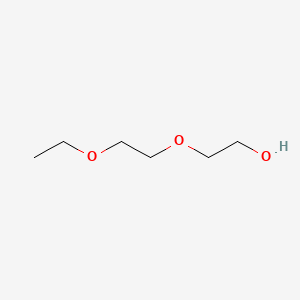
Diethylene Glycol Monoethyl Ether
Diethylene glycol monoethyl ether is a primary alcohol that is ethanol substituted by a 2-ethoxyethoxy group at position 2. It has a role as a protic solvent. It is a primary alcohol, a glycol ether, a diether and a hydroxypolyether. It is functionally related to a diethylene glycol. — ChEBI
- Nom IUPAC
- 2-(2-ethoxyethoxy)ethanol
- Formule moléculaire
- C6H14O3
- Masse moléculaire
- 134.17 g/mol
- Masse exacte
- 134.094294304 Da
- XLogP3
- -0,5
- Surface polaire topologique
- 38,7 Ų
- Donneurs de liaisons hydrogène
- 1
- Accepteurs de liaisons hydrogène
- 3
- Unités covalentes
- 1
- Stéréocentres définis
- 0
Également connu sous le nom de
16 autres noms signalés
Identifiants de bases de données externes
- ChEBI:CHEBI:40572
- ChEMBL:CHEMBL1230841
- EPA DTXSID:DTXSID2021941
- PubMed:33358762
- PubMed:25959454
- PubMed:22218002
- PubMed:22026377
- PubMed:21330095
- PubMed:20521179
- PubMed:19589377
- PubMed:19333469
- PubMed:19152165
- PubMed:18563577
- PubMed:18205921
- PubMed:18068919
Preuves issues de bases de données scientifiques complémentaires
NIH PubChem PUG-View
Attributed physical-property, hazard, environmental and use annotations.
- Autoignition Temperature: 400 °F (USCG, 1999) Source: CAMEO Chemicals
- Autoignition Temperature: 400 °F (204 °C) Source: Hazardous Substances Data Bank (HSDB)
- Autoignition Temperature: 204 °C Source: ILO-WHO International Chemical Safety Cards (ICSCs)
- Boiling Point: 396 °F at 760 mmHg (NTP, 1992) Source: CAMEO Chemicals
- Boiling Point: boiling point equals 396 °F Source: Haz-Map, Information on Hazardous Chemicals and Occupational Diseases
- Boiling Point: 196 °C Source: Hazardous Substances Data Bank (HSDB)
- Boiling Point: 196-202 °C Source: ILO-WHO International Chemical Safety Cards (ICSCs)
- Boiling Point: 396 °F Source: Occupational Safety and Health Administration (OSHA)
- Boiling Point: 196 °C @760 [mm Hg] Source: PAC Chemical Database, U.S. Department of Energy
- Color/Form: Colorless liquid Source: Hazardous Substances Data Bank (HSDB)
- Density: 0.99 at 68 °F (USCG, 1999) - Less dense than water; will float Source: CAMEO Chemicals
- Density: 0.9885 g/cu cm at 20 °C Source: Hazardous Substances Data Bank (HSDB)
- Density: Relative density (water = 1): 0.99 Source: ILO-WHO International Chemical Safety Cards (ICSCs)
- Density: 0.99 Source: Occupational Safety and Health Administration (OSHA)
- Density: 0.986 @ 20°C Source: PAC Chemical Database, U.S. Department of Energy
- Flash Point: 205 °F (NTP, 1992) Source: CAMEO Chemicals
- Flash Point: Flash point equals 205 °F Source: Haz-Map, Information on Hazardous Chemicals and Occupational Diseases
- Flash Point: 196 °F (91 °C) (CLOSED CUP) Source: Hazardous Substances Data Bank (HSDB)
- Flash Point: 96 °C o.c. Source: ILO-WHO International Chemical Safety Cards (ICSCs)
- Flash Point: 205 °F Source: Occupational Safety and Health Administration (OSHA)
- LogP: log Kow = -0.54 Source: Hazardous Substances Data Bank (HSDB)
- LogP: -0.15 (estimated) Source: ILO-WHO International Chemical Safety Cards (ICSCs)
- Melting Point: -108 °F (NTP, 1992) Source: CAMEO Chemicals
- Melting Point: Freezing point = -54.0 °C Source: Hazardous Substances Data Bank (HSDB)
- Melting Point: -76 °C Source: ILO-WHO International Chemical Safety Cards (ICSCs)
- Melting Point: -108 °F Source: Occupational Safety and Health Administration (OSHA)
- Odor: Mild, pleasant odor Source: Hazardous Substances Data Bank (HSDB)
- Physical Description: Diethylene glycol monoethyl ether appears as a colorless, slightly viscous liquid with a mild pleasant odor. Flash point near 190 °F. Used to make soaps, dyes, and other chemicals. Source: CAMEO Chemicals
- Physical Description: Liquid; CBI; Other Solid Source: EPA Chemical Data Reporting (CDR)
- Physical Description: A clear slightly viscous liquid with a mild pleasant odor; [CAMEO] Source: Haz-Map, Information on Hazardous Chemicals and Occupational Diseases
- Physical Description: COLOURLESS HYGROSCOPIC LIQUID. Source: ILO-WHO International Chemical Safety Cards (ICSCs)
- Physical Description: A colorless, slightly viscous liquid with a mildly sweet odor. Source: Occupational Safety and Health Administration (OSHA)
- Refractive Index: Index of refraction: 1.4273 at 20 °C/D Source: Hazardous Substances Data Bank (HSDB)
- Solubility: greater than or equal to 100 mg/mL at 68 °F (NTP, 1992) Source: CAMEO Chemicals
- Solubility: Miscible with ether, pyridine, chloroform Source: Hazardous Substances Data Bank (HSDB)
- Solubility: Miscible with the common organic solvents. Source: Hazardous Substances Data Bank (HSDB)
- Solubility: Miscible with ethanol, acetone, benzene; very soluble in ethyl ether Source: Hazardous Substances Data Bank (HSDB)
- Solubility: In water, miscible at 25 °C Source: Hazardous Substances Data Bank (HSDB)
- Solubility: Solubility in water: very good Source: ILO-WHO International Chemical Safety Cards (ICSCs)
- Vapor Pressure: 0.13 mmHg at 77 °F (NTP, 1992) Source: CAMEO Chemicals
- Vapor Pressure: 0.12 [mmHg] Source: Haz-Map, Information on Hazardous Chemicals and Occupational Diseases
- Vapor Pressure: Vapor pressure, Pa at 25 °C: 19 Source: ILO-WHO International Chemical Safety Cards (ICSCs)
- Vapor Pressure: 0.13 mmHg Source: Occupational Safety and Health Administration (OSHA)
- Vapor Pressure: 0.126 [mm Hg] @25 °C Source: PAC Chemical Database, U.S. Department of Energy
- Viscosity: 3.85 mPa.s (=cPs) at 25 °C Source: Hazardous Substances Data Bank (HSDB)
- First Aid: EYES: First check the victim for contact lenses and remove if present. Flush victim's eyes with water or normal saline solution for 20 to 30 minutes while simultaneously calling a hospital or poison control center. Do not put any ointments, oils, or medication in the victim's eyes without specific instructions from a physician. IMMEDIATELY transport the victim after flushing eyes to a hospital even if no symptoms (such as redness or irritation) develop.; SKIN: IMMEDIATELY flood affected skin with water while removing and isolating all contaminated clothing. Gently wash all affected skin areas thoroughly with soap and water. If symptoms such as redness or irritation develop, IMMEDIATELY call a physician and be prepared to transport the victim to a hospital for treatment.; INHALATION: IMMEDIATELY leave the contaminated area; take deep breaths of fresh air. If symptoms (such as wheezing, coughing, shortness of breath, or burning in the mouth, throat, or chest) develop, call a physician and be prepared to transport the victim to a hospital. Provide proper respiratory protection to rescuers entering an unknown atmosphere. Whenever possible, Self-Contained Breathing Apparatus (SCBA) shou Source: CAMEO Chemicals
- Note: This chemical does not meet GHS hazard criteria for 90.4% (4397 of 4862) of all reports. Source: European Chemicals Agency (ECHA)
- GHS Hazard Statements: Not Classified; Reported as not meeting GHS hazard criteria by 4397 of 4862 companies (only 9.6% companies provided GHS information). For more detailed information, please visit ECHA C&L website. Source: European Chemicals Agency (ECHA)
- ECHA C&L Notifications Summary: Aggregated GHS information provided per 4862 reports by companies from 13 notifications to the ECHA C&L Inventory.; Reported as not meeting GHS hazard criteria per 4397 of 4862 reports by companies.; There are 11 notifications provided by 465 of 4862 reports by companies with hazard statement code(s).; Information may vary between notifications depending on impurities, additives, and other factors. The percentage value in parenthesis indicates the notified classification ratio from companies that provide hazard codes. Only hazard codes with percentage values above 10% are shown. For more detailed information, please visit ECHA C&L website. Source: European Chemicals Agency (ECHA)
- Signal: Danger Source: NITE-CMC
- GHS Hazard Statements: H227: Combustible liquid [Warning Flammable liquids]; H320: Causes eye irritation [Warning Serious eye damage/eye irritation]; H372: Causes damage to organs through prolonged or repeated exposure [Danger Specific target organ toxicity, repeated exposure] Source: NITE-CMC
- Precautionary Statement Codes: P210, P260, P264, P264+P265, P270, P280, P305+P351+P338, P319, P337+P317, P370+P378, P403, and P501 (click each P-code to see the statement) Source: NITE-CMC
- NFPA Health Rating: 2 - Materials that, under emergency conditions, can cause temporary incapacitation or residual injury. Source: Hazardous Substances Data Bank (HSDB)
- NFPA Fire Rating: 2 - Materials that must be moderately heated or exposed to relatively high ambient temperatures before ignition can occur. Materials would not under normal conditions form hazardous atmospheres with air, but under high ambient temperatures or under moderate heating could release vapor in sufficient quantities to produce hazardous atmospheres with air. Source: Hazardous Substances Data Bank (HSDB)
- NFPA Instability Rating: 0 - Materials that in themselves are normally stable, even under fire conditions. Source: Hazardous Substances Data Bank (HSDB)
- Cosmetic Ingredient Review Finding(s): Safe in the present practices of use and concentration. Ingredient, concentration, and use information are available in documents discoverable at https://cir-reports.cir-safety.org Source: Cosmetic Ingredient Review (CIR)
- Environmental Bioconcentration: An estimated BCF of 3 was calculated in fish for diethylene glycol monoethyl ether(SRC), using a log Kow of -0.54(1) and a regression-derived equation(2). According to a classification scheme(3), this BCF suggests the potential for bioconcentration in aquatic organisms is low(SRC). Source: Hazardous Substances Data Bank (HSDB)
- Environmental Fate: TERRESTRIAL FATE: Based on a classification scheme(1), an estimated Koc value of 12(SRC), determined from a log Kow of -0.54(2) and a regression-derived equation(3), indicates that diethylene glycol monoethyl ether is expected to have very high mobility in soil(SRC). Volatilization of diethylene glycol monoethyl ether from moist soil surfaces is not expected to be an important fate process(SRC) given an estimated Henry's Law constant of 2.2X10⁻⁸ atm-cu m/mole(SRC), derived from its vapor pressure, 0.126 mm Hg(4), and assigned value for water solubility of 1X10+6 mg/L (miscible)(5). Diethylene glycol monoethyl ether is expected to volatilize from dry soil surfaces(SRC) based upon its vapor pressure(4). Aerobic screening test data(6-11) indicate that rapid aerobic biodegradation is likely to be the most important mechanism for the removal of diethylene glycol monoethyl ether from soil. Biodegradation of 48%(6) to 87%(7) were reported in non-acclimated cultures incubated for 20 days. Source: Hazardous Substances Data Bank (HSDB)
- Environmental Fate: AQUATIC FATE: Based on a classification scheme(1), an estimated Koc value of 12(SRC), determined from a log Kow of -0.54(2) and a regression-derived equation(3), indicates that diethylene glycol monoethyl ether is not expected to adsorb to suspended solids and sediment(SRC). Volatilization from water surfaces is not expected(3) based upon an estimated Henry's Law constant of 2.2X10⁻⁸ atm-cu m/mole(SRC), derived from its vapor pressure, 0.126 mm Hg(4), and assigned value for water solubility of 1X10+6 mg/L (5)(miscible). According to a classification scheme(6), an estimated BCF of 3(SRC), from its log Kow(2) and a regression-derived equation(7), suggests the potential for bioconcentration in aquatic organisms is low(SRC). Diethylene glycol monoethyl ether is not expected to undergo hydrolysis or direct photolysis in aquatic environments(SRC). Alcohols and ethers are generally resistant to hydrolysis(3). They do not absorb UV light in the environmental range of >290 nm and are commonly used as solvents for obtaining UV spectra(14). Aerobic screening test data(8-13) indicate that rapid aerobic biodegradation is likely to be the most important mechanism for the removal of diethylene gl Source: Hazardous Substances Data Bank (HSDB)
- Environmental Fate: ATMOSPHERIC FATE: According to a model of gas/particle partitioning of semivolatile organic compounds in the atmosphere(1), diethylene glycol monoethyl ether, which has a vapor pressure of 0.126 mm Hg at 25 °C(2), is expected to exist solely as a vapor in the ambient atmosphere. Vapor-phase diethylene glycol monoethyl ether is degraded in the atmosphere by reaction with photochemically-produced hydroxyl radicals(SRC); the half-life for this reaction in air is estimated to be 6.7 hours(SRC), calculated from its rate constant of 5.72X10⁻¹¹ cu cm/molecule-sec at 23 °C(3). Diethylene glycol monoethyl ether does not contain chromophores that absorb at wavelengths >290 nm and therefore is not expected to be susceptible to direct photolysis by sunlight(4). Source: Hazardous Substances Data Bank (HSDB)
- Consumer Uses: Solvent; Cleaning agent; Fragrance; Not Known or Reasonably Ascertainable Source: EPA Chemical Data Reporting (CDR)
- Industry Uses: Cleaning agent; Not Known or Reasonably Ascertainable; Coalescing agent; Laboratory chemicals; Solvent; Other; Solubility enhancer Source: EPA Chemical Data Reporting (CDR)
- Cosmetic Ingredient Review Link: CIR ingredient: Ethoxydiglycol Source: Cosmetic Ingredient Review (CIR)
- Sources/Uses: Used in lubricating oil and braking fluid; [ChemIDplus] Used as a solvent for cellulose esters, lacquers, varnishes, enamels, dyestuffs, wood stains, gums, and resins; [Merck Index, 1800] Used in textile printing; [CHEMINFO] Used in photography (solvent for color processing); [www.ci.tucson.az.us/arthazards/medium.html] Source: Haz-Map, Information on Hazardous Chemicals and Occupational Diseases
- Industrial Processes with risk of exposure: Painting (Solvents) [Category: Paint]; Photographic Processing [Category: Other]; Textiles (Printing, Dyeing, or Finishing) [Category: Industry] Source: Haz-Map, Information on Hazardous Chemicals and Occupational Diseases
- Uses: AS SOLVENT FOR CELLULOSE ESTERS, IN LACQUER & THINNER FORMULATIONS; IN QUICK DRYING VARNISHES AND ENAMELS, FOR DYESTUFFS AND WOOD STAINS. Source: Hazardous Substances Data Bank (HSDB)
- Uses: A DILUENT FOR HYDRAULIC BRAKE FLUIDS; SOLVENT IN PROTECTIVE COATINGS, TEXTILE DYEING & PRINTING; SOLVENT IN COSMETICS, TOILETRIES Source: Hazardous Substances Data Bank (HSDB)
- Uses: Used as a chemical intermediate for the synthesis of 2-(2-ethoxyethoxy)ethyl acrylate. Source: Hazardous Substances Data Bank (HSDB)
- Uses: Solvent for dyes, nitrocellulose, and resins; mutual solvent for mineral-oil-soap and mineral-oil-sulfonated-oil mixtures; nonaqueous stains for wood, for setting the twist and conditioning yarns and cloth; textile printing, textile soaps, lacquers, organic synthesis; brake fluid diluent. Source: Hazardous Substances Data Bank (HSDB)
- Uses: Inert ingredient in pesticide products. Diethylene glycol monoethyl ether is found on List 2: potentially toxic other ingredients/high priority for testing inerts. ... List 2 inert ingredients are structurally similar to chemicals known to be toxic; some have data suggesting a concern. Source: Hazardous Substances Data Bank (HSDB)
Mis en correspondance par: Existing checksum-valid CAS to unique PubChem CID match. Récupéré le: 2026-08-31. Ouvrir la fiche source
Les classifications scientifiques et les annotations de danger apportent du contexte et ne remplacent pas la décision réglementaire propre au marché indiquée ci-dessus.
Couverture des sources complémentaires et état des correspondances
| Source | Résultat | Vérifié |
|---|---|---|
| NIH PubChem PUG-View | Correspondance exacte | 2026-08-31 |
Une absence de correspondance enregistrée est une preuve utile que la source a été vérifiée ; ce n’est pas l’affirmation que la substance n’existe pas ailleurs.
Récupéré depuis NIH PubChem le 2026-09-02 par correspondance CAS à somme de contrôle valide. Les propriétés chimiques ne remplacent pas la décision réglementaire de cette page.
Preuves officielles sur le nom d’ingrédient de l’UE
Le nom de l’ingrédient correspond exactement au glossaire officiel 2025 de l’UE des dénominations communes d’ingrédients.
Preuves d’inventaire associées
Ingrédients ayant des fonctions de formulation communes
Sources officielles et scientifiques complémentaires
11 bases de données externes pour vérifier cette identité
Chaque lien lance une recherche de cette identité dans la source concernée. Ce qu’est chaque source et sa valeur juridique
Comment ETHOXYDIGLYCOL apparaît dans l’inventaire CosIng
L’inventaire CosIng répertorie ETHOXYDIGLYCOL comme ingrédient cosmétique et cette page l’associe à 1 fiche d’annexe. L’entrée d’inventaire reprend les noms et identifiants, tandis que la fiche d’annexe indique où la substance est interdite, soumise à restrictions ou inscrite sur une liste positive dans le droit de l’UE sur les cosmétiques.
ETHOXYDIGLYCOL est aussi associé à 3 fonctions cosmétiques dans les données officielles. Les désignations de fonction décrivent l’usage prévu, mais ne remplacent pas l’examen réglementaire des fiches d’annexe associées avant un travail de formulation ou d’étiquetage.
Questions fréquentes
Note de source pour ETHOXYDIGLYCOL
Cette page associe l’entrée d’inventaire CosIng de ETHOXYDIGLYCOL à 1 fiche liée des annexes II à VI de notre jeu de données, construit à partir de documents publics de la Commission européenne sur les ingrédients cosmétiques.
Utilisez cette page d’inventaire pour étudier ETHOXYDIGLYCOL et comparer les fiches associées, mais vérifiez les restrictions et le statut juridique auprès du texte officiel en vigueur et de la législation avant toute décision réglementaire.
Outils et étapes suivantes
Vérifiez votre formule
Analysez une liste INCI complète pour détecter ETHOXYDIGLYCOL et les éventuelles restrictions d’annexes de l’UE ou signalements d’allergènes associés.
Vérificateur INCIRechercher des ingrédients similaires
Trouvez d’autres ingrédients de l’inventaire et entrées d’annexe liés à ETHOXYDIGLYCOL, à ses identifiants ou à des variantes de nom proches.
Rechercher