
CALCIUM PHOSPHATE
Calcium bis(dihydrogenorthophosphate)
CALCIUM PHOSPHATE figure dans l’inventaire CosIng de l’UE, mais aucune fiche d’annexe directe n’est encore associée sur cette page.
En un coup d’œil
- Fonction
- Abrasive, antiplaque, buffering, bulking, oral care, viscosity controlling
- CAS
- 7758-23-8 / 10103-46-5
- EC
- 231-837-1 / 233-283-6
- Annexes de l’UE
- Non répertoriéAucune fiche d’annexe de l’UE n’est associée. Ce n’est pas une autorisation.
Preuves réglementaires par marché
Aucune règle pour cet ingrédient n’a été importée pour aucun des 13 marchés suivis ici.
Cela décrit cet inventaire, et non le droit. L’absence de règle importée n’est pas la preuve qu’un ingrédient est autorisé : une règle peut exister sous un autre nom ou identifiant, ou dans un jeu de données pas encore importé ici.
Détails d’inventaire pour CALCIUM PHOSPHATE
Nom INCI
CALCIUM PHOSPHATE
Nom Ph. Eur.
calcarea phosphorica
Description
Calcium bis(dihydrogenorthophosphate)
Provenance de la fiche
- Référence d’inventaire
- 32340
- Identité importée
- CALCIUM PHOSPHATE
- Mise à jour de la source
- 15/10/2010
Fiches d’annexe pour CALCIUM PHOSPHATE
Données clés
- ABRASIVE
Removing unwanted tissue or foreign materials from various body surfaces, including mechanical tooth cleaning and/or gloss improvement.
- ANTIPLAQUE
Helping protect against plaque.
- BUFFERING
Stabilising the pH of an aqueous medium in a narrow range even if an acid or base is added. Altering and/or maintaining a cosmetic product's pH at the desired level.
- BULKING
Non-reactive (chemically inert), solid ingredients that dilute other solids and/or increase the volume of cosmetic products.
- ORAL CARE
Providing cosmetic effects to the oral cavity, e.g. cleansing, deodorising, protecting.
- VISCOSITY CONTROLLING
Increasing or decreasing the viscosity (thickness) of cosmetics.
Identité et propriétés chimiques
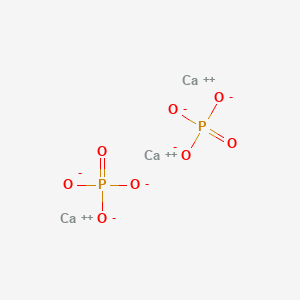
Tricalcium Phosphate
Calcium phosphate is typically available as an over the counter supplement, antacid, or as an added ingredient in some toothpastes. — DrugBank
- Nom IUPAC
- tricalcium diphosphate
- Formule moléculaire
- Ca3O8P2
- Masse moléculaire
- 310.18 g/mol
- Masse exacte
- 309.7946135 Da
- Surface polaire topologique
- 173,0 Ų
- Donneurs de liaisons hydrogène
- 0
- Accepteurs de liaisons hydrogène
- 8
- Unités covalentes
- 5
- Stéréocentres définis
- 0
Également connu sous le nom de
16 autres noms signalés
Identifiants de bases de données externes
- ChEBI:CHEBI:9679
- ChEMBL:CHEMBL2106566
- EPA DTXSID:DTXSID1049803
- PubMed:39887523
- PubMed:37678662
- PubMed:22522029
- PubMed:18782374
- PubMed:14600836
- PubMed:12784042
Preuves issues de bases de données scientifiques complémentaires
NIH PubChem PUG-View
Attributed physical-property, hazard, environmental and use annotations.
- Color/Form: White amorphous powder Source: Hazardous Substances Data Bank (HSDB)
- Color/Form: White, crystalline powder Source: Hazardous Substances Data Bank (HSDB)
- Color/Form: Two crystalline modifications are known, the high temperature alpha- and the low-temperature beta-form, transition temperature 110 °C. Source: Hazardous Substances Data Bank (HSDB)
- Color/Form: Rhombohedral crystals /Whitlockite/ Source: Hazardous Substances Data Bank (HSDB)
- Density: 2 to 3 at 68 °F (USCG, 1999) Source: CAMEO Chemicals
- Density: 3.14 g/cu cm Source: Hazardous Substances Data Bank (HSDB)
- Density: 2.5 @ 20°C Source: PAC Chemical Database, U.S. Department of Energy
- Melting Point: >450 Source: DrugBank
- Melting Point: 1670 °C Source: Hazardous Substances Data Bank (HSDB)
- Odor: Odorless Source: Hazardous Substances Data Bank (HSDB)
- Physical Description: Calcium phosphate is an odorless white solid. Sinks and mixes with water. (USCG, 1999) Source: CAMEO Chemicals
- Physical Description: Dry Powder; Liquid Source: EPA Chemical Data Reporting (CDR)
- Physical Description: Wet Solid Source: EPA Chemical Data Reporting (CDR)
- Physical Description: A white, odourless powder which is stable in air Source: EU Food Improvement Agents
- Physical Description: White odorless solid; [HSDB] White odorless powder; [MSDSonline] Source: Haz-Map, Information on Hazardous Chemicals and Occupational Diseases
- Physical Description: White odorless solid; [CAMEO] Source: Haz-Map, Information on Hazardous Chemicals and Occupational Diseases
- Refractive Index: INDEX OF REFRACTION: 1.629, 1.626 Source: Hazardous Substances Data Bank (HSDB)
- Solubility: 7.7g/L Source: DrugBank
- Solubility: Practically insoluble in water; insoluble in ethanol, soluble in dilute hydrochloric and nitric acid Source: EU Food Improvement Agents
- Solubility: Practically insol in alcohol and acetic acid; sol in dilute hydrochloric acid, nitric acid Source: Hazardous Substances Data Bank (HSDB)
- Solubility: Solubility in cold water: 2 mg/100 cc Source: Hazardous Substances Data Bank (HSDB)
- Solubility: 2.5 mg/100 g water at 25 °C Source: Hazardous Substances Data Bank (HSDB)
- First Aid: INHALATION: move to clean air; see physician in case of persistent coughing, expectoration, chest pain, or shortness of breath.; INGESTION: get medical attention quickly; induce vomiting by giving large amounts of water or warm salty water, or by tickling back of patient's throat; continue until vomitus is clear; follow with milk, eggs, or olive oil to soothe stomach.; EYES: immediately flush with large quantities of running water for at least 15 min., holding eyelids apart to insure thorough flushing of eyes and lids; do not attempt to neutralize with chemical agents; get medical attention quickly; if physician is (USCG, 1999) Source: CAMEO Chemicals
- Note: This chemical does not meet GHS hazard criteria for 95.7% (529 of 553) of all reports. Source: European Chemicals Agency (ECHA)
- GHS Hazard Statements: Not Classified; Reported as not meeting GHS hazard criteria by 529 of 553 companies (only 4.3% companies provided GHS information). For more detailed information, please visit ECHA C&L website. Source: European Chemicals Agency (ECHA)
- ECHA C&L Notifications Summary: Aggregated GHS information provided per 553 reports by companies from 6 notifications to the ECHA C&L Inventory.; Reported as not meeting GHS hazard criteria per 529 of 553 reports by companies.; There are 4 notifications provided by 24 of 553 reports by companies with hazard statement code(s).; Information may vary between notifications depending on impurities, additives, and other factors. The percentage value in parenthesis indicates the notified classification ratio from companies that provide hazard codes. Only hazard codes with percentage values above 10% are shown. For more detailed information, please visit ECHA C&L website. Source: European Chemicals Agency (ECHA)
- Note: This chemical does not meet GHS hazard criteria for 75% (27 of 36) of all reports. Source: European Chemicals Agency (ECHA)
- Signal: Danger Source: European Chemicals Agency (ECHA)
- GHS Hazard Statements: H318 (25%): Causes serious eye damage [Danger Serious eye damage/eye irritation] Source: European Chemicals Agency (ECHA)
- Precautionary Statement Codes: P264+P265, P280, P305+P354+P338, and P317 (click each P-code to see the statement) Source: European Chemicals Agency (ECHA)
- ECHA C&L Notifications Summary: Aggregated GHS information provided per 36 reports by companies from 2 notifications to the ECHA C&L Inventory.; Reported as not meeting GHS hazard criteria per 27 of 36 reports by companies.; There is 1 notification provided by 9 of 36 reports by companies with hazard statement code(s).; Information may vary between notifications depending on impurities, additives, and other factors. The percentage value in parenthesis indicates the notified classification ratio from companies that provide hazard codes. Only hazard codes with percentage values above 10% are shown. For more detailed information, please visit ECHA C&L website. Source: European Chemicals Agency (ECHA)
- Cosmetic Ingredient Review Conclusion: The CIR Expert Panel concluded that the following 31 ingredients are safe in the present practices of use and concentration in cosmetics as described in this safety assessment, when formulated to be non-irritating...Calcium Phosphate... Source: Cosmetic Ingredient Review (CIR)
- Cosmetic Ingredient Review Finding(s): Safe for use in cosmetics, with qualifications Source: Cosmetic Ingredient Review (CIR)
- Cosmetic Ingredient Review Conclusion: The CIR Expert Panel concluded that the following 31 ingredients are safe in the present practices of use and concentration in cosmetics as described in this safety assessment, when formulated to be non-irritating...Tricalcium Phosphate... Source: Cosmetic Ingredient Review (CIR)
- Toxicity Summary: IDENTIFICATION AND USE: White amorphous, or crystaline powder. It is odorless and tasteless. It is practically insoluble in alcohol, and acetic acid, and soluble in dilute hydrochloric acid, and nitric acid. Slightly soluble in water. It is used in the manufacture of fertilizers, phosphate compounds, manufacture of milk glass, polishing and dental powders, porcelains, pottery, enameling; clarifying sugar syrups; in animal feeds; as noncaking agent; in textile industry. It is used as a stabilizer in plastics; in meat tenderizers; in food as a buffer and used in medical applications as a calcium replenisher. It veterinary medicine it is used as a dietary supplement and an antacid. It is used in the manufacture of luminescent materials. HUMAN EXPOSURE AND TOXICITY: Tricalcium phosphate is not irritating and toxic doses by ingestion would have to be more than 2 g/kg. Skin sensitization is unusual. Aspiration or inhalation could cause chemical pneumonitis. Implantation of material will cause foreign body reaction. Tricalcium phosphate is contraindicated in treatment of hypocalcemia with hyperphosphatemia which may occur in hypoparathyroidism and renal failure. ANIMAL STUDIES: Tricalcium Source: Hazardous Substances Data Bank (HSDB)
- Consumer Uses: Corrosion inhibitor; Not Known or Reasonably Ascertainable; Pigment; Lubricating agent Source: EPA Chemical Data Reporting (CDR)
- Consumer Uses: Intermediate; Filler Source: EPA Chemical Data Reporting (CDR)
- Industry Uses: Lubricating agent; Not Known or Reasonably Ascertainable; Corrosion inhibitor; Soil amendments (fertilizers) Source: EPA Chemical Data Reporting (CDR)
- Industry Uses: Filler; Intermediate Source: EPA Chemical Data Reporting (CDR)
- Cosmetic Ingredient Review Link: CIR ingredient: Calcium Phosphate Source: Cosmetic Ingredient Review (CIR)
- Cosmetic Ingredient Review Link: CIR ingredient: Tricalcium Phosphate Source: Cosmetic Ingredient Review (CIR)
- Sources/Uses: Found in the minerals oxydapatit, voelicherite, and whitlockite; [Merck Index] Used to make fertilizers, phosphoric acid, phosphorus compounds, milk-glass, polishing and dental powders, porcelains, pottery, and luminescent materials; Also used in enamels, white pigments for ceramics, meat tenderizers, food buffers and flow conditioners, and as a non-caking agent, a mordant in dyeing, a stabilizer for plastics, a clarifying agent for sugar syrups, a polishing agent, a calcium supplement, and a veterinary antacid; [HSDB] Source: Haz-Map, Information on Hazardous Chemicals and Occupational Diseases
- Industrial Processes with risk of exposure: Textiles (Printing, Dyeing, or Finishing) [Category: Industry]; Glass Manufacturing [Category: Industry] Source: Haz-Map, Information on Hazardous Chemicals and Occupational Diseases
- Activities with risk of exposure: Ceramics making [Category: Hobbies]; Enameling [Category: Hobbies] Source: Haz-Map, Information on Hazardous Chemicals and Occupational Diseases
- Sources/Uses: Permitted for use as an inert ingredient in non-food pesticide products; [EPA] Used in fertilizers, food additives, and animal feeds; [IUCLID] Also used in glass manufacture; [EPA OHM/TADS] Source: Haz-Map, Information on Hazardous Chemicals and Occupational Diseases
- Industrial Processes with risk of exposure: Glass Manufacturing [Category: Industry]; Farming (Feed Additives) [Category: Industry] Source: Haz-Map, Information on Hazardous Chemicals and Occupational Diseases
- Uses: Manuf of fertilizers, H3PO4 and P compds; manuf milk-glass, polishing and dental powders, porcelains, pottery; enameling; clarifying sugar syrups; in animal feeds; as noncaking agent; in the textile industry. Source: Hazardous Substances Data Bank (HSDB)
- Uses: STABILIZER FOR PLASTICS; IN MEAT TENDERIZERS; IN FOOD AS BUFFER Source: Hazardous Substances Data Bank (HSDB)
- Uses: THERAP CAT: Calcium replenisher. Source: Hazardous Substances Data Bank (HSDB)
- Uses: THERAP CAT (VET): Has been used as a dietary supplement, and as an antacid. Source: Hazardous Substances Data Bank (HSDB)
- Uses: For more Uses (Complete) data for TRICALCIUM PHOSPHATE (6 total), please visit the HSDB record page. Source: Hazardous Substances Data Bank (HSDB)
Mis en correspondance par: Existing checksum-valid CAS to unique PubChem CID match. Récupéré le: 2026-08-31. Ouvrir la fiche source
Les classifications scientifiques et les annotations de danger apportent du contexte et ne remplacent pas la décision réglementaire propre au marché indiquée ci-dessus.
Couverture des sources complémentaires et état des correspondances
| Source | Résultat | Vérifié |
|---|---|---|
| EMBL-EBI ChEBI | Aucune fiche exacte | 2026-08-31 |
| NIH PubChem PUG-View | Correspondance exacte | 2026-08-31 |
Une absence de correspondance enregistrée est une preuve utile que la source a été vérifiée ; ce n’est pas l’affirmation que la substance n’existe pas ailleurs.
Récupéré depuis NIH PubChem le 2026-08-31 par correspondance CAS à somme de contrôle valide. Les propriétés chimiques ne remplacent pas la décision réglementaire de cette page.
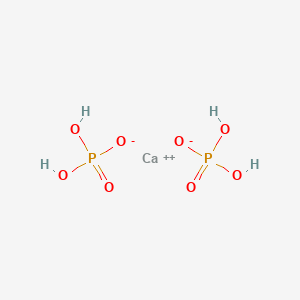
Calcium Dihydrogen Phosphate
Calcium bis(dihydrogenphosphate) is a calcium phosphate. It has a role as a fertilizer. — ChEBI
- Nom IUPAC
- calcium bis(dihydrogen phosphate)
- Formule moléculaire
- CaH4O8P2
- Masse moléculaire
- 234.05 g/mol
- Masse exacte
- 233.9007319 Da
- Surface polaire topologique
- 161,0 Ų
- Donneurs de liaisons hydrogène
- 4
- Accepteurs de liaisons hydrogène
- 8
- Unités covalentes
- 3
- Stéréocentres définis
- 0
Également connu sous le nom de
16 autres noms signalés
Identifiants de bases de données externes
- ChEBI:CHEBI:35433
- EPA DTXSID:DTXSID2044262
Récupéré depuis NIH PubChem le 2026-08-31 par correspondance CAS à somme de contrôle valide. Les propriétés chimiques ne remplacent pas la décision réglementaire de cette page.
Preuves officielles sur le nom d’ingrédient de l’UE
Le nom de l’ingrédient correspond exactement au glossaire officiel 2025 de l’UE des dénominations communes d’ingrédients.
Preuves d’inventaire associées
Ingrédients ayant des fonctions de formulation communes
Sources officielles et scientifiques complémentaires
11 bases de données externes pour vérifier cette identité
Chaque lien lance une recherche de cette identité dans la source concernée. Ce qu’est chaque source et sa valeur juridique
Comment CALCIUM PHOSPHATE apparaît dans l’inventaire CosIng
L’inventaire CosIng répertorie CALCIUM PHOSPHATE comme ingrédient cosmétique et cette page l’associe à 0 fiche d’annexe. L’entrée d’inventaire reprend les noms et identifiants, tandis que la fiche d’annexe indique où la substance est interdite, soumise à restrictions ou inscrite sur une liste positive dans le droit de l’UE sur les cosmétiques.
CALCIUM PHOSPHATE est aussi associé à 6 fonctions cosmétiques dans les données officielles. Les désignations de fonction décrivent l’usage prévu, mais ne remplacent pas l’examen réglementaire des fiches d’annexe associées avant un travail de formulation ou d’étiquetage.
Questions fréquentes
Note de source pour CALCIUM PHOSPHATE
Cette page reproduit l’entrée d’inventaire CosIng de CALCIUM PHOSPHATE issue de documents publics de la Commission européenne sur les ingrédients cosmétiques et affiche les identifiants associés, même si aucune correspondance directe avec une annexe n’est actuellement rattachée.
Utilisez cette page d’inventaire pour étudier CALCIUM PHOSPHATE et comparer les fiches associées, mais vérifiez les restrictions et le statut juridique auprès du texte officiel en vigueur et de la législation avant toute décision réglementaire.
Outils et étapes suivantes
Vérifiez votre formule
Analysez une liste INCI complète pour détecter CALCIUM PHOSPHATE et les éventuelles restrictions d’annexes de l’UE ou signalements d’allergènes associés.
Vérificateur INCIRechercher des ingrédients similaires
Trouvez d’autres ingrédients de l’inventaire et entrées d’annexe liés à CALCIUM PHOSPHATE, à ses identifiants ou à des variantes de nom proches.
Rechercher