
CALCIUM PEROXIDE
Calcium peroxide
CALCIUM PEROXIDE est lié à 1 fiche d’annexe de l’UE sur cette page. Note d’inventaire : III/12.
En un coup d’œil
- Fonction
- Oxidising
- CAS
- 1305-79-9
- EC
- 215-139-4
- Annexes de l’UE
- Annexe III/12
- Annexe III/12:
max. · (a) Hair products
(b) Skin products
(c) Nail hardening products
(d) Oral products, inc… · avertissement d'étiquetage :
(a) (f) Wear suitable gloves (a) (b) (c) (e) Contains hydrogen peroxide Avoid contact with eyes Rinse immediately …
Base scientifique : 6 avis du CSSC
Le comité scientifique européen pour la sécurité des consommateurs (CSSC) a évalué cette substance. Ses avis sont la base scientifique de l’entrée de l’annexe.
- Opinion on Hydrogen Peroxide in Tooth Whitening products
- Opinion concerning Hydrogen (Carbamide, Zinc) Peroxide in Tooth Bleaching/Whitening Products,Guidance document on Epidemiological and clinical studies on Tooth…
- Opinion of concerning Hydrogen (Carbamide) Peroxide in Tooth Whitening Products
- Clarification on Hydrogen (Carbamide) peroxide in Tooth Whitening Products
- Opinion concerning Hydrogen Peroxide and Hydrogen Peroxide releasing Substances used in Oral Care Products
- Opinion on Hydrogen peroxide, in its free form or when released, oral hygiene products
Preuves réglementaires par marché
Cette matrice distingue les règles d’ingrédients vérifiées des sources cartographiées mais pas encore importées. L’absence de règle importée ne signifie pas que l’ingrédient est autorisé.
Balayez ou faites défiler horizontalement pour voir toutes les colonnes.
| Marché | Statut des preuves | Fiches | Langue de la source |
|---|---|---|---|
| European Union | Preuves associées Restricted entry found Ouvrir cette preuve | 1 | English and EU languages |
| Great Britain | Source cartographiée Official source mapped; ingredient rule not imported | 0 | English |
| Canada | Preuves associées Restricted Ouvrir cette preuve | 1 | English and French |
| New Zealand | Source cartographiée Official source mapped; ingredient rule not imported | 0 | English |
| ASEAN | Source cartographiée Official source mapped; ingredient rule not imported | 0 | English and national languages |
| China | Source cartographiée Official source mapped; ingredient rule not imported | 0 | Chinese with selected English material |
| Japan | Source cartographiée Official source mapped; ingredient rule not imported | 0 | Japanese; official English translation available |
| South Korea | Source cartographiée Official source mapped; ingredient rule not imported | 0 | Korean with some English names |
| United States | Source cartographiée Official source mapped; ingredient rule not imported | 0 | English |
| Australia | Source cartographiée Official source mapped; ingredient rule not imported | 0 | English |
| Brazil | Source cartographiée Official source mapped; ingredient rule not imported | 0 | Portuguese with INCI crosswalks |
| India | Source cartographiée Official source mapped; ingredient rule not imported | 0 | English and Hindi |
| Saudi Arabia | Source cartographiée Official source mapped; ingredient rule not imported | 0 | Arabic and English |
Détails d’inventaire pour CALCIUM PEROXIDE
Nom INCI
CALCIUM PEROXIDE
Description
Calcium peroxide
Provenance de la fiche
- Référence d’inventaire
- 32339
- Identité importée
- CALCIUM PEROXIDE
- Mise à jour de la source
- 15/10/2010
Fiches d’annexe pour CALCIUM PEROXIDE
Données clés
Identité et propriétés chimiques
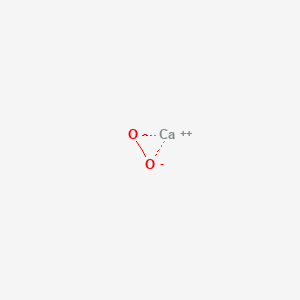
Calcium peroxide
Calcium peroxide is a member of calcium oxides. — ChEBI
- Nom IUPAC
- calcium peroxide
- Formule moléculaire
- CaO2
- Masse moléculaire
- 72.08 g/mol
- Masse exacte
- 71.9524201 Da
- Surface polaire topologique
- 46,1 Ų
- Donneurs de liaisons hydrogène
- 0
- Accepteurs de liaisons hydrogène
- 2
- Unités covalentes
- 2
- Stéréocentres définis
- 0
Également connu sous le nom de
13 autres noms signalés
Identifiants de bases de données externes
- ChEBI:CHEBI:48233
- EPA DTXSID:DTXSID4050489
- PubMed:31515881
- PubMed:26053405
Preuves issues de bases de données scientifiques complémentaires
NIH PubChem PUG-View
Attributed physical-property, hazard, environmental and use annotations.
- Color/Form: White or yellowish powder Source: Hazardous Substances Data Bank (HSDB)
- Color/Form: White tetragonal crystals Source: Hazardous Substances Data Bank (HSDB)
- Density: 2.92 at 77 °F (USCG, 1999) - Denser than water; will sink Source: CAMEO Chemicals
- Density: 2.9 g/cu cm Source: Hazardous Substances Data Bank (HSDB)
- Melting Point: Decomp at 200 °C Source: Hazardous Substances Data Bank (HSDB)
- Odor: Odorless Source: Hazardous Substances Data Bank (HSDB)
- Physical Description: Calcium peroxide appears as a grayish white granular material. Used in baking, in medicine, in bleaching oils. Source: CAMEO Chemicals
- Physical Description: White or yellowish odorless solid; Slightly soluble in water; Decomposes in moist air; [Merck Index] Yellowish odorless powder; Insoluble in water; [MSDSonline] Source: Haz-Map, Information on Hazardous Chemicals and Occupational Diseases
- Refractive Index: INDEX OF REFRACTION: 1.895 Source: Hazardous Substances Data Bank (HSDB)
- Solubility: Slightly soluble in water Source: Hazardous Substances Data Bank (HSDB)
- Solubility: Soluble in acids with formation of hydrogen peroxide Source: Hazardous Substances Data Bank (HSDB)
- First Aid: INHALATION: remove to fresh air.; EYES: flush with water for 15 min. and consult physician.; SKIN: flush with water.; INGESTION: give large amounts of water. (USCG, 1999) Source: CAMEO Chemicals
- ERG2024, Guide 140 (Calcium peroxide): General First Aid:; · Call 911 or emergency medical service.; · Ensure that medical personnel are aware of the material(s) involved, take precautions to protect themselves and avoid contamination.; · Move victim to fresh air if it can be done safely.; · Administer oxygen if breathing is difficult.; · If victim is not breathing:; -- DO NOT perform mouth-to-mouth resuscitation; the victim may have ingested or inhaled the substance.; -- If equipped and pulse detected, wash face and mouth, then give artificial respiration using a proper respiratory medical device (bag-valve mask, pocket mask equipped with a one-way valve or other device).; -- If no pulse detected or no respiratory medical device available, provide continuous compressions. Conduct a pulse check every two minutes or monitor for any signs of spontaneous respirations.; · Remove and isolate contaminated clothing and shoes.; · For minor skin contact, avoid spreading material on unaffected skin.; · In case of contact with substance, remove immediately by flushing skin or eyes with running water for at least 20 minutes.; · For severe burns, immediate medical attention is required.; · Effects of exposure (inhalation, ingestion, Source: Emergency Response Guidebook (ERG)
- Signal: Danger Source: European Chemicals Agency (ECHA)
- GHS Hazard Statements: H272 (97.1%): May intensify fire; oxidizer [Danger Oxidizing liquids; Oxidizing solids]; H315 (94.3%): Causes skin irritation [Warning Skin corrosion/irritation]; H319 (94.3%): Causes serious eye irritation [Warning Serious eye damage/eye irritation]; H335 (94.3%): May cause respiratory irritation [Warning Specific target organ toxicity, single exposure; Respiratory tract irritation] Source: European Chemicals Agency (ECHA)
- Precautionary Statement Codes: P210, P220, P261, P264, P264+P265, P271, P280, P302+P352, P304+P340, P305+P351+P338, P319, P321, P332+P317, P337+P317, P362+P364, P370+P378, P403+P233, P405, and P501 (click each P-code to see the statement) Source: European Chemicals Agency (ECHA)
- ECHA C&L Notifications Summary: Aggregated GHS information provided per 140 reports by companies from 7 notifications to the ECHA C&L Inventory. Each notification may be associated with multiple companies.; Information may vary between notifications depending on impurities, additives, and other factors. The percentage value in parenthesis indicates the notified classification ratio from companies that provide hazard codes. Only hazard codes with percentage values above 10% are shown. For more detailed information, please visit ECHA C&L website. Source: European Chemicals Agency (ECHA)
- GHS Hazard Statements: H272 (100%): May intensify fire; oxidizer [Danger Oxidizing liquids; Oxidizing solids]; H315 (100%): Causes skin irritation [Warning Skin corrosion/irritation]; H319 (100%): Causes serious eye irritation [Warning Serious eye damage/eye irritation]; H335 (100%): May cause respiratory irritation [Warning Specific target organ toxicity, single exposure; Respiratory tract irritation] Source: European Chemicals Agency (ECHA)
- ECHA C&L Notifications Summary: Aggregated GHS information provided per 38 reports by companies from 1 notifications to the ECHA C&L Inventory. Each notification may be associated with multiple companies.; Information may vary between notifications depending on impurities, additives, and other factors. The percentage value in parenthesis indicates the notified classification ratio from companies that provide hazard codes. Only hazard codes with percentage values above 10% are shown. For more detailed information, please visit ECHA C&L website. Source: European Chemicals Agency (ECHA)
- Signal: Danger Source: NITE-CMC
- GHS Hazard Statements: H272: May intensify fire; oxidizer [Danger Oxidizing liquids; Oxidizing solids]; H318: Causes serious eye damage [Danger Serious eye damage/eye irritation] Source: NITE-CMC
- Precautionary Statement Codes: P210, P220, P264+P265, P280, P305+P354+P338, P317, P370+P378, and P501 (click each P-code to see the statement) Source: NITE-CMC
- Signal: Danger Source: Hazardous Chemical Information System (HCIS), Safe Work Australia
- GHS Hazard Statements: H302: Harmful if swallowed [Warning Acute toxicity, oral]; H314: Causes severe skin burns and eye damage [Danger Skin corrosion/irritation]; H335: May cause respiratory irritation [Warning Specific target organ toxicity, single exposure; Respiratory tract irritation] Source: Hazardous Chemical Information System (HCIS), Safe Work Australia
- Precautionary Statement Codes: P260, P261, P264, P270, P271, P280, P301+P317, P301+P330+P331, P302+P361+P354, P304+P340, P305+P354+P338, P316, P319, P321, P330, P363, P403+P233, P405, and P501 (click each P-code to see the statement) Source: Hazardous Chemical Information System (HCIS), Safe Work Australia
- Toxicity Summary: IDENTIFICATION AND USE: Calcium peroxide is white or yellowish powder. It is used as a stabilizer for rubber. Other uses including seed disinfectant, dentifrices, dough conditioners, antiseptic, bleaching of oils, modification of starches, high temperature oxidation. An important application of calcium peroxide is for curing the polysulfide sealants used in double glazing window units. Calcium peroxide is also used at several gold mines in Australia to increase recovery of gold and reduce the consumption of cyanide. Calcium peroxide has been identified as being used in hydraulic fracturing as a breaker. HUMAN EXPOSURE AND TOXICITY: Contact with calcium peroxide can severely irritate and may burn the skin and eyes. Exposure can irritate the eyes, nose, and throat. Prolonged exposure can damage the skin. Higher levels of calcium peroxide can irritate the lungs causing coughing and/or shortness of breath. Still higher exposures may cause a buildup of fluid in the lungs (pulmonary edema). This can cause death. ANIMAL STUDIES: Experiments with calcium peroxide revealed that the compound is not toxic to dogs treated orally. ECOTOXICITY STUDIES: New method was proposed for increasing the Source: Hazardous Substances Data Bank (HSDB)
- Consumer Uses: Oxidizing agent Source: EPA Chemical Data Reporting (CDR)
- Industry Uses: Oxidizing agent Source: EPA Chemical Data Reporting (CDR)
- Sources/Uses: Used as a rubber stabilizer, antiseptic, seed disinfectant, starch modifier, sewage deodorizer, and wastewater dechlorinator; Also used for dentifrices; in dough conditioners; for bleaching of oils; in high temperature oxidations; for curing the polysulfide sealants used in double glazing window units; to increase recovery of gold and reduce the consumption of cyanide (at gold mines); to improve the bioremediation of soils contaminated with creosote or kerosene; for removing metal ions from acidic waste streams such as coal ash leachate and acid mine drainage; in the cultivation of tomatoes, cucumbers, tobacco, and prawns (Japan); [HSDB] Used as a flour treatment agent; [JECFA] Source: Haz-Map, Information on Hazardous Chemicals and Occupational Diseases
- Industrial Processes with risk of exposure: Using Disinfectants or Biocides [Category: Clean]; Farming (Pesticides) [Category: Industry]; Sewer and Wastewater Treatment [Category: Industry]; Metal Extraction and Refining [Category: Industry] Source: Haz-Map, Information on Hazardous Chemicals and Occupational Diseases
- Uses: Stabilizer for rubber. Source: Hazardous Substances Data Bank (HSDB)
- Uses: Seed disinfectant, dentifrices, dough conditioners, antiseptic, bleaching of oils, modification of starches, high temperature oxidation. Source: Hazardous Substances Data Bank (HSDB)
- Uses: Calcium peroxide is used as oxygen source in the leaching of gold and silver ores with cyanide to improve precious metal recovery and leaching kinetics. A relatively new application for CaO2 is as a peroxide source in toothpaste and dental chewing gum products. Calcium peroxide is also used in limited quantities as a hardening accelerator for sulfide rubber, as dough conditioner in the baking industry, and as a nontoxic disinfectant for seed and grain. Source: Hazardous Substances Data Bank (HSDB)
- Uses: An important application of calcium peroxide is for curing the polysulfide sealants used in double glazing window units. Calcium peroxide is also used at several gold mines in Australia to increase recovery of gold and reduce the consumption of cyanide. Calcium peroxide (PermeOx) is also used to improve the bioremediation of soils contaminated with creosote or kerosene, to deodorize sewage sludges and wastewater, and to dechlorinate wastewater and effluents. A special formulation of calcium peroxide ... is used for removing metal ions from acidic waste streams such as coal ash leachate and acid mine drainage. Source: Hazardous Substances Data Bank (HSDB)
- Uses: For more Uses (Complete) data for CALCIUM PEROXIDE (7 total), please visit the HSDB record page. Source: Hazardous Substances Data Bank (HSDB)
Mis en correspondance par: Existing checksum-valid CAS to unique PubChem CID match. Récupéré le: 2026-08-31. Ouvrir la fiche source
Les classifications scientifiques et les annotations de danger apportent du contexte et ne remplacent pas la décision réglementaire propre au marché indiquée ci-dessus.
Couverture des sources complémentaires et état des correspondances
| Source | Résultat | Vérifié |
|---|---|---|
| NIH PubChem PUG-View | Correspondance exacte | 2026-08-31 |
Une absence de correspondance enregistrée est une preuve utile que la source a été vérifiée ; ce n’est pas l’affirmation que la substance n’existe pas ailleurs.
Récupéré depuis NIH PubChem le 2026-08-31 par correspondance CAS à somme de contrôle valide. Les propriétés chimiques ne remplacent pas la décision réglementaire de cette page.
Preuves officielles sur le nom d’ingrédient de l’UE
Le nom de l’ingrédient correspond exactement au glossaire officiel 2025 de l’UE des dénominations communes d’ingrédients.
Preuves d’inventaire associées
Ingrédients ayant des fonctions de formulation communes
Sources officielles et scientifiques complémentaires
11 bases de données externes pour vérifier cette identité
Chaque lien lance une recherche de cette identité dans la source concernée. Ce qu’est chaque source et sa valeur juridique
Comment CALCIUM PEROXIDE apparaît dans l’inventaire CosIng
L’inventaire CosIng répertorie CALCIUM PEROXIDE comme ingrédient cosmétique et cette page l’associe à 1 fiche d’annexe. L’entrée d’inventaire reprend les noms et identifiants, tandis que la fiche d’annexe indique où la substance est interdite, soumise à restrictions ou inscrite sur une liste positive dans le droit de l’UE sur les cosmétiques.
CALCIUM PEROXIDE est aussi associé à 1 fonction cosmétique dans les données officielles. Les désignations de fonction décrivent l’usage prévu, mais ne remplacent pas l’examen réglementaire des fiches d’annexe associées avant un travail de formulation ou d’étiquetage.
Questions fréquentes
Note de source pour CALCIUM PEROXIDE
Cette page associe l’entrée d’inventaire CosIng de CALCIUM PEROXIDE à 1 fiche liée des annexes II à VI de notre jeu de données, construit à partir de documents publics de la Commission européenne sur les ingrédients cosmétiques.
Utilisez cette page d’inventaire pour étudier CALCIUM PEROXIDE et comparer les fiches associées, mais vérifiez les restrictions et le statut juridique auprès du texte officiel en vigueur et de la législation avant toute décision réglementaire.
Outils et étapes suivantes
Vérifiez votre formule
Analysez une liste INCI complète pour détecter CALCIUM PEROXIDE et les éventuelles restrictions d’annexes de l’UE ou signalements d’allergènes associés.
Vérificateur INCIRechercher des ingrédients similaires
Trouvez d’autres ingrédients de l’inventaire et entrées d’annexe liés à CALCIUM PEROXIDE, à ses identifiants ou à des variantes de nom proches.
Rechercher