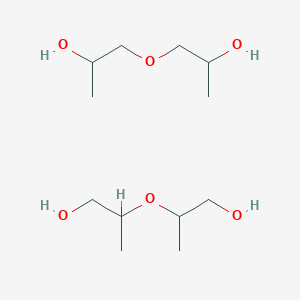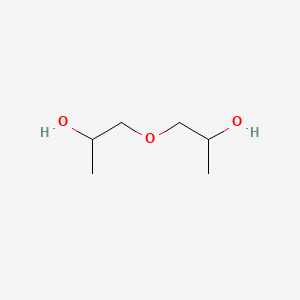
1,1'-Oxydi-2-propanol
- Nom IUPAC
- 1-(2-hydroxypropoxy)propan-2-ol
- Formule moléculaire
- C6H14O3
- Masse moléculaire
- 134.17 g/mol
- Masse exacte
- 134.094294304 Da
- XLogP3
- -0,4
- Surface polaire topologique
- 49,7 Ų
- Donneurs de liaisons hydrogène
- 2
- Accepteurs de liaisons hydrogène
- 3
- Unités covalentes
- 1
- Stéréocentres définis
- 0
Également connu sous le nom de
16 autres noms signalés
Identifiants de bases de données externes
- ChEMBL:CHEMBL3182176
- EPA DTXSID:DTXSID7026863
- PubMed:21654886
- PubMed:21159175
- PubMed:20417501
- PubMed:18855439
- PubMed:18049859
- PubMed:16010361
- PubMed:15983044
Preuves issues de bases de données scientifiques complémentaires
NIH PubChem PUG-View
Attributed physical-property, hazard, environmental and use annotations.
- Boiling Point: 232.8 °C Source: Hazardous Substances Data Bank (HSDB)
- Color/Form: Colorless, slightly viscous liquid Source: Hazardous Substances Data Bank (HSDB)
- Density: 1.0252 at 20 °C/20 °C Source: Hazardous Substances Data Bank (HSDB)
- Density: Coefficient of expansion: 0.00073/K at 20 °C; bulk density:8.5 lb/gal at 20 °C Source: Hazardous Substances Data Bank (HSDB)
- Flash Point: 137.7 °C Source: Haz-Map, Information on Hazardous Chemicals and Occupational Diseases
- Flash Point: 280 °F (open cup) Source: Hazardous Substances Data Bank (HSDB)
- Melting Point: less than -40 °C Source: Hazardous Substances Data Bank (HSDB)
- Odor: Nearly odorless Source: Hazardous Substances Data Bank (HSDB)
- Physical Description: Liquid Source: EPA Chemical Data Reporting (CDR)
- Physical Description: Colorless liquid; [Hawley] Viscous hygroscopic liquid; [MSDSonline] Source: Haz-Map, Information on Hazardous Chemicals and Occupational Diseases
- Refractive Index: Index of refraction: 1.439 at 25 °C Source: Hazardous Substances Data Bank (HSDB)
- Solubility: In water, 100 g/L /1X10+5 mg/L/, temperature not specified Source: Hazardous Substances Data Bank (HSDB)
- Solubility: Soluble in toluene Source: Hazardous Substances Data Bank (HSDB)
- Solubility: Miscible with ether Source: Hazardous Substances Data Bank (HSDB)
- Vapor Pressure: 0.03 [mmHg] Source: Haz-Map, Information on Hazardous Chemicals and Occupational Diseases
- Vapor Pressure: VP: 0.03 mm Hg at 25 °C (extrapolated) Source: Hazardous Substances Data Bank (HSDB)
- Vapor Pressure: VP: 1 mm Hg at 73.8 °C Source: Hazardous Substances Data Bank (HSDB)
- Viscosity: 1.07 cP at 20 °C Source: Hazardous Substances Data Bank (HSDB)
- Note: This chemical does not meet GHS hazard criteria for 97.2% (1893 of 1947) of all reports. Source: European Chemicals Agency (ECHA)
- GHS Hazard Statements: Not Classified; Reported as not meeting GHS hazard criteria by 1893 of 1947 companies (only 2.8% companies provided GHS information). For more detailed information, please visit ECHA C&L website. Source: European Chemicals Agency (ECHA)
- ECHA C&L Notifications Summary: Aggregated GHS information provided per 1947 reports by companies from 6 notifications to the ECHA C&L Inventory.; Reported as not meeting GHS hazard criteria per 1893 of 1947 reports by companies.; There are 5 notifications provided by 54 of 1947 reports by companies with hazard statement code(s).; Information may vary between notifications depending on impurities, additives, and other factors. The percentage value in parenthesis indicates the notified classification ratio from companies that provide hazard codes. Only hazard codes with percentage values above 10% are shown. For more detailed information, please visit ECHA C&L website. Source: European Chemicals Agency (ECHA)
- NFPA Health Rating: 1 - Materials that, under emergency conditions, can cause significant irritation. Source: Hazardous Substances Data Bank (HSDB)
- NFPA Fire Rating: 1 - Materials that must be preheated before ignition can occur. Materials require considerable preheating, under all ambient temperature conditions, before ignition and combustion can occur. Source: Hazardous Substances Data Bank (HSDB)
- NFPA Instability Rating: 0 - Materials that in themselves are normally stable, even under fire conditions. Source: Hazardous Substances Data Bank (HSDB)
- Toxicity Summary: IDENTIFICATION AND USE: 1,1'-Oxydi-2-propanol is a colorless slightly viscous liquid that is nearly odorless. Commercial dipropylene glycol is composed of 3 isomers and is typically 98% pure. The commercial product is typically composed of up to 48% of the isomer 1,1'-oxydi-2-propanol. 1,1'-Oxydi-2-propanol is registered for use as an approved pesticide in the USA but approved pesticide uses may change periodically and so federal, state and local authorities must be consulted for currently approved uses. It is also used as a solvent and in the production of polyester and alkyd resins, reinforced plastics, and plasticizers. Uses for dipropylene glycol include in printing industry, in antifreeze, and air sanitation, since its vapor is highly germicidal. HUMAN EXPOSURE AND TOXICITY: There is no human toxicity data reported for 1,1'-oxydi-2-propanol. ANIMAL STUDIES: All toxicity data reported is for the related chemical dipropylene glycol. Although more acutely depressant to the central nervous system than ethylene, diethylene or propylene glycol, dipropylene glycol is still low in toxicity to animals, especially to the liver. It is not irritating to the skin and is not absorbed in tox Source: Hazardous Substances Data Bank (HSDB)
- Environmental Bioconcentration: BCFs of <2.2-4.6 and 0.3-1.4 were reported in carp (Cyprinus carpio) exposed over a 6 week period to 0.3 and 3 mg/L of 2,2'-dihydroxydi-n-propyl ester, respectively(1). According to a classification scheme(2), these BCFs suggest bioconcentration in aquatic organisms is low(SRC). Source: Hazardous Substances Data Bank (HSDB)
- Environmental Fate: TERRESTRIAL FATE: Based on a classification scheme(1), an estimated Koc value of 1(SRC), determined from a structure estimation method(2), indicates that 2,2'-dihydroxydi-n-propyl ester is expected to have very high mobility in soil(SRC). Volatilization of 2,2'-dihydroxydi-n-propyl ester from moist soil surfaces is not expected(SRC) given an estimated Henry's Law constant of 3.6X10⁻⁹ atm-cu m/mole(SRC), using a fragment constant estimation method(2). 2,2'-Dihydroxydi-n-propyl ester is not expected to volatilize from dry soil surfaces(SRC) based upon an estimated vapor pressure of 6.3X10⁻³ mm Hg at 25 °C(SRC), determined from a fragment constant method(2). A 1% of theoretical BOD using activated sludge in the Japanese MITI test(3) suggests that biodegradation is not an important environmental fate process in soil(SRC). Source: Hazardous Substances Data Bank (HSDB)
- Environmental Fate: AQUATIC FATE: Based on a classification scheme(1), an estimated Koc value of 1(SRC), determined from a structure estimation method(2), indicates that 2,2'-dihydroxydi-n-propyl ester is not expected to adsorb to suspended solids and sediment(SRC). Volatilization from water surfaces is not expected(3) based upon an estimated Henry's Law constant of 3.6X10⁻⁹ atm-cu m/mole(SRC), developed using a fragment constant estimation method(2). 2,2'-Dihydroxydi-n-propyl ester is not expected to undergo hydrolysis in the environment due to the lack of functional groups that hydrolyze under environmental conditions(3). According to a classification scheme(4), BCFs of <2.2-4.6 and 0.3-1.4 reported in carp (Cyprinus carpio) exposed over a 6 week period to 0.3 and 3 mg/L of 2,2'-dihydroxydi-n-propyl ester(5), respectively, suggest bioconcentration in aquatic organisms is low(SRC). A 1% of theoretical BOD using activated sludge in the Japanese MITI test(5) suggests that biodegradation is not an important environmental fate process in water(SRC). Source: Hazardous Substances Data Bank (HSDB)
- Environmental Fate: ATMOSPHERIC FATE: According to a model of gas/particle partitioning of semivolatile organic compounds in the atmosphere(1), 2,2'-dihydroxydi-n-propyl ester, which has an estimated vapor pressure of 6.3X10⁻³ mm Hg at 25 °C(SRC), determined from a fragment constant method(2), is expected to exist solely as a vapor in the ambient atmosphere. Vapor-phase 2,2'-dihydroxydi-n-propyl ester is degraded in the atmosphere by reaction with photochemically-produced hydroxyl radicals(SRC); the half-life for this reaction in air is estimated to be 12 hours(SRC), calculated from its rate constant of 3.1X10⁻¹¹ cu cm/molecule-sec at 25 °C(SRC) that was derived using a structure estimation method(2). 2,2'-Dihydroxydi-n-propyl ester does not contain chromophores that absorb at wavelengths >290 nm(3) and, therefore, is not expected to be susceptible to direct photolysis by sunlight(SRC). Source: Hazardous Substances Data Bank (HSDB)
- Consumer Uses: Fragrance Source: EPA Chemical Data Reporting (CDR)
- Industry Uses: Fragrance Source: EPA Chemical Data Reporting (CDR)
- Sources/Uses: Used in polyesters, alkyd resins, and reinforced plastics; Used as a plasticizer, solvent, extracting agent, and antifreeze; [HSDB] Used in pesticides and as a humectant and emollient in cosmetics and fragrances; Also used in dyes, inks, paints, coatings, hydraulic brake fluids, and cutting oils; [eChemPortal: SIDSUNEP] Source: Haz-Map, Information on Hazardous Chemicals and Occupational Diseases
- Industrial Processes with risk of exposure: Metal Machining [Category: Heat or Machine]; Painting (Pigments, Binders, and Biocides) [Category: Paint]; Farming (Pesticides) [Category: Industry] Source: Haz-Map, Information on Hazardous Chemicals and Occupational Diseases
- Uses: For 1,1'- oxybis-2-propanol (USEPA/OPP Pesticide Code: 068604) ACTIVE products with label matches. /SRP: Registered for use in the USA but approved pesticide uses may change periodically and so federal, state and local authorities must be consulted for currently approved uses./ Source: Hazardous Substances Data Bank (HSDB)
- Uses: Polyester and alkyd resins, reinforced plastics, plasticizers, solvent. Source: Hazardous Substances Data Bank (HSDB)
- Uses: In printing indust, especially as water-miscible solvent in 'steam-setting' types of printing ink /Dipropylene glycol/ Source: Hazardous Substances Data Bank (HSDB)
- Uses: In extraction of aromatic hydrocarbons, mixed with ethylene glycol in proportion of 65/35%; antifreeze agent /Dipropylene glycol/ Source: Hazardous Substances Data Bank (HSDB)
- Uses: Air sanitation, since its vapor is highly germicidal /Dipropylene glycol/ Source: Hazardous Substances Data Bank (HSDB)
Mis en correspondance par: Existing checksum-valid CAS to unique PubChem CID match. Récupéré le: 2026-08-31. Ouvrir la fiche source
Les classifications scientifiques et les annotations de danger apportent du contexte et ne remplacent pas la décision réglementaire propre au marché indiquée ci-dessus.
Couverture des sources complémentaires et état des correspondances
| Source | Résultat | Vérifié |
|---|---|---|
| NIH PubChem PUG-View | Correspondance exacte | 2026-08-31 |
Une absence de correspondance enregistrée est une preuve utile que la source a été vérifiée ; ce n’est pas l’affirmation que la substance n’existe pas ailleurs.
Récupéré depuis NIH PubChem le 2026-08-31 par correspondance CAS à somme de contrôle valide. Les propriétés chimiques ne remplacent pas la décision réglementaire de cette page.