
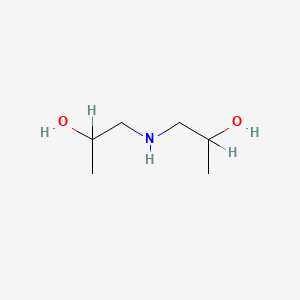
Diisopropanolamine
Diisopropanolamine appears as colorless liquid or white to yellow crystalline solid with an odor of dead fish or ammonia. Liquid floats and mixes with water. Solid sinks and mixes in water. (USCG, 1999) — CAMEO Chemicals
- Nom IUPAC
- 1-(2-hydroxypropylamino)propan-2-ol
- Formule moléculaire
- C6H15NO2
- Masse moléculaire
- 133.19 g/mol
- Masse exacte
- 133.110278721 Da
- XLogP3
- -0,8
- Surface polaire topologique
- 52,5 Ų
- Donneurs de liaisons hydrogène
- 3
- Accepteurs de liaisons hydrogène
- 3
- Unités covalentes
- 1
- Stéréocentres définis
- 0
Également connu sous le nom de
16 autres noms signalés
Identifiants de bases de données externes
- ChEBI:CHEBI:143266
- ChEMBL:CHEMBL2106303
- EPA DTXSID:DTXSID8020179
Preuves issues de bases de données scientifiques complémentaires
NIH PubChem PUG-View
Attributed physical-property, hazard, environmental and use annotations.
- Autoignition Temperature: 580 °F (USCG, 1999) Source: CAMEO Chemicals
- Autoignition Temperature: 374 °C Source: ILO-WHO International Chemical Safety Cards (ICSCs)
- Boiling Point: 480.2 °F at 760 mmHg (NTP, 1992) Source: CAMEO Chemicals
- Boiling Point: 249 °C Source: Hazardous Substances Data Bank (HSDB)
- Boiling Point: 248 °C Source: ILO-WHO International Chemical Safety Cards (ICSCs)
- Color/Form: White waxy solid Source: Hazardous Substances Data Bank (HSDB)
- Density: 0.99 at 107.6 °F (USCG, 1999) - Less dense than water; will float Source: CAMEO Chemicals
- Density: 0.989 at 20 °C/4 °C Source: Hazardous Substances Data Bank (HSDB)
- Density: Relative density (water = 1): 0.99 Source: ILO-WHO International Chemical Safety Cards (ICSCs)
- Dissociation Constants: pKa = 9.1 Source: Hazardous Substances Data Bank (HSDB)
- Flash Point: 259 °F (NTP, 1992) Source: CAMEO Chemicals
- Flash Point: 255 °F (127 °C) (open cup) Source: Hazardous Substances Data Bank (HSDB)
- Flash Point: 127 °C o.c. Source: ILO-WHO International Chemical Safety Cards (ICSCs)
- LogP: log Kow= -0.82 Source: Hazardous Substances Data Bank (HSDB)
- Melting Point: 107.6 °F (NTP, 1992) Source: CAMEO Chemicals
- Melting Point: 32-42 °C Source: Hazardous Substances Data Bank (HSDB)
- Melting Point: 42 °C Source: ILO-WHO International Chemical Safety Cards (ICSCs)
- Physical Description: Diisopropanolamine appears as colorless liquid or white to yellow crystalline solid with an odor of dead fish or ammonia. Liquid floats and mixes with water. Solid sinks and mixes in water. (USCG, 1999) Source: CAMEO Chemicals
- Physical Description: Liquid; Liquid; Other Solid Source: EPA Chemical Data Reporting (CDR)
- Physical Description: White hygroscopic solid; Yellows upon light and air exposure; mp = 42 deg C; [ICSC] May also be in the form of colorless liquid; Odor of dead fish; [CAMEO] White solid; mp = 43-47 deg C; [MSDSonline] Source: Haz-Map, Information on Hazardous Chemicals and Occupational Diseases
- Physical Description: WHITE HYGROSCOPIC CRYSTALLINE POWDER WITH CHARACTERISTIC ODOUR. TURNS YELLOW ON EXPOSURE TO LIGHT AND AIR. Source: ILO-WHO International Chemical Safety Cards (ICSCs)
- Refractive Index: Index of refraction = 1.4450-1.4550 at 60 °C Source: Hazardous Substances Data Bank (HSDB)
- Solubility: Soluble (>=10 mg/ml) (NTP, 1992) Source: CAMEO Chemicals
- Solubility: Miscible in alcohol. Slightly soluble in toluene. Insoluble in hydrocarbons. Source: Hazardous Substances Data Bank (HSDB)
- Solubility: In water, 8.6X10+5 mg/L at 25 °C Source: Hazardous Substances Data Bank (HSDB)
- Solubility: Solubility in water, g/100ml at 20 °C: 87 Source: ILO-WHO International Chemical Safety Cards (ICSCs)
- Vapor Pressure: 0.02 mmHg at 108 °F (NTP, 1992) Source: CAMEO Chemicals
- Vapor Pressure: 0.000125 [mmHg] Source: Haz-Map, Information on Hazardous Chemicals and Occupational Diseases
- Vapor Pressure: 1.25X10⁻⁴ mm Hg at 25 °C /extrapolated/ Source: Hazardous Substances Data Bank (HSDB)
- Vapor Pressure: Vapor pressure, Pa at 42 °C: 2.67 Source: ILO-WHO International Chemical Safety Cards (ICSCs)
- Viscosity: 1.98 cP at 45 °C Source: Hazardous Substances Data Bank (HSDB)
- pH: pH of 5% aqueous solution = 11.5 Source: Hazardous Substances Data Bank (HSDB)
- Exposure Routes: The substance can be absorbed into the body by inhalation of its aerosol, through the skin and by ingestion. Source: ILO-WHO International Chemical Safety Cards (ICSCs)
- First Aid: EYES: First check the victim for contact lenses and remove if present. Flush victim's eyes with water or normal saline solution for 20 to 30 minutes while simultaneously calling a hospital or poison control center. Do not put any ointments, oils, or medication in the victim's eyes without specific instructions from a physician. IMMEDIATELY transport the victim after flushing eyes to a hospital even if no symptoms (such as redness or irritation) develop.; SKIN: IMMEDIATELY flood affected skin with water while removing and isolating all contaminated clothing. Gently wash all affected skin areas thoroughly with soap and water. If symptoms such as redness or irritation develop, IMMEDIATELY call a physician and be prepared to transport the victim to a hospital for treatment.; INHALATION: IMMEDIATELY leave the contaminated area; take deep breaths of fresh air. If symptoms (such as wheezing, coughing, shortness of breath, or burning in the mouth, throat, or chest) develop, call a physician and be prepared to transport the victim to a hospital. Provide proper respiratory protection to rescuers entering an unknown atmosphere. Whenever possible, Self-Contained Breathing Apparatus (SCBA) shou Source: CAMEO Chemicals
- Signal: Warning Source: Regulation (EC) No 1272/2008 of the European Parliament and of the Council
- GHS Hazard Statements: H319: Causes serious eye irritation [Warning Serious eye damage/eye irritation] Source: Regulation (EC) No 1272/2008 of the European Parliament and of the Council
- Precautionary Statement Codes: P264+P265, P280, P305+P351+P338, and P337+P317 (click each P-code to see the statement) Source: Regulation (EC) No 1272/2008 of the European Parliament and of the Council
- Note: This chemical does not meet GHS hazard criteria for < 0.1% (1 of 1635) of reports. Source: European Chemicals Agency (ECHA)
- Signal: Danger Source: European Chemicals Agency (ECHA)
- GHS Hazard Statements: H318 (51.2%): Causes serious eye damage [Danger Serious eye damage/eye irritation]; H319 (48.7%): Causes serious eye irritation [Warning Serious eye damage/eye irritation] Source: European Chemicals Agency (ECHA)
- Precautionary Statement Codes: P264+P265, P280, P305+P351+P338, P305+P354+P338, P317, and P337+P317 (click each P-code to see the statement) Source: European Chemicals Agency (ECHA)
- ECHA C&L Notifications Summary: Aggregated GHS information provided per 1635 reports by companies from 7 notifications to the ECHA C&L Inventory. Each notification may be associated with multiple companies.; Reported as not meeting GHS hazard criteria per 1 of 1635 reports by companies.; There are 6 notifications provided by 1634 of 1635 reports by companies with hazard statement code(s).; Information may vary between notifications depending on impurities, additives, and other factors. The percentage value in parenthesis indicates the notified classification ratio from companies that provide hazard codes. Only hazard codes with percentage values above 10% are shown. For more detailed information, please visit ECHA C&L website. Source: European Chemicals Agency (ECHA)
- Signal: Danger Source: NITE-CMC
- GHS Hazard Statements: H314: Causes severe skin burns and eye damage [Danger Skin corrosion/irritation]; H319: Causes serious eye irritation [Warning Serious eye damage/eye irritation] Source: NITE-CMC
- Precautionary Statement Codes: P260, P264, P264+P265, P280, P301+P330+P331, P302+P361+P354, P304+P340, P305+P351+P338, P305+P354+P338, P316, P321, P337+P317, P363, P405, and P501 (click each P-code to see the statement) Source: NITE-CMC
- Signal: Warning Source: Hazardous Chemical Information System (HCIS), Safe Work Australia
- Cosmetic Ingredient Review Conclusion: The Panel concludes that Diisopropanolamine, Triisopropanolamine, Isopropanolamine, and Mixed Isopropanolamines are safe as cosmetic ingredients in the present practices of use and concentration. The isopropanolamines should not be used in products containing N-nitrosating agents. Source: Cosmetic Ingredient Review (CIR)
- Cosmetic Ingredient Review Finding(s): Safe for use in cosmetics, with qualifications Source: Cosmetic Ingredient Review (CIR)
- Environmental Bioconcentration: An estimated BCF of 3 was calculated for diisopropanolamine(SRC), using a log Kow of -0.82(1) and a regression-derived equation(2). According to a classification scheme(3), this BCF suggests the potential for bioconcentration in aquatic organisms is low(SRC). Source: Hazardous Substances Data Bank (HSDB)
- Environmental Fate: TERRESTRIAL FATE: Based on a classification scheme(1), an estimated Koc value of 10(SRC) from a log Kow of -0.82(2) and a regression derived equation(3) indicates that diisopropanolamine is expected to have very high mobility in soil(SRC). A pKa value of 9.1(4) indicates that the protonated form of diisopropanolamine will be the dominant species in moist soil surfaces and cations adsorb more strongly than neutral species. Batch adsorption experiments indicated that the adsorption mechanism of diisopropanolamine involves ionic interaction at cation exchange sites of soils and clays, and tends to be greatest in materials that have a large cation exchange capacity such as montmorillonite(5). Volatilization of diisopropanolamine from moist soil surfaces will not be an important fate process since cations do not volatilize. Diisopropanolamine is not expected to volatilize from dry soil surfaces(SRC) based upon its extrapolated vapor pressure of 1.25X10⁻⁴ mm Hg at 25 °C(6). Screening studies using sewage sludge indicated that diisopropanolamine does not biodegrade readily(4,7). Source: Hazardous Substances Data Bank (HSDB)
- Environmental Fate: AQUATIC FATE: Based on a classification scheme(1), an estimated Koc value of 10(SRC) from a log Kow of -0.82(2) and a regression derived equation(3) indicates that diisopropanolamine is not expected to adsorb to suspended solids and sediment in water(SRC). A pKa value of 9.1(4) indicates that the protonated form of diisopropanolamine will be the predominant species in water and cations adsorb more strongly to suspended solids and sediment than neutral species. Volatilization from water surfaces will not occur since cations do not volatilize(SRC). According to a classification scheme(5), an estimated BCF of 3(SRC), from its log Kow(2) and a regression-derived equation(6), suggests the potential for bioconcentration in aquatic organisms is low(SRC). Screening studies using sewage sludge indicated that diisopropanolamine does not biodegrade readily(4,7). Source: Hazardous Substances Data Bank (HSDB)
- Environmental Fate: ATMOSPHERIC FATE: According to a model of gas/particle partitioning of semivolatile organic compounds in the atmosphere(1), diisopropanolamine, which has a vapor pressure of 1.25X10⁻⁴ mm Hg at 25 °C(2), is expected to exist solely as a vapor in the ambient atmosphere. Vapor-phase diisopropanolamine is degraded in the atmosphere by reaction with photochemically-produced hydroxyl radicals(SRC); the half-life for this reaction in air is estimated to be 4 hours(SRC), from its rate constant of 1X10⁻¹⁰ cu cm/molecule-sec at 25 °C, that was derived using a structure estimation method(3). Diisopropanolamine is not expected to directly photolyze due to the lack of absorption in the environmental UV spectrum(SRC). Source: Hazardous Substances Data Bank (HSDB)
- Consumer Uses: Hydraulic fluids Source: EPA Chemical Data Reporting (CDR)
- Industry Uses: Hydraulic fluids; Absorbent; Brightener; Not Known or Reasonably Ascertainable; Intermediate; Solvent; Lubricating agent; pH regulating agent Source: EPA Chemical Data Reporting (CDR)
- Cosmetic Ingredient Review Link: CIR ingredient: Diisopropanolamine Source: Cosmetic Ingredient Review (CIR)
- Sources/Uses: Used as chemical intermediate, emulsifying agent (polishes, textile specialties, leather compounds, insecticides, cold wave permanent hair solutions, and water paints), antimicrobial agent in cutting fluids, and for removal of hydrogen sulfide and carbon dioxide from natural and industrial gases; Also used in adhesives, paper and paperboard, coatings, food packaging, and in prescription drugs; [HSDB] Source: Haz-Map, Information on Hazardous Chemicals and Occupational Diseases
- Industrial Processes with risk of exposure: Metal Machining [Category: Heat or Machine]; Petroleum Production and Refining [Category: Industry]; Pulp and Paper Processing [Category: Industry]; Painting (Pigments, Binders, and Biocides) [Category: Paint]; Working with Glues and Adhesives [Category: Other]; Farming (Pesticides) [Category: Industry]; Leather Tanning and Processing [Category: Industry]; Textiles (Printing, Dyeing, or Finishing) [Category: Industry] Source: Haz-Map, Information on Hazardous Chemicals and Occupational Diseases
- Uses: Chemical intermediate; agent for removal of hydrogen sulfide from natural gas Source: Hazardous Substances Data Bank (HSDB)
- Uses: Emulsifying agents for polishes, textile specialties, leather compounds, insecticides, cutting oils, and water paints Source: Hazardous Substances Data Bank (HSDB)
- Uses: Emulsifying and neutralizing agent in cosmetics. Removal of hydrogen sulfide and carbon dioxide from natural and industrial gases. Antimicrobial agent in cutting fluids. Source: Hazardous Substances Data Bank (HSDB)
- Uses: The alkaline character of /diisopropanolamine/... is used to neutralize cosmetic preparations, such as cold wave solutions (hair perms), aerosol hair fixatives, and indoor tanning lotions. Source: Hazardous Substances Data Bank (HSDB)
- Uses: Diisopropanolamine... /is/ used in adhesives, paper and paperboard, paper and paperboard coatings, and production aids and sanitizers for food packaging and, as such, are regulated as indirect food additives by the FDA... . ...Has been used in prescription drug formulations of theophylline and ophthalmic preparations of tropicamide. Source: Hazardous Substances Data Bank (HSDB)
Mis en correspondance par: Existing checksum-valid CAS to unique PubChem CID match. Récupéré le: 2026-08-31. Ouvrir la fiche source
Les classifications scientifiques et les annotations de danger apportent du contexte et ne remplacent pas la décision réglementaire propre au marché indiquée ci-dessus.
Couverture des sources complémentaires et état des correspondances
| Source | Résultat | Vérifié |
|---|---|---|
| NIH PubChem PUG-View | Correspondance exacte | 2026-08-31 |
Une absence de correspondance enregistrée est une preuve utile que la source a été vérifiée ; ce n’est pas l’affirmation que la substance n’existe pas ailleurs.
Récupéré depuis NIH PubChem le 2026-09-02 par correspondance CAS à somme de contrôle valide. Les propriétés chimiques ne remplacent pas la décision réglementaire de cette page.