
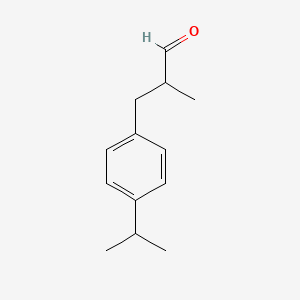
Cyclamen aldehyde
Xi-3-(4-Isopropylphenyl)-2-methylpropanal is a monoterpenoid. — ChEBI
- Nom IUPAC
- 2-methyl-3-(4-propan-2-ylphenyl)propanal
- Formule moléculaire
- C13H18O
- Masse moléculaire
- 190.28 g/mol
- Masse exacte
- 190.135765193 Da
- XLogP3
- 3,3
- Surface polaire topologique
- 17,1 Ų
- Donneurs de liaisons hydrogène
- 0
- Accepteurs de liaisons hydrogène
- 1
- Unités covalentes
- 1
- Stéréocentres définis
- 0
Également connu sous le nom de
16 autres noms signalés
Identifiants de bases de données externes
- ChEBI:CHEBI:188336
- ChEMBL:CHEMBL3183483
- EPA DTXSID:DTXSID2044769
- PubMed:29540657
- PubMed:27965148
- PubMed:26795242
Preuves issues de bases de données scientifiques complémentaires
EMBL-EBI ChEBI
xi-3-(4-Isopropylphenyl)-2-methylpropanal
- Formule
- C13H18O
- Masse moyenne
- 190.286 g/mol
- Masse monoisotopique
- 190.13577 Da
- Charge formelle
- 0
- monoterpenoid — is a (CHEBI:25409)
- monoterpenoid — is a (CHEBI:25409)
Noms supplémentaires validés
Références croisées de cette source
- CAS: 103-95-7 — ChemIDplus
- MANUAL_X_REF: 451801 — ChemSpider
- MANUAL_X_REF: HMDB0037763 — HMDB
Mis en correspondance par: Exact CAS cross-reference in the ChEBI compound record. Récupéré le: 2026-08-31. Ouvrir la fiche source
NIH PubChem PUG-View
Attributed physical-property, hazard, environmental and use annotations.
- Boiling Point: 270 °C Source: Joint FAO/WHO Expert Committee on Food Additives (JECFA)
- Density: 0.946-0.952 Source: Joint FAO/WHO Expert Committee on Food Additives (JECFA)
- Physical Description: Liquid; Dry Powder; Liquid; CBI Source: EPA Chemical Data Reporting (CDR)
- Physical Description: Colourless to pale yellow liquid; Strong floral aroma Source: Joint FAO/WHO Expert Committee on Food Additives (JECFA)
- Refractive Index: 1.503-1.508 Source: Joint FAO/WHO Expert Committee on Food Additives (JECFA)
- Solubility: Soluble in most fixed oils; Insoluble in propylene glycol, glycerin, water Source: Joint FAO/WHO Expert Committee on Food Additives (JECFA)
- Solubility: Soluble (in ethanol) Source: Joint FAO/WHO Expert Committee on Food Additives (JECFA)
- Note: This chemical does not meet GHS hazard criteria for < 0.1% (1 of 2062) of reports. Source: European Chemicals Agency (ECHA)
- Signal: Warning Source: European Chemicals Agency (ECHA)
- GHS Hazard Statements: H315 (98.8%): Causes skin irritation [Warning Skin corrosion/irritation]; H317 (95.9%): May cause an allergic skin reaction [Warning Sensitization, Skin]; H361 (12.3%): Suspected of damaging fertility or the unborn child [Warning Reproductive toxicity]; H411 (15.1%): Toxic to aquatic life with long lasting effects [Hazardous to the aquatic environment, long-term hazard]; H412 (76.6%): Harmful to aquatic life with long lasting effects [Hazardous to the aquatic environment, long-term hazard] Source: European Chemicals Agency (ECHA)
- Precautionary Statement Codes: P203, P261, P264, P272, P273, P280, P302+P352, P318, P321, P332+P317, P333+P317, P362+P364, P391, P405, and P501 (click each P-code to see the statement) Source: European Chemicals Agency (ECHA)
- ECHA C&L Notifications Summary: Aggregated GHS information provided per 2062 reports by companies from 28 notifications to the ECHA C&L Inventory. Each notification may be associated with multiple companies.; Reported as not meeting GHS hazard criteria per 1 of 2062 reports by companies.; There are 27 notifications provided by 2061 of 2062 reports by companies with hazard statement code(s).; Information may vary between notifications depending on impurities, additives, and other factors. The percentage value in parenthesis indicates the notified classification ratio from companies that provide hazard codes. Only hazard codes with percentage values above 10% are shown. For more detailed information, please visit ECHA C&L website. Source: European Chemicals Agency (ECHA)
- Signal: Danger Source: NITE-CMC
- GHS Hazard Statements: H302: Harmful if swallowed [Warning Acute toxicity, oral]; H317: May cause an allergic skin reaction [Warning Sensitization, Skin]; H318: Causes serious eye damage [Danger Serious eye damage/eye irritation]; H335: May cause respiratory irritation [Warning Specific target organ toxicity, single exposure; Respiratory tract irritation]; H336: May cause drowsiness or dizziness [Warning Specific target organ toxicity, single exposure; Narcotic effects] Source: NITE-CMC
- Precautionary Statement Codes: P261, P264, P264+P265, P270, P271, P272, P280, P301+P317, P302+P352, P304+P340, P305+P354+P338, P317, P319, P321, P330, P333+P317, P362+P364, P403+P233, P405, and P501 (click each P-code to see the statement) Source: NITE-CMC
- Consumer Uses: Other; Fragrance Source: EPA Chemical Data Reporting (CDR)
- Industry Uses: Other; Fragrance Source: EPA Chemical Data Reporting (CDR)
Mis en correspondance par: Existing checksum-valid CAS to unique PubChem CID match. Récupéré le: 2026-08-31. Ouvrir la fiche source
Les classifications scientifiques et les annotations de danger apportent du contexte et ne remplacent pas la décision réglementaire propre au marché indiquée ci-dessus.
Couverture des sources complémentaires et état des correspondances
| Source | Résultat | Vérifié |
|---|---|---|
| EMBL-EBI ChEBI | Correspondance exacte | 2026-08-31 |
| NIH PubChem PUG-View | Correspondance exacte | 2026-08-31 |
Une absence de correspondance enregistrée est une preuve utile que la source a été vérifiée ; ce n’est pas l’affirmation que la substance n’existe pas ailleurs.
Récupéré depuis NIH PubChem le 2026-08-31 par correspondance CAS à somme de contrôle valide. Les propriétés chimiques ne remplacent pas la décision réglementaire de cette page.