Aller au contenu principal
Nom officiel d’étiquetage de l’UEEntrée 6286 du glossaire

CHROMIUM

Cette fiche confirme une dénomination commune officielle d’ingrédient pour l’étiquetage des produits cosmétiques de l’UE. Elle ne confirme pas à elle seule que la substance est autorisée, non restreinte ou sûre.

Aperçu des preuves mondiales

L’identité résolue présente des preuves réglementaires correspondantes dans 9 des 13 jeux de données de marchés indexés : 13 fiches de pays et 0 fiches d’annexes de l’UE. Chaque résultat et chaque lacune de preuves sont énumérés ci-dessous.

9 marchés avec preuves
Marchés vérifiés
13
Marchés avec preuves
9
Lacunes de preuves
4
Identifiants résolus
5

Identité résolue de la substance

CAS:7440-47-31308-38-912001-99-9
EC:231-157-5215-160-9
Fiches de l’index des ingrédients :
CHROMIUM
Fonctions cosmétiques : COLORANT

Note de restriction de l’inventaire : II/97

11 noms correspondants ou signalés
CHROMIUMChromium (III) oxideChromium (III) hydroxideChromium; chromic acid and its saltsChromiumChromium (III) oxide (Pigment Green 17, Chromia)Chromium (III) hydroxide (Pigment Green 18)铬、铬酸及其盐类, 以 Cr6+计 — Chromium (CAS No. 7440-47-3); chromic acid and its salts (Cr6+)크롬 ; 크로믹애씨드 및 그 염류Crômio, ácido crômico e seus saisChromium; chromic acid and its salts (CAS No. 7440-47-3)

Preuves réglementaires dans les 13 marchés

Ouvrez chaque fiche correspondante pour connaître son champ d’application, sa concentration, ses conditions, ses avertissements et la version de la source officielle.

Balayez ou faites défiler horizontalement pour voir la couverture des jeux de données et les actions suivantes.

MarchéRésultatFichesJeu de donnéesSignification / action suivante
European Union
EU
Aucune correspondance trouvée0
Complete annex dataset
Regulation (EC) 1223/2009 consolidated to 1 May 2026
No annex match only means that these five annexes did not return a match; CosIng identity data and other EU obligations still need review.
Great Britain
GB
Prohibited3Ouvrir la fiche 1Ouvrir la fiche 2
Complete consolidated annex dataset
GB retained Regulation 1223/2009 schedules, effective 15 August 2026
Examinez chaque fiche associée et ses conditions exactes.
Canada
CA
Prohibited1Ouvrir la fiche 1
Complete Hotlist snapshot
Health Canada Cosmetic Ingredient Hotlist, 13 August 2025
Examinez chaque fiche associée et ses conditions exactes.
New Zealand
NZ
Prohibited3Ouvrir la fiche 1Ouvrir la fiche 2
Complete schedules dataset
Cosmetic Products Group Standard schedules effective 1 January 2026
Examinez chaque fiche associée et ses conditions exactes.
ASEAN
ASEAN
Prohibited1Ouvrir la fiche 1
Complete regional annex dataset
ASEAN Cosmetic Directive annexes 2026-1, 22 June 2026
Examinez chaque fiche associée et ses conditions exactes.
China
CN
Prohibited1Ouvrir la fiche 1
Complete prohibited catalogues plus official-source workflow
NMPA 2021 banned catalogues plus dynamic IECIC List I/List II system current since 2025
Examinez chaque fiche associée et ses conditions exactes.
Japan
JP
Aucune correspondance trouvée0
Complete Standards appendices dataset
MHLW Standards for Cosmetics official English source and Japanese amendments checked for the imported snapshot
The Japanese text and subsequent notices are canonical; no local match is not a product-compliance conclusion.
South Korea
KR
Prohibited1Ouvrir la fiche 1
Complete current appendix dataset
MFDS Notice 2026-19, effective 18 March 2026
Examinez chaque fiche associée et ses conditions exactes.
United States
US
Aucune correspondance trouvée0
Complete enumerated federal ingredient rules
eCFR Title 21 issue date 27 August 2026
FDA has no general approved-cosmetic-ingredient catalogue; absence from these sections is not approval or proof of safety.
Australia
AU
Aucune correspondance trouvée0
Complete cosmetic-relevant Poisons Standard subset plus official workflow
Therapeutic Goods (Poisons Standard—June 2026) Instrument 2026
An AICIS Inventory match is not cosmetic approval; no Inventory match can indicate a new, exempted, reported or confidential introduction.
Brazil
BR
Prohibited1Ouvrir la fiche 1
Complete prohibited dataset plus current restricted-list workflow
ANVISA RDC 1.029/2026 and RDC 1.030/2026, published 15 June 2026
Examinez chaque fiche associée et ses conditions exactes.
India
IN
Prohibited1Ouvrir la fiche 1
Complete current Part 2 dataset plus official workflow for Parts 1, 3 and 4
Cosmetics Rules 2020 plus current BIS IS 4707 parts (1:2020, 2:2025, 3:2025, 4:2022)
Examinez chaque fiche associée et ses conditions exactes.
Saudi Arabia
SA
Prohibited1Ouvrir la fiche 1
Complete official list index
SFDA live prohibited/restricted lists, snapshot 30 August 2026
Examinez chaque fiche associée et ses conditions exactes.
Aucune ligne de marché ne correspond à ce filtre.

Fiches de marché correspondantes et conditions

Identité et propriétés chimiques

Structure chimique 2D PubChem pour le CAS 12001-99-9
CAS 12001-99-9PubChem CID 22504267

C.I. Pigment Green 18

Nom IUPAC
bis(chromium(3+));tris(oxygen(2-));dihydrate
Formule moléculaire
Cr2H4O5
Masse moléculaire
188.02 g/mol
Masse exacte
187.886883 Da
Surface polaire topologique
5,0 Ų
Donneurs de liaisons hydrogène
2
Accepteurs de liaisons hydrogène
5
Unités covalentes
7
Stéréocentres définis
0

Également connu sous le nom de

Chromium hydroxide greenRV8FT8XF5RChromic oxide hydratedUNII-RV8FT8XF5R11958 GREENCHROME OXIDE (HYDRATED) GREENC.I. 77289Guignet'S green
8 autres noms signalés
RefChem:122490CHROMIUM HYDROXIDE GREEN [INCI]601-657-1chromium(3+);oxygen(2-);dihydrateHydrated chromium sesquioxideCI 77289Viridian 3BCYYGBBNBGCVXEL-UHFFFAOYSA-N

Preuves issues de bases de données scientifiques complémentaires

NIH PubChem PUG-View
Correspondance exacte d’identifiant22504267

Attributed physical-property, hazard, environmental and use annotations.

  • Note: This chemical does not meet GHS hazard criteria for 91.7% (11 of 12) of all reports. Source: European Chemicals Agency (ECHA)
  • GHS Hazard Statements: Not Classified; Reported as not meeting GHS hazard criteria by 11 of 12 companies (only 8.3% companies provided GHS information). For more detailed information, please visit ECHA C&L website. Source: European Chemicals Agency (ECHA)
  • ECHA C&L Notifications Summary: Aggregated GHS information provided per 12 reports by companies from 2 notifications to the ECHA C&L Inventory.; Reported as not meeting GHS hazard criteria per 11 of 12 reports by companies.; There is 1 notification provided by 1 of 12 reports by companies with hazard statement code(s).; Information may vary between notifications depending on impurities, additives, and other factors. The percentage value in parenthesis indicates the notified classification ratio from companies that provide hazard codes. Only hazard codes with percentage values above 10% are shown. For more detailed information, please visit ECHA C&L website. Source: European Chemicals Agency (ECHA)

Mis en correspondance par: Existing checksum-valid CAS to unique PubChem CID match. Récupéré le: 2026-08-31. Ouvrir la fiche source

Les classifications scientifiques et les annotations de danger apportent du contexte et ne remplacent pas la décision réglementaire propre au marché indiquée ci-dessus.

Couverture des sources complémentaires et état des correspondances
SourceRésultatVérifié
NIH PubChem PUG-ViewCorrespondance exacte2026-08-31

Une absence de correspondance enregistrée est une preuve utile que la source a été vérifiée ; ce n’est pas l’affirmation que la substance n’existe pas ailleurs.

Récupéré depuis NIH PubChem le 2026-09-02 par correspondance CAS à somme de contrôle valide. Les propriétés chimiques ne remplacent pas la décision réglementaire de cette page.

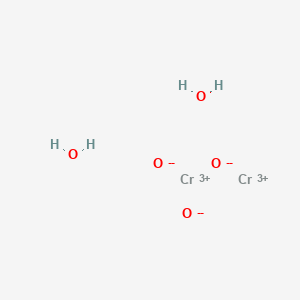
Structure chimique 2D PubChem pour le CAS 1308-38-9
CAS 1308-38-9PubChem CID 517277

Chromia

Dichromium trioxide is a chromium oxide. — ChEBI

Nom IUPAC
oxo(oxochromiooxy)chromium
Formule moléculaire
Cr2O3
Masse moléculaire
151.990 g/mol
Masse exacte
151.865753 Da
Surface polaire topologique
43,4 Ų
Donneurs de liaisons hydrogène
0
Accepteurs de liaisons hydrogène
3
Unités covalentes
1
Stéréocentres définis
0

Également connu sous le nom de

Chromium(III) oxideDichromium trioxideCHROMIC OXIDEChrome oxideChrome GreenGreen chromium oxideGreen cinnabarChrome ochre
16 autres noms signalés
Chromium Oxide GreenAnadonis GreenCasalis GreenGreen rougeChrome OcherLeaf greenChromium(3+) oxideLevanox green gachromium (III) oxideOxide of chromiumGreen oxide of chromiumGreen chrome oxideChromic Acid GreenGreen chromic oxideChrome Green F 3Chromium oxide (Cr2O3)
Identifiants de bases de données externes

Preuves issues de bases de données scientifiques complémentaires

NIH PubChem PUG-View
Correspondance exacte d’identifiant517277

Attributed physical-property, hazard, environmental and use annotations.

  • Note: This chemical does not meet GHS hazard criteria for 57.8% (1112 of 1924) of all reports. Source: European Chemicals Agency (ECHA)
  • Signal: Danger Source: European Chemicals Agency (ECHA)
  • GHS Hazard Statements: H302 (24%): Harmful if swallowed [Warning Acute toxicity, oral]; H317 (25.7%): May cause an allergic skin reaction [Warning Sensitization, Skin]; H319 (24.3%): Causes serious eye irritation [Warning Serious eye damage/eye irritation]; H360 (14.6%): May damage fertility or the unborn child [Danger Reproductive toxicity] Source: European Chemicals Agency (ECHA)
  • Precautionary Statement Codes: P203, P261, P264, P264+P265, P270, P272, P280, P301+P317, P302+P352, P305+P351+P338, P318, P321, P330, P333+P317, P337+P317, P362+P364, P405, and P501 (click each P-code to see the statement) Source: European Chemicals Agency (ECHA)
  • ECHA C&L Notifications Summary: Aggregated GHS information provided per 1924 reports by companies from 27 notifications to the ECHA C&L Inventory. Each notification may be associated with multiple companies.; Reported as not meeting GHS hazard criteria per 1112 of 1924 reports by companies.; There are 23 notifications provided by 812 of 1924 reports by companies with hazard statement code(s).; Information may vary between notifications depending on impurities, additives, and other factors. The percentage value in parenthesis indicates the notified classification ratio from companies that provide hazard codes. Only hazard codes with percentage values above 10% are shown. For more detailed information, please visit ECHA C&L website. Source: European Chemicals Agency (ECHA)
  • Signal: Danger Source: NITE-CMC
  • GHS Hazard Statements: H317: May cause an allergic skin reaction [Warning Sensitization, Skin]; H334: May cause allergy or asthma symptoms or breathing difficulties if inhaled [Danger Sensitization, respiratory]; H372: Causes damage to organs through prolonged or repeated exposure [Danger Specific target organ toxicity, repeated exposure] Source: NITE-CMC
  • Precautionary Statement Codes: P233, P260, P261, P264, P270, P271, P272, P280, P284, P302+P352, P304+P340, P319, P321, P333+P317, P342+P316, P362+P364, P403, and P501 (click each P-code to see the statement) Source: NITE-CMC
  • GHS Hazard Statements: H317: May cause an allergic skin reaction [Warning Sensitization, Skin]; H334: May cause allergy or asthma symptoms or breathing difficulties if inhaled [Danger Sensitization, respiratory] Source: NITE-CMC
  • Precautionary Statement Codes: P233, P260, P261, P271, P272, P280, P284, P302+P352, P304+P340, P321, P333+P317, P342+P316, P362+P364, P403, and P501 (click each P-code to see the statement) Source: NITE-CMC
  • Health Effects: Chromium in its trivalent state is not very toxic. It may be oxidized to hexavalent chromium, a known carcinogen. Hexavalent chromium has also been shown to affect reproduction and development. (A12) Source: Toxin and Toxin Target Database (T3DB)
  • Toxicity Summary: IDENTIFICATION AND USE: Chromic oxide (Cr(2)O(3)) is a green powder. It is not registered for current use in the U.S., but approved pesticide uses may change periodically and so federal, state and local authorities must be consulted for currently approved uses. It is used in abrasives and electric semiconductors; in alloys; in printing fabrics and banknotes. It is also used in dyeing polymers; colorant for latex paints, in manufacturing of chromium metal and aluminum-chromium master alloys. It's other uses include catalyst in organic synthesis, green granules in asphalt roofing, component of refractory brick. Chromic oxide is a color additive in drug use. HUMAN EXPOSURE AND TOXICITY: Fine chromic oxide particles were insoluble in the culture medium; on the contrary, Cr(2)O(3) nanoparticles released soluble hexavalent chromium into the culture medium. Human lung carcinoma A549 cells and human keratinocyte HaCaT cells showed an increase in intracellular reactive oxygen species (ROS) level and activation of antioxidant defense systems on exposure to Cr(2)O(3) nanoparticles. The cellular influences of Cr(2)O(3) nanoparticles matched those of hexavalent chromium. Human lung epithelial c Source: Hazardous Substances Data Bank (HSDB)
  • Toxicity Summary: Trivalent chromium may also form complexes with peptides, proteins, and DNA, resulting in DNA-protein crosslinks, DNA strand breaks, DNA-DNA interstrand crosslinks, chromium-DNA adducts, chromosomal aberrations and alterations in cellular signaling pathways. It has been shown to induce carcinogenesis by overstimulating cellular regulatory pathways and increasing peroxide levels by activating certain mitogen-activated protein kinases. It can also cause transcriptional repression by cross-linking histone deacetylase 1-DNA methyltransferase 1 complexes to CYP1A1 promoter chromatin, inhibiting histone modification. Chromium may increase its own toxicity by modifying metal regulatory transcription factor 1, causing the inhibition of zinc-induced metallothionein transcription. (A12, L16, A34, A35, A36) Source: Toxin and Toxin Target Database (T3DB)
  • Consumer Uses: Other; Processing aids not otherwise specified; Catalyst; Not Known or Reasonably Ascertainable; Corrosion inhibitor; Pigment Source: EPA Chemical Data Reporting (CDR)
  • Sources/Uses: Used in abrasives, refractory materials, semiconductors, pigments, alloys, textile printing inks, and catalysts; [Merck Index] Used as a pigment in polymers and latex paints; [HSDB] Source: Haz-Map, Information on Hazardous Chemicals and Occupational Diseases
  • Industrial Processes with risk of exposure: Semiconductor Manufacturing [Category: Industry]; Painting (Pigments, Binders, and Biocides) [Category: Paint]; Textiles (Printing, Dyeing, or Finishing) [Category: Industry] Source: Haz-Map, Information on Hazardous Chemicals and Occupational Diseases
  • Uses: For chromic oxide (USEPA/OPP Pesticide Code: 021103) there are 0 labels match. /SRP: Not registered for current use in the U.S., but approved pesticide uses may change periodically and so federal, state and local authorities must be consulted for currently approved uses./ Source: Hazardous Substances Data Bank (HSDB)
  • Uses: In abrasives, refractory materials, electric semiconductors; as pigment, particularly in coloring glass; in alloys; in printing fabrics and banknotes; catalyst for organic and inorganic reactions. Source: Hazardous Substances Data Bank (HSDB)
  • Uses: Used in dyeing polymers, ... colorant for latex paints. Source: Hazardous Substances Data Bank (HSDB)
  • Uses: In metallurgy in the manufacture of chromium metal and aluminum-chromium master alloys. Source: Hazardous Substances Data Bank (HSDB)
  • Uses: For more Uses (Complete) data for Chromium (III) oxide (11 total), please visit the HSDB record page. Source: Hazardous Substances Data Bank (HSDB)
  • Uses: Plastics -> Typical concentration range in plastic materials -> 1% Source: NORMAN Suspect List Exchange
  • Uses: Chromium(III) oxide is commonly used as pigment, under the name viridian, in paints, inks, and glasses. (L523) Source: Toxin and Toxin Target Database (T3DB)

Mis en correspondance par: Existing checksum-valid CAS to unique PubChem CID match. Récupéré le: 2026-08-31. Ouvrir la fiche source

Les classifications scientifiques et les annotations de danger apportent du contexte et ne remplacent pas la décision réglementaire propre au marché indiquée ci-dessus.

Couverture des sources complémentaires et état des correspondances
SourceRésultatVérifié
NIH PubChem PUG-ViewCorrespondance exacte2026-08-31

Une absence de correspondance enregistrée est une preuve utile que la source a été vérifiée ; ce n’est pas l’affirmation que la substance n’existe pas ailleurs.

Récupéré depuis NIH PubChem le 2026-09-02 par correspondance CAS à somme de contrôle valide. Les propriétés chimiques ne remplacent pas la décision réglementaire de cette page.
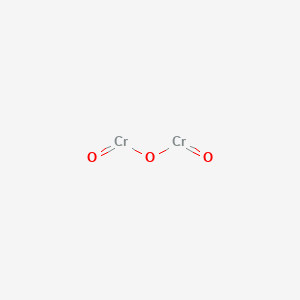
Structure chimique 2D PubChem pour le CAS 7440-47-3
CAS 7440-47-3PubChem CID 23976

Chromium

Chromium atom is a chromium group element atom that has atomic number 24. It has a role as a micronutrient. It is a chromium group element atom and a metal allergen. — ChEBI

Nom IUPAC
chromium
Formule moléculaire
Cr
Masse moléculaire
51.996 g/mol
Masse exacte
51.940505 Da
Surface polaire topologique
0,0 Ų
Donneurs de liaisons hydrogène
0
Accepteurs de liaisons hydrogène
0
Unités covalentes
1
Stéréocentres définis
0

Également connu sous le nom de

ChromeChromium metalChromChromium, elementalDinakromeBioChromeCHEBI:280730R0008Q3JB
16 autres noms signalés
Dietary ChromiumChromium MetallicumRefChem:5683lambda6-chromium(6+) ion231-157-5Crchromium atomchromide(1-)CHROMIUM IONChromium powder, APS <10 micronChrome [French]Chrom [German]cromoChromium Hollow Cathode Lamp: 1.5" Diameter, 2-pin, Non-CodedChromium Hollow Cathode Lamp: 2.0" Diameter, 4-pin, CablelessChromium Hollow Cathode Lamp: 2.0" Diameter, 9-pin, Non-Coded
Identifiants de bases de données externes

Récupéré depuis NIH PubChem le 2026-08-31 par correspondance CAS à somme de contrôle valide. Les propriétés chimiques ne remplacent pas la décision réglementaire de cette page.

Recherche complémentaire sur la substance auprès de sources faisant autorité

Chaque lien lance une recherche de cette identité dans la source concernée. Un lien est une piste de recherche, et non l’affirmation que la source détient une fiche exacte. Ce qu’est chaque source et sa valeur juridique

Aller plus loin avec cette fiche

Analyser dans une formuleOuvrir la comparaison autonome

Source officielle et champ d’application

Importé de la décision d’exécution (UE) 2025/1175 de la Commission (version du jeu de données EU 2025/1175). Le glossaire fournit les dénominations communes des ingrédients pour la liste d’ingrédients exigée par l’article 19, paragraphe 1, point g) ; ce n’est ni une liste d’autorisation ni une liste de sécurité.

Ouvrir la décision officielle