
Nom officiel d’étiquetage de l’UEEntrée 3038 du glossaire
BARIUM CHLORIDE
Cette fiche confirme une dénomination commune officielle d’ingrédient pour l’étiquetage des produits cosmétiques de l’UE. Elle ne confirme pas à elle seule que la substance est autorisée, non restreinte ou sûre.
Aperçu des preuves mondiales
L’identité résolue présente des preuves réglementaires correspondantes dans 1 des 13 jeux de données de marchés indexés : 1 fiches de pays et 0 fiches d’annexes de l’UE. Chaque résultat et chaque lacune de preuves sont énumérés ci-dessous.
Marchés vérifiés
13
Marchés avec preuves
1
Lacunes de preuves
12
Identifiants résolus
3
Identité résolue de la substance
CAS:10361-37-222561-74-6
EC:233-788-1
Fiches de l’index des ingrédients :
2 noms correspondants ou signalés
BARIUM CHLORIDE바륨염(바륨설페이트 및 색소레이크희석제로 사용한 바륨염은 제외)
Preuves réglementaires dans les 13 marchés
Ouvrez chaque fiche correspondante pour connaître son champ d’application, sa concentration, ses conditions, ses avertissements et la version de la source officielle.
Balayez ou faites défiler horizontalement pour voir la couverture des jeux de données et les actions suivantes.
| Marché | Résultat | Fiches | Jeu de données | Signification / action suivante |
|---|---|---|---|---|
| European Union EU | Aucune correspondance trouvée | 0 | Complete annex dataset Regulation (EC) 1223/2009 consolidated to 1 May 2026 | No annex match only means that these five annexes did not return a match; CosIng identity data and other EU obligations still need review. |
| Great Britain GB | Aucune correspondance trouvée | 0 | Complete consolidated annex dataset GB retained Regulation 1223/2009 schedules, effective 15 August 2026 | No annex match is not approval and does not cover Northern Ireland, which follows the applicable EU framework. |
| Canada CA | Aucune correspondance trouvée | 0 | Complete Hotlist snapshot Health Canada Cosmetic Ingredient Hotlist, 13 August 2025 | The Hotlist is an administrative compliance tool, not an exhaustive safety approval list. |
| New Zealand NZ | Aucune correspondance trouvée | 0 | Complete schedules dataset Cosmetic Products Group Standard schedules effective 1 January 2026 | The searchable spreadsheet is an aid; the legal Group Standard and incorporated notices remain authoritative. |
| ASEAN ASEAN | Aucune correspondance trouvée | 0 | Complete regional annex dataset ASEAN Cosmetic Directive annexes 2026-1, 22 June 2026 | Regional annex coverage does not replace member-state implementation dates, notifications or national deviations. |
| China CN | Aucune correspondance trouvée | 0 | Complete prohibited catalogues plus official-source workflow NMPA 2021 banned catalogues plus dynamic IECIC List I/List II system current since 2025 | IECIC listing is not blanket approval; absence may require the new cosmetic ingredient route, and restrictions are checked separately. |
| Japan JP | Aucune correspondance trouvée | 0 | Complete Standards appendices dataset MHLW Standards for Cosmetics official English source and Japanese amendments checked for the imported snapshot | The Japanese text and subsequent notices are canonical; no local match is not a product-compliance conclusion. |
| South Korea KR | Prohibited | 1Ouvrir la fiche 1 | Complete current appendix dataset MFDS Notice 2026-19, effective 18 March 2026 | Examinez chaque fiche associée et ses conditions exactes. |
| United States US | Aucune correspondance trouvée | 0 | Complete enumerated federal ingredient rules eCFR Title 21 issue date 27 August 2026 | FDA has no general approved-cosmetic-ingredient catalogue; absence from these sections is not approval or proof of safety. |
| Australia AU | Aucune correspondance trouvée | 0 | Complete cosmetic-relevant Poisons Standard subset plus official workflow Therapeutic Goods (Poisons Standard—June 2026) Instrument 2026 | An AICIS Inventory match is not cosmetic approval; no Inventory match can indicate a new, exempted, reported or confidential introduction. |
| Brazil BR | Aucune correspondance trouvée | 0 | Complete prohibited dataset plus current restricted-list workflow ANVISA RDC 1.029/2026 and RDC 1.030/2026, published 15 June 2026 | RDC 1.030/2026 amends rather than replaces the prohibited baseline, and the second restricted-list revision was still under consultation in July 2026. |
| India IN | Aucune correspondance trouvée | 0 | Complete current Part 2 dataset plus official workflow for Parts 1, 3 and 4 Cosmetics Rules 2020 plus current BIS IS 4707 parts (1:2020, 2:2025, 3:2025, 4:2022) | The standards are separate controlled publications; absence from a locally indexed excerpt is not permission. |
| Saudi Arabia SA | Aucune correspondance trouvée | 0 | Complete official list index SFDA live prohibited/restricted lists, snapshot 30 August 2026 | No list match is not permission; Gulf/SFDA product, claim, notification and technical requirements still apply. |
Aucune ligne de marché ne correspond à ce filtre.
Fiches de marché correspondantes et conditions
Identité et propriétés chimiques
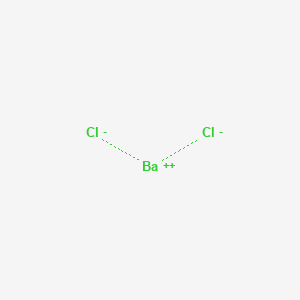
CAS 10361-37-2PubChem CID 25204
Barium chloride
Barium chloride appears as white crystals. A salt arising from the direct reaction of barium and chlorine. Toxic by ingestion. (NTP, 1992) — CAMEO Chemicals
- Nom IUPAC
- barium(2+) dichloride
- Formule moléculaire
- BaCl2
- Masse moléculaire
- 208.23 g/mol
- Masse exacte
- 207.842952 Da
- Surface polaire topologique
- 0,0 Ų
- Donneurs de liaisons hydrogène
- 0
- Accepteurs de liaisons hydrogène
- 2
- Unités covalentes
- 3
- Stéréocentres définis
- 0
Également connu sous le nom de
Barium chloride (BaCl2)Ba 0108ESBA 0108ENCI-C610740VK51DA1T2NSC-146181DICHLOROBARIUMRefChem:5582
16 autres noms signalés
233-788-1BaCl2Barium dichlorideCHEBI:63317Barium chloride, 99.9% trace metals basisBarium chloride, anhydrousBarium chloride, ultra dryBariumchloridCCRIS 2286HSDB 2633Barium Chloride Dihydrate (8CI); Barium Chloride (BaCl2) Hydrate; Barium Dichloride DihydrateEINECS 233-788-1NSC 146181UNII-0VK51DA1T2WLN: BA G2Ba-0108E
Preuves issues de bases de données scientifiques complémentaires
EMBL-EBI ChEBI
Correspondance exacte d’identifiantCHEBI:63317
barium chloride
The inorganic dichloride salt of barium.
- Formule
- Ba.2Cl
- Masse moyenne
- 208.234 g/mol
- Masse monoisotopique
- 207.84295 Da
- Charge formelle
- 0
- inorganic chloride — is a (CHEBI:36093)
- barium salt — is a (CHEBI:63320)
- potassium channel blocker — has role (CHEBI:50509)
- NMR chemical shift reference compound — has role (CHEBI:228364)
- potassium channel blocker — has role (CHEBI:50509)
- NMR chemical shift reference compound — has role (CHEBI:228364)
- inorganic chloride — is a (CHEBI:36093)
- barium salt — is a (CHEBI:63320)
- 21601246 Source: PubMed
Noms supplémentaires validés
barium dichlorideBaCl2
Références croisées de cette source
- CAS: 10361-37-2 — ChemIDplus
- CAS: 10361-37-2 — NIST Chemistry WebBook
- REGISTRY_NUMBER: 1209229 — Reaxys
- REGISTRY_NUMBER: 8128158 — Reaxys
- MANUAL_X_REF: Barium_chloride — Wikipedia
- MANUAL_X_REF: CPD0-1592 — MetaCyc
Mis en correspondance par: Exact CAS cross-reference in the ChEBI compound record. Source mise à jour le: 2024-06-06. Récupéré le: 2026-08-31. Ouvrir la fiche source
NIH PubChem PUG-View
Correspondance exacte d’identifiant25204
Attributed physical-property, hazard, environmental and use annotations.
- Boiling Point: 2840 °F at 760 mmHg (NTP, 1992) Source: CAMEO Chemicals
- Boiling Point: 1560 °C Source: Hazardous Substances Data Bank (HSDB)
- Boiling Point: 1560 °C Source: ILO-WHO International Chemical Safety Cards (ICSCs)
- Boiling Point: 1560 °C @760 [mm Hg] Source: PAC Chemical Database, U.S. Department of Energy
- Boiling Point: 2840 °F Source: The National Institute for Occupational Safety and Health (NIOSH)
- Color/Form: White orthorhombic crystals Source: Hazardous Substances Data Bank (HSDB)
- Color/Form: White solid Source: Hazardous Substances Data Bank (HSDB)
- Density: 3.856 (NTP, 1992) - Denser than water; will sink Source: CAMEO Chemicals
- Density: 3.9 g/cu cm Source: Hazardous Substances Data Bank (HSDB)
- Density: 3.9 g/cm³ Source: ILO-WHO International Chemical Safety Cards (ICSCs)
- Density: 3.9 @25 °C Source: PAC Chemical Database, U.S. Department of Energy
- Density: 3.86 Source: The National Institute for Occupational Safety and Health (NIOSH)
- Melting Point: 1764 to 1765 °F transition to cubic crystals at 1697 °F (NTP, 1992) Source: CAMEO Chemicals
- Melting Point: 961 °C Source: Hazardous Substances Data Bank (HSDB)
- Melting Point: 960 °C Source: ILO-WHO International Chemical Safety Cards (ICSCs)
- Melting Point: 961 °C Source: PAC Chemical Database, U.S. Department of Energy
- Melting Point: 1765 °F Source: The National Institute for Occupational Safety and Health (NIOSH)
- Odor: Odorless Source: Hazardous Substances Data Bank (HSDB)
- Physical Description: Barium chloride appears as white crystals. A salt arising from the direct reaction of barium and chlorine. Toxic by ingestion. (NTP, 1992) Source: CAMEO Chemicals
- Physical Description: CBI; Dry Powder; Liquid Source: EPA Chemical Data Reporting (CDR)
- Physical Description: Colorless solid; [Hawley] White solid; [HSDB] White odorless solid; Soluble in water; [MSDSonline] Source: Haz-Map, Information on Hazardous Chemicals and Occupational Diseases
- Physical Description: ODOURLESS COLOURLESS CRYSTALS. Source: ILO-WHO International Chemical Safety Cards (ICSCs)
- Physical Description: White, odorless solid. Source: The National Institute for Occupational Safety and Health (NIOSH)
- Solubility: 38 % (NIOSH, 2024) Source: CAMEO Chemicals
- Solubility: 37.0 g/100 g water at 25 °C Source: Hazardous Substances Data Bank (HSDB)
- Solubility: Solubility in water as weight %: 24%, 0 °C; 26.3%, 20 °C; 28.9%, 40 °C; 31.7%, 60 °C; 34.4%, 80 °C, 26.2%, 100 °C Source: Hazardous Substances Data Bank (HSDB)
- Solubility: Practically insoluble in ethanol Source: Hazardous Substances Data Bank (HSDB)
- Solubility: Solubility in water, g/100ml: 36 Source: ILO-WHO International Chemical Safety Cards (ICSCs)
- Solubility: 38% Source: The National Institute for Occupational Safety and Health (NIOSH)
- Vapor Pressure: Low (NIOSH, 2024) Source: CAMEO Chemicals
- Vapor Pressure: Essentially zero Source: Hazardous Substances Data Bank (HSDB)
- Vapor Pressure: Low Source: The National Institute for Occupational Safety and Health (NIOSH)
- Carcinogen Classification: No indication of carcinogenicity to humans (not listed by IARC). Source: Toxin and Toxin Target Database (T3DB)
- Exposure Routes: The substance can be absorbed into the body by inhalation of its aerosol and by ingestion. Source: ILO-WHO International Chemical Safety Cards (ICSCs)
- Exposure Routes: inhalation, ingestion, skin and/or eye contact Source: The National Institute for Occupational Safety and Health (NIOSH)
- Exposure Routes: Oral (L214) ; inhalation (L214) Source: Toxin and Toxin Target Database (T3DB)
- First Aid: EYES: First check the victim for contact lenses and remove if present. Flush victim's eyes with water or normal saline solution for 20 to 30 minutes while simultaneously calling a hospital or poison control center. Do not put any ointments, oils, or medication in the victim's eyes without specific instructions from a physician. IMMEDIATELY transport the victim after flushing eyes to a hospital even if no symptoms (such as redness or irritation) develop.; SKIN: IMMEDIATELY flood affected skin with water while removing and isolating all contaminated clothing. Gently wash all affected skin areas thoroughly with soap and water. If symptoms such as redness or irritation develop, IMMEDIATELY call a physician and be prepared to transport the victim to a hospital for treatment.; INHALATION: IMMEDIATELY leave the contaminated area; take deep breaths of fresh air. IMMEDIATELY call a physician and be prepared to transport the victim to a hospital even if no symptoms (such as wheezing, coughing, shortness of breath, or burning in the mouth, throat, or chest) develop. Provide proper respiratory protection to rescuers entering an unknown atmosphere. Whenever possible, Self-Contained Breathing Ap Source: CAMEO Chemicals
- First Aid: (General first aid procedures); Eye: Irrigate immediately - If this chemical contacts the eyes, immediately wash (irrigate) the eyes with large amounts of water, occasionally lifting the lower and upper lids. Get medical attention immediately.; Skin: Water flush immediately - If this chemical contacts the skin, immediately flush the contaminated skin with water. If this chemical penetrates the clothing, immediately remove the clothing and flush the skin with water. Get medical attention promptly.; Breathing: Respiratory support; Swallow: Medical attention immediately - If this chemical has been swallowed, get medical attention immediately. Source: The National Institute for Occupational Safety and Health (NIOSH)
- Signal: Danger Source: Regulation (EC) No 1272/2008 of the European Parliament and of the Council
- GHS Hazard Statements: H301: Toxic if swallowed [Danger Acute toxicity, oral]; H332: Harmful if inhaled [Warning Acute toxicity, inhalation] Source: Regulation (EC) No 1272/2008 of the European Parliament and of the Council
- Precautionary Statement Codes: P261, P264, P270, P271, P301+P316, P304+P340, P317, P321, P330, P405, and P501 (click each P-code to see the statement) Source: Regulation (EC) No 1272/2008 of the European Parliament and of the Council
- Note: This chemical does not meet GHS hazard criteria for 0.3% (3 of 881) of reports. Source: European Chemicals Agency (ECHA)
- Signal: Danger Source: European Chemicals Agency (ECHA)
- GHS Hazard Statements: H301 (99.5%): Toxic if swallowed [Danger Acute toxicity, oral]; H319 (75%): Causes serious eye irritation [Warning Serious eye damage/eye irritation]; H332 (99.7%): Harmful if inhaled [Warning Acute toxicity, inhalation]; H413 (14.2%): May cause long lasting harmful effects to aquatic life [Hazardous to the aquatic environment, long-term hazard] Source: European Chemicals Agency (ECHA)
- Precautionary Statement Codes: P261, P264, P264+P265, P270, P271, P273, P280, P301+P316, P304+P340, P305+P351+P338, P317, P321, P330, P337+P317, P405, and P501 (click each P-code to see the statement) Source: European Chemicals Agency (ECHA)
- ECHA C&L Notifications Summary: Aggregated GHS information provided per 881 reports by companies from 11 notifications to the ECHA C&L Inventory. Each notification may be associated with multiple companies.; Reported as not meeting GHS hazard criteria per 3 of 881 reports by companies.; There are 10 notifications provided by 878 of 881 reports by companies with hazard statement code(s).; Information may vary between notifications depending on impurities, additives, and other factors. The percentage value in parenthesis indicates the notified classification ratio from companies that provide hazard codes. Only hazard codes with percentage values above 10% are shown. For more detailed information, please visit ECHA C&L website. Source: European Chemicals Agency (ECHA)
- Signal: Danger Source: NITE-CMC
- GHS Hazard Statements: H301: Toxic if swallowed [Danger Acute toxicity, oral]; H315: Causes skin irritation [Warning Skin corrosion/irritation]; H319: Causes serious eye irritation [Warning Serious eye damage/eye irritation]; H335: May cause respiratory irritation [Warning Specific target organ toxicity, single exposure; Respiratory tract irritation]; H370: Causes damage to organs [Danger Specific target organ toxicity, single exposure]; H372: Causes damage to organs through prolonged or repeated exposure [Danger Specific target organ toxicity, repeated exposure]; H402: Harmful to aquatic life [Hazardous to the aquatic environment, acute hazard]; H412: Harmful to aquatic life with long lasting effects [Hazardous to the aquatic environment, long-term hazard] Source: NITE-CMC
- Precautionary Statement Codes: P260, P261, P264, P264+P265, P270, P271, P273, P280, P301+P316, P302+P352, P304+P340, P305+P351+P338, P308+P316, P319, P321, P330, P332+P317, P337+P317, P362+P364, P403+P233, P405, and P501 (click each P-code to see the statement) Source: NITE-CMC
- GHS Hazard Statements: H301: Toxic if swallowed [Danger Acute toxicity, oral]; H315: Causes skin irritation [Warning Skin corrosion/irritation]; H335: May cause respiratory irritation [Warning Specific target organ toxicity, single exposure; Respiratory tract irritation]; H336: May cause drowsiness or dizziness [Warning Specific target organ toxicity, single exposure; Narcotic effects]; H370: Causes damage to organs [Danger Specific target organ toxicity, single exposure]; H371: May cause damage to organs [Warning Specific target organ toxicity, single exposure]; H372: Causes damage to organs through prolonged or repeated exposure [Danger Specific target organ toxicity, repeated exposure]; H373: May causes damage to organs through prolonged or repeated exposure [Warning Specific target organ toxicity, repeated exposure] Source: NITE-CMC
- Health Effects: The health effects of the different barium compounds depend on how well the compound dissolves in water or the stomach contents. At low doses, barium acts as a muscle stimulant, while higher doses affect the nervous system, causing cardiac irregularities, tremors, weakness, anxiety, dyspnea, paralysisand possibly death. Barium may also cause gastrointestinal disturbances, damage the kidneys and cause decreases in body weight. (L214) Source: Toxin and Toxin Target Database (T3DB)
- Target Organs: Eyes, skin, respiratory system, heart, central nervous system Source: The National Institute for Occupational Safety and Health (NIOSH)
- Toxicity Summary: Barium is a competitive potassium channel antagonist that blocks the passive efflux of intracellular potassium, resulting in a shift of potassium from extracellular to intracellular compartments. The intracellular translocation of potassium results in a decreased resting membrane potential, making the muscle fibers electrically unexcitable and causing paralysis. Some of these barium's effects may also be due to barium induced neuromuscular blockade and membrane depolarization. (L214) Source: Toxin and Toxin Target Database (T3DB)
- Industry Uses: Not Known or Reasonably Ascertainable; Flux agent; Intermediate Source: EPA Chemical Data Reporting (CDR)
- Sources/Uses: Used to manufacture pigments, color lakes, glass, and mordant for acid dyes; for weighting and dyeing textile fabrics; in aluminum refining; as pesticide; as boiler compound for softening water; for tanning and finishing leather; in treating wool for stuffing mattresses; in lubrication oil additives; as an intermediate for barium salts; as intermediate for steel hardening compounds; in the production of magnesium metal; in chemical analysis; as 5% constituent of material (ternary eutectic salt) effective in extinguishing fires of uranium and plutonium; [HSDB] Source: Haz-Map, Information on Hazardous Chemicals and Occupational Diseases
- Industrial Processes with risk of exposure: Aluminum Producing [Category: Industry]; Steel Producing [Category: Industry]; Metal Preparation and Pouring [Category: Foundry]; Textiles (Fiber & Fabric Manufacturing) [Category: Industry]; Leather Tanning and Processing [Category: Industry]; Glass Manufacturing [Category: Industry] Source: Haz-Map, Information on Hazardous Chemicals and Occupational Diseases
- Uses: Manufacture pigments, color lakes, glass, mordant for acid dyes; weighting and dyeing textile fabrics; in aluminum refining; as pesticide; boiler cmpd for softening water; tanning and finishing leather. Source: Hazardous Substances Data Bank (HSDB)
- Uses: Used in treating wool for stuffing mattresses. Source: Hazardous Substances Data Bank (HSDB)
- Uses: Chemicals (artificial barium sulfate, other barium salts); reagents, lubrication oil additives; boiler compounds, textile dying, pigments, manufacture of white leather. /Barium chloride dihydrate/ Source: Hazardous Substances Data Bank (HSDB)
- Uses: For chlorine and sodium hydroxide manufacture, as flux for magnesium alloys. /Barium chloride, dihydrate/ Source: Hazardous Substances Data Bank (HSDB)
- Uses: For more Uses (Complete) data for Barium chloride (7 total), please visit the HSDB record page. Source: Hazardous Substances Data Bank (HSDB)
- Uses: Barium chloride is used in the laboratory as a test for sulfate ion. In industry, barium chloride is mainly used in the purification of brine solution in caustic chlorine plants and also in the manufacture of heat treatment salts, case hardening of steel, in the manufacture of pigments, and in the manufacture of other barium salts. It is also used in fireworks to give a bright green color. (L204) Source: Toxin and Toxin Target Database (T3DB)
Mis en correspondance par: Existing checksum-valid CAS to unique PubChem CID match. Récupéré le: 2026-08-31. Ouvrir la fiche source
Les classifications scientifiques et les annotations de danger apportent du contexte et ne remplacent pas la décision réglementaire propre au marché indiquée ci-dessus.
Couverture des sources complémentaires et état des correspondances
| Source | Résultat | Vérifié |
|---|---|---|
| EMBL-EBI ChEBI | Correspondance exacte | 2026-08-31 |
| NIH PubChem PUG-View | Correspondance exacte | 2026-08-31 |
Une absence de correspondance enregistrée est une preuve utile que la source a été vérifiée ; ce n’est pas l’affirmation que la substance n’existe pas ailleurs.
Récupéré depuis NIH PubChem le 2026-09-02 par correspondance CAS à somme de contrôle valide. Les propriétés chimiques ne remplacent pas la décision réglementaire de cette page.
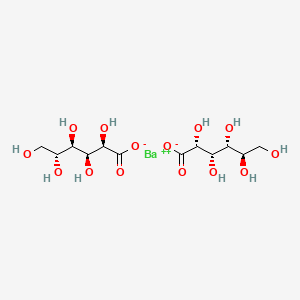
CAS 22561-74-6PubChem CID 89753
Barium gluconate
- Nom IUPAC
- barium(2+);bis((2R,3S,4R,5R)-2,3,4,5,6-pentahydroxyhexanoate)
- Formule moléculaire
- C12H22BaO14
- Masse moléculaire
- 527.62 g/mol
- Masse exacte
- 528.006202 Da
- Surface polaire topologique
- 283,0 Ų
- Donneurs de liaisons hydrogène
- 10
- Accepteurs de liaisons hydrogène
- 14
- Unités covalentes
- 3
- Stéréocentres définis
- 8
Également connu sous le nom de
D-Gluconic acid, barium saltBarium di-D-gluconateEINECS 245-081-5NSC-1945Barium di(D-gluconate)UNII-C23395US5PTox21_110002CAS-5328-41-6
2 autres noms signalés
D-GLUCONIC ACID, BARIUM SALT (2:1)GLUCONIC ACID, BARIUM SALT (2:1), D-
Identifiants de bases de données externes
- ChEMBL:CHEMBL3182297
- EPA DTXSID:DTXSID7045079
Récupéré depuis NIH PubChem le 2026-09-02 par correspondance CAS à somme de contrôle valide. Les propriétés chimiques ne remplacent pas la décision réglementaire de cette page.
Recherche complémentaire sur la substance auprès de sources faisant autorité
Chaque lien lance une recherche de cette identité dans la source concernée. Un lien est une piste de recherche, et non l’affirmation que la source détient une fiche exacte. Ce qu’est chaque source et sa valeur juridique
Aller plus loin avec cette fiche
Source officielle et champ d’application
Importé de la décision d’exécution (UE) 2025/1175 de la Commission (version du jeu de données EU 2025/1175). Le glossaire fournit les dénominations communes des ingrédients pour la liste d’ingrédients exigée par l’article 19, paragraphe 1, point g) ; ce n’est ni une liste d’autorisation ni une liste de sécurité.
Ouvrir la décision officielle