
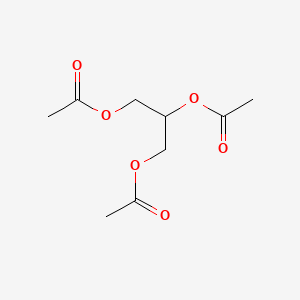
Triacetin
Triacetin is a triglyceride obtained by acetylation of the three hydroxy groups of glycerol. It has fungistatic properties (based on release of acetic acid) and has been used in the topical treatment of minor dermatophyte infections. It has a role as a solvent, an adjuvant, a fuel additive, a food emulsifier, a plant metabolite, a food humectant, a food additive carrier and an antifungal drug. It is functionally related to an acetic acid. — ChEBI
- Nom IUPAC
- 2,3-diacetyloxypropyl acetate
- Formule moléculaire
- C9H14O6
- Masse moléculaire
- 218.20 g/mol
- Masse exacte
- 218.07903816 Da
- XLogP3
- 0,2
- Surface polaire topologique
- 78,9 Ų
- Donneurs de liaisons hydrogène
- 0
- Accepteurs de liaisons hydrogène
- 6
- Unités covalentes
- 1
- Stéréocentres définis
- 0
Également connu sous le nom de
16 autres noms signalés
Identifiants de bases de données externes
- ChEBI:CHEBI:9661
- ChEMBL:CHEMBL1489254
- EPA DTXSID:DTXSID3026691
- PubMed:30738890
- PubMed:22863357
- PubMed:22615646
- PubMed:22512236
- PubMed:22504633
- PubMed:22459467
- PubMed:22396747
- PubMed:22345880
- PubMed:22318766
- PubMed:22280568
- PubMed:22273565
- PubMed:22167090
Preuves issues de bases de données scientifiques complémentaires
EMBL-EBI ChEBI
triacetin
A triglyceride obtained by acetylation of the three hydroxy groups of glycerol. It has fungistatic properties (based on release of acetic acid) and has been used in the topical treatment of minor dermatophyte infections.
- Formule
- C9H14O6
- Masse moyenne
- 218.205 g/mol
- Masse monoisotopique
- 218.07904 Da
- Charge formelle
- 0
- triglyceride — is a (CHEBI:17855)
- plant metabolite — has role (CHEBI:76924)
- solvent — has role (CHEBI:46787)
- fuel additive — has role (CHEBI:62803)
- adjuvant — has role (CHEBI:60809)
- antifungal drug — has role (CHEBI:86327)
- food additive carrier — has role (CHEBI:78059)
- food emulsifier — has role (CHEBI:63047)
- food humectant — has role (CHEBI:77969)
- acetic acid — has functional parent (CHEBI:15366)
- plant metabolite — has role (CHEBI:76924)
- solvent — has role (CHEBI:46787)
- fuel additive — has role (CHEBI:62803)
- adjuvant — has role (CHEBI:60809)
- antifungal drug — has role (CHEBI:86327)
- food additive carrier — has role (CHEBI:78059)
- food emulsifier — has role (CHEBI:63047)
- food humectant — has role (CHEBI:77969)
- triglyceride — is a (CHEBI:17855)
Noms supplémentaires validés
Références croisées de cette source
- CAS: 102-76-1 — NIST Chemistry WebBook
- CAS: 102-76-1 — ChemIDplus
- REGISTRY_NUMBER: 1792353 — Reaxys
- MANUAL_X_REF: 3624 — DrugCentral
- MANUAL_X_REF: D00384 — KEGG DRUG
- MANUAL_X_REF: HMDB0029592 — HMDB
- MANUAL_X_REF: LMGL03012615 — LIPID MAPS
- MANUAL_X_REF: Triacetin — Wikipedia
Mis en correspondance par: Exact CAS cross-reference in the ChEBI compound record. Source mise à jour le: 2017-02-22. Récupéré le: 2026-08-31. Ouvrir la fiche source
NIH PubChem PUG-View
Attributed physical-property, hazard, environmental and use annotations.
- Autoignition Temperature: 812 °F (433 °C) Source: Hazardous Substances Data Bank (HSDB)
- Autoignition Temperature: 433 °C Source: ILO-WHO International Chemical Safety Cards (ICSCs)
- Boiling Point: 258-259 °C Source: Hazardous Substances Data Bank (HSDB)
- Boiling Point: 258.00 to 260.00 °C. @ 760.00 mm Hg Source: Human Metabolome Database (HMDB)
- Boiling Point: 258 °C Source: ILO-WHO International Chemical Safety Cards (ICSCs)
- Boiling Point: 258 °C Source: Joint FAO/WHO Expert Committee on Food Additives (JECFA)
- Boiling Point: 258 °C @760 [mm Hg] Source: PAC Chemical Database, U.S. Department of Energy
- Color/Form: Colorless liquid Source: Hazardous Substances Data Bank (HSDB)
- Color/Form: Colorless somewhat oily liquid Source: Hazardous Substances Data Bank (HSDB)
- Density: 1.1583 g/cu cm at 20 °C Source: Hazardous Substances Data Bank (HSDB)
- Density: Bulk density: 9.7 lb/gal Source: Hazardous Substances Data Bank (HSDB)
- Density: Relative density (water = 1): 1.16 Source: ILO-WHO International Chemical Safety Cards (ICSCs)
- Density: 1.154-1.159 Source: Joint FAO/WHO Expert Committee on Food Additives (JECFA)
- Density: 1.1562 @25 °C Source: PAC Chemical Database, U.S. Department of Energy
- Flash Point: 280 °F (138 °C) (closed cup) Source: Hazardous Substances Data Bank (HSDB)
- Flash Point: 138 °C c.c. Source: ILO-WHO International Chemical Safety Cards (ICSCs)
- LogP: log Kow = 0.25 Source: Hazardous Substances Data Bank (HSDB)
- LogP: 0.25 Source: Human Metabolome Database (HMDB)
- LogP: 0.21 Source: ILO-WHO International Chemical Safety Cards (ICSCs)
- Melting Point: -78 °C Source: Hazardous Substances Data Bank (HSDB)
- Melting Point: -78 °C Source: Human Metabolome Database (HMDB)
- Melting Point: 3 °C Source: ILO-WHO International Chemical Safety Cards (ICSCs)
- Melting Point: -78 °C Source: PAC Chemical Database, U.S. Department of Energy
- Odor: Slightly fatty odor Source: Hazardous Substances Data Bank (HSDB)
- Odor: Slightly fruity or fatty odor Source: Hazardous Substances Data Bank (HSDB)
- Physical Description: Liquid; CBI Source: EPA Chemical Data Reporting (CDR)
- Physical Description: Colourless, somewhat oily liquid having a slightly fatty odour Source: EU Food Improvement Agents
- Physical Description: Colorless liquid with a mild fatty odor; [Merck Index] Colorless oily liquid with an odor like petroleum; [MSDSonline] Source: Haz-Map, Information on Hazardous Chemicals and Occupational Diseases
- Physical Description: Liquid Source: Human Metabolome Database (HMDB)
- Physical Description: COLOURLESS OILY LIQUID. Source: ILO-WHO International Chemical Safety Cards (ICSCs)
- Physical Description: colourless oily liquid with a very slight, ethereal, fruity odour Source: Joint FAO/WHO Expert Committee on Food Additives (JECFA)
- Refractive Index: [n]D/25 between 1,429 and 1,431 Source: EU Food Improvement Agents
- Refractive Index: Index of refraction = 1.4312 at 20 °C/D Source: Hazardous Substances Data Bank (HSDB)
- Refractive Index: 1.424-1.432 Source: Joint FAO/WHO Expert Committee on Food Additives (JECFA)
- Solubility: In water, 52,130 mg/L at 24.5 °C Source: Hazardous Substances Data Bank (HSDB)
- Solubility: In water, 58,000 mg/L at 25 °C Source: Hazardous Substances Data Bank (HSDB)
- Solubility: Slightly soluble in carbon disulfide; miscible with alcohol, ether, chloroform Source: Hazardous Substances Data Bank (HSDB)
- Solubility: Miscible with benzene; very soluble in acetone Source: Hazardous Substances Data Bank (HSDB)
- Solubility: For more Solubility (Complete) data for TRIACETIN (6 total), please visit the HSDB record page. Source: Hazardous Substances Data Bank (HSDB)
- Solubility: 58 mg/mL at 25 °C Source: Human Metabolome Database (HMDB)
- Solubility: Solubility in water, g/100ml at 25 °C: 7 (soluble) Source: ILO-WHO International Chemical Safety Cards (ICSCs)
- Solubility: moderately soluble in water; soluble in organic solvents Source: Joint FAO/WHO Expert Committee on Food Additives (JECFA)
- Solubility: miscible (in ethanol) Source: Joint FAO/WHO Expert Committee on Food Additives (JECFA)
- Vapor Pressure: 0.00248 [mmHg] Source: Haz-Map, Information on Hazardous Chemicals and Occupational Diseases
- Vapor Pressure: VP: 1 mm Hg at 100 °C Source: Hazardous Substances Data Bank (HSDB)
- Vapor Pressure: 0.00248 mm Hg at 25 °C Source: Hazardous Substances Data Bank (HSDB)
- Vapor Pressure: Vapor pressure, Pa at 25 °C: 0.33 Source: ILO-WHO International Chemical Safety Cards (ICSCs)
- Note: This chemical does not meet GHS hazard criteria for 99.8% (1973 of 1977) of all reports. Source: European Chemicals Agency (ECHA)
- GHS Hazard Statements: Not Classified; Reported as not meeting GHS hazard criteria by 1973 of 1977 companies (only 0.2% companies provided GHS information). For more detailed information, please visit ECHA C&L website. Source: European Chemicals Agency (ECHA)
- ECHA C&L Notifications Summary: Aggregated GHS information provided per 1977 reports by companies from 5 notifications to the ECHA C&L Inventory.; Reported as not meeting GHS hazard criteria per 1973 of 1977 reports by companies.; There are 3 notifications provided by 4 of 1977 reports by companies with hazard statement code(s).; Information may vary between notifications depending on impurities, additives, and other factors. The percentage value in parenthesis indicates the notified classification ratio from companies that provide hazard codes. Only hazard codes with percentage values above 10% are shown. For more detailed information, please visit ECHA C&L website. Source: European Chemicals Agency (ECHA)
- GHS Hazard Statements: Not Classified; Reported as not meeting GHS hazard criteria by 1 of 1 companies. For more detailed information, please visit ECHA C&L website. Source: European Chemicals Agency (ECHA)
- NFPA Health Rating: 0 - Materials that, under emergency conditions, would offer no hazard beyond that of ordinary combustible materials. Source: Hazardous Substances Data Bank (HSDB)
- NFPA Fire Rating: 1 - Materials that must be preheated before ignition can occur. Materials require considerable preheating, under all ambient temperature conditions, before ignition and combustion can occur. Source: Hazardous Substances Data Bank (HSDB)
- NFPA Instability Rating: 0 - Materials that in themselves are normally stable, even under fire conditions. Source: Hazardous Substances Data Bank (HSDB)
- Cosmetic Ingredient Review Finding(s): Safe in the present practices of use and concentration. Ingredient, concentration, and use information are available in documents discoverable at https://cir-reports.cir-safety.org Source: Cosmetic Ingredient Review (CIR)
- Toxicity Summary: IDENTIFICATION AND USE: Triacetin, also known as glyceryl triacetate (GTA), is a colorless liquid. It is reported to function as a cosmetic biocide, plasticizer, and solvent in cosmetic formulations. Triacetin is also used as a cellulose plasticizer in the manufacture of cigarette filters, as a carrier in fungicidal compositions, and to remove carbon dioxide from natural gas. Triacetin was affirmed as a GRAS (generally recognized as safe) human food ingredient by FDA. Triacetin has been used experimentally for the treatment of Canavan disease, a fatal dysmyelinating genetic disorder associated with aspartoacylase deficiency, resulting in decreased brain acetate levels and reduced myelin lipid synthesis in the developing brain. HUMAN EXPOSURE AND TOXICITY: In humans, commercial Triacetin has caused ocular irritation but no injury. Triacetin was not an irritant or a sensitizer in a clinical maximization study, and only very mild reactions were seen in a Duhring-chamber test using a 50% dilution. In sensitive individuals, it may cause slight irritation. ANIMAL STUDIES: Triacetin is moderately toxic by intraperitoneal, subcutaneous, and intravenous routes. The symptoms of toxicity with Source: Hazardous Substances Data Bank (HSDB)
- Environmental Bioconcentration: An estimated BCF of 3 was calculated in fish for triacetin(SRC), using a log Kow of 0.25(1) and a regression-derived equation(2). According to a classification scheme(3), this BCF suggests the potential for bioconcentration in aquatic organisms is low(SRC). Source: Hazardous Substances Data Bank (HSDB)
- Environmental Fate: TERRESTRIAL FATE: Based on a classification scheme(1), an estimated Koc value of 40(SRC), determined from a structure estimation method(2), indicates that triacetin is expected to have very high mobility in soil(SRC). Volatilization of triacetin from moist soil surfaces is not expected to be an important fate process(SRC) given an estimated Henry's Law constant of 1.2X10⁻⁸ atm-cu m/mole(3) based upon its vapor pressure, 2.48X10⁻³ mm Hg(4), and water solubility, 5.8X10+4 mg/L(5). Triacetin is not expected to volatilize from dry soil surfaces(SRC) based upon its vapor pressure(4). Utilizing the Japanese MITI test, 93% of the Theoretical BOD of a mixture containing triacetin was reached in 4 weeks(6) indicating that biodegradation is an important environmental fate process in soil(SRC). Source: Hazardous Substances Data Bank (HSDB)
- Environmental Fate: AQUATIC FATE: Based on a classification scheme(1), an estimated Koc value of 40(SRC), determined from a structure estimation method(2), indicates that triacetin is not expected to adsorb to suspended solids and sediment(SRC). Volatilization from water surfaces is not expected(3) based upon an estimated Henry's Law constant of 1.2X10⁻⁸ atm-cu m/mole(4) derived from its vapor pressure, 2.48X10⁻³ mm Hg(5), and water solubility, 5.8X10+4 mg/L(6). According to a classification scheme(7), an estimated BCF of 30(SRC), from its log Kow of 0.25(8) and a regression-derived equation(2), suggests the potential for bioconcentration in aquatic organisms is low(SRC). Utilizing the Japanese MITI test, 93% of the Theoretical BOD of a mixture containing triacetin was reached in 4 weeks(9) indicating that biodegradation is an important environmental fate process in water(SRC). Source: Hazardous Substances Data Bank (HSDB)
- Environmental Fate: ATMOSPHERIC FATE: According to a model of gas/particle partitioning of semivolatile organic compounds in the atmosphere(1), triacetin, which has a vapor pressure of 2.48X10⁻³ mm Hg at 25 °C(5), is expected to exist solely as a vapor in the ambient atmosphere. Vapor-phase triacetin is degraded in the atmosphere by reaction with photochemically-produced hydroxyl radicals(SRC); the half-life for this reaction in air is estimated to be 4 days(SRC), calculated from its rate constant of 8.5X10⁻¹² cu cm/molecule-sec at 25 °C(SRC) that was derived using a structure estimation method(3). Triacetin does not contain chromophores that absorb at wavelengths >290 nm(4) and, therefore, is not expected to be susceptible to direct photolysis by sunlight(SRC). Source: Hazardous Substances Data Bank (HSDB)
- Consumer Uses: Binder; Flavoring and nutrient; Solvent; Surfactant (surface active agent); Not Known or Reasonably Ascertainable; Plasticizer; Elasticizer; Fragrance; Adsorbent Source: EPA Chemical Data Reporting (CDR)
- Industry Uses: Other; Binder; Solvent; Processing aids not otherwise specified; Surfactant (surface active agent); Reducing agent; Not Known or Reasonably Ascertainable; Fragrance; Plasticizer; Terminator/Blocker; Hardener Source: EPA Chemical Data Reporting (CDR)
- Cosmetic Ingredient Review Link: CIR ingredient: Triacetin Source: Cosmetic Ingredient Review (CIR)
- Sources/Uses: Used as cellulose plasticizer for cigarette filters; in binders for solid rocket fuels; as fixative in perfumes; to make cosmetics and pharmaceuticals; as solvent for celluloid and photographic films; to remove carbon dioxide from natural gas; and as topical antifungal medication; Technical triacetin (mixture of mono-, di-, and small quantities of triacetin) used as a solvent for basic dyes (especially indulines) and tannin in dyeing; [HSDB] Used in cigarette filters; Skin sensitization reported in a worker at a cigarette manufacturing plant; [Kanerva, p. 1841] Source: Haz-Map, Information on Hazardous Chemicals and Occupational Diseases
- Industrial Processes with risk of exposure: Photographic Processing [Category: Other] Source: Haz-Map, Information on Hazardous Chemicals and Occupational Diseases
- Uses: ... Primary use is as a cellulose plasticizer in the manufacture of cigarette filters, and its second largest use is as a component in binders for solid rocket fuels. Smaller amounts are used as a fixative in perfume, as a plasticizer for cellulose nitrate, in the manufacture of cosmetics, and as a carrier in fungicidal compositions. Source: Hazardous Substances Data Bank (HSDB)
- Uses: Constituents of solid propellants: functions as inert plasticizer. Source: Hazardous Substances Data Bank (HSDB)
- Uses: Fixative in perfumery; solvent in manufacturing celluloid, photographic films. Technical triacetin (a mixture of mono-, di-, and small quantities of triacetin) as a solvent for basic dyes, particularly indulines, and tannin in dyeing. Source: Hazardous Substances Data Bank (HSDB)
- Uses: To remove carbon dioxide from natural gas. Source: Hazardous Substances Data Bank (HSDB)
- Uses: For more Uses (Complete) data for TRIACETIN (11 total), please visit the HSDB record page. Source: Hazardous Substances Data Bank (HSDB)
- Uses: Plastics -> Typical concentration range in plastic materials -> 10% Source: NORMAN Suspect List Exchange
Mis en correspondance par: Existing checksum-valid CAS to unique PubChem CID match. Récupéré le: 2026-08-31. Ouvrir la fiche source
Les classifications scientifiques et les annotations de danger apportent du contexte et ne remplacent pas la décision réglementaire propre au marché indiquée ci-dessus.
Couverture des sources complémentaires et état des correspondances
| Source | Résultat | Vérifié |
|---|---|---|
| EMBL-EBI ChEBI | Correspondance exacte | 2026-08-31 |
| NIH PubChem PUG-View | Correspondance exacte | 2026-08-31 |
Une absence de correspondance enregistrée est une preuve utile que la source a été vérifiée ; ce n’est pas l’affirmation que la substance n’existe pas ailleurs.
Récupéré depuis NIH PubChem le 2026-08-31 par correspondance CAS à somme de contrôle valide. Les propriétés chimiques ne remplacent pas la décision réglementaire de cette page.