
Nom officiel d’étiquetage de l’UEEntrée 27967 du glossaire
STRONTIUM NITRATE
Cette fiche confirme une dénomination commune officielle d’ingrédient pour l’étiquetage des produits cosmétiques de l’UE. Elle ne confirme pas à elle seule que la substance est autorisée, non restreinte ou sûre.
Aperçu des preuves mondiales
L’identité résolue présente des preuves réglementaires correspondantes dans 8 des 13 jeux de données de marchés indexés : 7 fiches de pays et 1 fiches d’annexes de l’UE. Chaque résultat et chaque lacune de preuves sont énumérés ci-dessous.
Marchés vérifiés
13
Marchés avec preuves
8
Lacunes de preuves
5
Identifiants résolus
2
Identité résolue de la substance
CAS:10042-76-9
EC:233-131-9
Fiches de l’index des ingrédients :
STRONTIUM NITRATE
Fonctions cosmétiques : ORAL CARE, SKIN CONDITIONING
Note de restriction de l’inventaire : II/403
5 noms correspondants ou signalés
STRONTIUM NITRATEStrontium nitrate硝酸锶 — Strontium nitrate (CAS No. 10042-76-9)Nitrato de estrôncioStrontium nitrate (CAS No. 10042-76-9)
Preuves réglementaires dans les 13 marchés
Ouvrez chaque fiche correspondante pour connaître son champ d’application, sa concentration, ses conditions, ses avertissements et la version de la source officielle.
Balayez ou faites défiler horizontalement pour voir la couverture des jeux de données et les actions suivantes.
| Marché | Résultat | Fiches | Jeu de données | Signification / action suivante |
|---|---|---|---|---|
| European Union EU | Interdite | 1Ouvrir la fiche 1 | Complete annex dataset Regulation (EC) 1223/2009 consolidated to 1 May 2026 | Examinez chaque fiche associée et ses conditions exactes. |
| Great Britain GB | Prohibited | 1Ouvrir la fiche 1 | Complete consolidated annex dataset GB retained Regulation 1223/2009 schedules, effective 15 August 2026 | Examinez chaque fiche associée et ses conditions exactes. |
| Canada CA | Aucune correspondance trouvée | 0 | Complete Hotlist snapshot Health Canada Cosmetic Ingredient Hotlist, 13 August 2025 | The Hotlist is an administrative compliance tool, not an exhaustive safety approval list. |
| New Zealand NZ | Prohibited | 1Ouvrir la fiche 1 | Complete schedules dataset Cosmetic Products Group Standard schedules effective 1 January 2026 | Examinez chaque fiche associée et ses conditions exactes. |
| ASEAN ASEAN | Prohibited | 1Ouvrir la fiche 1 | Complete regional annex dataset ASEAN Cosmetic Directive annexes 2026-1, 22 June 2026 | Examinez chaque fiche associée et ses conditions exactes. |
| China CN | Prohibited | 1Ouvrir la fiche 1 | Complete prohibited catalogues plus official-source workflow NMPA 2021 banned catalogues plus dynamic IECIC List I/List II system current since 2025 | Examinez chaque fiche associée et ses conditions exactes. |
| Japan JP | Aucune correspondance trouvée | 0 | Complete Standards appendices dataset MHLW Standards for Cosmetics official English source and Japanese amendments checked for the imported snapshot | The Japanese text and subsequent notices are canonical; no local match is not a product-compliance conclusion. |
| South Korea KR | Aucune correspondance trouvée | 0 | Complete current appendix dataset MFDS Notice 2026-19, effective 18 March 2026 | Korean source wording is canonical and other positive lists/notices may still apply to the formulation. |
| United States US | Aucune correspondance trouvée | 0 | Complete enumerated federal ingredient rules eCFR Title 21 issue date 27 August 2026 | FDA has no general approved-cosmetic-ingredient catalogue; absence from these sections is not approval or proof of safety. |
| Australia AU | Aucune correspondance trouvée | 0 | Complete cosmetic-relevant Poisons Standard subset plus official workflow Therapeutic Goods (Poisons Standard—June 2026) Instrument 2026 | An AICIS Inventory match is not cosmetic approval; no Inventory match can indicate a new, exempted, reported or confidential introduction. |
| Brazil BR | Prohibited | 1Ouvrir la fiche 1 | Complete prohibited dataset plus current restricted-list workflow ANVISA RDC 1.029/2026 and RDC 1.030/2026, published 15 June 2026 | Examinez chaque fiche associée et ses conditions exactes. |
| India IN | Prohibited | 1Ouvrir la fiche 1 | Complete current Part 2 dataset plus official workflow for Parts 1, 3 and 4 Cosmetics Rules 2020 plus current BIS IS 4707 parts (1:2020, 2:2025, 3:2025, 4:2022) | Examinez chaque fiche associée et ses conditions exactes. |
| Saudi Arabia SA | Prohibited | 1Ouvrir la fiche 1 | Complete official list index SFDA live prohibited/restricted lists, snapshot 30 August 2026 | Examinez chaque fiche associée et ses conditions exactes. |
Aucune ligne de marché ne correspond à ce filtre.
Fiches de marché correspondantes et conditions
Great Britain
GB retained Regulation 1223/2009 schedules, effective 15 August 2026New Zealand
Cosmetic Products Group Standard schedules effective 1 January 2026ASEAN
ASEAN Cosmetic Directive annexes 2026-1, 22 June 2026China
NMPA 2021 banned catalogues plus dynamic IECIC List I/List II system current since 2025Brazil
ANVISA RDC 1.029/2026 and RDC 1.030/2026, published 15 June 2026India
Cosmetics Rules 2020 plus current BIS IS 4707 parts (1:2020, 2:2025, 3:2025, 4:2022)Saudi Arabia
SFDA live prohibited/restricted lists, snapshot 30 August 2026Preuves exactes des annexes II à VI
Annex IIentrée 403
Ouvrir la fiche réglementaire complèteStrontium nitrate
Identité et propriétés chimiques
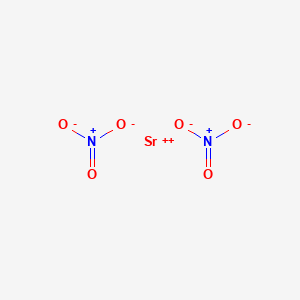
CAS 10042-76-9PubChem CID 24848
Strontium nitrate
Strontium nitrate appears as a white crystalline solid. Noncombustible but accelerates burning of combustible materials. May explode if large quantities are involved in a fire or the combustible material is finely divided. May explode under prolonged exposure to heat or fire. Toxic oxides of nitrogen are produced in fires. Used in pyrotechnics, in medicine, and to make other chemicals. — CAMEO Chemicals
- Nom IUPAC
- strontium dinitrate
- Formule moléculaire
- N2O6Sr
- Masse moléculaire
- 211.63 g/mol
- Masse exacte
- 211.88124798 Da
- Surface polaire topologique
- 126,0 Ų
- Donneurs de liaisons hydrogène
- 0
- Accepteurs de liaisons hydrogène
- 6
- Unités covalentes
- 3
- Stéréocentres définis
- 0
Également connu sous le nom de
Nitric acid, strontium saltStrontium nitrate (Sr(NO3)2)Strontium nitricumNitrate de strontiumNitric acid, strontium salt (2:1)Strontium(II) nitrate (1:2)BDG873AQZLNitric acid strontium salt (2:1)
16 autres noms signalés
STRONTIUM(2+) NITRATERefChem:6263strontium(2+) ion dinitrate233-131-9strontium;dinitrateStrontium Nitrate AnhydrousStrontium nitrate, anhydrousNitrate de strontium [French]HSDB 787N2O6SrEINECS 233-131-9UNII-BDG873AQZLUN1507strontium(II) nitratestrontium (II) nitrateEC 233-131-9
Identifiants de bases de données externes
- ChEMBL:CHEMBL2219742
- EPA DTXSID:DTXSID9064924
Preuves issues de bases de données scientifiques complémentaires
NIH PubChem PUG-View
Correspondance exacte d’identifiant24848
Attributed physical-property, hazard, environmental and use annotations.
- Boiling Point: 1193 °F at 760 mmHg (USCG, 1999) Source: CAMEO Chemicals
- Boiling Point: 645 °C Source: Hazardous Substances Data Bank (HSDB)
- Boiling Point: 645 °C @760 [mm Hg] Source: PAC Chemical Database, U.S. Department of Energy
- Color/Form: WHITE GRANULES OR POWDER Source: Hazardous Substances Data Bank (HSDB)
- Color/Form: Colorless cubic crystals Source: Hazardous Substances Data Bank (HSDB)
- Density: 2.98 (USCG, 1999) - Denser than water; will sink Source: CAMEO Chemicals
- Density: 2.99 g/cu-cm Source: Hazardous Substances Data Bank (HSDB)
- Density: 2.99 @25 °C Source: PAC Chemical Database, U.S. Department of Energy
- Melting Point: 1058 °F (USCG, 1999) Source: CAMEO Chemicals
- Melting Point: 570 °C Source: Hazardous Substances Data Bank (HSDB)
- Melting Point: 570 °C Source: PAC Chemical Database, U.S. Department of Energy
- Physical Description: Strontium nitrate appears as a white crystalline solid. Noncombustible but accelerates burning of combustible materials. May explode if large quantities are involved in a fire or the combustible material is finely divided. May explode under prolonged exposure to heat or fire. Toxic oxides of nitrogen are produced in fires. Used in pyrotechnics, in medicine, and to make other chemicals. Source: CAMEO Chemicals
- Physical Description: Dry Powder; CBI; Large Crystals Source: EPA Chemical Data Reporting (CDR)
- Physical Description: White solid; [Merck Index] White odorless crystalline solid; [MSDSonline] Source: Haz-Map, Information on Hazardous Chemicals and Occupational Diseases
- Solubility: 70.9 g/100 ml water at 18 °C, 100 g/100 ml water at 100 °C Source: Hazardous Substances Data Bank (HSDB)
- Solubility: 401 G/L OF WATER @ 0 °C; 1 KG/L WATER @ 90 °C Source: Hazardous Substances Data Bank (HSDB)
- Solubility: Slightly sol in alcohol or acetone. Source: Hazardous Substances Data Bank (HSDB)
- Solubility: 0.012 g/100 ml absolute alcohol Source: Hazardous Substances Data Bank (HSDB)
- pH: AQ SOLN IS NEUTRAL Source: Hazardous Substances Data Bank (HSDB)
- Carcinogen Classification: Ingested nitrate or nitrite under conditions that result in endogenous nitrosation is probably carcinogenic to humans (Group 2A). (L135) Source: Toxin and Toxin Target Database (T3DB)
- Exposure Routes: Oral (L1137) ; inhalation (L1137) Source: Toxin and Toxin Target Database (T3DB)
- First Aid: Call for medical aid.; EYES: Rinse with water.; SKIN: Wash with water for 15 minutes.; INGESTION: Drink water, milk, or activated charcoal; then induce vomiting. (USCG, 1999) Source: CAMEO Chemicals
- ERG2024, Guide 140 (Strontium nitrate): General First Aid:; · Call 911 or emergency medical service.; · Ensure that medical personnel are aware of the material(s) involved, take precautions to protect themselves and avoid contamination.; · Move victim to fresh air if it can be done safely.; · Administer oxygen if breathing is difficult.; · If victim is not breathing:; -- DO NOT perform mouth-to-mouth resuscitation; the victim may have ingested or inhaled the substance.; -- If equipped and pulse detected, wash face and mouth, then give artificial respiration using a proper respiratory medical device (bag-valve mask, pocket mask equipped with a one-way valve or other device).; -- If no pulse detected or no respiratory medical device available, provide continuous compressions. Conduct a pulse check every two minutes or monitor for any signs of spontaneous respirations.; · Remove and isolate contaminated clothing and shoes.; · For minor skin contact, avoid spreading material on unaffected skin.; · In case of contact with substance, remove immediately by flushing skin or eyes with running water for at least 20 minutes.; · For severe burns, immediate medical attention is required.; · Effects of exposure (inhalation, ingestion, Source: Emergency Response Guidebook (ERG)
- Note: This chemical does not meet GHS hazard criteria for 0.6% (2 of 363) of reports. Source: European Chemicals Agency (ECHA)
- Signal: Danger Source: European Chemicals Agency (ECHA)
- GHS Hazard Statements: H271 (66.1%): May cause fire or explosion; strong Oxidizer [Danger Oxidizing liquids; Oxidizing solids]; H272 (33.1%): May intensify fire; oxidizer [Danger Oxidizing liquids; Oxidizing solids]; H302 (13.5%): Harmful if swallowed [Warning Acute toxicity, oral]; H315 (14.9%): Causes skin irritation [Warning Skin corrosion/irritation]; H318 (77.4%): Causes serious eye damage [Danger Serious eye damage/eye irritation]; H319 (14.9%): Causes serious eye irritation [Warning Serious eye damage/eye irritation]; H335 (13.8%): May cause respiratory irritation [Warning Specific target organ toxicity, single exposure; Respiratory tract irritation] Source: European Chemicals Agency (ECHA)
- Precautionary Statement Codes: P210, P220, P261, P264, P264+P265, P270, P271, P280, P283, P301+P317, P302+P352, P304+P340, P305+P351+P338, P305+P354+P338, P306+P360, P317, P319, P321, P330, P332+P317, P337+P317, P362+P364, P370+P378, P371+P380+P375, P403+P233, P405, P420, and P501 (click each P-code to see the statement) Source: European Chemicals Agency (ECHA)
- ECHA C&L Notifications Summary: Aggregated GHS information provided per 363 reports by companies from 22 notifications to the ECHA C&L Inventory. Each notification may be associated with multiple companies.; Reported as not meeting GHS hazard criteria per 2 of 363 reports by companies.; There are 21 notifications provided by 361 of 363 reports by companies with hazard statement code(s).; Information may vary between notifications depending on impurities, additives, and other factors. The percentage value in parenthesis indicates the notified classification ratio from companies that provide hazard codes. Only hazard codes with percentage values above 10% are shown. For more detailed information, please visit ECHA C&L website. Source: European Chemicals Agency (ECHA)
- Signal: Danger Source: NITE-CMC
- GHS Hazard Statements: H272: May intensify fire; oxidizer [Danger Oxidizing liquids; Oxidizing solids]; H315: Causes skin irritation [Warning Skin corrosion/irritation]; H320: Causes eye irritation [Warning Serious eye damage/eye irritation] Source: NITE-CMC
- Precautionary Statement Codes: P210, P220, P264, P264+P265, P280, P302+P352, P305+P351+P338, P321, P332+P317, P337+P317, P362+P364, P370+P378, and P501 (click each P-code to see the statement) Source: NITE-CMC
- Health Effects: Nitrate and nitrite poisoning causes methemoglobinemia. Nitrites may cause pregnancy complications and developmental effects. They may also be carcinogenic. (L1137) Source: Toxin and Toxin Target Database (T3DB)
- Toxicity Summary: Nitrate's toxicity is a result of it's conversion to nitrite once in the body. Nitrite causes the autocatalytic oxidation of oxyhemoglobin to hydrogen peroxide and methemoglobin. This elevation of methemoglobin levels is a condition known as methemoglobinemia, and is characterized by tissue hypoxia, as methemoglobin cannot bind oxygen. (A2450, L1613) Source: Toxin and Toxin Target Database (T3DB)
- Consumer Uses: Not Known or Reasonably Ascertainable; Soil amendments (fertilizers) Source: EPA Chemical Data Reporting (CDR)
- Industry Uses: Intermediate; Oxidizing agent; Not Known or Reasonably Ascertainable; Other Source: EPA Chemical Data Reporting (CDR)
- Sources/Uses: Used in pyrotechnics (red fire), signal lights, marine signals, railroad flares, matches, and military tracer bullets; Also used in electron tubes and as a pigment; [HSDB] Source: Haz-Map, Information on Hazardous Chemicals and Occupational Diseases
- Uses: In signal lights, marine signals, railroad flares, matches; in pyrotechnics (red fire) Source: Hazardous Substances Data Bank (HSDB)
- Uses: INTERMEDIATE; ELECTRON TUBES Source: Hazardous Substances Data Bank (HSDB)
- Uses: PIGMENT Source: Hazardous Substances Data Bank (HSDB)
- Uses: Mfr of pyrotechnics as it imparts brilliant color to flame Source: Hazardous Substances Data Bank (HSDB)
- Uses: For more Uses (Complete) data for STRONTIUM NITRATE (6 total), please visit the HSDB record page. Source: Hazardous Substances Data Bank (HSDB)
- Uses: Strontium nitrate is used as an oxidizer and colorant in fireworks. Source: Toxin and Toxin Target Database (T3DB)
Mis en correspondance par: Existing checksum-valid CAS to unique PubChem CID match. Récupéré le: 2026-08-31. Ouvrir la fiche source
Les classifications scientifiques et les annotations de danger apportent du contexte et ne remplacent pas la décision réglementaire propre au marché indiquée ci-dessus.
Couverture des sources complémentaires et état des correspondances
| Source | Résultat | Vérifié |
|---|---|---|
| EMBL-EBI ChEBI | Aucune fiche exacte | 2026-08-31 |
| NIH PubChem PUG-View | Correspondance exacte | 2026-08-31 |
Une absence de correspondance enregistrée est une preuve utile que la source a été vérifiée ; ce n’est pas l’affirmation que la substance n’existe pas ailleurs.
Récupéré depuis NIH PubChem le 2026-09-02 par correspondance CAS à somme de contrôle valide. Les propriétés chimiques ne remplacent pas la décision réglementaire de cette page.
Recherche complémentaire sur la substance auprès de sources faisant autorité
Chaque lien lance une recherche de cette identité dans la source concernée. Un lien est une piste de recherche, et non l’affirmation que la source détient une fiche exacte. Ce qu’est chaque source et sa valeur juridique
Aller plus loin avec cette fiche
Source officielle et champ d’application
Importé de la décision d’exécution (UE) 2025/1175 de la Commission (version du jeu de données EU 2025/1175). Le glossaire fournit les dénominations communes des ingrédients pour la liste d’ingrédients exigée par l’article 19, paragraphe 1, point g) ; ce n’est ni une liste d’autorisation ni une liste de sécurité.
Ouvrir la décision officielle