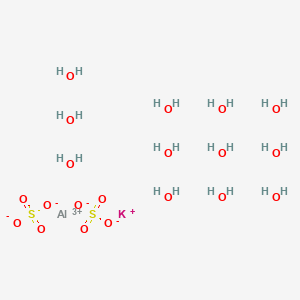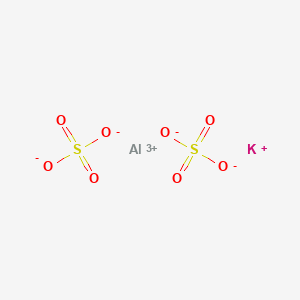
Potassium Alum
Potassium aluminium sulfate is a metal sulfate composed of potassium, aluminium and sulfate ions in the ration 1:1:2. It has a role as a mordant, an astringent and a flame retardant. It is a potassium salt, an aluminium salt and a metal sulfate. It contains an aluminium(3+). — ChEBI
- Nom IUPAC
- aluminum;potassium;disulfate
- Formule moléculaire
- AlKO8S2
- Masse moléculaire
- 258.21 g/mol
- Masse exacte
- 257.8487042 Da
- Surface polaire topologique
- 177,0 Ų
- Donneurs de liaisons hydrogène
- 0
- Accepteurs de liaisons hydrogène
- 8
- Unités covalentes
- 4
- Stéréocentres définis
- 0
Également connu sous le nom de
16 autres noms signalés
Identifiants de bases de données externes
- ChEBI:CHEBI:86463
- EPA DTXSID:DTXSID9039234
- PubMed:4194940
- PubMed:740662
- PubMed:712205
Preuves issues de bases de données scientifiques complémentaires
EMBL-EBI ChEBI
potassium aluminium sulfate
A metal sulfate composed of potassium, aluminium and sulfate ions in the ration 1:1:2.
- Formule
- Al.K.2O4S
- Masse moyenne
- 258.206 g/mol
- Masse monoisotopique
- 257.84870 Da
- Charge formelle
- 0
- potassium salt — is a (CHEBI:26218)
- aluminium salt — is a (CHEBI:35510)
- metal sulfate — is a (CHEBI:51336)
- flame retardant — has role (CHEBI:79314)
- mordant — has role (CHEBI:74152)
- astringent — has role (CHEBI:74783)
- aluminium(3+) — has part (CHEBI:49470)
- flame retardant — has role (CHEBI:79314)
- mordant — has role (CHEBI:74152)
- astringent — has role (CHEBI:74783)
- potassium salt — is a (CHEBI:26218)
- aluminium salt — is a (CHEBI:35510)
- metal sulfate — is a (CHEBI:51336)
Noms supplémentaires validés
Références croisées de cette source
- CAS: 10043-67-1 — ChemIDplus
- REGISTRY_NUMBER: 11323401 — Reaxys
- REGISTRY_NUMBER: 27446053 — Reaxys
- MANUAL_X_REF: Potassium_alum — Wikipedia
Mis en correspondance par: Exact CAS cross-reference in the ChEBI compound record. Source mise à jour le: 2015-07-14. Récupéré le: 2026-08-31. Ouvrir la fiche source
NIH PubChem PUG-View
Attributed physical-property, hazard, environmental and use annotations.
- Boiling Point: 200 °C Source: DrugBank
- Color/Form: WHITE POWDER Source: Hazardous Substances Data Bank (HSDB)
- Density: 1.725 Source: Hazardous Substances Data Bank (HSDB)
- Density: ODORLESS; SWEETISH, ASTRINGENT TASTE; DENSITY 1.725; MP 92.5 °C. /POTASSIUM ALUM DODECAHYDRATE/ Source: Hazardous Substances Data Bank (HSDB)
- Melting Point: 92.5 °C Source: DrugBank
- Physical Description: Dry Powder; Large Crystals; Dry Powder Source: EPA Chemical Data Reporting (CDR)
- Physical Description: Large, transparent crystals or white crystalline powder Source: EU Food Improvement Agents
- Physical Description: White hygroscopic solid; [Merck Index] Colorless odorless crystals; Partially soluble in water; [MSDSonline] Source: Haz-Map, Information on Hazardous Chemicals and Occupational Diseases
- Refractive Index: INDEX OF REFRACTION: 1.454, 1.4564; HEXAGONAL: 1.456, 1.429 /POTASSIUM ALUM DODECAHYDRATE/ Source: Hazardous Substances Data Bank (HSDB)
- Solubility: 1 g/ 7.5 ml at 25ºC Source: DrugBank
- Solubility: Freely soluble in water, insoluble in ethanol Source: EU Food Improvement Agents
- Solubility: BECOMES ANHYD @ ABOUT 200 °C; @ HIGHER TEMP LOSES SULFUR TRIOXIDE & BECOMES BASIC & INCOMPLETELY SOL IN WATER. /POTASSIUM ALUM DODECAHYDRATE/ Source: Hazardous Substances Data Bank (HSDB)
- Solubility: 1 G DISSOLVES IN ABOUT 20 ML COLD WATER, ABOUT 1 ML BOILING WATER, INCOMPLETELY; PRACTICALLY INSOL IN ALC. Source: Hazardous Substances Data Bank (HSDB)
- pH: Between 3,0 and 4,0 (10 % solution) Source: EU Food Improvement Agents
- Carcinogen Classification: Not listed by IARC. IARC classified aluminum production as carcinogenic to humans (Group 1), but did not implicate aluminum itself as a human carcinogen. (L135) A link between use of aluminum-containing antiperspirants and increased risk of breast cancer has been proposed (A235), but studies have not been able to establish a clear link (A15468). Source: Toxin and Toxin Target Database (T3DB)
- Exposure Routes: Oral (L739) ; inhalation (L739) Source: Toxin and Toxin Target Database (T3DB)
- Note: This chemical does not meet GHS hazard criteria for 97.8% (135 of 138) of all reports. Source: European Chemicals Agency (ECHA)
- GHS Hazard Statements: Not Classified; Reported as not meeting GHS hazard criteria by 135 of 138 companies (only 2.2% companies provided GHS information). For more detailed information, please visit ECHA C&L website. Source: European Chemicals Agency (ECHA)
- ECHA C&L Notifications Summary: Aggregated GHS information provided per 138 reports by companies from 3 notifications to the ECHA C&L Inventory.; Reported as not meeting GHS hazard criteria per 135 of 138 reports by companies.; There is 1 notification provided by 3 of 138 reports by companies with hazard statement code(s).; Information may vary between notifications depending on impurities, additives, and other factors. The percentage value in parenthesis indicates the notified classification ratio from companies that provide hazard codes. Only hazard codes with percentage values above 10% are shown. For more detailed information, please visit ECHA C&L website. Source: European Chemicals Agency (ECHA)
- Health Effects: Aluminum targets the nervous system and causes decreased nervous system performance and is associated with altered function of the blood-brain barrier. The accumulation of aluminum in the body may cause bone or brain diseases. High levels of aluminum have been linked to Alzheimer's disease. A small percentage of people are allergic to aluminium and experience contact dermatitis, digestive disorders, vomiting or other symptoms upon contact or ingestion of products containing aluminium. (L739, L740) Source: Toxin and Toxin Target Database (T3DB)
- Toxicity Summary: The main target organs of aluminum are the central nervous system and bone. Aluminum binds with dietary phosphorus and impairs gastrointestinal absorption of phosphorus. The decreased phosphate body burden results in osteomalacia (softening of the bones due to defective bone mineralization) and rickets. Aluminum's neurotoxicity is believed to involve several mechanisms. Changes in cytoskeletal protein functions as a results of altered phosphorylation, proteolysis, transport, and synthesis are believed to be one cause. Aluminum may induce neurobehavioral effects by affecting permeability of the blood-brain barrier, cholinergic activity, signal transduction pathways, lipid peroxidation, and impair neuronal glutamate nitric oxide-cyclic GMP pathway, as well as interfere with metabolism of essential trace elements because of similar coordination chemistries and consequent competitive interactions. It has been suggested that aluminum's interaction with estrogen receptors increases the expression of estrogen-related genes and thereby contributes to the progression of breast cancer (A235), but studies have not been able to establish a clear link between aluminum and increased risk of brea Source: Toxin and Toxin Target Database (T3DB)
- Environmental Fate: AQUATIC FATE: The adsorption of aluminum by fine particulates was studied in Whitray Beck, a hill stream in England. ... Uptake of aluminum by the particles increased with total aluminum, with pH, and with particle concentration, although the fraction of aluminum bound at a given pH and particle concentration decreased with total aluminum ... . /Aluminum/ Source: Hazardous Substances Data Bank (HSDB)
- Environmental Fate: TERRESTRIAL FATE: Air dried, <2 mm fractions of 3 soil samples from The Netherlands and 1 from New Hampshire, were taken from the surface and subsurface horizons of two podzols (Haplorthods) and of a recent driftsand (Udipsamment). Duplicate samples of each emulsion soil horizon were leached ... with aqueous hydrogen chloride (pH 3.0). ... Charge balances of the leachates indicate that dissolved aluminum is present mainly as aquo-aluminum (+3). Only in leachates of podzol Bhs horizons is a significant fraction (20-30%) of dissolved aluminum organically complexed. Dissolved aluminum concn are significantly correlated with the organic (tetrasodium pyrophosphate extractable) aluminum content of the soil sample. Mobility of aluminum in the Hubbard Brook soils is significantly lower than in the Dutch soils, because of higher soil-solution pH values. /Aluminum cmpd/ Source: Hazardous Substances Data Bank (HSDB)
- Environmental Fate: TERRESTRIAL FATE: Albic and spodic soil horizons were sampled from old growth eastern white pine/mixed northern hardwoods. Adirondacks, and an ochric soil horizon was sampled from the Appalachian plateau of NY State. 21 Three horizon forest floor and 21 forest floor/mineral soil (field moist equivalent of 12.0 oven dry albic, spodic, or ochric mineral soil) columns were leached in triplicate with either 10 uM nitric acid (pH 5), 5 uM sulfuric acid (pH 5), 100 uM nitric acid (pH 4), 50 uM sulfuric acid (pH 4), 1000 uM nitric acid (pH 3), 500 uM sulfuric acid (pH 3), or distilled, deionized water (pH 5.7) control treatment). Nitric acid leached more aluminum than did sulfuric acid from forest floor/spodic soil columns. Increasing the nitric acid concn from pH 3-5 increased total aluminum concn in leachates from 0.70 to 0.85 mM, while increasing sulfuric acid had no effect. Addition of pH 3 sulfuric acid to forest floor/spodic columns raised leachate pH relative to pH 3 nitric acid and controls, and resulted in the lowest aluminum concn of all treatments in the first 3 of 4 sequential leachings. /Aluminum/ Source: Hazardous Substances Data Bank (HSDB)
- Environmental Fate: Albic and spodic soil horizons were sampled from old growth eastern white pine/mixed northern hardwoods sites in the Adirondacks, and an ochric soil horizon was sampled from the Appalachian Plateau of NY State. 9 Three horizon forest floor, 9 mineral soil (field moist equivalent of 12.0 oven dry albic, spodic, or ochric mineral soil) and 9 forest floor/mineral soil columns were leached with 60 ml of (a) 10 mM ammonium nitrate (control), (b) 1.0 mM nitric acid in 10 mM ammonium nitrate (pH 3), and (c) 1.0 mM ammonium nitrate (pH 3) at the rate of 10 ml/hr. The above procedure was repeated on each mineral soil without a forest floor, except leaching soln were 0.5 mM calcium nitrate or calcium sulfate, each in 10 mM ammonium nitrate. Adding 2 and 0.5 cmol sub c (H+)/kg to forest floor and minera soils, respectively, simulated snowmelt additions. Total aluminum concn in leachates from forest floor/albic or forest floor/ochric columns were greater than the sum of concn in leachates from the forest floor and mineral horizon when leached separately. This positive synergistic behavior of the forest floor-mineral horizon sequences was also observed in the forest floor-spodic horizon sequenc Source: Hazardous Substances Data Bank (HSDB)
- Consumer Uses: Crystal growth modifiers (nucleating agents) Source: EPA Chemical Data Reporting (CDR)
- Industry Uses: Other; Soil amendments (fertilizers) Source: EPA Chemical Data Reporting (CDR)
- Sources/Uses: Used in dyeing and printing fabrics; manufacturing dyes, lakes, paper, vegetable glue, marble cement, porcelain cement, explosives, aluminum salts, artificial stones, and statuary; tanning; waterproofing; hardening gelatin; purifying water; clarifying sugar; hardening plaster casts; and electrolytic copper plating; Also used as a catalyst in synthesis of ammonia, a mordant in staining (with carmine, eosine, and hematoxylin), a clarifier (as alumina cream), a hardening agent in microscopy, an additive (matches, paints, baking powder, and foods), a water correcting agent used in brewing industry, an astringent, a veterinary antiseptic and antimycotic, and in taxidermy; [HSDB] Used as a coagulating agent for latex and as a styptic pencil; [CHEMINFO] Potassium aluminum sulfate (alum) is used as a hardener in photographic processing; Also used as a mordant in textile dyeing (textile arts); [www.ci.tucson.az.us/arthazards/medium.html] Source: Haz-Map, Information on Hazardous Chemicals and Occupational Diseases
- Industrial Processes with risk of exposure: Electroplating [Category: Plate]; Pulp and Paper Processing [Category: Industry]; Using Disinfectants or Biocides [Category: Clean]; Sewer and Wastewater Treatment [Category: Industry]; Leather Tanning and Processing [Category: Industry]; Photographic Processing [Category: Other]; Textiles (Printing, Dyeing, or Finishing) [Category: Industry] Source: Haz-Map, Information on Hazardous Chemicals and Occupational Diseases
- Activities with risk of exposure: Textile arts [Category: Hobbies]; Preparing and mounting animal skins (taxidermy) [Category: Hobbies] Source: Haz-Map, Information on Hazardous Chemicals and Occupational Diseases
- Uses: IN DYEING, PRINTING FABRICS; MFR DYES, LAKES, PAPER, VEGETABLE GLUE Source: Hazardous Substances Data Bank (HSDB)
- Uses: MFR OF MARBLE CEMENT, PORCELAIN CEMENT, EXPLOSIVES, IN TANNING, HARDENING GELATIN, BAKING POWDERS Source: Hazardous Substances Data Bank (HSDB)
- Uses: IN PURIFYING WATER, CLARIFYING SUGAR, HARDENING PLASTER CASTS; ELECTROLYTIC COPPERPLATING. Source: Hazardous Substances Data Bank (HSDB)
- Uses: AS CATALYST IN SYNTHESIS OF AMMONIA; AS MORDANT IN STAINING WITH CARMINE, EOSINE HEMATOXYLIN. Source: Hazardous Substances Data Bank (HSDB)
- Uses: For more Uses (Complete) data for ALUM, POTASSIUM (11 total), please visit the HSDB record page. Source: Hazardous Substances Data Bank (HSDB)
- Uses: Potassium alum or potash alum is an astringent/styptic and antiseptic and is commonly used in water purification, leather tanning, fireproof textiles, and baking powder. It also has cosmetic uses as a deodorant and as an aftershave treatment. (L776) Source: Toxin and Toxin Target Database (T3DB)
Mis en correspondance par: Existing checksum-valid CAS to unique PubChem CID match. Récupéré le: 2026-08-31. Ouvrir la fiche source
Les classifications scientifiques et les annotations de danger apportent du contexte et ne remplacent pas la décision réglementaire propre au marché indiquée ci-dessus.
Couverture des sources complémentaires et état des correspondances
| Source | Résultat | Vérifié |
|---|---|---|
| EMBL-EBI ChEBI | Correspondance exacte | 2026-08-31 |
| NIH PubChem PUG-View | Correspondance exacte | 2026-08-31 |
Une absence de correspondance enregistrée est une preuve utile que la source a été vérifiée ; ce n’est pas l’affirmation que la substance n’existe pas ailleurs.
Récupéré depuis NIH PubChem le 2026-08-31 par correspondance CAS à somme de contrôle valide. Les propriétés chimiques ne remplacent pas la décision réglementaire de cette page.