
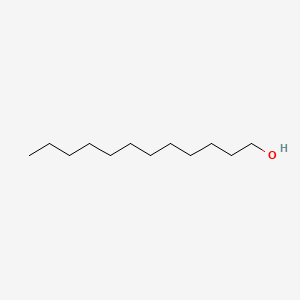
1-Dodecanol
Dodecan-1-ol is a primary alcohol that is dodecane in which a hydrogen from one of the methyl groups is replaced by a hydroxy group. It is registered for use in apple and pear orchards as a Lepidopteran pheromone/sex attractant, used to disrupt the mating behaviour of certain moths whose larvae destroy crops. It has a role as an insect attractant, an insecticide, a pheromone, a cosmetic, a plant metabolite and a bacterial metabolite. It is a primary alcohol and a dodecanol. — ChEBI
- Nom IUPAC
- dodecan-1-ol
- Formule moléculaire
- C12H26O
- Masse moléculaire
- 186.33 g/mol
- Masse exacte
- 186.198365449 Da
- XLogP3
- 5,1
- Surface polaire topologique
- 20,2 Ų
- Donneurs de liaisons hydrogène
- 1
- Accepteurs de liaisons hydrogène
- 1
- Unités covalentes
- 1
- Stéréocentres définis
- 0
Également connu sous le nom de
16 autres noms signalés
Identifiants de bases de données externes
- ChEBI:CHEBI:28878
- ChEMBL:CHEMBL24722
- EPA DTXSID:DTXSID5026918
- PubMed:29968805
- PubMed:27965148
- PubMed:23016629
- PubMed:22841080
- PubMed:22829335
- PubMed:22771259
- PubMed:22675534
- PubMed:22675389
- PubMed:22645735
- PubMed:22619535
- PubMed:22613574
- PubMed:22609163
Preuves issues de bases de données scientifiques complémentaires
NIH PubChem PUG-View
Attributed physical-property, hazard, environmental and use annotations.
- Autoignition Temperature: 527 °F (USCG, 1999) Source: CAMEO Chemicals
- Autoignition Temperature: 527 °F (275 °C) Source: Hazardous Substances Data Bank (HSDB)
- Autoignition Temperature: 250 °C Source: ILO-WHO International Chemical Safety Cards (ICSCs)
- Boiling Point: 498 °F at 760 mmHg (USCG, 1999) Source: CAMEO Chemicals
- Boiling Point: 259 °C at 760 mm Hg Source: Hazardous Substances Data Bank (HSDB)
- Boiling Point: BP: 235.7 °C at 400 mm Hg; 213 °C at 200 mm Hg; 192 °C at 100 mm Hg; 177.8 °C at 60 mm Hg; 167.2 °C at 40 mm Hg; 150 °C at 20 mm Hg; 134.7 °C at 10 mm Hg; 120.2 °C at 5 mm Hg; 91.0 °C at 1.0 mm Hg Source: Hazardous Substances Data Bank (HSDB)
- Boiling Point: 259 °C Source: Hazardous Substances Data Bank (HSDB)
- Boiling Point: at 101.3kPa: 250 °C Source: ILO-WHO International Chemical Safety Cards (ICSCs)
- Boiling Point: 259 °C Source: Joint FAO/WHO Expert Committee on Food Additives (JECFA)
- Boiling Point: 260 °C @760 [mm Hg] Source: PAC Chemical Database, U.S. Department of Energy
- Color/Form: Leaflets from dilute alcohol Source: Hazardous Substances Data Bank (HSDB)
- Color/Form: COLORLESS LIQ AT ROOM TEMP; CRYSTALLINE OR FLAKES BELOW 20 °C Source: Hazardous Substances Data Bank (HSDB)
- Color/Form: Colorless solid Source: Hazardous Substances Data Bank (HSDB)
- Color/Form: CRYSTALLINE SOLID Source: Hazardous Substances Data Bank (HSDB)
- Density: 0.831 at 75.2 °F (USCG, 1999) - Less dense than water; will float Source: CAMEO Chemicals
- Density: 0.8309 at 24 °C/4 °C Source: Hazardous Substances Data Bank (HSDB)
- Density: 0.8309 AT 24 °C/4 °C Source: Hazardous Substances Data Bank (HSDB)
- Density: Density (at 24 °C): 0.83 g/cm³ Source: ILO-WHO International Chemical Safety Cards (ICSCs)
- Density: Relative density of the vapour/air-mixture at 20 °C (air = 1): 1.00 Source: ILO-WHO International Chemical Safety Cards (ICSCs)
- Density: 0.830-0.836 Source: Joint FAO/WHO Expert Committee on Food Additives (JECFA)
- Density: 0.831 @ 24°C Source: PAC Chemical Database, U.S. Department of Energy
- Flash Point: 260 °F (USCG, 1999) Source: CAMEO Chemicals
- Flash Point: 127 °C Source: Haz-Map, Information on Hazardous Chemicals and Occupational Diseases
- Flash Point: 260 °F (127 °C) (Closed cup) Source: Hazardous Substances Data Bank (HSDB)
- Flash Point: 121 °C c.c. Source: ILO-WHO International Chemical Safety Cards (ICSCs)
- LogP: log Kow = 5.13 Source: Hazardous Substances Data Bank (HSDB)
- LogP: 5.13 Source: Human Metabolome Database (HMDB)
- LogP: 5.4 Source: ILO-WHO International Chemical Safety Cards (ICSCs)
- Melting Point: 75 °F (USCG, 1999) Source: CAMEO Chemicals
- Melting Point: 24 °C Source: Hazardous Substances Data Bank (HSDB)
- Melting Point: 24 °C Source: Human Metabolome Database (HMDB)
- Melting Point: 24 °C Source: ILO-WHO International Chemical Safety Cards (ICSCs)
- Melting Point: 24 °C Source: PAC Chemical Database, U.S. Department of Energy
- Odor: CHARACTERISTIC FATTY ODOR; UNPLEASANT AT HIGH CONCN BUT DELICATE & FLORAL ON DILUTION Source: Hazardous Substances Data Bank (HSDB)
- Odor: Fatty repulsive odor Source: Hazardous Substances Data Bank (HSDB)
- Physical Description: Dodecanol is a colorless thick liquid with a sweet odor. Floats on water. Freezing point is 75 °F. (USCG, 1999) Source: CAMEO Chemicals
- Physical Description: Liquid; Other Solid; Liquid Source: EPA Chemical Data Reporting (CDR)
- Physical Description: Colorless solid below 20 deg C; Colorless liquid at room temperature; Unpleasant odor at high concentrations; Delicate floral odor when diluted; [HSDB] White solid with an alcohol-like odor; mp = 26 deg C; [MSDSonline] Source: Haz-Map, Information on Hazardous Chemicals and Occupational Diseases
- Physical Description: Solid; mp = 24 deg C; [HSDB] Source: Haz-Map, Information on Hazardous Chemicals and Occupational Diseases
- Physical Description: Solid Source: Human Metabolome Database (HMDB)
- Physical Description: COLOURLESS LIQUID OR WHITE CRYSTALS WITH CHARACTERISTIC ODOUR. Source: ILO-WHO International Chemical Safety Cards (ICSCs)
- Physical Description: Colourless liquid above 21 °C, fatty odour Source: Joint FAO/WHO Expert Committee on Food Additives (JECFA)
- Refractive Index: Index of refraction: 0.8201 at 40 °C/4 °C; 0.7781 at 99 °C/4 °C Source: Hazardous Substances Data Bank (HSDB)
- Refractive Index: Index of refraction: 0.8309 at 24 °C/4 °C (liq) Source: Hazardous Substances Data Bank (HSDB)
- Refractive Index: INDEX OF REFRACTION: 1.4400-1.4440 AT 20 °C/D Source: Hazardous Substances Data Bank (HSDB)
- Refractive Index: 1.440-1.444 Source: Joint FAO/WHO Expert Committee on Food Additives (JECFA)
- Solubility: In water, 4 mg/L at 25 °C Source: Hazardous Substances Data Bank (HSDB)
- Solubility: Soluble in ethanol, ether; slightly soluble in benzene Source: Hazardous Substances Data Bank (HSDB)
- Solubility: Soluble in two parts of 70% alcohol Source: Hazardous Substances Data Bank (HSDB)
- Solubility: SOL IN ALCOHOL & ETHER; INSOL IN WATER Source: Hazardous Substances Data Bank (HSDB)
- Solubility: Insoluble Source: Human Metabolome Database (HMDB)
- Solubility: Solubility in water, g/l at 25 °C: 0.004 (very poor) Source: ILO-WHO International Chemical Safety Cards (ICSCs)
- Solubility: soluble in most fixed oils, propylene glycol; insoluble in glycerin, water Source: Joint FAO/WHO Expert Committee on Food Additives (JECFA)
- Solubility: 1 ml in 3 ml 70% alcohol; remains clear to 10 ml (in ethanol) Source: Joint FAO/WHO Expert Committee on Food Additives (JECFA)
- Vapor Pressure: 0.000848 [mmHg] Source: Haz-Map, Information on Hazardous Chemicals and Occupational Diseases
- Vapor Pressure: 8.48X10⁻⁴ mm Hg at 25 °C Source: Hazardous Substances Data Bank (HSDB)
- Vapor Pressure: 1 MM HG AT 91 °C Source: Hazardous Substances Data Bank (HSDB)
- Vapor Pressure: Vapor pressure, Pa at 24 °C: 1.3 Source: ILO-WHO International Chemical Safety Cards (ICSCs)
- Vapor Pressure: 0.000848 [mm Hg] @25 °C Source: PAC Chemical Database, U.S. Department of Energy
- Viscosity: 18.8 mPa-s at 20 °C Source: Hazardous Substances Data Bank (HSDB)
- Viscosity: 21.7 mm²/s at 20 °C Source: ILO-WHO International Chemical Safety Cards (ICSCs)
- Exposure Routes: The substance can be absorbed into the body by inhalation, through the skin and by ingestion. Source: ILO-WHO International Chemical Safety Cards (ICSCs)
- First Aid: SKIN OR EYES: wash exposed areas with water. (USCG, 1999) Source: CAMEO Chemicals
- Note: This chemical does not meet GHS hazard criteria for 2.2% (85 of 3888) of reports. Source: European Chemicals Agency (ECHA)
- Signal: Warning Source: European Chemicals Agency (ECHA)
- GHS Hazard Statements: H319 (83.8%): Causes serious eye irritation [Warning Serious eye damage/eye irritation]; H400 (85.7%): Very toxic to aquatic life [Warning Hazardous to the aquatic environment, acute hazard]; H410 (14%): Very toxic to aquatic life with long lasting effects [Warning Hazardous to the aquatic environment, long-term hazard]; H411 (24.8%): Toxic to aquatic life with long lasting effects [Hazardous to the aquatic environment, long-term hazard] Source: European Chemicals Agency (ECHA)
- Precautionary Statement Codes: P264+P265, P273, P280, P305+P351+P338, P337+P317, P391, and P501 (click each P-code to see the statement) Source: European Chemicals Agency (ECHA)
- ECHA C&L Notifications Summary: Aggregated GHS information provided per 3888 reports by companies from 38 notifications to the ECHA C&L Inventory. Each notification may be associated with multiple companies.; Reported as not meeting GHS hazard criteria per 85 of 3888 reports by companies.; There are 37 notifications provided by 3803 of 3888 reports by companies with hazard statement code(s).; Information may vary between notifications depending on impurities, additives, and other factors. The percentage value in parenthesis indicates the notified classification ratio from companies that provide hazard codes. Only hazard codes with percentage values above 10% are shown. For more detailed information, please visit ECHA C&L website. Source: European Chemicals Agency (ECHA)
- Signal: Danger Source: NITE-CMC
- GHS Hazard Statements: H320: Causes eye irritation [Warning Serious eye damage/eye irritation]; H370: Causes damage to organs [Danger Specific target organ toxicity, single exposure]; H400: Very toxic to aquatic life [Warning Hazardous to the aquatic environment, acute hazard]; H412: Harmful to aquatic life with long lasting effects [Hazardous to the aquatic environment, long-term hazard] Source: NITE-CMC
- Precautionary Statement Codes: P260, P264, P264+P265, P270, P273, P305+P351+P338, P308+P316, P321, P337+P317, P391, P405, and P501 (click each P-code to see the statement) Source: NITE-CMC
- Signal: Warning Source: NITE-CMC
- GHS Hazard Statements: H320: Causes eye irritation [Warning Serious eye damage/eye irritation]; H371: May cause damage to organs [Warning Specific target organ toxicity, single exposure] Source: NITE-CMC
- Precautionary Statement Codes: P260, P264, P264+P265, P270, P305+P351+P338, P308+P316, P337+P317, P405, and P501 (click each P-code to see the statement) Source: NITE-CMC
- Signal: Warning Source: Hazardous Substances Data Bank (HSDB)
- NFPA Health Rating: 3 - Materials that, under emergency conditions, can cause serious or permanent injury. Source: Hazardous Substances Data Bank (HSDB)
- NFPA Fire Rating: 1 - Materials that must be preheated before ignition can occur. Materials require considerable preheating, under all ambient temperature conditions, before ignition and combustion can occur. Source: Hazardous Substances Data Bank (HSDB)
- NFPA Instability Rating: 0 - Materials that in themselves are normally stable, even under fire conditions. Source: Hazardous Substances Data Bank (HSDB)
- Toxicity Summary: IDENTIFICATION AND USE: 1-Dodecanol is used principally as chemical intermediate for salts of n-dodecyl sulfate and foam stabilizer for alcohol sulfate surfactants. It is also used in synthetic detergents, lube additives, pharmaceuticals, rubber, textiles, perfumes, and as a flavoring agent. The substance is practically non-toxic, and is a permitted food additive (GRAS) in both the U.S. and the EU. It is registered for pesticide use in the U.S. but approved pesticide uses may change periodically and so federal, state and local authorities must be consulted for currently approved uses. HUMAN EXPOSURE AND TOXICITY: Contact for 48 hours with 4% 1-dodecanol in petrolatum was not irritating to 25 human volunteers, but marked skin irritation was noted when 25% 1-dodecanol in mineral oil was given in open contact with scarified skin of 5 to 10 volunteers once a day for 3 days. There was no skin sensitization in 25 human volunteers at a concentration of 4% in petrolatum. ANIMAL STUDIES: Aspiration of 0.2 mL of 1-dodecanol produced death among 9 out of 10 rats. The deaths were caused by pulmonary edema rather than cardiac arrest or respiratory failure as with the C3 to C10 alcohols. The lun Source: Hazardous Substances Data Bank (HSDB)
- Environmental Bioconcentration: An estimated BCF of 48 was calculated in fish for 1-dodecanol(SRC), using a log Kow of 5.13(1) and a regression-derived equation(2). According to a classification scheme(3), this BCF suggests the potential for bioconcentration in aquatic organisms is moderate(SRC). Source: Hazardous Substances Data Bank (HSDB)
- Environmental Fate: TERRESTRIAL FATE: Based on a classification scheme(1), reported Koc values of 2042-3388 in humic acid(2), indicate that 1-dodecanol is expected to have slight mobility in soil(SRC). Volatilization of 1-dodecanol from moist soil surfaces is expected(SRC) given a Henry's Law constant of 5.19X10⁻⁵ atm-cu m/mole(3). However, adsorption to soil is expected to attenuate volatilization(SRC). 1-Dodecanol is not expected to volatilize from dry soil surfaces(SRC) based upon a vapor pressure of 8.48X10⁻⁴ mm Hg at 25 °C(4). Theoretical BOD values using standard 5-day aerobic sewage tests ranged from 20-29.7%(5-7) indicate that biodegradation may be an important environmental fate process in soil(SRC). Source: Hazardous Substances Data Bank (HSDB)
- Environmental Fate: AQUATIC FATE: Based on a classification scheme(1), a reported Koc value of 7700 in suspended solids and 2337-11,184 in sediment(2), indicate that 1-dodecanol is expected to adsorb to suspended solids and sediment(SRC). Volatilization from water surfaces is expected(3) based upon a Henry's Law constant of 5.19X10⁻⁵ atm-cu m/mole(4). Using this Henry's Law constant and an estimation method(3), volatilization half-lives for a model river and model lake are 27 hours and 12 days, respectively(SRC). However, volatilization from water surfaces is expected to be attenuated by adsorption to suspended solids and sediment in the water column. The volatilization half-life from a model pond is about 11 months when adsorption is considered(5). 1-Dodecanol is not expected to undergo hydrolysis in the environment due to the lack of functional groups that hydrolyze under environmental conditions(3). According to a classification scheme(6), an estimated BCF of 48(SRC), from its log Kow of 5.13(7) and a regression-derived equation(8), suggests the potential for bioconcentration in aquatic organisms is moderate(SRC). Theoretical BOD values, using standard 5-day aerobic sewage tests ranged from 20-29.7 Source: Hazardous Substances Data Bank (HSDB)
- Environmental Fate: ATMOSPHERIC FATE: According to a model of gas/particle partitioning of semivolatile organic compounds in the atmosphere(1), 1-dodecanol, which has a vapor pressure of 8.48X10⁻⁴ mm Hg at 25 °C(2), is expected to exist solely as a vapor in the ambient atmosphere. Vapor-phase 1-dodecanol is degraded in the atmosphere by reaction with photochemically-produced hydroxyl radicals(SRC); the half-life for this reaction in air is estimated to be 21 hours(SRC), calculated from its rate constant of 1.8X10⁻¹¹ cu cm/molecule-sec at 25 °C(SRC) that was derived using a structure estimation method(3). 1-Dodecanol does not contain chromophores that absorb at wavelengths >290 nm(4) and, therefore, is not expected to be susceptible to direct photolysis by sunlight(SRC). Source: Hazardous Substances Data Bank (HSDB)
- Consumer Uses: Lubricating agent; Cleaning agent; Not Known or Reasonably Ascertainable; Emulsifier Source: EPA Chemical Data Reporting (CDR)
- Industry Uses: Emulsifier; Not Known or Reasonably Ascertainable; Cleaning agent; Intermediate; Lubricating agent; Solvent; Solubility enhancer; Surfactant (surface active agent) Source: EPA Chemical Data Reporting (CDR)
- Sources/Uses: Used to manufacture sulfuric acid esters (wetting agents) and in synthetic detergents, lube additives, pharmaceuticals, rubber, textiles, and perfumes; Also used as a flavoring agent and as a foam stabilizer for alcohol sulfate surfactants; [HSDB] Used to make surfactants for detergents, cleaning products, shampoos, cosmetics, lubricants, wetting agents, emulsifiers, dispersing agents, and antioxidants; Also used to make biocides and disinfectants; 1-Dodecanol is used in foam control, aluminum rolling, metalworking, and in the rubber, textiles, cosmetics, and perfume industries; Also used as a froth flotation agent and a flavoring ingredient in non-alcoholic beverages, ice cream, candy, baked goods, chewing gum, and syrups; [CHEMINFO] Used as Lepidoptera pheromone in apple and pear orchards; [EPA] Source: Haz-Map, Information on Hazardous Chemicals and Occupational Diseases
- Industrial Processes with risk of exposure: Aluminum Producing [Category: Industry]; Metal Machining [Category: Heat or Machine]; Textiles (Fiber & Fabric Manufacturing) [Category: Industry] Source: Haz-Map, Information on Hazardous Chemicals and Occupational Diseases
- Sources/Uses: Used to make detergents, sulfonic acid esters (wetting agents), thiodipropionate, lauryl chloride, specialty ethoxylates, sulfate defoamers, lube additives, pharmaceuticals, rubbers, textiles, perfumes, and foaming agents; [HSDB] Source: Haz-Map, Information on Hazardous Chemicals and Occupational Diseases
- Industrial Processes with risk of exposure: Textiles (Fiber & Fabric Manufacturing) [Category: Industry] Source: Haz-Map, Information on Hazardous Chemicals and Occupational Diseases
- Uses: For 1-dodecanol (USEPA/OPP Pesticide Code: 001509 ) ACTIVE products with label matches. /SRP: Registered for use in the U.S. but approved pesticide uses may change periodically and so federal, state and local authorities must be consulted for currently approved uses./ Source: Hazardous Substances Data Bank (HSDB)
- Uses: Manufacture of sulfuric acid esters which are used as wetting agents. Source: Hazardous Substances Data Bank (HSDB)
- Uses: Synthetic detergents; lube additives; pharmaceuticals; rubber; textiles; perfumes; flavoring agent. Source: Hazardous Substances Data Bank (HSDB)
- Uses: Principally as chemical intermediate for salts of n-dodecyl sulfate; foam stabilizer for alcohol sulfate surfactants; chemical intermediate for ethoxylated 1-dodecanol, alkyl glyceryl ethers and tri-n-dodecyl trithiophosphate, n-dodecyl derivatives such as lactate, thioglycholate, mercaptopropionate, methacrylate and chloride, n-dodecyl sulfosuccinate salts, n-dodecyloxypropylamine and di-n-dodecyl 3,3'-thiodipropionate, di-n-dodecyl phosphate and di-n-dodecyl hydrogen phosphate Source: Hazardous Substances Data Bank (HSDB)
- Uses: For more Uses (Complete) data for 1-DODECANOL (8 total), please visit the HSDB record page. Source: Hazardous Substances Data Bank (HSDB)
- Uses: LAURYL ALCOHOL IS USED IN MFR OF DETERGENTS Source: Hazardous Substances Data Bank (HSDB)
- Uses: MANUFACTURE OF SULFONIC ACID ESTERS WHICH ARE USED AS WETTING AGENTS Source: Hazardous Substances Data Bank (HSDB)
- Uses: INTERMEDIATE FOR PRODUCTION OF THIODIPROPIONATE, LAURYL CHLORIDE, SPECIALTY ETHOXYLATES AND SULFATE DEFOAMERS Source: Hazardous Substances Data Bank (HSDB)
Mis en correspondance par: Existing checksum-valid CAS to unique PubChem CID match. Récupéré le: 2026-08-31. Ouvrir la fiche source
Les classifications scientifiques et les annotations de danger apportent du contexte et ne remplacent pas la décision réglementaire propre au marché indiquée ci-dessus.
Couverture des sources complémentaires et état des correspondances
| Source | Résultat | Vérifié |
|---|---|---|
| NIH PubChem PUG-View | Correspondance exacte | 2026-08-31 |
Une absence de correspondance enregistrée est une preuve utile que la source a été vérifiée ; ce n’est pas l’affirmation que la substance n’existe pas ailleurs.
Récupéré depuis NIH PubChem le 2026-08-31 par correspondance CAS à somme de contrôle valide. Les propriétés chimiques ne remplacent pas la décision réglementaire de cette page.