
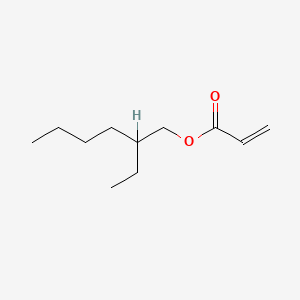
2-Ethylhexyl acrylate
2-ethylhexyl acrylate appears as a clear colorless liquid with a pleasant odor. Less dense than water and insoluble in water. Vapors heavier than air. Flash point 180 °F. Used in making of paints and plastics. — CAMEO Chemicals
- Nom IUPAC
- 2-ethylhexyl prop-2-enoate
- Formule moléculaire
- C11H20O2
- Masse moléculaire
- 184.27 g/mol
- Masse exacte
- 184.146329876 Da
- XLogP3
- 3,8
- Surface polaire topologique
- 26,3 Ų
- Donneurs de liaisons hydrogène
- 0
- Accepteurs de liaisons hydrogène
- 2
- Unités covalentes
- 1
- Stéréocentres définis
- 0
Également connu sous le nom de
16 autres noms signalés
Identifiants de bases de données externes
- ChEBI:CHEBI:82465
- ChEMBL:CHEMBL1574328
- EPA DTXSID:DTXSID9025297
- PubMed:30561685
- PubMed:27965148
- PubMed:27633901
- PubMed:22834708
- PubMed:22428681
- PubMed:21638488
- PubMed:21152308
- PubMed:20967430
- PubMed:20608687
- PubMed:20356189
- PubMed:20019424
- PubMed:20001660
Preuves issues de bases de données scientifiques complémentaires
EMBL-EBI ChEBI
2-Ethylhexyl acrylate
- Formule
- C11H20O2
- Masse moyenne
- 184.279 g/mol
- Masse monoisotopique
- 184.14633 Da
- Charge formelle
- 0
- enoate ester — is a (CHEBI:51702)
- enoate ester — is a (CHEBI:51702)
Références croisées de cette source
- CAS: 103-11-7 — KEGG COMPOUND
- MANUAL_X_REF: C19420 — KEGG COMPOUND
Mis en correspondance par: Exact CAS cross-reference in the ChEBI compound record. Récupéré le: 2026-08-31. Ouvrir la fiche source
NIH PubChem PUG-View
Attributed physical-property, hazard, environmental and use annotations.
- Autoignition Temperature: 496 °F (USCG, 1999) Source: CAMEO Chemicals
- Autoignition Temperature: 485 °F (252 °C) Source: Hazardous Substances Data Bank (HSDB)
- Autoignition Temperature: 252 °C Source: ILO-WHO International Chemical Safety Cards (ICSCs)
- Boiling Point: 417 to 424 °F at 760 mmHg (NTP, 1992) Source: CAMEO Chemicals
- Boiling Point: 214-218 °C Source: Hazardous Substances Data Bank (HSDB)
- Boiling Point: Boiling point: 130 °C @ 50 mm Hg; conversion factor: 1 ppm = 7.52 mg/cu cm Source: Hazardous Substances Data Bank (HSDB)
- Boiling Point: 213.5 °C Source: ILO-WHO International Chemical Safety Cards (ICSCs)
- Boiling Point: 417-424 °F Source: Occupational Safety and Health Administration (OSHA)
- Color/Form: Colorless liquid Source: Hazardous Substances Data Bank (HSDB)
- Density: 0.885 at 68 °F (USCG, 1999) - Less dense than water; will float Source: CAMEO Chemicals
- Density: 0.880 g/cu cm at 25 °C Source: Hazardous Substances Data Bank (HSDB)
- Density: Relative density (water = 1): 0.89 Source: ILO-WHO International Chemical Safety Cards (ICSCs)
- Density: 0.885 Source: Occupational Safety and Health Administration (OSHA)
- Density: 0.8869 @ 20°C Source: PAC Chemical Database, U.S. Department of Energy
- Flash Point: 180 °F (NTP, 1992) Source: CAMEO Chemicals
- Flash Point: 180 °F (82 °C) (open cup) Source: Hazardous Substances Data Bank (HSDB)
- Flash Point: 86 °C (closed cup) Source: Hazardous Substances Data Bank (HSDB)
- Flash Point: 82 °C o.c. Source: ILO-WHO International Chemical Safety Cards (ICSCs)
- Flash Point: 180 °F Source: Occupational Safety and Health Administration (OSHA)
- LogP: log Kow = 4.09 /Estimated/ Source: Hazardous Substances Data Bank (HSDB)
- LogP: 3.67 Source: ILO-WHO International Chemical Safety Cards (ICSCs)
- Melting Point: -130 °F (NTP, 1992) Source: CAMEO Chemicals
- Melting Point: -90 °C Source: Hazardous Substances Data Bank (HSDB)
- Melting Point: -90 °C Source: ILO-WHO International Chemical Safety Cards (ICSCs)
- Melting Point: -130 °F Source: Occupational Safety and Health Administration (OSHA)
- Melting Point: -90 °C Source: PAC Chemical Database, U.S. Department of Energy
- Odor: Pleasant Source: Hazardous Substances Data Bank (HSDB)
- Physical Description: 2-ethylhexyl acrylate appears as a clear colorless liquid with a pleasant odor. Less dense than water and insoluble in water. Vapors heavier than air. Flash point 180 °F. Used in making of paints and plastics. Source: CAMEO Chemicals
- Physical Description: Liquid Source: EPA Chemical Data Reporting (CDR)
- Physical Description: Colorless liquid with a pleasant odor; [HSDB] Pale yellow liquid with a pleasant odor; [NTP] Source: Haz-Map, Information on Hazardous Chemicals and Occupational Diseases
- Physical Description: COLOURLESS LIQUID WITH CHARACTERISTIC ODOUR. Source: ILO-WHO International Chemical Safety Cards (ICSCs)
- Physical Description: Clear liquid with a pleasant odor. Source: Occupational Safety and Health Administration (OSHA)
- Refractive Index: Index of refraction: 1.4332 @ 25 °C Source: Hazardous Substances Data Bank (HSDB)
- Solubility: less than 1 mg/mL at 72 °F (NTP, 1992) Source: CAMEO Chemicals
- Solubility: 100 mg/l @ 25 °C Source: Hazardous Substances Data Bank (HSDB)
- Solubility: Solubility in water: none Source: ILO-WHO International Chemical Safety Cards (ICSCs)
- Vapor Pressure: 0.01 mmHg at 68 °F (NTP, 1992) Source: CAMEO Chemicals
- Vapor Pressure: 0.17 [mmHg] Source: Haz-Map, Information on Hazardous Chemicals and Occupational Diseases
- Vapor Pressure: 0.178 mm Hg @ 25 °C /Extrapolated/ Source: Hazardous Substances Data Bank (HSDB)
- Vapor Pressure: Vapor pressure, Pa at 20 °C: 19 Source: ILO-WHO International Chemical Safety Cards (ICSCs)
- Vapor Pressure: 0.01 mmHg Source: Occupational Safety and Health Administration (OSHA)
- Vapor Pressure: 1 [mm Hg] @50 °C Source: PAC Chemical Database, U.S. Department of Energy
- IARC Carcinogenic Agent: 2-Ethylhexyl acrylate Source: International Agency for Research on Cancer (IARC)
- IARC Carcinogenic Classes: Group 2B: Possibly carcinogenic to humans Source: International Agency for Research on Cancer (IARC)
- IARC Monographs: Volume 60: (1994) Some Industrial Chemicals; Volume 122: (2019) Isobutyl Nitrite, β-Picoline, and Some Acrylates Source: International Agency for Research on Cancer (IARC)
- Publication Year: 2019 Source: International Agency for Research on Cancer (IARC)
- Evaluation Year: 2018 Source: International Agency for Research on Cancer (IARC)
- Exposure Routes: The substance can be absorbed into the body by inhalation and by ingestion. Source: ILO-WHO International Chemical Safety Cards (ICSCs)
- First Aid: EYES: First check the victim for contact lenses and remove if present. Flush victim's eyes with water or normal saline solution for 20 to 30 minutes while simultaneously calling a hospital or poison control center. Do not put any ointments, oils, or medication in the victim's eyes without specific instructions from a physician. IMMEDIATELY transport the victim after flushing eyes to a hospital even if no symptoms (such as redness or irritation) develop.; SKIN: IMMEDIATELY flood affected skin with water while removing and isolating all contaminated clothing. Gently wash all affected skin areas thoroughly with soap and water. If symptoms such as redness or irritation develop, IMMEDIATELY call a physician and be prepared to transport the victim to a hospital for treatment.; INHALATION: IMMEDIATELY leave the contaminated area; take deep breaths of fresh air. If symptoms (such as wheezing, coughing, shortness of breath, or burning in the mouth, throat, or chest) develop, call a physician and be prepared to transport the victim to a hospital. Provide proper respiratory protection to rescuers entering an unknown atmosphere. Whenever possible, Self-Contained Breathing Apparatus (SCBA) shou Source: CAMEO Chemicals
- Signal: Warning Source: Regulation (EC) No 1272/2008 of the European Parliament and of the Council
- GHS Hazard Statements: H315: Causes skin irritation [Warning Skin corrosion/irritation]; H317: May cause an allergic skin reaction [Warning Sensitization, Skin]; H335: May cause respiratory irritation [Warning Specific target organ toxicity, single exposure; Respiratory tract irritation] Source: Regulation (EC) No 1272/2008 of the European Parliament and of the Council
- Precautionary Statement Codes: P261, P264, P271, P272, P280, P302+P352, P304+P340, P319, P321, P332+P317, P333+P317, P362+P364, P403+P233, P405, and P501 (click each P-code to see the statement) Source: Regulation (EC) No 1272/2008 of the European Parliament and of the Council
- Note: This chemical does not meet GHS hazard criteria for < 0.1% (1 of 3581) of reports. Source: European Chemicals Agency (ECHA)
- Signal: Warning Source: European Chemicals Agency (ECHA)
- GHS Hazard Statements: H315 (> 99.9%): Causes skin irritation [Warning Skin corrosion/irritation]; H317 (> 99.9%): May cause an allergic skin reaction [Warning Sensitization, Skin]; H335 (99.6%): May cause respiratory irritation [Warning Specific target organ toxicity, single exposure; Respiratory tract irritation]; H412 (16.2%): Harmful to aquatic life with long lasting effects [Hazardous to the aquatic environment, long-term hazard] Source: European Chemicals Agency (ECHA)
- Precautionary Statement Codes: P261, P264, P271, P272, P273, P280, P302+P352, P304+P340, P319, P321, P332+P317, P333+P317, P362+P364, P403+P233, P405, and P501 (click each P-code to see the statement) Source: European Chemicals Agency (ECHA)
- ECHA C&L Notifications Summary: Aggregated GHS information provided per 3581 reports by companies from 48 notifications to the ECHA C&L Inventory. Each notification may be associated with multiple companies.; Reported as not meeting GHS hazard criteria per 1 of 3581 reports by companies.; There are 47 notifications provided by 3580 of 3581 reports by companies with hazard statement code(s).; Information may vary between notifications depending on impurities, additives, and other factors. The percentage value in parenthesis indicates the notified classification ratio from companies that provide hazard codes. Only hazard codes with percentage values above 10% are shown. For more detailed information, please visit ECHA C&L website. Source: European Chemicals Agency (ECHA)
- GHS Hazard Statements: H315 (100%): Causes skin irritation [Warning Skin corrosion/irritation]; H319 (100%): Causes serious eye irritation [Warning Serious eye damage/eye irritation] Source: European Chemicals Agency (ECHA)
- Precautionary Statement Codes: P264, P264+P265, P280, P302+P352, P305+P351+P338, P321, P332+P317, P337+P317, and P362+P364 (click each P-code to see the statement) Source: European Chemicals Agency (ECHA)
- ECHA C&L Notifications Summary: The GHS information provided by 1 company from 1 notification to the ECHA C&L Inventory. Source: European Chemicals Agency (ECHA)
- Signal: Warning Source: NITE-CMC
- NFPA Health Rating: 1 - Materials that, under emergency conditions, can cause significant irritation. Source: Hazardous Substances Data Bank (HSDB)
- NFPA Fire Rating: 2 - Materials that must be moderately heated or exposed to relatively high ambient temperatures before ignition can occur. Materials would not under normal conditions form hazardous atmospheres with air, but under high ambient temperatures or under moderate heating could release vapor in sufficient quantities to produce hazardous atmospheres with air. Source: Hazardous Substances Data Bank (HSDB)
- NFPA Instability Rating: 1 - Materials that in themselves are normally stable but that can become unstable at elevated temperatures and pressures. Source: Hazardous Substances Data Bank (HSDB)
- Environmental Bioconcentration: An estimated BCF of 430 was calculated for 2-ethylhexyl acrylate(SRC), using an estimated log Kow of 4.09(1) and a regression-derived equation(2). According to a classification scheme(3), this BCF suggests the potential for bioconcentration in aquatic organisms is high(SRC), provided the compound is not altered biologically or chemically once released into the environment(SRP). Source: Hazardous Substances Data Bank (HSDB)
- Environmental Fate: TERRESTRIAL FATE: Based on a classification scheme(1), an estimated Koc value of 430(SRC), determined from a structure estimation method(2), indicates that 2-ethylhexyl acrylate is expected to have moderate mobility in soil(SRC). Volatilization of 2-ethylhexyl acrylate from moist soil surfaces is expected to be an important fate process(SRC) given a Henry's Law constant of 0.000432 atm-cu m/mole(SRC), derived from its vapor pressure, 0.178 mm Hg(3) and water solubility, 100 mg/L(4). 2-Ethylhexyl acrylate is not expected to volatilize from dry soil surfaces(SRC) based upon its vapor pressure(3). Biodegradation data in soil were not found; however, 2-ethylhexyl acrylate was found to biodegrade 51 to >90% in biodegradation screening tests(4,5). Source: Hazardous Substances Data Bank (HSDB)
- Environmental Fate: AQUATIC FATE: Based on a classification scheme(1), an estimated Koc value of 430(SRC), determined from a structure estimation method(2), indicates that 2-ethylhexyl acrylate is expected to adsorb to suspended solids and sediment(SRC). Volatilization from water surfaces is expected(3) based upon a Henry's Law constant of 0.000432 atm-cu m/mole(SRC), derived from its vapor pressure, 0.178 mm Hg(4) and water solubility, 100 mg/L(5). Using this Henry's Law constant and an estimation method(3), volatilization half-lives for a model river and model lake are 7 hours and 6 days, respectively(SRC). According to a classification scheme(6), an estimated BCF of 280(SRC), from an estimated log Kow of 4.09(7) and a regression-derived equation(8), suggests the potential for bioconcentration in aquatic organisms is high(SRC), provided the compound is not altered physically or chemically once released into the environment(SRP). No hydrolysis data are available for 2-ethylhexyl acrylate; however, hydrolysis is expected to be an important environmental fate process for 2-ethylhexyl acrylate but only at alkaline pHs(SRC). The base-catalyzed second-order hydrolysis rate constant for an analogous compou Source: Hazardous Substances Data Bank (HSDB)
- Environmental Fate: ATMOSPHERIC FATE: According to a model of gas/particle partitioning of semivolatile organic compounds in the atmosphere(1), 2-ethylhexyl acrylate, which has a vapor pressure of 0.178 mm Hg at 25 °C(2), is expected to exist solely as a vapor in the ambient atmosphere. Vapor-phase 2-ethylhexyl acrylate is degraded in the atmosphere by reaction with photochemically-produced hydroxyl radicals(SRC); the half-life for this reaction in air is estimated to be 19 hours(SRC), calculated from its rate constant of 2.0X10⁻¹¹ cu cm/molecule-sec at 25 °C(SRC) that was derived using a structure estimation method(3). The rate constant for the vapor-phase reaction of 2-ethylhexyl acrylate with ozone has been estimated as 1.8X10⁻¹⁶ cu cm/molecule-sec at 25 °C(SRC) that was derived using a structure estimation method(3). This corresponds to an atmospheric half-life of about 6.5 days at an atmospheric concentration of 7X10+11 ozone molecules per cu cm(4). 2-Ethylhexyl acrylate is not expected to be susceptible to direct photolysis by sunlight, since it does not contain functional groups that are expected to absorb light with wavelengths >290 nm(SRC). Source: Hazardous Substances Data Bank (HSDB)
- Consumer Uses: Monomers; Anti-adhesive/cohesive; Absorbent; Plasticizer; Sealant (barrier); Anti-stain agent Source: EPA Chemical Data Reporting (CDR)
- Industry Uses: Binder; Solvent; Monomers; Wrinkle resisting agent; Not Known or Reasonably Ascertainable; Anti-stain agent; Absorbent; Plasticizer; Intermediate Source: EPA Chemical Data Reporting (CDR)
- Sources/Uses: Used as a monomer for plastics, protective coatings, and paper treatment, in copolymerization of vinyl acetate and vinyl chloride, and in the manufacture of water-based paints, adhesives, printing inks, impregnating agents, and reactive diluent/cross-linking agents; [HSDB] Used to make polymers and copolymers that are usually further processed to aqueous polymer dispersions--used mainly in adhesives and paints; Also used for coating raw materials, in the plastics industry, and as a monomer in construction industry chemicals (concentrations of 0.1-21%); [EC] Source: Haz-Map, Information on Hazardous Chemicals and Occupational Diseases
- Uses: Monomer for plastics, protective coatings, paper treatment; in water-based paints Source: Hazardous Substances Data Bank (HSDB)
- Uses: In vinyl acetate copolymerization Source: Hazardous Substances Data Bank (HSDB)
- Uses: In vinyl chloride copolymerization Source: Hazardous Substances Data Bank (HSDB)
- Uses: Acrylic acid, 2 ethylhexyl ester is used... in the production of water-based paints intended for use in contact with food or drink. Source: Hazardous Substances Data Bank (HSDB)
- Uses: ... Used to manufacture coating materials (especially emulsion paints), adhesives, printing inks, impregnating agents, and reactive diluent/cross-linking agents. Source: Hazardous Substances Data Bank (HSDB)
Mis en correspondance par: Existing checksum-valid CAS to unique PubChem CID match. Récupéré le: 2026-08-31. Ouvrir la fiche source
Les classifications scientifiques et les annotations de danger apportent du contexte et ne remplacent pas la décision réglementaire propre au marché indiquée ci-dessus.
Couverture des sources complémentaires et état des correspondances
| Source | Résultat | Vérifié |
|---|---|---|
| EMBL-EBI ChEBI | Correspondance exacte | 2026-08-31 |
| NIH PubChem PUG-View | Correspondance exacte | 2026-08-31 |
Une absence de correspondance enregistrée est une preuve utile que la source a été vérifiée ; ce n’est pas l’affirmation que la substance n’existe pas ailleurs.
Récupéré depuis NIH PubChem le 2026-08-31 par correspondance CAS à somme de contrôle valide. Les propriétés chimiques ne remplacent pas la décision réglementaire de cette page.