
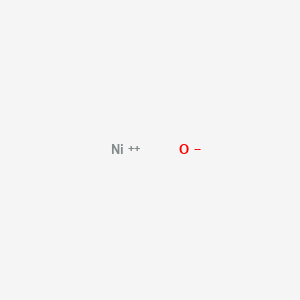
Nickel Monoxide
Nickel Monoxide is a green to black colored, inorganic compound that turns yellow and produces toxic gases upon heating. Nickel monoxide is used in the electronics, ceramics, steel and alloy industries. Exposure to this substance can cause severe dermatitis, skin and asthma-like allergies and damages the lungs, kidneys, gastrointestinal tract and neurological system. Nickel monoxide is a known carcinogen and is associated with an increased risk of developing lung and nasal cancers. (NCI05) — NCI Thesaurus (NCIt)
- Nom IUPAC
- nickel(2+);oxygen(2-)
- Formule moléculaire
- NiO
- Masse moléculaire
- 74.693 g/mol
- Masse exacte
- 73.930256 Da
- Surface polaire topologique
- 1,0 Ų
- Donneurs de liaisons hydrogène
- 0
- Accepteurs de liaisons hydrogène
- 1
- Unités covalentes
- 2
- Stéréocentres définis
- 0
Également connu sous le nom de
4 autres noms signalés
Identifiants de bases de données externes
Preuves issues de bases de données scientifiques complémentaires
NIH PubChem PUG-View
Attributed physical-property, hazard, environmental and use annotations.
- Density: 6.7 g/cm³ Source: ILO-WHO International Chemical Safety Cards (ICSCs)
- Melting Point: 1955 °C Source: ILO-WHO International Chemical Safety Cards (ICSCs)
- Physical Description: Large Crystals; CBI; Dry Powder; Other Solid; Liquid; Other Solid; Dry Powder; Other Solid; Dry Powder; Large Crystals Source: EPA Chemical Data Reporting (CDR)
- Physical Description: Green solid, insoluble in water; [Merck Index] Source: Haz-Map, Information on Hazardous Chemicals and Occupational Diseases
- Physical Description: GREEN-TO-BLACK CRYSTALLINE POWDER. Source: ILO-WHO International Chemical Safety Cards (ICSCs)
- Solubility: Solubility in water, mg/l at 20 °C: 1.1 (practically insoluble) Source: ILO-WHO International Chemical Safety Cards (ICSCs)
- Substance: Nickel (II) Oxide Source: NTP Technical Reports
- NTP Technical Report: TR-451: Toxicology and Carcinogenesis Studies of Nickel Oxide (CASRN 1313-99-1) in F344/N Rats and B6C3F1 Mice (Inhalation Studies) (1996 ) Source: NTP Technical Reports
- Peer Review Date: 11/29/94 Source: NTP Technical Reports
- Conclusion for Male Rat: Some Evidence Source: NTP Technical Reports
- Conclusion for Female Rat: Some Evidence Source: NTP Technical Reports
- Conclusion for Male Mice: No Evidence Source: NTP Technical Reports
- Conclusion for Female Mice: Equivocal Evidence Source: NTP Technical Reports
- Summary: Under the conditions of these 2-year inhalation studies, there was some evidence of carcinogenic activity of nickel oxide in male F344/N rats based on increased incidences of alveolar/bronchiolar adenoma or carcinoma (combined) and increased incidences of benign or malignant pheochromocytoma (combined) of the adrenal medulla. There was some evidence of carcinogenic activity of nickel oxide in female F344/N rats based on increased incidences of alveolar/bronchiolar adenoma or carcinoma (combined) and increased incidences of benign pheochromocytoma of the adrenal medulla. There was no evidence of carcinogenic activity of nickel oxide in male B6C3F1 mice exposed to 1.25, 2.5, or 5 mg/m3. There was equivocal evidence of carcinogenic activity of nickel oxide in female B6C3F1 mice based on marginally increased incidences of alveolar/bronchiolar adenoma in 2.5 mg/m3 females and of alveolar/bronchiolar adenoma or carcinoma (combined) in 1.25 mg/m3 females.; Exposure of rats to nickel oxide by inhalation for 2 years resulted in inflammation and pigmentation in the lung, lymphoid hyperplasia and pigmentation in the bronchial lymph nodes, and hyperplasia of the adrenal medulla (females). Expo Source: NTP Technical Reports
- Exposure Routes: The substance can be absorbed into the body by inhalation of its aerosol and by ingestion. Source: ILO-WHO International Chemical Safety Cards (ICSCs)
- Signal: Danger Source: Regulation (EC) No 1272/2008 of the European Parliament and of the Council
- GHS Hazard Statements: H317: May cause an allergic skin reaction [Warning Sensitization, Skin]; H350i: May cause cancer by inhalation [Danger Carcinogenicity]; H372 **: Causes damage to organs through prolonged or repeated exposure [Danger Specific target organ toxicity, repeated exposure]; H413: May cause long lasting harmful effects to aquatic life [Hazardous to the aquatic environment, long-term hazard] Source: Regulation (EC) No 1272/2008 of the European Parliament and of the Council
- Precautionary Statement Codes: P203, P260, P261, P264, P270, P272, P273, P280, P302+P352, P318, P319, P321, P333+P317, P362+P364, P405, and P501 (click each P-code to see the statement) Source: Regulation (EC) No 1272/2008 of the European Parliament and of the Council
- Signal: Danger Source: European Chemicals Agency (ECHA)
- GHS Hazard Statements: H317 (100%): May cause an allergic skin reaction [Warning Sensitization, Skin]; H332 (13.5%): Harmful if inhaled [Warning Acute toxicity, inhalation]; H334 (17.5%): May cause allergy or asthma symptoms or breathing difficulties if inhaled [Danger Sensitization, respiratory]; H350 (67.8%): May cause cancer [Danger Carcinogenicity]; H350i (32.3%): May cause cancer by inhalation [Danger Carcinogenicity]; H360 (16.9%): May damage fertility or the unborn child [Danger Reproductive toxicity]; H372 (99.7%): Causes damage to organs through prolonged or repeated exposure [Danger Specific target organ toxicity, repeated exposure]; H401 (20.2%): Toxic to aquatic life [Hazardous to the aquatic environment, acute hazard]; H411 (20.2%): Toxic to aquatic life with long lasting effects [Hazardous to the aquatic environment, long-term hazard]; H413 (79.8%): May cause long lasting harmful effects to aquatic life [Hazardous to the aquatic environment, long-term hazard] Source: European Chemicals Agency (ECHA)
- Precautionary Statement Codes: P203, P233, P260, P261, P264, P270, P271, P272, P273, P280, P284, P302+P352, P304+P340, P317, P318, P319, P321, P333+P317, P342+P316, P362+P364, P391, P403, P405, and P501 (click each P-code to see the statement) Source: European Chemicals Agency (ECHA)
- ECHA C&L Notifications Summary: Aggregated GHS information provided per 2079 reports by companies from 51 notifications to the ECHA C&L Inventory. Each notification may be associated with multiple companies.; Information may vary between notifications depending on impurities, additives, and other factors. The percentage value in parenthesis indicates the notified classification ratio from companies that provide hazard codes. Only hazard codes with percentage values above 10% are shown. For more detailed information, please visit ECHA C&L website. Source: European Chemicals Agency (ECHA)
- Signal: Danger Source: NITE-CMC
- GHS Hazard Statements: H317: May cause an allergic skin reaction [Warning Sensitization, Skin]; H334: May cause allergy or asthma symptoms or breathing difficulties if inhaled [Danger Sensitization, respiratory]; H350: May cause cancer [Danger Carcinogenicity]; H372: Causes damage to organs through prolonged or repeated exposure [Danger Specific target organ toxicity, repeated exposure] Source: NITE-CMC
- Precautionary Statement Codes: P203, P233, P260, P261, P264, P270, P271, P272, P280, P284, P302+P352, P304+P340, P318, P319, P321, P333+P317, P342+P316, P362+P364, P403, P405, and P501 (click each P-code to see the statement) Source: NITE-CMC
- Signal: Danger Source: Hazardous Chemical Information System (HCIS), Safe Work Australia
- GHS Hazard Statements: H317: May cause an allergic skin reaction [Warning Sensitization, Skin]; H350i: May cause cancer by inhalation [Danger Carcinogenicity]; H372: Causes damage to organs through prolonged or repeated exposure [Danger Specific target organ toxicity, repeated exposure] Source: Hazardous Chemical Information System (HCIS), Safe Work Australia
- Consumer Uses: Catalyst; Pigment; Adsorbent; Other Source: EPA Chemical Data Reporting (CDR)
- Industry Uses: Catalyst; Not Known or Reasonably Ascertainable; Intermediate; Pigment; Other; Intermediates Source: EPA Chemical Data Reporting (CDR)
- Sources/Uses: Used in painting porcelain, electroplating, and glass coloring; Also used to make fuel cell electrodes, ferrites (e.g. NiOFe2O3), nickel salts, nickel catalysts, varistors, and propellant for automotive air bags; [HSDB] Found in the mineral bunsenite; Used in porcelain paint; [Merck Index] Source: Haz-Map, Information on Hazardous Chemicals and Occupational Diseases
- Industrial Processes with risk of exposure: Electroplating [Category: Plate]; Semiconductor Manufacturing [Category: Industry]; Painting (Pigments, Binders, and Biocides) [Category: Paint]; Mining [Category: Industry]; Glass Manufacturing [Category: Industry] Source: Haz-Map, Information on Hazardous Chemicals and Occupational Diseases
Mis en correspondance par: Existing checksum-valid CAS to unique PubChem CID match. Récupéré le: 2026-08-31. Ouvrir la fiche source
Les classifications scientifiques et les annotations de danger apportent du contexte et ne remplacent pas la décision réglementaire propre au marché indiquée ci-dessus.
Couverture des sources complémentaires et état des correspondances
| Source | Résultat | Vérifié |
|---|---|---|
| NIH PubChem PUG-View | Correspondance exacte | 2026-08-31 |
Une absence de correspondance enregistrée est une preuve utile que la source a été vérifiée ; ce n’est pas l’affirmation que la substance n’existe pas ailleurs.
Récupéré depuis NIH PubChem le 2026-09-02 par correspondance CAS à somme de contrôle valide. Les propriétés chimiques ne remplacent pas la décision réglementaire de cette page.