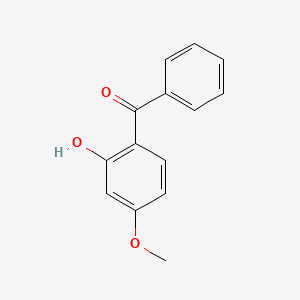
CAS 131-57-7PubChem CID 4632
2-Hydroxy-4-methoxybenzophenone
Oxybenzone is a hydroxybenzophenone that is benzophenone which is substituted at the 2- and 4-positions of one of the benzene rings by hydroxy and methoxy groups respectively. It has a role as a xenobiotic, a dermatologic drug, a protective agent, an ultraviolet filter and an environmental contaminant. It is a hydroxybenzophenone and a monomethoxybenzene.
— ChEBI
- Nom IUPAC
- (2-hydroxy-4-methoxyphenyl)-phenylmethanone
- Formule moléculaire
- C14H12O3
- Masse moléculaire
- 228.24 g/mol
- Masse exacte
- 228.078644241 Da
- XLogP3
- 3,6
- Surface polaire topologique
- 46,5 Ų
- Donneurs de liaisons hydrogène
- 1
- Accepteurs de liaisons hydrogène
- 3
- Unités covalentes
- 1
- Stéréocentres définis
- 0
Également connu sous le nom de
oxybenzoneBenzophenone-32-Benzoyl-5-methoxyphenolAdvastab 45Methanone, (2-hydroxy-4-methoxyphenyl)phenyl-OxybenzonAnuvex4-Methoxy-2-hydroxybenzophenone
16 autres noms signalés
Ongrostab HMBOxibenzonaUsaf cy-9Spectra-sorb UV 9Chimassorb 90OxybenzonumUvinul 9Syntase 62Uvistat 24Cyasorb UV 9Sunscreen UV-15Uvinul M40Escalol 567NSC-7778Oxibenzonum(2-Hydroxy-4-methoxyphenyl)phenylmethanone
Identifiants de bases de données externes
Preuves issues de bases de données scientifiques complémentaires
NIH PubChem PUG-View
Correspondance exacte d’identifiant4632
Attributed physical-property, hazard, environmental and use annotations.
- Boiling Point:
302 to 320 °F at 5 mmHg (NTP, 1992)
Source: CAMEO Chemicals
- Boiling Point:
155 °C at 5.00E+00 mm Hg
Source: DrugBank
- Substance:
2-Hydroxy-4-methoxybenzophenone
Source: NTP Technical Reports
- NTP Technical Report:
TR-597: Toxicology and Carcinogenesis Studies of 2-Hydroxy-4- methoxybenzophenone (CASRN 131-57-7) Administered in Feed to Sprague Dawley (Hsd:Sprague Dawley SD) Rats and B6C3F1/N Mice (2020 )
Source: NTP Technical Reports
- Peer Review Date:
12/12/19
Source: NTP Technical Reports
- Conclusion for Male Rat:
Equivocal Evidence
Source: NTP Technical Reports
- Conclusion for Female Rat:
Equivocal Evidence
Source: NTP Technical Reports
- Conclusion for Male Mice:
No Evidence
Source: NTP Technical Reports
- Conclusion for Female Mice:
No Evidence
Source: NTP Technical Reports
- Summary:
Under the conditions of these 2-year studies, there was equivocal evidence of carcinogenic activity of 2H4MBP exposure in male Hsd:Sprague Dawley SD rats based on the occurrence of malignant meningiomas in the brain. There was equivocal evidence of carcinogenic activity in female Hsd:Sprague Dawley SD rats based on the increased incidence of thyroid C-cell adenomas and the increased incidence of uterine stromal polyps. There was no evidence of carcinogenic activity in male or female B6C3F1/N mice at exposure concentrations of 1,000, 3,000, and 10,000 ppm.; Increases in the incidences of nonneoplastic lesions of the testis in male rats and of the uterus and adrenal cortex in female rats occurred with exposure to 2H4MBP. Increases in the incidences of nonneoplastic lesions of the bone marrow (males and females), spleen (males and females), kidney (males and females), and liver (males) in mice occurred with exposure to 2H4MBP.
Source: NTP Technical Reports
- Carcinogen Classification:
No indication of carcinogenicity to humans (not listed by IARC).
Source: Toxin and Toxin Target Database (T3DB)
- First Aid:
EYES: First check the victim for contact lenses and remove if present. Flush victim's eyes with water or normal saline solution for 20 to 30 minutes while simultaneously calling a hospital or poison control center. Do not put any ointments, oils, or medication in the victim's eyes without specific instructions from a physician. IMMEDIATELY transport the victim after flushing eyes to a hospital even if no symptoms (such as redness or irritation) develop.; SKIN: IMMEDIATELY flood affected skin with water while removing and isolating all contaminated clothing. Gently wash all affected skin areas thoroughly with soap and water. If symptoms such as redness or irritation develop, IMMEDIATELY call a physician and be prepared to transport the victim to a hospital for treatment.; INHALATION: IMMEDIATELY leave the contaminated area; take deep breaths of fresh air. If symptoms (such as wheezing, coughing, shortness of breath, or burning in the mouth, throat, or chest) develop, call a physician and be prepared to transport the victim to a hospital. Provide proper respiratory protection to rescuers entering an unknown atmosphere. Whenever possible, Self-Contained Breathing Apparatus (SCBA) shou
Source: CAMEO Chemicals
- Note:
This chemical does not meet GHS hazard criteria for 6% (116 of 1945) of reports.
Source: European Chemicals Agency (ECHA)
- Signal:
Warning
Source: European Chemicals Agency (ECHA)
- GHS Hazard Statements:
H315 (70.2%): Causes skin irritation [Warning Skin corrosion/irritation]; H319 (70.2%): Causes serious eye irritation [Warning Serious eye damage/eye irritation]; H335 (69.3%): May cause respiratory irritation [Warning Specific target organ toxicity, single exposure; Respiratory tract irritation]; H400 (14.3%): Very toxic to aquatic life [Warning Hazardous to the aquatic environment, acute hazard]; H411 (24.3%): Toxic to aquatic life with long lasting effects [Hazardous to the aquatic environment, long-term hazard]
Source: European Chemicals Agency (ECHA)
- Precautionary Statement Codes:
P261, P264, P264+P265, P271, P273, P280, P302+P352, P304+P340, P305+P351+P338, P319, P321, P332+P317, P337+P317, P362+P364, P391, P403+P233, P405, and P501 (click each P-code to see the statement)
Source: European Chemicals Agency (ECHA)
- ECHA C&L Notifications Summary:
Aggregated GHS information provided per 1945 reports by companies from 26 notifications to the ECHA C&L Inventory. Each notification may be associated with multiple companies.; Reported as not meeting GHS hazard criteria per 116 of 1945 reports by companies.; There are 24 notifications provided by 1829 of 1945 reports by companies with hazard statement code(s).; Information may vary between notifications depending on impurities, additives, and other factors. The percentage value in parenthesis indicates the notified classification ratio from companies that provide hazard codes. Only hazard codes with percentage values above 10% are shown. For more detailed information, please visit ECHA C&L website.
Source: European Chemicals Agency (ECHA)
- Signal:
Warning
Source: NITE-CMC
- GHS Hazard Statements:
H361: Suspected of damaging fertility or the unborn child [Warning Reproductive toxicity]; H400: Very toxic to aquatic life [Warning Hazardous to the aquatic environment, acute hazard]; H410: Very toxic to aquatic life with long lasting effects [Warning Hazardous to the aquatic environment, long-term hazard]
Source: NITE-CMC
- Precautionary Statement Codes:
P203, P273, P280, P318, P391, P405, and P501 (click each P-code to see the statement)
Source: NITE-CMC
- GHS Hazard Statements:
H317: May cause an allergic skin reaction [Warning Sensitization, Skin]
Source: NITE-CMC
- Precautionary Statement Codes:
P261, P272, P280, P302+P352, P321, P333+P317, P362+P364, and P501 (click each P-code to see the statement)
Source: NITE-CMC
- Signal:
Warning
Source: Hazardous Substances Data Bank (HSDB)
- GHS Hazard Statements:
H315: Causes skin irritation [Warning Skin corrosion/irritation]; H319: Causes serious eye irritation [Warning Serious eye damage/eye irritation]; H335: May cause respiratory irritation [Warning Specific target organ toxicity, single exposure; Respiratory tract irritation]
Source: Hazardous Substances Data Bank (HSDB)
- Cosmetic Ingredient Review Finding(s):
Safe in the present practices of use and concentration. Ingredient, concentration, and use information are available in documents discoverable at https://cir-reports.cir-safety.org
Source: Cosmetic Ingredient Review (CIR)
- Toxicity Summary:
IDENTIFICATION AND USE: 2-Hydroxy-4-methoxybenzophenone (Benzophenone-3; BP-3) forms crystals or powder. It is used as an ultraviolet light absorber and stabilizer, especially in plastics and paints. It is also used as a broad-band UV filter in concentrations of up to 10% in sunscreen products alone or in combination with other UV filters. It serves not only to prevent sunburn but also to protect against the photodynamic, photosensitizing, and phototoxic effects of various drugs. HUMAN STUDIES: Photosensitivity to the UV-blocking agent benzophenone-3 has been reported. ANIMAL STUDIES: Benzophenone-3 was not a skin sensitizer in mice. Mice received benzophenone-3 in concentrations of 0; 3,125; 6,250; 12,500; 25,000 and 50,000 ppm in the diet for 13 weeks. The following effects were noted: 554 mg/kg bw/day: no adverse effects noted. 1,246 mg/kg bw/day: increased liver weight. 2,860 mg/kg bw/day: increased liver weight. 6,780 mg/kg bw/day: decreased body weight gain in males and females; increased liver weight; minimal cytoplasmic vacuolisation of hepatocytes. 16,238 mg/kg bw/day: decreased body weight gain in males and females; minimal renal lesions in males; increased liver weight;
Source: Hazardous Substances Data Bank (HSDB)
- Toxicity Summary:
Oxybenzone absorbs UV-A ultraviolet rays, preventing them from reaching the skin.
Source: Toxin and Toxin Target Database (T3DB)
- Environmental Bioconcentration:
BCFs of 39-160 and 33-156 were reported in fish for 2-hydroxy-4-methoxybenzophenone, using carp (Cyprinus carpio) which were exposed over an 10-week period at respective concentrations of 0.1 and 0.01 mg/L(1). According to a classification scheme(2), this BCF range suggests the bioconcentration in aquatic organisms is moderate to high.
Source: Hazardous Substances Data Bank (HSDB)
- Environmental Bioconcentration:
Bioaccumulation and trophic transfer in ecosystems is an important criterion for assessing environmental risks of contaminants. This study investigated bioaccumulation and biomagnification of 13 organic ultraviolet absorbents (UVAs) in marine wildlife organisms in the Pearl River Estuary, South China Sea. The UVAs could accumulate in the organisms with biota - sediment accumulation factors (BSAF) of 0.003-2.152. UV531 was the most abundant and showed the highest tendency to accumulate in the organisms with a median BSAF of 1.105. The UVAs demonstrated species - and compound-specific accumulation in the marine organism. Fishes showed significantly higher capability than the cephalopods and crustaceans in accumulation of the UVAs. Habitat did not demonstrate obvious impact on accumulation of the UVA. On the other hand, benzophenone-3, UV328, and UV234 showed significantly higher concentration in the detritus feeding fishes than carnivorous and planktivorous fishes, suggesting governing effect of dietary habits of the organisms on bioaccumulation of these UVAs. Direct uptake from growth media was a significant exposure pathway of the organisms to the UVAs. The estimated trophic magnif
Source: Hazardous Substances Data Bank (HSDB)
- Environmental Fate:
TERRESTRIAL FATE: Based on a classification scheme(1), an estimated Koc value of 950(SRC), determined from a structure estimation method(2), indicates that 2-hydroxy-4-methoxybenzophenone is expected to have low mobility in soil(SRC). The estimated pKa of 2-hydroxy-4-methoxybenzophenone is 7.1(3), indicating that this compound will exist partially in anion form in the environment and anions generally do not adsorb more strongly to soils containing organic carbon and clay than their neutral counterparts(4). Volatilization of the anion from moist soil is not expected because anions do not volatilize(SRC). Volatilization of neutral 2-hydroxy-4-methoxybenzophenone from moist soil surfaces is not expected to be an important fate process(SRC) given an estimated Henry's Law constant of 1.5X10⁻⁸ atm-cu m/mole(SRC), using a fragment constant estimation method(5). 2-Hydroxy-4-methoxybenzophenone is not expected to volatilize from dry soil surfaces(SRC) based upon an estimated vapor pressure of 6.6X10⁻⁶ mm Hg at 25 °C(SRC), determined from a fragment constant method(2). A 4% of Theoretical BOD using activated sludge in the Japanese MITI test suggests that 2-hydroxy-4-methoxybenzophenone is no
Source: Hazardous Substances Data Bank (HSDB)
- Environmental Fate:
AQUATIC FATE: Based on a classification scheme(1), an estimated Koc value of 950(SRC), determined from a structure estimation method(2), indicates that 2-hydroxy-4-methoxybenzophenone is expected to adsorb to suspended solids and sediment(SRC). An estimated pKa of 7.1(3) indicates 2-hydroxy-4-methoxybenzophenone will exist partially in the anion form at pH values of 5 to 9 and, therefore, volatilization from water surfaces of the anion is not expected to be an important fate process(SRC). Volatilization from water surfaces of neutral 2-hydroxy-4-methoxybenzophenone is not expected(4) based upon an estimated Henry's Law constant of 1.5X10⁻⁸ atm-cu m/mole(SRC), developed using a fragment constant estimation method(5). 2-Hydroxy-4-methoxybenzophenone did not undergo hydrolysis or volatilization in sterile controls incubated at 25 °C for 42 days(6). According to a classification scheme(7), BCFs of 33-160, reported for 2-hydroxy-4-methoxybenzophenone in carp (Cyprinus carpio), exposed over an 10-week period(8), suggest bioconcentration in aquatic organisms is moderate to high. 2-Hydroxy-4-methoxybenzophenone may biodegrade, based on half-lives of 10.7 and 4.2-8.7 days under aerobic and
Source: Hazardous Substances Data Bank (HSDB)
- Environmental Fate:
ATMOSPHERIC FATE: According to a model of gas/particle partitioning of semivolatile organic compounds in the atmosphere(1), 2-hydroxy-4-methoxybenzophenone, which has an estimated vapor pressure of 6.6X10⁻⁶ mm Hg at 25 °C(SRC), determined from a fragment constant method(2), will exist in both the vapor and particulate phases in the ambient atmosphere. Vapor-phase 2-hydroxy-4-methoxybenzophenone is degraded in the atmosphere by reaction with photochemically-produced hydroxyl radicals(SRC); the half-life for this reaction in air is estimated to be 1.9 hours(SRC), calculated from its rate constant of 2.0X10⁻¹⁰ cu cm/molecule-sec at 25 °C(SRC) that was derived using a structure estimation method(2). Particulate-phase 2-hydroxy-4-methoxybenzophenone may be removed from the air by wet and dry deposition(SRC). 2-Hydroxy-4-methoxybenzophenone absorbs light at maximum of 287 nm with absorption extending to 400 nm(3) and, therefore, may be susceptible to direct photolysis by sunlight.
Source: Hazardous Substances Data Bank (HSDB)
- Cosmetic Ingredient Review Link:
CIR ingredient: Benzophenone-3
Source: Cosmetic Ingredient Review (CIR)
- Sources/Uses:
Used as an ultraviolet light absorber and stabilizer (especially in plastics), photostabilizer for synthetic resins, and topical sunscreen agent; [HSDB]
Source: Haz-Map, Information on Hazardous Chemicals and Occupational Diseases
- Industrial Processes with risk of exposure:
Plastic Composites Manufacturing [Category: Industry]
Source: Haz-Map, Information on Hazardous Chemicals and Occupational Diseases
- Uses:
Sunscreening Agents.
Source: Hazardous Substances Data Bank (HSDB)
- Uses:
For 2-hydroxy-4-methoxybenzophenone (USEPA/OPP Pesticide Code: 000691) there are 0 labels match. /SRP: Not registered for current use in the U.S., but approved pesticide uses may change periodically and so federal, state and local authorities must be consulted for currently approved uses./
Source: Hazardous Substances Data Bank (HSDB)
- Uses:
An ultraviolet light absorber and stabilizer, especially in plastics and paints.
Source: Hazardous Substances Data Bank (HSDB)
- Uses:
Benzophenone-3 (BZ-3) is one of the UV-absorbing agents that has been used in industry and medicine for more than 30 years. Millions of consumers are exposed to benzophenones on a daily basis owing to the widespread use of these compounds in many of the products on the market, such as lipsticks, hair sprays, hair dyes, shampoo and detergent bars and sunscreen lotions. ...
Source: Hazardous Substances Data Bank (HSDB)
- Uses:
For more Uses (Complete) data for 2-Hydroxy-4-methoxybenzophenone (7 total), please visit the HSDB record page.
Source: Hazardous Substances Data Bank (HSDB)
- Uses:
Used as an ingredient in sunscreen and other cosmetics.
Source: Toxin and Toxin Target Database (T3DB)
Mis en correspondance par: Existing checksum-valid CAS to unique PubChem CID match.
Récupéré le: 2026-08-31.
Ouvrir la fiche source
Les classifications scientifiques et les annotations de danger apportent du contexte et ne remplacent pas la décision réglementaire propre au marché indiquée ci-dessus.
Couverture des sources complémentaires et état des correspondances
| Source | Résultat | Vérifié |
|---|
| NIH PubChem PUG-View | Correspondance exacte | 2026-08-31 |
|---|
Une absence de correspondance enregistrée est une preuve utile que la source a été vérifiée ; ce n’est pas l’affirmation que la substance n’existe pas ailleurs.
Récupéré depuis NIH PubChem le 2026-09-02 par correspondance CAS à somme de contrôle valide. Les propriétés chimiques ne remplacent pas la décision réglementaire de cette page.