
CAS 130-95-0
Le CAS 130-95-0 correspond à 1 fiche d’annexe de l’UE dans les annexes II à VI du règlement (CE) n° 1223/2009.
Fiches pour le CAS 130-95-0
1 au totalIdentité et propriétés chimiques
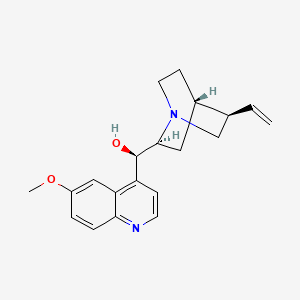
Quinine
Quinine is a cinchona alkaloid that is cinchonidine in which the hydrogen at the 6-position of the quinoline ring is substituted by methoxy. It has a role as a non-narcotic analgesic, an antimalarial and a muscle relaxant. It is a conjugate base of a quinine(1+). It derives from a hydride of an (8S)-cinchonan. — ChEBI
- Nom IUPAC
- (R)-[(2S,4S,5R)-5-ethenyl-1-azabicyclo[2.2.2]octan-2-yl]-(6-methoxyquinolin-4-yl)methanol
- Formule moléculaire
- C20H24N2O2
- Masse moléculaire
- 324.4 g/mol
- Masse exacte
- 324.183778013 Da
- XLogP3
- 2,9
- Surface polaire topologique
- 45,6 Ų
- Donneurs de liaisons hydrogène
- 1
- Accepteurs de liaisons hydrogène
- 4
- Unités covalentes
- 1
- Stéréocentres définis
- 4
Également connu sous le nom de
16 autres noms signalés
Identifiants de bases de données externes
Preuves issues de bases de données scientifiques complémentaires
NIH PubChem PUG-View
Attributed physical-property, hazard, environmental and use annotations.
- Color/Form: Triboluminescent, orthorhombic needles from absolute alcohol Source: Hazardous Substances Data Bank (HSDB)
- Color/Form: Bulky, white, amorphous powder or crystalline alkaloid Source: Hazardous Substances Data Bank (HSDB)
- Color/Form: CRYSTALS TURN BROWN ON EXPOSURE TO AIR Source: Hazardous Substances Data Bank (HSDB)
- Basic pKa: 8.56 Source: ChEMBL
- Basic pKa: 8.55 Source: ChEMBL
- Dissociation Constants: pK1 (18 °C) = 5.07; pK2 = 9.7 Source: Hazardous Substances Data Bank (HSDB)
- LogP: 3.44 Source: DrugBank
- LogP: log Kow = 3.44 Source: Hazardous Substances Data Bank (HSDB)
- LogP: 2.6 Source: Human Metabolome Database (HMDB)
- Melting Point: 57 °C Source: DrugBank
- Melting Point: 177 °C (some decomposition) Source: Hazardous Substances Data Bank (HSDB)
- Melting Point: Microcrystalline powder; mp: 57 °C; efflorescent; loses one water molecule in air, two water molecules over sulfuric acid; anhydrous at 125 °C /Quinine trihydrate/ Source: Hazardous Substances Data Bank (HSDB)
- Melting Point: 57 °C Source: Human Metabolome Database (HMDB)
- Odor: ODORLESS Source: Hazardous Substances Data Bank (HSDB)
- Physical Description: Solid Source: Human Metabolome Database (HMDB)
- Refractive Index: INDEX OF REFRACTION: 1.625 Source: Hazardous Substances Data Bank (HSDB)
- Solubility: 500 mg/L (at 15 °C) Source: DrugBank
- Solubility: In water, 500 mg/L at 15 °C Source: Hazardous Substances Data Bank (HSDB)
- Solubility: 1 g dissolves in: 1900 mL water, 760 mL boiling water Source: Hazardous Substances Data Bank (HSDB)
- Solubility: 1 g dissolves in: 80 mL benzene (18 mL at 50 °C), 1.2 mL chloroform, 250 mL dry ether, 20 mL glycerol, 0.8 mL alcohol, 1900 mL of 10% ammonia water; almost insoluble in petroleum ether Source: Hazardous Substances Data Bank (HSDB)
- Solubility: Soluble in ether, chloroform, carbon disulfide, glycerol, alkalies, and acids (with formation of salts) Source: Hazardous Substances Data Bank (HSDB)
- Solubility: Sol in pyrimidine Source: Hazardous Substances Data Bank (HSDB)
- Solubility: 3.34e-01 g/L Source: Human Metabolome Database (HMDB)
- pH: pH of saturated aqueous solution = 8.8 Source: Hazardous Substances Data Bank (HSDB)
- Carcinogen Classification: No indication of carcinogenicity to humans (not listed by IARC). Source: Toxin and Toxin Target Database (T3DB)
- Exposure Routes: Oral Source: Toxin and Toxin Target Database (T3DB)
- Signal: Danger Source: European Chemicals Agency (ECHA)
- GHS Hazard Statements: H302 (22.9%): Harmful if swallowed [Warning Acute toxicity, oral]; H315 (28.4%): Causes skin irritation [Warning Skin corrosion/irritation]; H317 (99.5%): May cause an allergic skin reaction [Warning Sensitization, Skin]; H319 (28.4%): Causes serious eye irritation [Warning Serious eye damage/eye irritation]; H334 (83.1%): May cause allergy or asthma symptoms or breathing difficulties if inhaled [Danger Sensitization, respiratory] Source: European Chemicals Agency (ECHA)
- Precautionary Statement Codes: P233, P260, P261, P264, P264+P265, P270, P271, P272, P280, P284, P301+P317, P302+P352, P304+P340, P305+P351+P338, P321, P330, P332+P317, P333+P317, P337+P317, P342+P316, P362+P364, P403, and P501 (click each P-code to see the statement) Source: European Chemicals Agency (ECHA)
- ECHA C&L Notifications Summary: Aggregated GHS information provided per 201 reports by companies from 10 notifications to the ECHA C&L Inventory. Each notification may be associated with multiple companies.; Information may vary between notifications depending on impurities, additives, and other factors. The percentage value in parenthesis indicates the notified classification ratio from companies that provide hazard codes. Only hazard codes with percentage values above 10% are shown. For more detailed information, please visit ECHA C&L website. Source: European Chemicals Agency (ECHA)
- Signal: Warning Source: Hazardous Chemical Information System (HCIS), Safe Work Australia
- GHS Hazard Statements: H302: Harmful if swallowed [Warning Acute toxicity, oral]; H317: May cause an allergic skin reaction [Warning Sensitization, Skin] Source: Hazardous Chemical Information System (HCIS), Safe Work Australia
- Precautionary Statement Codes: P261, P264, P270, P272, P280, P301+P317, P302+P352, P321, P330, P333+P317, P362+P364, and P501 (click each P-code to see the statement) Source: Hazardous Chemical Information System (HCIS), Safe Work Australia
- Signal: Danger Source: Hazardous Substances Data Bank (HSDB)
- GHS Hazard Statements: H315: Causes skin irritation [Warning Skin corrosion/irritation]; H317: May cause an allergic skin reaction [Warning Sensitization, Skin]; H319: Causes serious eye irritation [Warning Serious eye damage/eye irritation]; H334: May cause allergy or asthma symptoms or breathing difficulties if inhaled [Danger Sensitization, respiratory] Source: Hazardous Substances Data Bank (HSDB)
- Precautionary Statement Codes: P233, P260, P261, P264, P264+P265, P271, P272, P280, P284, P302+P352, P304+P340, P305+P351+P338, P321, P332+P317, P333+P317, P337+P317, P342+P316, P362+P364, P403, and P501 (click each P-code to see the statement) Source: Hazardous Substances Data Bank (HSDB)
- Health Effects: It is usual for quinine in therapeutic doses to cause cinchonism; in rare cases, it may even cause death (usually by pulmonary edema). Quinine can worsen hemoglobinuria, myasthenia gravis and optic neuritis. It can cause paralysis if accidentally injected into a nerve, and is extremely toxic in overdose[Wikipedia] Source: Toxin and Toxin Target Database (T3DB)
- Toxicity Summary: IDENTIFICATION AND USE: Quinine is a bulky, white, amorphous powder or crystalline alkaloid, used as medication: non-narcotic analgesics; antimalarial; central muscle relaxants. It is also used as flavor in carbonated beverages. HUMAN EXPOSURE AND TOXICITY: Serious hypersensitivity reactions, including anaphylactic shock, anaphylactoid reactions, urticaria, serious skin rashes, angioedema, facial edema, bronchospasm, and pruritus, have been reported with quinine. In addition, thrombocytopenia, hemolytic uremic syndrome/thrombotic thrombocytopenic purpura (HUS/TTP), immune thrombocytopenic purpura, blackwater fever, disseminated intravascular coagulation, leukopenia, neutropenia, granulomatous hepatitis, and acute interstitial nephritis have been reported and may also be due to hypersensitivity reactions to the drug. Potentially fatal cardiac arrhythmias, including torsades de pointes and ventricular fibrillation, have been reported rarely during quinine therapy. At least 1 case of fatal ventricular arrhythmia has been reported in a geriatric patient with preexisting prolonged QT interval treated with IV quinine sulfate for Plasmodium falciparum malaria. Visual impairment can range Source: Hazardous Substances Data Bank (HSDB)
- Toxicity Summary: The theorized mechanism of action for quinine and related anti-malarial drugs is that these drugs are toxic to the malaria parasite. Specifically, the drugs interfere with the parasite's ability to break down and digest hemoglobin. Consequently, the parasite starves and/or builds up toxic levels of partially degraded hemoglobin in itself. Source: Toxin and Toxin Target Database (T3DB)
- Uses: Medicine (antimalarial) as the alkaloid or as numerous salts and derivatives; flavoring in carbonated beverages Source: Hazardous Substances Data Bank (HSDB)
- Uses: Flavor in carbonated beverages. Source: Hazardous Substances Data Bank (HSDB)
- Uses: MEDICATION Source: Hazardous Substances Data Bank (HSDB)
- Uses: MEDICATION (VET) Source: Hazardous Substances Data Bank (HSDB)
- Uses: For more Uses (Complete) data for QUININE (8 total), please visit the HSDB record page. Source: Hazardous Substances Data Bank (HSDB)
- Uses: Use (kg; approx.) in Germany (2009): >5000; Use (kg) in USA (2002): 56800; Consumption (g per capita; approx.) in Germany (2009): 0.0611; Consumption (g per capita) in the USA (2002): 0.201; Calculated removal (%): 41.8 Source: NORMAN Suspect List Exchange
- Uses: For the treatment of malaria and leg cramps. Used as an antipyretic (fever-reducing), antimalarial, analgesic (painkilling), and anti-inflammatory. It is also used as a flavor component of tonic water and bitter lemon. Source: Toxin and Toxin Target Database (T3DB)
Mis en correspondance par: Existing checksum-valid CAS to unique PubChem CID match. Récupéré le: 2026-08-31. Ouvrir la fiche source
Les classifications scientifiques et les annotations de danger apportent du contexte et ne remplacent pas la décision réglementaire propre au marché indiquée ci-dessus.
Couverture des sources complémentaires et état des correspondances
| Source | Résultat | Vérifié |
|---|---|---|
| NIH PubChem PUG-View | Correspondance exacte | 2026-08-31 |
Une absence de correspondance enregistrée est une preuve utile que la source a été vérifiée ; ce n’est pas l’affirmation que la substance n’existe pas ailleurs.
Récupéré depuis NIH PubChem le 2026-08-31 par correspondance CAS à somme de contrôle valide. Les propriétés chimiques ne remplacent pas la décision réglementaire de cette page.
Comment le CAS 130-95-0 est utilisé sur ce site
Le CAS 130-95-0 est l’identifiant du Chemical Abstracts Service utilisé pour rattacher cette page à une substance précise. Dans le jeu de données actuel, 1 fiche d’annexe de l’UE partage cet identifiant, ce qui vous aide à vérifier si la même substance apparaît dans un seul contexte réglementaire ou dans plusieurs.
Utilisez cette page lorsqu’une spécification fournisseur, une FDS ou un dossier de matière première vous donne le CAS 130-95-0 et que vous devez voir au même endroit toutes les fiches liées des annexes II à VI. Les cartes d’entrées ci-dessus sont le moyen le plus rapide d’accéder aux limites de concentration, aux avertissements, à l’annexe concernée et aux conditions par type de produit.
Questions fréquentes
Outils et étapes suivantes
Vérifiez votre formule
Analysez une liste INCI complète, puis utilisez le CAS 130-95-0 pour recouper les documents fournisseurs relatifs aux substances identifiées.
Vérificateur INCIParcourir les annexes
Parcourez toutes les annexes du règlement de l’UE sur les cosmétiques par catégorie.
Toutes les annexesRechercher par nom
Recherchez les noms INCI, alias ou identifiants associés qui figurent à côté du CAS 130-95-0 dans votre documentation.
Rechercher