
CAS
1 fiche
CAS 127-65-1
Le CAS 127-65-1 correspond à 1 fiche d’annexe de l’UE dans les annexes II à VI du règlement (CE) n° 1223/2009.
Fiches pour le CAS 127-65-1
1 au totalIdentité et propriétés chimiques
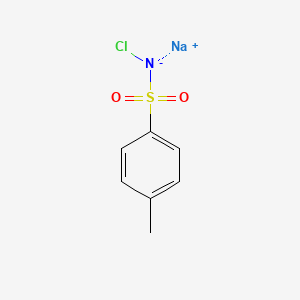
CAS 127-65-1PubChem CID 3641960
Chloramine-T
Chloramine T is an organic sodium salt derivative of toluene-4-sulfonamide with a chloro substituent in place of an amino hydrogen. It has a role as a disinfectant, an allergen and an antifouling biocide. It contains a chloro(p-tolylsulfonyl)azanide. — ChEBI
- Nom IUPAC
- sodium chloro-(4-methylphenyl)sulfonylazanide
- Formule moléculaire
- C7H7ClNNaO2S
- Masse moléculaire
- 227.64 g/mol
- Masse exacte
- 226.9783716 Da
- Surface polaire topologique
- 43,5 Ų
- Donneurs de liaisons hydrogène
- 0
- Accepteurs de liaisons hydrogène
- 3
- Unités covalentes
- 2
- Stéréocentres définis
- 0
Également connu sous le nom de
CHLORAMINE TChlorazeneTosylchloramide sodiumChloraloneChlorasanChlorazoneTochlorineTolamine
16 autres noms signalés
AktivinActi-chloreChlorozoneChlorseptolGyneclorinaMultichlorBerkendylChlorazanChlorosolHeliogenMannoliteMianineTampulesAnexolGansilEuclorina
Identifiants de bases de données externes
- ChEBI:CHEBI:53767
- ChEMBL:CHEMBL1697734
- EPA DTXSID:DTXSID6040321
Preuves issues de bases de données scientifiques complémentaires
NIH PubChem PUG-View
Correspondance exacte d’identifiant3641960
Attributed physical-property, hazard, environmental and use annotations.
- Color/Form: White or slightly yellow crystals or crystalline powder Source: Hazardous Substances Data Bank (HSDB)
- Density: Density (trihydrate): 1.4 g/cm³ Source: ILO-WHO International Chemical Safety Cards (ICSCs)
- Flash Point: 192 °C c.c. (trihydrate) Source: ILO-WHO International Chemical Safety Cards (ICSCs)
- LogP: log Kow = 0.84 /Estimated/ Source: Hazardous Substances Data Bank (HSDB)
- LogP: 0.84 (estimated) Source: ILO-WHO International Chemical Safety Cards (ICSCs)
- Melting Point: 170-177 °C decomposes Source: Hazardous Substances Data Bank (HSDB)
- Odor: Slight odor of chlorine Source: Hazardous Substances Data Bank (HSDB)
- Physical Description: CBI Source: EPA Chemical Data Reporting (CDR)
- Physical Description: White or slightly yellow crystals or crystalline powder; [HSDB] Source: Haz-Map, Information on Hazardous Chemicals and Occupational Diseases
- Physical Description: WHITE SOLID IN VARIOUS FORMS WITH CHARACTERISTIC ODOUR. Source: ILO-WHO International Chemical Safety Cards (ICSCs)
- Solubility: Insoluble in benzene, chloroform, and ether; decomposed by alcohol Source: Hazardous Substances Data Bank (HSDB)
- Solubility: Soluble in water. Source: Hazardous Substances Data Bank (HSDB)
- Solubility: Solubility in water, g/100ml at 25 °C: (good, trihydrate) Source: ILO-WHO International Chemical Safety Cards (ICSCs)
- Exposure Routes: The substance can be absorbed into the body by inhalation of its aerosol and by ingestion. Source: ILO-WHO International Chemical Safety Cards (ICSCs)
- Signal: Danger Source: Regulation (EC) No 1272/2008 of the European Parliament and of the Council
- GHS Hazard Statements: H302: Harmful if swallowed [Warning Acute toxicity, oral]; H314: Causes severe skin burns and eye damage [Danger Skin corrosion/irritation]; H334: May cause allergy or asthma symptoms or breathing difficulties if inhaled [Danger Sensitization, respiratory] Source: Regulation (EC) No 1272/2008 of the European Parliament and of the Council
- Precautionary Statement Codes: P233, P260, P264, P270, P271, P280, P284, P301+P317, P301+P330+P331, P302+P361+P354, P304+P340, P305+P354+P338, P316, P321, P330, P342+P316, P363, P403, P405, and P501 (click each P-code to see the statement) Source: Regulation (EC) No 1272/2008 of the European Parliament and of the Council
- Signal: Danger Source: European Chemicals Agency (ECHA)
- GHS Hazard Statements: H302 (100%): Harmful if swallowed [Warning Acute toxicity, oral]; H314 (100%): Causes severe skin burns and eye damage [Danger Skin corrosion/irritation]; H317 (34.9%): May cause an allergic skin reaction [Warning Sensitization, Skin]; H318 (34.9%): Causes serious eye damage [Danger Serious eye damage/eye irritation]; H334 (100%): May cause allergy or asthma symptoms or breathing difficulties if inhaled [Danger Sensitization, respiratory] Source: European Chemicals Agency (ECHA)
- Precautionary Statement Codes: P233, P260, P261, P264, P264+P265, P270, P271, P272, P280, P284, P301+P317, P301+P330+P331, P302+P352, P302+P361+P354, P304+P340, P305+P354+P338, P316, P317, P321, P330, P333+P317, P342+P316, P362+P364, P363, P403, P405, and P501 (click each P-code to see the statement) Source: European Chemicals Agency (ECHA)
- ECHA C&L Notifications Summary: Aggregated GHS information provided per 298 reports by companies from 6 notifications to the ECHA C&L Inventory. Each notification may be associated with multiple companies.; Information may vary between notifications depending on impurities, additives, and other factors. The percentage value in parenthesis indicates the notified classification ratio from companies that provide hazard codes. Only hazard codes with percentage values above 10% are shown. For more detailed information, please visit ECHA C&L website. Source: European Chemicals Agency (ECHA)
- Signal: Danger Source: Hazardous Chemical Information System (HCIS), Safe Work Australia
- GHS Hazard Statements: H302: Harmful if swallowed [Warning Acute toxicity, oral]; H314: Causes severe skin burns and eye damage [Danger Skin corrosion/irritation]; H317: May cause an allergic skin reaction [Warning Sensitization, Skin]; H334: May cause allergy or asthma symptoms or breathing difficulties if inhaled [Danger Sensitization, respiratory] Source: Hazardous Chemical Information System (HCIS), Safe Work Australia
- Precautionary Statement Codes: P233, P260, P261, P264, P270, P271, P272, P280, P284, P301+P317, P301+P330+P331, P302+P352, P302+P361+P354, P304+P340, P305+P354+P338, P316, P321, P330, P333+P317, P342+P316, P362+P364, P363, P403, P405, and P501 (click each P-code to see the statement) Source: Hazardous Chemical Information System (HCIS), Safe Work Australia
- Consumer Uses: Other Source: EPA Chemical Data Reporting (CDR)
- Industry Uses: Preservative Source: EPA Chemical Data Reporting (CDR)
- Sources/Uses: Occupational asthma reported in janitors, brewery workers, and chemical workers; [Malo] Allergic contact dermatitis in housekeeping workers; [Marks] Source: Haz-Map, Information on Hazardous Chemicals and Occupational Diseases
- Industrial Processes with risk of exposure: Using Disinfectants or Biocides [Category: Clean] Source: Haz-Map, Information on Hazardous Chemicals and Occupational Diseases
- Uses: For chloramine t (USEPA/OPP Pesticide Code: 076502) there are 0 labels match. /SRP: Not registered for current use in the U.S., but approved pesticide uses may change periodically and so federal, state and local authorities must be consulted for currently approved uses./ Source: Hazardous Substances Data Bank (HSDB)
- Uses: Detection of bromate and halogens; antibacterial; VET: antiseptic (topical). Source: Hazardous Substances Data Bank (HSDB)
- Uses: Antiseptic /Trihydrate/ Source: Hazardous Substances Data Bank (HSDB)
- Uses: Chloramines are no longer employed for irrigation of wounds... but are used in the emergency sterilization of drinking water and for sanitization. /Chloramines/ Source: Hazardous Substances Data Bank (HSDB)
- Uses: Tosylchloramide sodium is an organic chlorine compound with an available chlorine content of 28-30% and is intended for use in fish farming for prevention and control of bacterial gill disease. Source: Hazardous Substances Data Bank (HSDB)
Mis en correspondance par: Existing checksum-valid CAS to unique PubChem CID match. Récupéré le: 2026-08-31. Ouvrir la fiche source
Les classifications scientifiques et les annotations de danger apportent du contexte et ne remplacent pas la décision réglementaire propre au marché indiquée ci-dessus.
Couverture des sources complémentaires et état des correspondances
| Source | Résultat | Vérifié |
|---|---|---|
| NIH PubChem PUG-View | Correspondance exacte | 2026-08-31 |
Une absence de correspondance enregistrée est une preuve utile que la source a été vérifiée ; ce n’est pas l’affirmation que la substance n’existe pas ailleurs.
Récupéré depuis NIH PubChem le 2026-08-31 par correspondance CAS à somme de contrôle valide. Les propriétés chimiques ne remplacent pas la décision réglementaire de cette page.
Comment le CAS 127-65-1 est utilisé sur ce site
Le CAS 127-65-1 est l’identifiant du Chemical Abstracts Service utilisé pour rattacher cette page à une substance précise. Dans le jeu de données actuel, 1 fiche d’annexe de l’UE partage cet identifiant, ce qui vous aide à vérifier si la même substance apparaît dans un seul contexte réglementaire ou dans plusieurs.
Utilisez cette page lorsqu’une spécification fournisseur, une FDS ou un dossier de matière première vous donne le CAS 127-65-1 et que vous devez voir au même endroit toutes les fiches liées des annexes II à VI. Les cartes d’entrées ci-dessus sont le moyen le plus rapide d’accéder aux limites de concentration, aux avertissements, à l’annexe concernée et aux conditions par type de produit.
Questions fréquentes
Une substance identifiée par le CAS 127-65-1 peut figurer dans plusieurs annexes du règlement de l’UE sur les cosmétiques lorsqu’elle est soumise à des conditions différentes selon les contextes. Par exemple, une substance peut être soumise à restrictions à l’annexe III avec des conditions précises, et le même CAS peut aussi figurer à l’annexe IV comme colorant autorisé, dans une entrée distincte avec ses propres conditions. Chaque entrée doit être examinée individuellement.
Recoupez le numéro CAS avec les fiches de spécification de vos matières premières et vos certificats d’analyse. Lorsqu’un CAS figure à l’annexe II, vérifiez son absence. Lorsqu’il figure à l’annexe III, vérifiez que les limites de concentration et les conditions de type de produit sont respectées dans votre formulation. Toutes les entrées d’annexe partageant ce numéro CAS sont énumérées ci-dessus.
Un numéro CAS est attribué par le Chemical Abstracts Service (États-Unis) et reconnu dans le monde entier. Un numéro CE est un identifiant de la Commission européenne issu d’inventaires tels que l’EINECS, l’ELINCS ou la liste NLP. Les deux identifiants peuvent figurer dans les entrées des annexes cosmétiques de l’UE. Certaines substances ont les deux, d’autres un seul, et certaines entrées plus anciennes peuvent n’en avoir aucun.
Le vérificateur INCI accepte les noms d’ingrédients, les numéros CAS et les numéros CE. Vérifiez directement ce numéro CAS, puis contrôlez le résultat auprès des fiches de spécification des fournisseurs et de toutes les conditions d’annexe associées.
Outils et étapes suivantes
Vérifiez votre formule
Analysez une liste INCI complète, puis utilisez le CAS 127-65-1 pour recouper les documents fournisseurs relatifs aux substances identifiées.
Vérificateur INCIParcourir les annexes
Parcourez toutes les annexes du règlement de l’UE sur les cosmétiques par catégorie.
Toutes les annexesRechercher par nom
Recherchez les noms INCI, alias ou identifiants associés qui figurent à côté du CAS 127-65-1 dans votre documentation.
Rechercher