
CAS 1255734-28-1
Le CAS 1255734-28-1 correspond à 1 fiche d’annexe de l’UE dans les annexes II à VI du règlement (CE) n° 1223/2009.
Fiches pour le CAS 1255734-28-1
1 au totalIdentité et propriétés chimiques
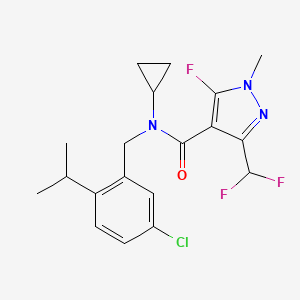
Isoflucypram
Isoflucypram is a tertiary carboxamide resulting from the formal condensation of the carboxy group of 3-(difluoromethyl)-5-fluoro-1-methyl-1H-pyrazole-4-carboxylic acid with the amino group of N-[5-chloro-2-(propan-2-yl)benzyl]cyclopropanamine. It is a broad spectrum fungicide developed by Bayer that exhibits high efficacy against the major fungal diseases of cereal crops (wheat, triticale, rye, barley and oats). It has a role as an EC 1.3.5.1 [succinate dehydrogenase (quinone)] inhibitor and an antifungal agrochemical. It is a tertiary carboxamide, a member of pyrazoles, an organofluorine pesticide, an alkylbenzene, a tertiary amino compound, a member of cyclopropanes and a member of monochlorobenzenes. — ChEBI
- Nom IUPAC
- N-[(5-chloro-2-propan-2-ylphenyl)methyl]-N-cyclopropyl-3-(difluoromethyl)-5-fluoro-1-methylpyrazole-4-carboxamide
- Formule moléculaire
- C19H21ClF3N3O
- Masse moléculaire
- 399.8 g/mol
- Masse exacte
- 399.1325245 Da
- XLogP3
- 4,6
- Surface polaire topologique
- 38,1 Ų
- Donneurs de liaisons hydrogène
- 0
- Accepteurs de liaisons hydrogène
- 5
- Unités covalentes
- 1
- Stéréocentres définis
- 0
Également connu sous le nom de
10 autres noms signalés
Identifiants de bases de données externes
- ChEBI:CHEBI:228225
- EPA DTXSID:DTXSID301023707
Preuves issues de bases de données scientifiques complémentaires
NIH PubChem PUG-View
Attributed physical-property, hazard, environmental and use annotations.
- Signal: Warning Source: Regulation (EC) No 1272/2008 of the European Parliament and of the Council
- GHS Hazard Statements: H317: May cause an allergic skin reaction [Warning Sensitization, Skin]; H332: Harmful if inhaled [Warning Acute toxicity, inhalation]; H361f: Suspected of damaging fertility [Warning Reproductive toxicity]; H400: Very toxic to aquatic life [Warning Hazardous to the aquatic environment, acute hazard]; H410: Very toxic to aquatic life with long lasting effects [Warning Hazardous to the aquatic environment, long-term hazard] Source: Regulation (EC) No 1272/2008 of the European Parliament and of the Council
- Precautionary Statement Codes: P203, P261, P271, P272, P273, P280, P302+P352, P304+P340, P317, P318, P321, P333+P317, P362+P364, P391, P405, and P501 (click each P-code to see the statement) Source: Regulation (EC) No 1272/2008 of the European Parliament and of the Council
- Signal: Warning Source: European Chemicals Agency (ECHA)
- GHS Hazard Statements: H317 (100%): May cause an allergic skin reaction [Warning Sensitization, Skin]; H332 (100%): Harmful if inhaled [Warning Acute toxicity, inhalation]; H361f (64.4%): Suspected of damaging fertility [Warning Reproductive toxicity]; H373 (62.2%): May causes damage to organs through prolonged or repeated exposure [Warning Specific target organ toxicity, repeated exposure]; H400 (100%): Very toxic to aquatic life [Warning Hazardous to the aquatic environment, acute hazard]; H410 (100%): Very toxic to aquatic life with long lasting effects [Warning Hazardous to the aquatic environment, long-term hazard] Source: European Chemicals Agency (ECHA)
- Precautionary Statement Codes: P203, P260, P261, P271, P272, P273, P280, P302+P352, P304+P340, P317, P318, P319, P321, P333+P317, P362+P364, P391, P405, and P501 (click each P-code to see the statement) Source: European Chemicals Agency (ECHA)
- ECHA C&L Notifications Summary: Aggregated GHS information provided per 45 reports by companies from 3 notifications to the ECHA C&L Inventory. Each notification may be associated with multiple companies.; Information may vary between notifications depending on impurities, additives, and other factors. The percentage value in parenthesis indicates the notified classification ratio from companies that provide hazard codes. Only hazard codes with percentage values above 10% are shown. For more detailed information, please visit ECHA C&L website. Source: European Chemicals Agency (ECHA)
Mis en correspondance par: Existing checksum-valid CAS to unique PubChem CID match. Récupéré le: 2026-08-31. Ouvrir la fiche source
Les classifications scientifiques et les annotations de danger apportent du contexte et ne remplacent pas la décision réglementaire propre au marché indiquée ci-dessus.
Couverture des sources complémentaires et état des correspondances
| Source | Résultat | Vérifié |
|---|---|---|
| NIH PubChem PUG-View | Correspondance exacte | 2026-08-31 |
Une absence de correspondance enregistrée est une preuve utile que la source a été vérifiée ; ce n’est pas l’affirmation que la substance n’existe pas ailleurs.
Récupéré depuis NIH PubChem le 2026-09-02 par correspondance CAS à somme de contrôle valide. Les propriétés chimiques ne remplacent pas la décision réglementaire de cette page.
Comment le CAS 1255734-28-1 est utilisé sur ce site
Le CAS 1255734-28-1 est l’identifiant du Chemical Abstracts Service utilisé pour rattacher cette page à une substance précise. Dans le jeu de données actuel, 1 fiche d’annexe de l’UE partage cet identifiant, ce qui vous aide à vérifier si la même substance apparaît dans un seul contexte réglementaire ou dans plusieurs.
Utilisez cette page lorsqu’une spécification fournisseur, une FDS ou un dossier de matière première vous donne le CAS 1255734-28-1 et que vous devez voir au même endroit toutes les fiches liées des annexes II à VI. Les cartes d’entrées ci-dessus sont le moyen le plus rapide d’accéder aux limites de concentration, aux avertissements, à l’annexe concernée et aux conditions par type de produit.
Questions fréquentes
Outils et étapes suivantes
Vérifiez votre formule
Analysez une liste INCI complète, puis utilisez le CAS 1255734-28-1 pour recouper les documents fournisseurs relatifs aux substances identifiées.
Vérificateur INCIParcourir les annexes
Parcourez toutes les annexes du règlement de l’UE sur les cosmétiques par catégorie.
Toutes les annexesRechercher par nom
Recherchez les noms INCI, alias ou identifiants associés qui figurent à côté du CAS 1255734-28-1 dans votre documentation.
Rechercher