
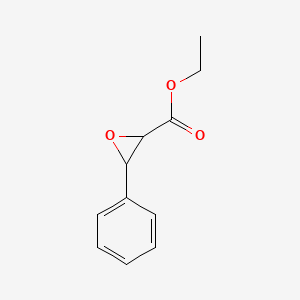
Ethyl 3-phenylglycidate
Ethyl-3-phenylglycidate appears as clear pale yellow or yellow liquid. (NTP, 1992) — CAMEO Chemicals
- Nom IUPAC
- ethyl 3-phenyloxirane-2-carboxylate
- Formule moléculaire
- C11H12O3
- Masse moléculaire
- 192.21 g/mol
- Masse exacte
- 192.078644241 Da
- XLogP3
- 1,7
- Surface polaire topologique
- 38,8 Ų
- Donneurs de liaisons hydrogène
- 0
- Accepteurs de liaisons hydrogène
- 3
- Unités covalentes
- 1
- Stéréocentres définis
- 0
Également connu sous le nom de
16 autres noms signalés
Identifiants de bases de données externes
- ChEBI:CHEBI:173922
- ChEMBL:CHEMBL1369819
- EPA DTXSID:DTXSID8025886
- PubMed:20932822
- PubMed:14969419
Preuves issues de bases de données scientifiques complémentaires
NIH PubChem PUG-View
Attributed physical-property, hazard, environmental and use annotations.
- Boiling Point: 509 to 518 °F at 760 mmHg (NTP, 1992) Source: CAMEO Chemicals
- Boiling Point: 96 °C (0.5 mm Hg) Source: Joint FAO/WHO Expert Committee on Food Additives (JECFA)
- Color/Form: COLORLESS TO PALE-YELLOW LIQUID Source: Hazardous Substances Data Bank (HSDB)
- Density: 1.122 (NTP, 1992) - Denser than water; will sink Source: CAMEO Chemicals
- Density: 1.120-1.128 @ 25/25 °C Source: Hazardous Substances Data Bank (HSDB)
- Density: 1.120-1.125 Source: Joint FAO/WHO Expert Committee on Food Additives (JECFA)
- Flash Point: greater than 200 °F (NTP, 1992) Source: CAMEO Chemicals
- Flash Point: 100 °C Source: Hazardous Substances Data Bank (HSDB)
- Melting Point: less than 32 °F (NTP, 1992) Source: CAMEO Chemicals
- Odor: STRONG FRUITY ODOR SUGGESTIVE OF STRAWBERRY Source: Hazardous Substances Data Bank (HSDB)
- Physical Description: Ethyl-3-phenylglycidate appears as clear pale yellow or yellow liquid. (NTP, 1992) Source: CAMEO Chemicals
- Physical Description: Colorless to pale yellow liquid with a strong fruity odor like strawberries; [HSDB] Source: Haz-Map, Information on Hazardous Chemicals and Occupational Diseases
- Physical Description: Clear, Colourless to pale yellow liquid; Strong fruity aroma suggestive of strawberry Source: Joint FAO/WHO Expert Committee on Food Additives (JECFA)
- Refractive Index: INDEX OF REFRACTION: 1.5190-1.5230 (1.516-1.521) AT 20 °C Source: Hazardous Substances Data Bank (HSDB)
- Refractive Index: 1.516-1.521 Source: Joint FAO/WHO Expert Committee on Food Additives (JECFA)
- Solubility: Slightly soluble (1-10 mg/ml) (NTP, 1992) Source: CAMEO Chemicals
- Solubility: 1:6 IN 70% ALCOHOL; 1:1 IN 80% ALCOHOL Source: Hazardous Substances Data Bank (HSDB)
- Solubility: Insoluble in water; Soluble in ether, oils Source: Joint FAO/WHO Expert Committee on Food Additives (JECFA)
- Solubility: Soluble (in ethanol) Source: Joint FAO/WHO Expert Committee on Food Additives (JECFA)
- pH: ACID VALUE: NOT MORE THAN 1.0 Source: Hazardous Substances Data Bank (HSDB)
- First Aid: EYES: First check the victim for contact lenses and remove if present. Flush victim's eyes with water or normal saline solution for 20 to 30 minutes while simultaneously calling a hospital or poison control center. Do not put any ointments, oils, or medication in the victim's eyes without specific instructions from a physician. IMMEDIATELY transport the victim after flushing eyes to a hospital even if no symptoms (such as redness or irritation) develop.; SKIN: IMMEDIATELY flood affected skin with water while removing and isolating all contaminated clothing. Gently wash all affected skin areas thoroughly with soap and water. If symptoms such as redness or irritation develop, IMMEDIATELY call a physician and be prepared to transport the victim to a hospital for treatment.; INHALATION: IMMEDIATELY leave the contaminated area; take deep breaths of fresh air. If symptoms (such as wheezing, coughing, shortness of breath, or burning in the mouth, throat, or chest) develop, call a physician and be prepared to transport the victim to a hospital. Provide proper respiratory protection to rescuers entering an unknown atmosphere. Whenever possible, Self-Contained Breathing Apparatus (SCBA) shou Source: CAMEO Chemicals
- Signal: Warning Source: European Chemicals Agency (ECHA)
- GHS Hazard Statements: H317 (99.6%): May cause an allergic skin reaction [Warning Sensitization, Skin] Source: European Chemicals Agency (ECHA)
- Precautionary Statement Codes: P261, P272, P280, P302+P352, P321, P333+P317, P362+P364, and P501 (click each P-code to see the statement) Source: European Chemicals Agency (ECHA)
- ECHA C&L Notifications Summary: Aggregated GHS information provided per 1593 reports by companies from 6 notifications to the ECHA C&L Inventory.; Information may vary between notifications depending on impurities, additives, and other factors. The percentage value in parenthesis indicates the notified classification ratio from companies that provide hazard codes. Only hazard codes with percentage values above 10% are shown. For more detailed information, please visit ECHA C&L website. Source: European Chemicals Agency (ECHA)
- Sources/Uses: Used as a flavor ingredient and a fragrance in soaps, detergents, creams, lotions, and perfumes; [HSDB] Source: Haz-Map, Information on Hazardous Chemicals and Occupational Diseases
- Uses: AS FRAGRANCE IN SOAPS, DETERGENTS, CREAMS, LOTIONS, PERFUME Source: Hazardous Substances Data Bank (HSDB)
- Uses: IN BERRY & CHERRY FOOD FLAVORINGS Source: Hazardous Substances Data Bank (HSDB)
- Uses: FLAVORING AGENT IN GELATINS, PUDDINGS & BAKED GOODS Source: Hazardous Substances Data Bank (HSDB)
- Uses: FLAVORING AGENT IN CANDY, ICE CREAM & BEVERAGES Source: Hazardous Substances Data Bank (HSDB)
Mis en correspondance par: Existing checksum-valid CAS to unique PubChem CID match. Récupéré le: 2026-08-31. Ouvrir la fiche source
Les classifications scientifiques et les annotations de danger apportent du contexte et ne remplacent pas la décision réglementaire propre au marché indiquée ci-dessus.
Couverture des sources complémentaires et état des correspondances
| Source | Résultat | Vérifié |
|---|---|---|
| NIH PubChem PUG-View | Correspondance exacte | 2026-08-31 |
Une absence de correspondance enregistrée est une preuve utile que la source a été vérifiée ; ce n’est pas l’affirmation que la substance n’existe pas ailleurs.
Récupéré depuis NIH PubChem le 2026-08-31 par correspondance CAS à somme de contrôle valide. Les propriétés chimiques ne remplacent pas la décision réglementaire de cette page.