
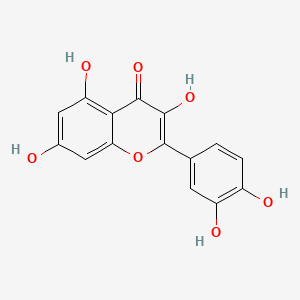
Quercetin
Quercetin is a pentahydroxyflavone having the five hydroxy groups placed at the 3-, 3'-, 4'-, 5- and 7-positions. It is one of the most abundant flavonoids in edible vegetables, fruit and wine. It has a role as a geroprotector, an antioxidant, an antibacterial agent, an antineoplastic agent, a protein kinase inhibitor, a chelator, a radical scavenger, an Aurora kinase inhibitor, a plant metabolite, a phytoestrogen and an EC 1.10.99.2 [ribosyldihydronicotinamide dehydrogenase (quinone)] inhibitor. It is a pentahydroxyflavone and a 7-hydroxyflavonol. It is a conjugate acid of a quercetin-7-olate. — ChEBI
- Nom IUPAC
- 2-(3,4-dihydroxyphenyl)-3,5,7-trihydroxychromen-4-one
- Formule moléculaire
- C15H10O7
- Masse moléculaire
- 302.23 g/mol
- Masse exacte
- 302.04265265 Da
- XLogP3
- 1,5
- Surface polaire topologique
- 127,0 Ų
- Donneurs de liaisons hydrogène
- 5
- Accepteurs de liaisons hydrogène
- 7
- Unités covalentes
- 1
- Stéréocentres définis
- 0
Également connu sous le nom de
16 autres noms signalés
Identifiants de bases de données externes
Preuves issues de bases de données scientifiques complémentaires
NIH PubChem PUG-View
Attributed physical-property, hazard, environmental and use annotations.
- Boiling Point: Sublimes (NTP, 1992) Source: CAMEO Chemicals
- Boiling Point: Sublimes Source: Hazardous Substances Data Bank (HSDB)
- Color/Form: Yellow needles (dilute alcohol, +2 water) Source: Hazardous Substances Data Bank (HSDB)
- Melting Point: 601 to 603 °F (NTP, 1992) Source: CAMEO Chemicals
- Melting Point: 316.5 °C Source: DrugBank
- Melting Point: 316.5 °C Source: Hazardous Substances Data Bank (HSDB)
- Melting Point: 316 - 318 °C Source: Human Metabolome Database (HMDB)
- Physical Description: Quercetin appears as yellow needles or yellow powder. Converts to anhydrous form at 203-207 °F. Alcoholic solutions taste very bitter. (NTP, 1992) Source: CAMEO Chemicals
- Physical Description: Solid Source: Human Metabolome Database (HMDB)
- Solubility: less than 1 mg/mL at 70 °F (NTP, 1992) Source: CAMEO Chemicals
- Solubility: 60 mg/L (at 16 °C) Source: DrugBank
- Solubility: Very soluble in ether, methanol; soluble in ethanol, acetone, pyridine, acetic acid Source: Hazardous Substances Data Bank (HSDB)
- Solubility: Soluble in alcohol and glacial acetic acid; insoluble in water Source: Hazardous Substances Data Bank (HSDB)
- Solubility: In water, 60 mg/L at 16 °C Source: Hazardous Substances Data Bank (HSDB)
- Solubility: 0.06 mg/mL at 16 °C Source: Human Metabolome Database (HMDB)
- IARC Carcinogenic Agent: Quercetin Source: International Agency for Research on Cancer (IARC)
- IARC Carcinogenic Classes: Group 3: Not classifiable as to its carcinogenicity to humans Source: International Agency for Research on Cancer (IARC)
- IARC Monographs: Volume Sup 7: Overall Evaluations of Carcinogenicity: An Updating of IARC Monographs Volumes 1 to 42, 1987; 440 pages; ISBN 92-832-1411-0 (out of print); Volume 73: (1999) Some Chemicals that Cause Tumours of the Kidney or Urinary Bladder in Rodents and Some Other Substances Source: International Agency for Research on Cancer (IARC)
- Publication Year: 1999 Source: International Agency for Research on Cancer (IARC)
- Evaluation Year: 1998 Source: International Agency for Research on Cancer (IARC)
- Substance: Quercetin Source: NTP Technical Reports
- NTP Technical Report: TR-409: Toxicology and Carcinogenesis Studies of Quercetin (CASRN 117-39-5) in F344 Rats (Feed Studies) (1992 ) Source: NTP Technical Reports
- Peer Review Date: 03/12/91 Source: NTP Technical Reports
- Conclusion for Male Rat: Some Evidence Source: NTP Technical Reports
- Conclusion for Female Rat: No Evidence Source: NTP Technical Reports
- Conclusion for Male Mice: Chemical Not Tested in Species/Sex Source: NTP Technical Reports
- Conclusion for Female Mice: Chemical Not Tested in Species/Sex Source: NTP Technical Reports
- First Aid: EYES: First check the victim for contact lenses and remove if present. Flush victim's eyes with water or normal saline solution for 20 to 30 minutes while simultaneously calling a hospital or poison control center. Do not put any ointments, oils, or medication in the victim's eyes without specific instructions from a physician. IMMEDIATELY transport the victim after flushing eyes to a hospital even if no symptoms (such as redness or irritation) develop.; SKIN: IMMEDIATELY flood affected skin with water while removing and isolating all contaminated clothing. Gently wash all affected skin areas thoroughly with soap and water. If symptoms such as redness or irritation develop, IMMEDIATELY call a physician and be prepared to transport the victim to a hospital for treatment.; INHALATION: IMMEDIATELY leave the contaminated area; take deep breaths of fresh air. IMMEDIATELY call a physician and be prepared to transport the victim to a hospital even if no symptoms (such as wheezing, coughing, shortness of breath, or burning in the mouth, throat, or chest) develop. Provide proper respiratory protection to rescuers entering an unknown atmosphere. Whenever possible, Self-Contained Breathing Ap Source: CAMEO Chemicals
- Note: This chemical does not meet GHS hazard criteria for 1.3% (3 of 224) of reports. Source: European Chemicals Agency (ECHA)
- Signal: Danger Source: European Chemicals Agency (ECHA)
- GHS Hazard Statements: H301 (97.3%): Toxic if swallowed [Danger Acute toxicity, oral] Source: European Chemicals Agency (ECHA)
- Precautionary Statement Codes: P264, P270, P301+P316, P321, P330, P405, and P501 (click each P-code to see the statement) Source: European Chemicals Agency (ECHA)
- ECHA C&L Notifications Summary: Aggregated GHS information provided per 224 reports by companies from 3 notifications to the ECHA C&L Inventory.; Reported as not meeting GHS hazard criteria per 3 of 224 reports by companies.; There are 2 notifications provided by 221 of 224 reports by companies with hazard statement code(s).; Information may vary between notifications depending on impurities, additives, and other factors. The percentage value in parenthesis indicates the notified classification ratio from companies that provide hazard codes. Only hazard codes with percentage values above 10% are shown. For more detailed information, please visit ECHA C&L website. Source: European Chemicals Agency (ECHA)
- Toxicity Summary: Quercetin is a specific quinone reductase 2 (QR2) inhibitor, an enzyme (along with the human QR1 homolog) which catalyzes metabolism of toxic quinolines. Inhibition of QR2 in plasmodium may potentially cause lethal oxidative stress. The inhibition of antioxidant activity in plasmodium may contribute to killing the malaria causing parasites. Source: Toxin and Toxin Target Database (T3DB)
- Environmental Bioconcentration: An estimated BCF of 61 was calculated in fish for quercetin(SRC), using a water solubility of 60 mg/L(1) and a regression-derived equation(2). According to a classification scheme(3), this BCF suggests the potential for bioconcentration in aquatic organisms is moderate(SRC), provided the compound is not metabolized by the organism(SRC). Source: Hazardous Substances Data Bank (HSDB)
- Environmental Fate: TERRESTRIAL FATE: Based on a classification scheme(1), an estimated Koc value of 460(SRC), determined from a water solubility of 60 mg/L(2) and a regression-derived equation(3), indicates that quercetin is expected to have moderate mobility in soil(SRC). The estimated pKas of quercetin are 7.17, 8.26, 10.13, 12,30, and 13.11(4), indicating that this compound will partially exist in the anion form in the environment at neutral pH and anions generally do not adsorb more strongly to soils containing organic carbon and clay than their neutral counterparts(5). Volatilization of quercetin from moist soil surfaces is not expected to be an important fate process because it is an anion and anions do not volatilize(SRC). Quercetin is not expected to volatilize from dry soil surfaces(SRC) based upon an estimated vapor pressure of 2.8X10⁻¹⁴ mm Hg(SRC), determined from a fragment constant method(6). Quercetin's rapid degradation in soil(7) suggests that biodegradation may be an important environmental fate process(SRC). Source: Hazardous Substances Data Bank (HSDB)
- Environmental Fate: AQUATIC FATE: Based on a classification scheme(1), an estimated Koc value of 460(SRC), determined from a water solubility of 60 mg/L(2) and a regression-derived equation(3), indicates that quercetin is not expected to adsorb to suspended solids and sediment(SRC). The estimated pKas of 7.17, 8.26, 10.13, 12,30, and 13.11(4) indicate quercetin will exist partially in the anion form at pH values of 5 to 9 and therefore volatilization from water surfaces is not expected to be an important fate process(5). According to a classification scheme(6), an estimated BCF of 61(SRC), from its water solubility(2) and a regression-derived equation(3), suggests the potential for bioconcentration in aquatic organisms is moderate(SRC). Quercetin's rapid degradation in soil(7) suggests that biodegradation may be an important environmental fate process in water(SRC). Source: Hazardous Substances Data Bank (HSDB)
- Environmental Fate: ATMOSPHERIC FATE: According to a model of gas/particle partitioning of semivolatile organic compounds in the atmosphere(1), quercetin, which has an estimated vapor pressure of 2.8X10⁻¹⁴ mm Hg at 25 °C(SRC), determined from a fragment constant method(2), is expected to exist solely in the particulate phase in the ambient atmosphere. Particulate-phase quercetin may be removed from the air by wet or dry deposition(SRC). Quercetin contains chromophores that absorb at wavelengths >290 nm(4) and therefore may be susceptible to direct photolysis by sunlight(SRC). Source: Hazardous Substances Data Bank (HSDB)
- Uses: Dietary supplement Source: Hazardous Substances Data Bank (HSDB)
- Uses: Quercetin has been used in ... dyes and as a veterinary drug. Source: Hazardous Substances Data Bank (HSDB)
- Uses: Medicine, reported formation of epoxy resins on mixing with epichlorohydrin Source: Hazardous Substances Data Bank (HSDB)
- Uses: Free-radical inhibiting antioxidant useful in cosmetics intended to protect the product from oxidative damage from UV radiation or singlet oxygen formation ... Use levels are normally about 0.1% and rarely exceed 0.2%. Source: Hazardous Substances Data Bank (HSDB)
- Uses: For more Uses (Complete) data for QUERCETIN (8 total), please visit the HSDB record page. Source: Hazardous Substances Data Bank (HSDB)
Mis en correspondance par: Existing checksum-valid CAS to unique PubChem CID match. Récupéré le: 2026-08-31. Ouvrir la fiche source
Les classifications scientifiques et les annotations de danger apportent du contexte et ne remplacent pas la décision réglementaire propre au marché indiquée ci-dessus.
Couverture des sources complémentaires et état des correspondances
| Source | Résultat | Vérifié |
|---|---|---|
| NIH PubChem PUG-View | Correspondance exacte | 2026-08-31 |
Une absence de correspondance enregistrée est une preuve utile que la source a été vérifiée ; ce n’est pas l’affirmation que la substance n’existe pas ailleurs.
Récupéré depuis NIH PubChem le 2026-08-31 par correspondance CAS à somme de contrôle valide. Les propriétés chimiques ne remplacent pas la décision réglementaire de cette page.