
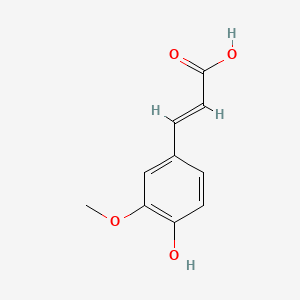
Ferulic Acid
Ferulic acid is a member of the class of ferulic acids that is cinnamic acid substituted by a methoxy and a hydroxy group at positions 3 and 4 of the phenyl ring. It has a role as an antioxidant, a neuroprotective agent and a plant metabolite. — ChEBI
- Nom IUPAC
- (E)-3-(4-hydroxy-3-methoxyphenyl)prop-2-enoic acid
- Formule moléculaire
- C10H10O4
- Masse moléculaire
- 194.18 g/mol
- Masse exacte
- 194.05790880 Da
- XLogP3
- 1,5
- Surface polaire topologique
- 66,8 Ų
- Donneurs de liaisons hydrogène
- 2
- Accepteurs de liaisons hydrogène
- 4
- Unités covalentes
- 1
- Stéréocentres définis
- 0
Également connu sous le nom de
16 autres noms signalés
Identifiants de bases de données externes
- ChEBI:CHEBI:17620
- ChEBI:CHEBI:193350
- ChEMBL:CHEMBL32749
- EPA DTXSID:DTXSID70892035
- PubMed:24358168
- PubMed:23800587
- PubMed:21763500
- PubMed:18952420
- PubMed:15229801
- PubMed:12076751
- PubMed:9561563
Preuves issues de bases de données scientifiques complémentaires
NIH PubChem PUG-View
Attributed physical-property, hazard, environmental and use annotations.
- Dissociation Constants: pKa = 4.58 Source: Hazardous Substances Data Bank (HSDB)
- LogP: log Kow = 1.51 Source: Hazardous Substances Data Bank (HSDB)
- LogP: 1.51 Source: Human Metabolome Database (HMDB)
- Melting Point: 168 - 171 °C Source: Human Metabolome Database (HMDB)
- Physical Description: cis-Form is a yellow liquid; trans-Form is a solid; [Merck Index] trans-Isomer: Tan powder; [Alfa Aesar MSDS] Source: Haz-Map, Information on Hazardous Chemicals and Occupational Diseases
- Physical Description: Tan powder; [Alfa Aesar MSDS] Source: Haz-Map, Information on Hazardous Chemicals and Occupational Diseases
- Physical Description: Solid Source: Human Metabolome Database (HMDB)
- Vapor Pressure: 0.00000269 [mmHg] Source: Haz-Map, Information on Hazardous Chemicals and Occupational Diseases
- Note: This chemical does not meet GHS hazard criteria for 2.4% (8 of 329) of reports. Source: European Chemicals Agency (ECHA)
- Signal: Warning Source: European Chemicals Agency (ECHA)
- GHS Hazard Statements: H315 (97.6%): Causes skin irritation [Warning Skin corrosion/irritation]; H319 (97.6%): Causes serious eye irritation [Warning Serious eye damage/eye irritation]; H335 (97.6%): May cause respiratory irritation [Warning Specific target organ toxicity, single exposure; Respiratory tract irritation] Source: European Chemicals Agency (ECHA)
- Precautionary Statement Codes: P261, P264, P264+P265, P271, P280, P302+P352, P304+P340, P305+P351+P338, P319, P321, P332+P317, P337+P317, P362+P364, P403+P233, P405, and P501 (click each P-code to see the statement) Source: European Chemicals Agency (ECHA)
- ECHA C&L Notifications Summary: Aggregated GHS information provided per 329 reports by companies from 8 notifications to the ECHA C&L Inventory. Each notification may be associated with multiple companies.; Reported as not meeting GHS hazard criteria per 8 of 329 reports by companies.; There are 7 notifications provided by 321 of 329 reports by companies with hazard statement code(s).; Information may vary between notifications depending on impurities, additives, and other factors. The percentage value in parenthesis indicates the notified classification ratio from companies that provide hazard codes. Only hazard codes with percentage values above 10% are shown. For more detailed information, please visit ECHA C&L website. Source: European Chemicals Agency (ECHA)
- Note: This chemical does not meet GHS hazard criteria for 1% (1 of 105) of reports. Source: European Chemicals Agency (ECHA)
- GHS Hazard Statements: H315 (99%): Causes skin irritation [Warning Skin corrosion/irritation]; H319 (99%): Causes serious eye irritation [Warning Serious eye damage/eye irritation]; H335 (98.1%): May cause respiratory irritation [Warning Specific target organ toxicity, single exposure; Respiratory tract irritation] Source: European Chemicals Agency (ECHA)
- ECHA C&L Notifications Summary: Aggregated GHS information provided per 105 reports by companies from 10 notifications to the ECHA C&L Inventory. Each notification may be associated with multiple companies.; Reported as not meeting GHS hazard criteria per 1 of 105 reports by companies.; There are 9 notifications provided by 104 of 105 reports by companies with hazard statement code(s).; Information may vary between notifications depending on impurities, additives, and other factors. The percentage value in parenthesis indicates the notified classification ratio from companies that provide hazard codes. Only hazard codes with percentage values above 10% are shown. For more detailed information, please visit ECHA C&L website. Source: European Chemicals Agency (ECHA)
- GHS Hazard Statements: H317 (100%): May cause an allergic skin reaction [Warning Sensitization, Skin] Source: European Chemicals Agency (ECHA)
- Precautionary Statement Codes: P261, P272, P280, P302+P352, P321, P333+P317, P362+P364, and P501 (click each P-code to see the statement) Source: European Chemicals Agency (ECHA)
- ECHA C&L Notifications Summary: The GHS information provided by 1 company from 1 notification to the ECHA C&L Inventory. Source: European Chemicals Agency (ECHA)
- Environmental Bioconcentration: An estimated BCF of 3.2 was calculated in fish for ferulic acid, using a measured log Kow of 1.51 (1) and a regression-derived equation (2). According to a classification scheme(3), this BCF suggests the potential for bioconcentration in aquatic organism is low(SRC), provided the compound is not metabolized by the organism(SRC). Source: Hazardous Substances Data Bank (HSDB)
- Environmental Fate: TERRESTRIAL FATE: Based on a classification scheme(1), an estimated Koc value of 57(SRC), determined from a log Kow of 1.51(2) and a regression-derived equation(3), indicates that ferulic acid is expected to have high mobility in soil(SRC). The pKa of ferulic acid is 4.58(4), indicating that this compound will almost entirely exist in the anion form. In the environment, anions generally do not adsorb more strongly to soils containing organic carbon and clay than their neutral counterparts(5). Volatilization of ferulic acid from moist soil surfaces is not expected to be an important fate process(SRC) given the anionic nature of ferulic acid in the environment. Ferulic acid is not expected to volatilize from dry soil surfaces(SRC) based upon an estimated vapor pressure of 2.7X10⁻⁶ mm Hg(SRC), determined from a fragment constant method(6). Under neutral and acidic conditions in soil, ferulic acid is expected to undergo rapid aerobic biodegradation(7)(8). Under alkaline conditions in soil, ferulic acid is not expected to undergo rapid aerobic biodegradation(8). Source: Hazardous Substances Data Bank (HSDB)
- Environmental Fate: AQUATIC FATE: Based on a classification scheme(1), an estimated Koc value of 57(SRC), determined from a log Kow of 1.51(2) and a regression-derived equation(3), indicates that ferulic acid is not expected to adsorb to suspended solids and sediment(SRC). A pKa of 4.58(4) indicates ferulic acid will exist almost entirely in the anion form at pH values of 5 to 9, and therefore volatilization from water surfaces/moist soil is not expected to be an important fate process(5). According to a classification scheme(6), an estimated BCF of 3.2(SRC), from its log Kow of 1.51(2) and a regression-derived equation(7), suggests the potential for bioconcentration in aquatic organisms is low(SRC). Ferulic acid is expected to biodegrade rapidly in water under anaerobic conditions(8). Source: Hazardous Substances Data Bank (HSDB)
- Environmental Fate: ATMOSPHERIC FATE: According to a model of gas/particle partitioning of semivolatile organic compounds in the atmosphere(1), ferulic acid, which has a an estimated vapor pressure of 2.7X10⁻⁶ mm Hg at 25 °C(SRC), determined from a fragment constant method(2), will exist in both the vapor and particulate phases. Vapor-phase ferulic acid is degraded in the atmosphere by reaction with photochemically-produced hydroxyl radicals(SRC); the half-life for this reaction in air is estimated to be 8 hours(SRC), calculated from its rate constant of 4.8X10⁻¹¹ cu cm/molecule-sec at 25 °C(SRC), derived using a structure estimation method(3). Particulate-phase ferulic acid may be removed from the air by wet or dry deposition(SRC). Ferulic acid contains a chromophore that absorbs light at wavelengths >290 nm(4) and therefore may be susceptible to direct photolysis by sunlight(SRC). Source: Hazardous Substances Data Bank (HSDB)
- Sources/Uses: Found in small amounts in many plants; Used as a food preservative; [Merck Index] Source: Haz-Map, Information on Hazardous Chemicals and Occupational Diseases
- Sources/Uses: Widely distributed in plants; [Alfa Aesar MSDS] Source: Haz-Map, Information on Hazardous Chemicals and Occupational Diseases
- Uses: Food preservative Source: Hazardous Substances Data Bank (HSDB)
- Uses: /Ferulic acid was one of several compounds identified in/ ... a survey of 624 commercially available supplements targeted towards bodybuilding athletes... Source: Hazardous Substances Data Bank (HSDB)
- Uses: Synthetic Polymer MALDI Matrix Compounds Source: NIST Synthetic Polymer MALDI Recipes Database
Mis en correspondance par: Existing checksum-valid CAS to unique PubChem CID match. Récupéré le: 2026-08-31. Ouvrir la fiche source
Les classifications scientifiques et les annotations de danger apportent du contexte et ne remplacent pas la décision réglementaire propre au marché indiquée ci-dessus.
Couverture des sources complémentaires et état des correspondances
| Source | Résultat | Vérifié |
|---|---|---|
| NIH PubChem PUG-View | Correspondance exacte | 2026-08-31 |
Une absence de correspondance enregistrée est une preuve utile que la source a été vérifiée ; ce n’est pas l’affirmation que la substance n’existe pas ailleurs.
Récupéré depuis NIH PubChem le 2026-09-02 par correspondance CAS à somme de contrôle valide. Les propriétés chimiques ne remplacent pas la décision réglementaire de cette page.