
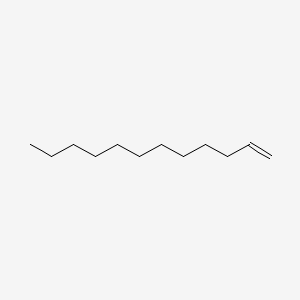
1-Dodecene
1-dodecene is an alkene that is dodecane containing one double bond at position 1. It is an intermediate used in the production of lubricants and surfactants. It has a role as a mammalian metabolite and a human metabolite. It is a volatile organic compound and a dodecene. — ChEBI
- Nom IUPAC
- dodec-1-ene
- Formule moléculaire
- C12H24
- Masse moléculaire
- 168.32 g/mol
- Masse exacte
- 168.187800766 Da
- XLogP3
- 6,8
- Surface polaire topologique
- 0,0 Ų
- Donneurs de liaisons hydrogène
- 0
- Accepteurs de liaisons hydrogène
- 0
- Unités covalentes
- 1
- Stéréocentres définis
- 0
Également connu sous le nom de
16 autres noms signalés
Identifiants de bases de données externes
- ChEBI:CHEBI:89713
- ChEMBL:CHEMBL1872885
- EPA DTXSID:DTXSID5026914
- PubMed:23067212
- PubMed:23023783
- PubMed:22980598
- PubMed:22955258
- PubMed:22941694
- PubMed:22851082
- PubMed:22844068
- PubMed:22826622
- PubMed:22746250
- PubMed:22701470
- PubMed:22666096
- PubMed:22654433
Preuves issues de bases de données scientifiques complémentaires
NIH PubChem PUG-View
Attributed physical-property, hazard, environmental and use annotations.
- Autoignition Temperature: 491 °F (USCG, 1999) Source: CAMEO Chemicals
- Autoignition Temperature: 491 °F (255 °C). Source: Hazardous Substances Data Bank (HSDB)
- Autoignition Temperature: 225 °C Source: ILO-WHO International Chemical Safety Cards (ICSCs)
- Boiling Point: 415 °F at 760 mmHg (USCG, 1999) Source: CAMEO Chemicals
- Boiling Point: 213.8 °C Source: Hazardous Substances Data Bank (HSDB)
- Boiling Point: 214 °C Source: ILO-WHO International Chemical Safety Cards (ICSCs)
- Color/Form: Colorless liquid Source: Hazardous Substances Data Bank (HSDB)
- Color/Form: COLORLESS LIQUID Source: Hazardous Substances Data Bank (HSDB)
- Density: 0.758 at 68 °F (USCG, 1999) - Less dense than water; will float Source: CAMEO Chemicals
- Density: 0.7584 g/cu cm @ 20 °C Source: Hazardous Substances Data Bank (HSDB)
- Density: 0.7584 @ 20 °C/4 °C Source: Hazardous Substances Data Bank (HSDB)
- Density: Relative density (water = 1): 0.8 Source: ILO-WHO International Chemical Safety Cards (ICSCs)
- Flash Point: 212 °F (USCG, 1999) Source: CAMEO Chemicals
- Flash Point: 49 °C Source: Haz-Map, Information on Hazardous Chemicals and Occupational Diseases
- Flash Point: Below 212 °F (below 100 °C) (Closed cup) Source: Hazardous Substances Data Bank (HSDB)
- Flash Point: 77 °C c.c. Source: ILO-WHO International Chemical Safety Cards (ICSCs)
- LogP: 6.1 Source: ILO-WHO International Chemical Safety Cards (ICSCs)
- Melting Point: -31 °F (USCG, 1999) Source: CAMEO Chemicals
- Melting Point: -35.2 °C Source: Hazardous Substances Data Bank (HSDB)
- Melting Point: -35 °C Source: ILO-WHO International Chemical Safety Cards (ICSCs)
- Odor: MILD, PLEASANT Source: Hazardous Substances Data Bank (HSDB)
- Physical Description: 1-dodecene appears as a clear colorless liquid with a mild, pleasnat odor. Insoluble in water and floats on water. Harmful or fatal by ingestion. Inhalation of vapors may irritate and damage lungs. High concentrations may have a narcotic effect. Source: CAMEO Chemicals
- Physical Description: Liquid; CBI Source: EPA Chemical Data Reporting (CDR)
- Physical Description: Colorless liquid with a mild, pleasant odor; [HSDB] Source: Haz-Map, Information on Hazardous Chemicals and Occupational Diseases
- Physical Description: Colorless liquid; [Hawley] Source: Haz-Map, Information on Hazardous Chemicals and Occupational Diseases
- Physical Description: COLOURLESS LIQUID WITH CHARACTERISTIC ODOUR. Source: ILO-WHO International Chemical Safety Cards (ICSCs)
- Refractive Index: Index of refraction: 1.4300 @ 20 °C Source: Hazardous Substances Data Bank (HSDB)
- Solubility: Insoluble in water; sol in ethanol, ethyl ether, and acetone Source: Hazardous Substances Data Bank (HSDB)
- Solubility: Solubility in water: none Source: ILO-WHO International Chemical Safety Cards (ICSCs)
- Vapor Pressure: 0.52 mmHg (USCG, 1999) Source: CAMEO Chemicals
- Vapor Pressure: 0.15 [mmHg] Source: Haz-Map, Information on Hazardous Chemicals and Occupational Diseases
- Vapor Pressure: 0.42 [mmHg] Source: Haz-Map, Information on Hazardous Chemicals and Occupational Diseases
- Vapor Pressure: 0.0159 mm Hg at 25 °C Source: Hazardous Substances Data Bank (HSDB)
- Vapor Pressure: 1 MM HG @ 47.2 °C Source: Hazardous Substances Data Bank (HSDB)
- Vapor Pressure: Vapor pressure, Pa at 25 °C: 2 Source: ILO-WHO International Chemical Safety Cards (ICSCs)
- Viscosity: 1.72 sq mm/s @ 20 °C Source: Hazardous Substances Data Bank (HSDB)
- First Aid: INHALATION: remove victim to fresh air.; INGESTION: do NOT induce vomiting] Do NOT lavage] Give vegetable oil and demulcents; call physician.; EYE CONTACT: flush with water for 15 min.; SKIN CONTACT: wash with soap and water. (USCG, 1999) Source: CAMEO Chemicals
- Note: This chemical does not meet GHS hazard criteria for 1% (13 of 1254) of reports. Source: European Chemicals Agency (ECHA)
- Signal: Danger Source: European Chemicals Agency (ECHA)
- GHS Hazard Statements: H304 (98.9%): May be fatal if swallowed and enters airways [Danger Aspiration hazard]; H315 (18.5%): Causes skin irritation [Warning Skin corrosion/irritation] Source: European Chemicals Agency (ECHA)
- Precautionary Statement Codes: P264, P280, P301+P316, P302+P352, P321, P331, P332+P317, P362+P364, P405, and P501 (click each P-code to see the statement) Source: European Chemicals Agency (ECHA)
- ECHA C&L Notifications Summary: Aggregated GHS information provided per 1254 reports by companies from 15 notifications to the ECHA C&L Inventory. Each notification may be associated with multiple companies.; Reported as not meeting GHS hazard criteria per 13 of 1254 reports by companies.; There are 14 notifications provided by 1241 of 1254 reports by companies with hazard statement code(s).; Information may vary between notifications depending on impurities, additives, and other factors. The percentage value in parenthesis indicates the notified classification ratio from companies that provide hazard codes. Only hazard codes with percentage values above 10% are shown. For more detailed information, please visit ECHA C&L website. Source: European Chemicals Agency (ECHA)
- Note: This chemical does not meet GHS hazard criteria for 22.6% (37 of 164) of reports. Source: European Chemicals Agency (ECHA)
- GHS Hazard Statements: H304 (64%): May be fatal if swallowed and enters airways [Danger Aspiration hazard]; H400 (76.8%): Very toxic to aquatic life [Warning Hazardous to the aquatic environment, acute hazard]; H410 (64%): Very toxic to aquatic life with long lasting effects [Warning Hazardous to the aquatic environment, long-term hazard] Source: European Chemicals Agency (ECHA)
- Precautionary Statement Codes: P273, P301+P316, P331, P391, P405, and P501 (click each P-code to see the statement) Source: European Chemicals Agency (ECHA)
- ECHA C&L Notifications Summary: Aggregated GHS information provided per 164 reports by companies from 4 notifications to the ECHA C&L Inventory. Each notification may be associated with multiple companies.; Reported as not meeting GHS hazard criteria per 37 of 164 reports by companies.; There are 3 notifications provided by 127 of 164 reports by companies with hazard statement code(s).; Information may vary between notifications depending on impurities, additives, and other factors. The percentage value in parenthesis indicates the notified classification ratio from companies that provide hazard codes. Only hazard codes with percentage values above 10% are shown. For more detailed information, please visit ECHA C&L website. Source: European Chemicals Agency (ECHA)
- Signal: Danger Source: NITE-CMC
- GHS Hazard Statements: H227: Combustible liquid [Warning Flammable liquids]; H304: May be fatal if swallowed and enters airways [Danger Aspiration hazard]; H315: Causes skin irritation [Warning Skin corrosion/irritation] Source: NITE-CMC
- Precautionary Statement Codes: P210, P264, P280, P301+P316, P302+P352, P321, P331, P332+P317, P362+P364, P370+P378, P403, P405, and P501 (click each P-code to see the statement) Source: NITE-CMC
- NFPA Health Rating: 0 - Materials that, under emergency conditions, would offer no hazard beyond that of ordinary combustible materials. Source: Hazardous Substances Data Bank (HSDB)
- NFPA Fire Rating: 1 - Materials that must be preheated before ignition can occur. Materials require considerable preheating, under all ambient temperature conditions, before ignition and combustion can occur. Source: Hazardous Substances Data Bank (HSDB)
- NFPA Instability Rating: 0 - Materials that in themselves are normally stable, even under fire conditions. Source: Hazardous Substances Data Bank (HSDB)
- Environmental Bioconcentration: An estimated BCF of 310 was calculated for 1-dodecene(SRC), using an estimated log Kow of 6.10(1,SRC) and a regression-derived equation(2). According to a classification scheme(3), this BCF suggests the potential for bioconcentration in aquatic organisms is high. Source: Hazardous Substances Data Bank (HSDB)
- Environmental Fate: TERRESTRIAL FATE: Based on a classification scheme(1), an estimated Koc value of 5900(SRC), determined from a structure estimation method(2), indicates that 1-dodecene is expected to be immobile in soil. Volatilization of 1-dodecene from moist soil surfaces is expected to be an important fate process(SRC) given an estimated Henry's Law constant of 4.25 atm-cu m/mole(SRC), using a fragment constant estimation method(3). 1-Dodecene is not expected to volatilize from dry soil surfaces(SRC) based upon a vapor pressure of 0.0159 mm Hg(4). However, adsorption to soil is expected to attenuate volatilization. Pure culture studies indicate that 1-dodecene has the potential to biodegrade under aerobic conditions in soil(5-7), but the rate of biodegradation in soil is unknown(SRC). Source: Hazardous Substances Data Bank (HSDB)
- Environmental Fate: AQUATIC FATE: Based on a classification scheme(1), an estimated Koc value of 5900(SRC), determined from an estimation method(2), indicates that 1-dodecene is expected to adsorb to suspended solids and sediment in water(SRC). Volatilization from water surfaces is expected(3) based upon an estimated Henry's Law constant of 4.25 atm-cu m/mole(SRC), developed using a fragment constant estimation method(4). Using this Henry's Law constant and an estimation method(3), volatilization half-lives for a model river and model lake are 1.3 hr and 120 hr, respectively, but these rates are expected to be attenuated by adsorption(SRC). The half-life for volatilization from a model pond, which takes into account adsorptive processes, is 17 months(8,SRC). According to a classification scheme(5), an estimated BCF of 310(SRC), from an estimated log Kow of 6.10(6) and a regression-derived equation(7), suggests the potential for bioconcentration in aquatic organisms is high. Pure culture studies indicate that 1-dodecene has the potential to biodegrade under aerobic conditions in water(9-11), but the rate of biodegradation is unknown. Source: Hazardous Substances Data Bank (HSDB)
- Environmental Fate: ATMOSPHERIC FATE: According to a model of gas/particle partitioning of semivolatile organic compounds in the atmosphere(1), 1-dodecene, which has a vapor pressure of 0.0159 mm Hg at 25 °C(2), is expected to exist solely as a vapor in the ambient atmosphere. Vapor-phase 1-dodecene is degraded in the atmosphere by reaction with photochemically-produced hydroxyl radicals(SRC); the half-life for this reaction in air is estimated to be 9.961 hr(SRC), calculated from its rate constant of 39X10-12 cu cm/molecule-sec at 25 °C(3) determined using a structure estimation method(3). Source: Hazardous Substances Data Bank (HSDB)
- Consumer Uses: Intermediate Source: EPA Chemical Data Reporting (CDR)
- Industry Uses: Processing aids not otherwise specified; Surfactant (surface active agent); Solvent; Other; Lubricating agent; Chain transfer agent; Intermediate; Diluent Source: EPA Chemical Data Reporting (CDR)
- Sources/Uses: Used as a chemical intermediate for n-dodecyl dimethyl amine; [HSDB] Used as a synthetic fatty acid intermediate; as feedstock for alkylbenzene; as an intermediate for amines, amine oxides, and mercaptans; [eChemPortal: SIDSUNEP] Source: Haz-Map, Information on Hazardous Chemicals and Occupational Diseases
- Sources/Uses: Used in flavors, perfumes, medicine, oils, dyes, and resins; [Hawley] Source: Haz-Map, Information on Hazardous Chemicals and Occupational Diseases
- Uses: CHEM INT FOR N-DODECYL DIMETHYL AMINE Source: Hazardous Substances Data Bank (HSDB)
- Uses: Chemical intermediate for n-dodecyl dimethyl amine ... Source: Hazardous Substances Data Bank (HSDB)
Mis en correspondance par: Existing checksum-valid CAS to unique PubChem CID match. Récupéré le: 2026-08-31. Ouvrir la fiche source
Les classifications scientifiques et les annotations de danger apportent du contexte et ne remplacent pas la décision réglementaire propre au marché indiquée ci-dessus.
Couverture des sources complémentaires et état des correspondances
| Source | Résultat | Vérifié |
|---|---|---|
| NIH PubChem PUG-View | Correspondance exacte | 2026-08-31 |
Une absence de correspondance enregistrée est une preuve utile que la source a été vérifiée ; ce n’est pas l’affirmation que la substance n’existe pas ailleurs.
Récupéré depuis NIH PubChem le 2026-08-31 par correspondance CAS à somme de contrôle valide. Les propriétés chimiques ne remplacent pas la décision réglementaire de cette page.