
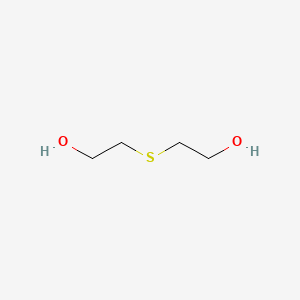
Thiodiglycol
Thiodiglycol is a diol that is pentane-1,5-diol in which the methylene group at position 3 is replaced by a sulfur atom. It has a role as an antioxidant, a metabolite, an antineoplastic agent and a solvent. It is an aliphatic sulfide and a diol. It is functionally related to a mercaptoethanol. — ChEBI
- Nom IUPAC
- 2-(2-hydroxyethylsulfanyl)ethanol
- Formule moléculaire
- C4H10O2S
- Masse moléculaire
- 122.19 g/mol
- Masse exacte
- 122.04015073 Da
- XLogP3
- -0,6
- Surface polaire topologique
- 65,8 Ų
- Donneurs de liaisons hydrogène
- 2
- Accepteurs de liaisons hydrogène
- 3
- Unités covalentes
- 1
- Stéréocentres définis
- 0
Également connu sous le nom de
16 autres noms signalés
Identifiants de bases de données externes
- ChEBI:CHEBI:75184
- ChEMBL:CHEMBL444480
- EPA DTXSID:DTXSID6026878
- PubMed:23045134
- PubMed:22909892
- PubMed:22567876
- PubMed:22460856
- PubMed:22460216
- PubMed:22408587
- PubMed:22042427
- PubMed:22035694
- PubMed:21967861
- PubMed:21833179
- PubMed:21737081
- PubMed:21375739
Preuves issues de bases de données scientifiques complémentaires
NIH PubChem PUG-View
Attributed physical-property, hazard, environmental and use annotations.
- Autoignition Temperature: 568 °F (298 °C) Source: Hazardous Substances Data Bank (HSDB)
- Autoignition Temperature: 260 °C Source: ILO-WHO International Chemical Safety Cards (ICSCs)
- Boiling Point: 282 °C Source: Hazardous Substances Data Bank (HSDB)
- Boiling Point: 282.00 °C. @ 760.00 mm Hg Source: Human Metabolome Database (HMDB)
- Color/Form: Liquid Source: Hazardous Substances Data Bank (HSDB)
- Color/Form: Syrupy, colorless, liquid Source: Hazardous Substances Data Bank (HSDB)
- Density: 1.1793 g/cu cm at 25 °C Source: Hazardous Substances Data Bank (HSDB)
- Density: Bulk density: 9.85 lb/gal Source: Hazardous Substances Data Bank (HSDB)
- Density: Relative density (water = 1): 1.18 Source: ILO-WHO International Chemical Safety Cards (ICSCs)
- Density: 1.1847 @ 20°C Source: PAC Chemical Database, U.S. Department of Energy
- Flash Point: 113 °C (235 °F) - closed cup Source: Hazardous Substances Data Bank (HSDB)
- Flash Point: 320 °F (160 °C) (Closed cup) Source: Hazardous Substances Data Bank (HSDB)
- Flash Point: 160 °C o.c. Source: ILO-WHO International Chemical Safety Cards (ICSCs)
- LogP: log Kow = -0.63 Source: Hazardous Substances Data Bank (HSDB)
- LogP: -0.63 Source: Human Metabolome Database (HMDB)
- LogP: -0.75 Source: ILO-WHO International Chemical Safety Cards (ICSCs)
- Melting Point: -10.2 °C Source: Hazardous Substances Data Bank (HSDB)
- Melting Point: -10.2 °C Source: Human Metabolome Database (HMDB)
- Melting Point: -18 - -10 °C Source: ILO-WHO International Chemical Safety Cards (ICSCs)
- Melting Point: -16 °C Source: PAC Chemical Database, U.S. Department of Energy
- Odor: Characteristic odor Source: Hazardous Substances Data Bank (HSDB)
- Odor: Odor similar to hydrogen sulfide Source: Hazardous Substances Data Bank (HSDB)
- Physical Description: This material has many uses, including as a precursor to the sulfur mustard family of chemical weapons. It is chemically similar to thioglycol and is expected to react in a similar way to this material. See the chemical datasheet for thioglycol for more information. Source: CAMEO Chemicals
- Physical Description: Liquid Source: EPA Chemical Data Reporting (CDR)
- Physical Description: Colorless viscous liquid; [ICSC] Colorless to yellowish liquid with an unpleasant odor; [Reference #1] Colorless or pale yellow liquid with a stench; [Alfa Aesar MSDS] Source: Haz-Map, Information on Hazardous Chemicals and Occupational Diseases
- Physical Description: Liquid Source: Human Metabolome Database (HMDB)
- Physical Description: COLOURLESS VISCOUS LIQUID WITH CHARACTERISTIC ODOUR. Source: ILO-WHO International Chemical Safety Cards (ICSCs)
- Refractive Index: Index of refraction: 1.5211 at 20 °C/D Source: Hazardous Substances Data Bank (HSDB)
- Solubility: In water, miscible at 20 °C Source: Hazardous Substances Data Bank (HSDB)
- Solubility: Miscible with water Source: Hazardous Substances Data Bank (HSDB)
- Solubility: Miscible with ethanol, chloroform, ethyl acetate; soluble in ether; slightly soluble in benzene Source: Hazardous Substances Data Bank (HSDB)
- Solubility: 1000 mg/mL at 20 °C Source: Human Metabolome Database (HMDB)
- Solubility: Solubility in water, g/100ml at 20 °C: 100 Source: ILO-WHO International Chemical Safety Cards (ICSCs)
- Vapor Pressure: 0.00323 [mmHg] Source: Haz-Map, Information on Hazardous Chemicals and Occupational Diseases
- Vapor Pressure: 5.09X10⁻⁴ mm Hg at 25 °C Source: Hazardous Substances Data Bank (HSDB)
- Vapor Pressure: Vapor pressure, Pa at 25 °C: 0.43 Source: ILO-WHO International Chemical Safety Cards (ICSCs)
- Viscosity: 0.652 cP at 20 °C Source: Hazardous Substances Data Bank (HSDB)
- Signal: Warning Source: Regulation (EC) No 1272/2008 of the European Parliament and of the Council
- GHS Hazard Statements: H319: Causes serious eye irritation [Warning Serious eye damage/eye irritation] Source: Regulation (EC) No 1272/2008 of the European Parliament and of the Council
- Precautionary Statement Codes: P264+P265, P280, P305+P351+P338, and P337+P317 (click each P-code to see the statement) Source: Regulation (EC) No 1272/2008 of the European Parliament and of the Council
- Signal: Warning Source: European Chemicals Agency (ECHA)
- GHS Hazard Statements: H319 (100%): Causes serious eye irritation [Warning Serious eye damage/eye irritation] Source: European Chemicals Agency (ECHA)
- Precautionary Statement Codes: P264+P265, P280, P305+P351+P338, and P337+P317 (click each P-code to see the statement) Source: European Chemicals Agency (ECHA)
- ECHA C&L Notifications Summary: Aggregated GHS information provided per 380 reports by companies from 2 notifications to the ECHA C&L Inventory.; Information may vary between notifications depending on impurities, additives, and other factors. The percentage value in parenthesis indicates the notified classification ratio from companies that provide hazard codes. Only hazard codes with percentage values above 10% are shown. For more detailed information, please visit ECHA C&L website. Source: European Chemicals Agency (ECHA)
- Signal: Warning Source: NITE-CMC
- GHS Hazard Statements: H335: May cause respiratory irritation [Warning Specific target organ toxicity, single exposure; Respiratory tract irritation] Source: NITE-CMC
- Precautionary Statement Codes: P261, P271, P304+P340, P319, P403+P233, P405, and P501 (click each P-code to see the statement) Source: NITE-CMC
- Signal: Warning Source: Hazardous Chemical Information System (HCIS), Safe Work Australia
- GHS Hazard Statements: H319: Causes serious eye irritation [Warning Serious eye damage/eye irritation] Source: Hazardous Chemical Information System (HCIS), Safe Work Australia
- NFPA Health Rating: 2 - Materials that, under emergency conditions, can cause temporary incapacitation or residual injury. Source: Hazardous Substances Data Bank (HSDB)
- NFPA Fire Rating: 1 - Materials that must be preheated before ignition can occur. Materials require considerable preheating, under all ambient temperature conditions, before ignition and combustion can occur. Source: Hazardous Substances Data Bank (HSDB)
- NFPA Instability Rating: 0 - Materials that in themselves are normally stable, even under fire conditions. Source: Hazardous Substances Data Bank (HSDB)
- Toxicity Summary: IDENTIFICATION AND USE: Thiodiglycol is a syrupy, colorless, liquid. It is used as chemical intermediate, additive for textile printing. It is also a Schedule 2B precursor (dual-use chemicals with low to moderate commercial use and high-risk precursors) to mustard gas, sesquimustard, HT, T, and Q. It is used to manufacture ball-point pen ink. HUMAN STUDIES: The hydrolysis products of mustard gas are reported to exhibit toxicity. However, thiodiglycol, the major breakdown product, exhibits low toxicity. Therefore, it is likely that the majority of the toxic effects attributed to the hydrolysis products are due to unreacted mustard and bis(chloroethyl)polysulfides present in the original material. ANIMAL STUDIES: Acute dermal irritation was tested on rabbits. A very slight erythema was noted in 1 out of 3 animals 1 hour after treatment until day 4. The effect was completely reversible within 5 days. No cutaneous reactions were observed in the other 2 animals. In a guinea pig maximization test the challenge resulted in no skin reaction in thiodiglycol treated animals. In the Rat Inhalation Hazard Test, no mortality was reported after 8 hr exposure to a saturated atmosphere at room tem Source: Hazardous Substances Data Bank (HSDB)
- Environmental Bioconcentration: An estimated BCF of 3 was calculated in fish for thiodiglycol(SRC), using a log Kow of -0.63(1) and a regression-derived equation(2). According to a classification scheme(3), this BCF suggests the potential for bioconcentration in aquatic organisms is low. Source: Hazardous Substances Data Bank (HSDB)
- Environmental Fate: TERRESTRIAL FATE: Koc values of 0.12-13.70 indicate that thiodiglycol is expected to have very high mobility in soil(1). Volatilization of thiodiglycol from moist soil surfaces is not expected to be an important fate process(SRC) given an estimated Henry's Law constant of 1.9X10⁻⁹ atm-cu m/mole(SRC), developed using a fragment constant estimation method(2). Thiodiglycol is not expected to volatilize from dry soil surfaces(SRC) based upon a vapor pressure of 5.09X10⁻⁴ mm Hg at 25 °C(3). Thiodiglycol was biologically transformed to thiodiglycolic acid at zero-order rate coefficients of 9.41X10⁻⁷ to 6.26X10⁻⁶ mol/L hr in 3 soils, with lag periods of 2 to 3.75 days, biodegradation was noted in 2 other soils, but transformation rates were not reported(1). The optimum pH for the biodegradation of thiodiglycol in soil has been reported as 8.25(4). Source: Hazardous Substances Data Bank (HSDB)
- Environmental Fate: AQUATIC FATE: Koc values of 0.12-13.70(1) indicate that thiodiglycol is not expected to adsorb to suspended solids and sediment(SRC). Volatilization from water surfaces is not expected(2) based upon an estimated Henry's Law constant of 1.9X10⁻⁹ atm-cu m/mole(SRC), developed using a fragment constant estimation method(3). Thiodiglycol did not undergo hydrolysis at pH 4, 7 or 11(1). According to a classification scheme(4), an estimated BCF of 3(SRC), from its log Kow of -0.63(5) and a regression-derived equation(3), suggests the potential for bioconcentration in aquatic organisms is low. Thiodiglycol did not undergo photolysis in aqueous solution after irradiation by sunlight for 14 days(1). Based on studies done in aerobic sludge with 19% biodegradation in 4 weeks(6), anaerobic sludge with 42% biodegradation in 185 days(7) and in soil where biodegradation was noted in 5 soils(1), biodegradation may be an important environmental fate process in water(SRC). Source: Hazardous Substances Data Bank (HSDB)
- Environmental Fate: ATMOSPHERIC FATE: According to a model of gas/particle partitioning of semivolatile organic compounds in the atmosphere(1), thiodiglycol, which has a vapor pressure of 5.09X10⁻⁴ mm Hg at 25 °C(2), is expected to exist solely as a vapor in the ambient atmosphere. Vapor-phase thiodiglycol is degraded in the atmosphere by reaction with photochemically-produced hydroxyl radicals(SRC); the half-life for this reaction in air is estimated to be 14 hours(SRC), calculated from its rate constant of 2.8X10⁻¹¹ cu cm/molecule-sec at 25 °C(SRC), that was derived using a structure estimation method(3). Thiodiglycol does not contain chromophores that absorb at wavelengths >290 nm(4) and, therefore, is not expected to be susceptible to direct photolysis by sunlight(SRC). Source: Hazardous Substances Data Bank (HSDB)
- Industry Uses: Stabilizing agent; Intermediate Source: EPA Chemical Data Reporting (CDR)
- Sources/Uses: A hydrolysis product of sulfur mustard (chemical weapon); Used as an intermediate for elastomers and antioxidants, a solvent for dyes in textile printing, to make ink for ball-point pens, and a precursor to mustard gas; Also used in the paint, lacquer, and varnish industry; in the polymers industry; and as a fixing agent, process regulator, and stabilizer; [HSDB] Used to make pulp, paper products, furniture, paints, pigments, dyestuffs, varnishes, coatings, and inks; Also used as a solvent for coloring paper, a softener for special rubbers, and possibly as an antioxidant in cosmetics; [OECD SIDS: Thiodiglycol - 2004] Source: Haz-Map, Information on Hazardous Chemicals and Occupational Diseases
- Restricted Notes: Manufacture and export strictly controlled under the International Chemical Weapons Convention (can be used to make sulfur mustard); [OECD SIDS: Thiodiglycol - 2004] Source: Haz-Map, Information on Hazardous Chemicals and Occupational Diseases
- Industrial Processes with risk of exposure: Pulp and Paper Processing [Category: Industry]; Painting (Pigments, Binders, and Biocides) [Category: Paint]; Textiles (Printing, Dyeing, or Finishing) [Category: Industry] Source: Haz-Map, Information on Hazardous Chemicals and Occupational Diseases
- Uses: Intermediate for elastomers and antioxidants; solvent for dyes in textile printing. Source: Hazardous Substances Data Bank (HSDB)
- Uses: Thiodiglycol is used as a precursor for sulfur mustard ... It is also an important primary metabolite of sulfur mustard formed by simple hydrolysis. Source: Hazardous Substances Data Bank (HSDB)
- Uses: /SRP: Chemical Weapons Convention/ schedule 2B precursor to mustard gas, sesquimustard, HT, T, and Q. Source: Hazardous Substances Data Bank (HSDB)
- Uses: ... The chemical thiodiglycol is used to manufacture ball-point pen ink and is also a precursor for mustard gas. Source: Hazardous Substances Data Bank (HSDB)
- Uses: As an ingredient in printer ink cartridges. Source: Hazardous Substances Data Bank (HSDB)
Mis en correspondance par: Existing checksum-valid CAS to unique PubChem CID match. Récupéré le: 2026-08-31. Ouvrir la fiche source
Les classifications scientifiques et les annotations de danger apportent du contexte et ne remplacent pas la décision réglementaire propre au marché indiquée ci-dessus.
Couverture des sources complémentaires et état des correspondances
| Source | Résultat | Vérifié |
|---|---|---|
| NIH PubChem PUG-View | Correspondance exacte | 2026-08-31 |
Une absence de correspondance enregistrée est une preuve utile que la source a été vérifiée ; ce n’est pas l’affirmation que la substance n’existe pas ailleurs.
Récupéré depuis NIH PubChem le 2026-08-31 par correspondance CAS à somme de contrôle valide. Les propriétés chimiques ne remplacent pas la décision réglementaire de cette page.