
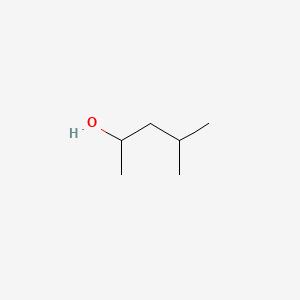
4-Methyl-2-Pentanol
Methyl isobutyl carbinol appears as a clear colorless liquid. Flash point 120 °F. Less dense than water. Vapors heavier than air. — CAMEO Chemicals
- Nom IUPAC
- 4-methylpentan-2-ol
- Formule moléculaire
- C6H14O
- Masse moléculaire
- 102.17 g/mol
- Masse exacte
- 102.104465066 Da
- XLogP3
- 1,7
- Surface polaire topologique
- 20,2 Ų
- Donneurs de liaisons hydrogène
- 1
- Accepteurs de liaisons hydrogène
- 1
- Unités covalentes
- 1
- Stéréocentres définis
- 0
Également connu sous le nom de
16 autres noms signalés
Identifiants de bases de données externes
Preuves issues de bases de données scientifiques complémentaires
NIH PubChem PUG-View
Attributed physical-property, hazard, environmental and use annotations.
- Boiling Point: 269.2 °F at 760 mmHg (USCG, 1999) Source: CAMEO Chemicals
- Boiling Point: 133 °C @ 760 MM HG Source: Hazardous Substances Data Bank (HSDB)
- Boiling Point: 132 °C Source: ILO-WHO International Chemical Safety Cards (ICSCs)
- Boiling Point: 271 °F Source: Occupational Safety and Health Administration (OSHA)
- Boiling Point: 271 °F Source: The National Institute for Occupational Safety and Health (NIOSH)
- Color/Form: COLORLESS LIQ Source: Hazardous Substances Data Bank (HSDB)
- Color/Form: Colorless liquid. Source: Hazardous Substances Data Bank (HSDB)
- Density: 0.807 at 68 °F (USCG, 1999) - Less dense than water; will float Source: CAMEO Chemicals
- Density: 0.8075 @ 20 °C/4 °C Source: Hazardous Substances Data Bank (HSDB)
- Density: % IN SATURATED AIR: 0.46 @ 20 °C; DENSITY OF SATURATED AIR: 1.01 (AIR= 1) Source: Hazardous Substances Data Bank (HSDB)
- Density: Relative density (water = 1): 0.82 Source: ILO-WHO International Chemical Safety Cards (ICSCs)
- Density: 0.81 Source: Occupational Safety and Health Administration (OSHA)
- Density: 0.81 Source: The National Institute for Occupational Safety and Health (NIOSH)
- Flash Point: 106 °F (USCG, 1999) Source: CAMEO Chemicals
- Flash Point: 105 °F Source: Haz-Map, Information on Hazardous Chemicals and Occupational Diseases
- Flash Point: 105 °F (OPEN CUP) Source: Hazardous Substances Data Bank (HSDB)
- Flash Point: 41 °C Source: ILO-WHO International Chemical Safety Cards (ICSCs)
- Flash Point: 106 °F Source: Occupational Safety and Health Administration (OSHA)
- Flash Point: 106 °F Source: The National Institute for Occupational Safety and Health (NIOSH)
- LogP: log Kow= 1.43 Source: Hazardous Substances Data Bank (HSDB)
- LogP: 1.43 Source: ILO-WHO International Chemical Safety Cards (ICSCs)
- Melting Point: less than -130 °F (USCG, 1999) Source: CAMEO Chemicals
- Melting Point: -90 °C Source: Hazardous Substances Data Bank (HSDB)
- Melting Point: -90 °C Source: ILO-WHO International Chemical Safety Cards (ICSCs)
- Melting Point: -130 °F Source: Occupational Safety and Health Administration (OSHA)
- Melting Point: -130 °F Source: The National Institute for Occupational Safety and Health (NIOSH)
- Odor: Mild odor. Source: Hazardous Substances Data Bank (HSDB)
- Physical Description: Methyl isobutyl carbinol appears as a clear colorless liquid. Flash point 120 °F. Less dense than water. Vapors heavier than air. Source: CAMEO Chemicals
- Physical Description: Liquid; CBI Source: EPA Chemical Data Reporting (CDR)
- Physical Description: Colorless liquid with a mild odor; [NIOSH] Source: Haz-Map, Information on Hazardous Chemicals and Occupational Diseases
- Physical Description: COLOURLESS LIQUID. Source: ILO-WHO International Chemical Safety Cards (ICSCs)
- Physical Description: Colorless liquid with a mild odor. Source: Occupational Safety and Health Administration (OSHA)
- Physical Description: Colorless liquid with a mild odor. Source: The National Institute for Occupational Safety and Health (NIOSH)
- Refractive Index: INDEX OF REFRACTION: 1.4100 @ 20 °C/D Source: Hazardous Substances Data Bank (HSDB)
- Solubility: 2 % (NIOSH, 2024) Source: CAMEO Chemicals
- Solubility: SOL IN ALC & ETHER. Source: Hazardous Substances Data Bank (HSDB)
- Solubility: MISCIBLE WITH MOST COMMON ORG SOLVENTS. Source: Hazardous Substances Data Bank (HSDB)
- Solubility: Water solubility of 1.64X10+4 mg/kg (experimental). Source: Hazardous Substances Data Bank (HSDB)
- Solubility: Solubility in water, g/100ml: 2 Source: ILO-WHO International Chemical Safety Cards (ICSCs)
- Solubility: 2% Source: The National Institute for Occupational Safety and Health (NIOSH)
- Vapor Pressure: 3 mmHg (NIOSH, 2024) Source: CAMEO Chemicals
- Vapor Pressure: 2.8 [mmHg] Source: Haz-Map, Information on Hazardous Chemicals and Occupational Diseases
- Vapor Pressure: 2.8 MM HG @ 20 °C Source: Hazardous Substances Data Bank (HSDB)
- Vapor Pressure: 3 mmHg Source: Occupational Safety and Health Administration (OSHA)
- Vapor Pressure: 3 mmHg Source: The National Institute for Occupational Safety and Health (NIOSH)
- Exposure Routes: The substance can be absorbed into the body by inhalation of its vapour and through the skin. Source: ILO-WHO International Chemical Safety Cards (ICSCs)
- Exposure Routes: inhalation, skin absorption, ingestion, skin and/or eye contact Source: The National Institute for Occupational Safety and Health (NIOSH)
- First Aid: Excerpt from NIOSH Pocket Guide for Methyl isobutyl carbinol:; Eye: IRRIGATE IMMEDIATELY - If this chemical contacts the eyes, immediately wash (irrigate) the eyes with large amounts of water, occasionally lifting the lower and upper lids. Get medical attention immediately.; Skin: WATER FLUSH PROMPTLY - If this chemical contacts the skin, flush the contaminated skin with water promptly. If this chemical penetrates the clothing, immediately remove the clothing and flush the skin with water promptly. If irritation persists after washing, get medical attention.; Breathing: RESPIRATORY SUPPORT - If a person breathes large amounts of this chemical, move the exposed person to fresh air at once. If breathing has stopped, perform artificial respiration. Keep the affected person warm and at rest. Get medical attention as soon as possible.; Swallow: MEDICAL ATTENTION IMMEDIATELY - If this chemical has been swallowed, get medical attention immediately. (NIOSH, 2024) Source: CAMEO Chemicals
- ERG2024, Guide 129 (Methyl isobutyl carbinol): General First Aid:; · Call 911 or emergency medical service.; · Ensure that medical personnel are aware of the material(s) involved, take precautions to protect themselves and avoid contamination.; · Move victim to fresh air if it can be done safely.; · Administer oxygen if breathing is difficult.; · If victim is not breathing:; -- DO NOT perform mouth-to-mouth resuscitation; the victim may have ingested or inhaled the substance.; -- If equipped and pulse detected, wash face and mouth, then give artificial respiration using a proper respiratory medical device (bag-valve mask, pocket mask equipped with a one-way valve or other device).; -- If no pulse detected or no respiratory medical device available, provide continuous compressions. Conduct a pulse check every two minutes or monitor for any signs of spontaneous respirations.; · Remove and isolate contaminated clothing and shoes.; · For minor skin contact, avoid spreading material on unaffected skin.; · In case of contact with substance, remove immediately by flushing skin or eyes with running water for at least 20 minutes.; · For severe burns, immediate medical attention is required.; · Effects of exposure (inhalation, ingestion, Source: Emergency Response Guidebook (ERG)
- First Aid: (General first aid procedures); Eye: Irrigate immediately - If this chemical contacts the eyes, immediately wash (irrigate) the eyes with large amounts of water, occasionally lifting the lower and upper lids. Get medical attention immediately.; Skin: Water flush promptly - If this chemical contacts the skin, flush the contaminated skin with water promptly. If this chemical penetrates the clothing, immediately remove the clothing and flush the skin with water promptly. If irritation persists after washing, get medical attention.; Breathing: Respiratory support; Swallow: Medical attention immediately - If this chemical has been swallowed, get medical attention immediately. Source: The National Institute for Occupational Safety and Health (NIOSH)
- Signal: Warning Source: Regulation (EC) No 1272/2008 of the European Parliament and of the Council
- GHS Hazard Statements: H226: Flammable liquid and vapor [Warning Flammable liquids]; H335: May cause respiratory irritation [Warning Specific target organ toxicity, single exposure; Respiratory tract irritation] Source: Regulation (EC) No 1272/2008 of the European Parliament and of the Council
- Precautionary Statement Codes: P210, P233, P240, P241, P242, P243, P261, P271, P280, P303+P361+P353, P304+P340, P319, P370+P378, P403+P233, P403+P235, P405, and P501 (click each P-code to see the statement) Source: Regulation (EC) No 1272/2008 of the European Parliament and of the Council
- Signal: Warning Source: European Chemicals Agency (ECHA)
- GHS Hazard Statements: H226 (100%): Flammable liquid and vapor [Warning Flammable liquids]; H319 (70.7%): Causes serious eye irritation [Warning Serious eye damage/eye irritation]; H335 (100%): May cause respiratory irritation [Warning Specific target organ toxicity, single exposure; Respiratory tract irritation] Source: European Chemicals Agency (ECHA)
- Precautionary Statement Codes: P210, P233, P240, P241, P242, P243, P261, P264+P265, P271, P280, P303+P361+P353, P304+P340, P305+P351+P338, P319, P337+P317, P370+P378, P403+P233, P403+P235, P405, and P501 (click each P-code to see the statement) Source: European Chemicals Agency (ECHA)
- ECHA C&L Notifications Summary: Aggregated GHS information provided per 1520 reports by companies from 37 notifications to the ECHA C&L Inventory. Each notification may be associated with multiple companies.; Information may vary between notifications depending on impurities, additives, and other factors. The percentage value in parenthesis indicates the notified classification ratio from companies that provide hazard codes. Only hazard codes with percentage values above 10% are shown. For more detailed information, please visit ECHA C&L website. Source: European Chemicals Agency (ECHA)
- Signal: Danger Source: NITE-CMC
- GHS Hazard Statements: H226: Flammable liquid and vapor [Warning Flammable liquids]; H315: Causes skin irritation [Warning Skin corrosion/irritation]; H319: Causes serious eye irritation [Warning Serious eye damage/eye irritation]; H335: May cause respiratory irritation [Warning Specific target organ toxicity, single exposure; Respiratory tract irritation]; H336: May cause drowsiness or dizziness [Warning Specific target organ toxicity, single exposure; Narcotic effects]; H372: Causes damage to organs through prolonged or repeated exposure [Danger Specific target organ toxicity, repeated exposure] Source: NITE-CMC
- Precautionary Statement Codes: P210, P233, P240, P241, P242, P243, P260, P261, P264, P264+P265, P270, P271, P280, P302+P352, P303+P361+P353, P304+P340, P305+P351+P338, P319, P321, P332+P317, P337+P317, P362+P364, P370+P378, P403+P233, P403+P235, P405, and P501 (click each P-code to see the statement) Source: NITE-CMC
- Signal: Warning Source: NITE-CMC
- GHS Hazard Statements: H226: Flammable liquid and vapor [Warning Flammable liquids]; H319: Causes serious eye irritation [Warning Serious eye damage/eye irritation]; H335: May cause respiratory irritation [Warning Specific target organ toxicity, single exposure; Respiratory tract irritation]; H336: May cause drowsiness or dizziness [Warning Specific target organ toxicity, single exposure; Narcotic effects] Source: NITE-CMC
- NFPA Health Rating: 2 - Materials that, under emergency conditions, can cause temporary incapacitation or residual injury. Source: Hazardous Substances Data Bank (HSDB)
- NFPA Fire Rating: 2 - Materials that must be moderately heated or exposed to relatively high ambient temperatures before ignition can occur. Materials would not under normal conditions form hazardous atmospheres with air, but under high ambient temperatures or under moderate heating could release vapor in sufficient quantities to produce hazardous atmospheres with air. Source: Hazardous Substances Data Bank (HSDB)
- NFPA Instability Rating: 0 - Materials that in themselves are normally stable, even under fire conditions. Source: Hazardous Substances Data Bank (HSDB)
- Target Organs: Eyes, skin, central nervous system Source: The National Institute for Occupational Safety and Health (NIOSH)
- Environmental Bioconcentration: Based upon an experimental log Kow of 1.43(1), a BCF of 7.2 has been estimated using a recommended regression equation(2). Based upon an experimental water solubility of 1.64X10+4 mg/kg(3), a BCF of 2.6 has been estimated using a recommended regression equation(2). Based upon these estimated BCF, 4-methyl-2-pentanol will not be expected to bioconcentrate in aquatic organisms(SRC). Source: Hazardous Substances Data Bank (HSDB)
- Environmental Fate: TERRESTRIAL FATE: If 4-methyl-2-pentanol is released to soil, it will be expected to exhibit high to very high mobility in soil(1,SRC) based upon estimated Koc of 143 and 21 estimated from log Kow(2) and water solubility(3), respectively, using a recommended regression equations(4,SRC). It may, therefore, leach through soil(SRC). It will not hydrolyze in moist soil(4), but it may be subject to volatilization from near surface soil based upon estimated rates for its volatilization from water(4-6). It may be subject to biodegradation in soil based upon the rapid biodegradation observed in laboratory aqueous screening tests using sewage and activated sludge inoculum(7,8). Source: Hazardous Substances Data Bank (HSDB)
- Environmental Fate: AQUATIC FATE: If 4-methyl-2-pentanol is released to water, it will not be expected to adsorb to sediment and suspended particulate matter or to bioconcentrate in aquatic organisms based upon estimated Koc and BCF, respectively, estimated(2,SRC) from the measured log Kow (1) and water solubility(3). It will not be expected to hydrolyze(2) or directly photolyze(4,SRC). It may be subject to biodegradation in natural waters based upon the rapid biodegradation observed in laboratory aqueous screening tests using sewage and activated sludge inoculum(5,6). It will be subject to volatilization from surface waters based upon half-lives of 23 hr for volatilization from a model river one meter deep flowing 1 m/sec with a wind velocity of 3 m/sec(2,SRC) and 10.6 days for volatilization from a model pond(7,SRC), respectively, estimated using a measured Henry's Law constant(8). Source: Hazardous Substances Data Bank (HSDB)
- Environmental Fate: ATMOSPHERIC FATE: If 4-methyl-2-pentanol is released to the atmosphere, it can be expected to exist mainly in the vapor-phase in the ambient atmosphere(1,SRC) based upon an experimental vapor pressure of 5.3 mm Hg at 25 °C(2,SRC). The measured rate constant for vapor-phase reaction with photochemically produced hydroxyl radicals of 7.1X10⁻¹² cu cm/molecule-sec at 25 °C(3) corresponds to an atmospheric half-life of 2.3 days at an atmospheric concentration of 5X10+5 hydroxyl radicals per cu cm(SRC). 4-Methyl-2-pentanol has been rated a moderately reactive (Class III) compound(4) with respect to ozone formation as observed in smog chamber tests(5). 4-Methyl-2-pentanol will not be expected to directly photolyze in the atmosphere(6,SRC). Source: Hazardous Substances Data Bank (HSDB)
- Consumer Uses: Solvent; Lubricating agent; Not Known or Reasonably Ascertainable Source: EPA Chemical Data Reporting (CDR)
- Industry Uses: Surfactant (surface active agent); Plating agent; Solvent; Lubricating agent; Intermediate; Flotation agent; Not Known or Reasonably Ascertainable Source: EPA Chemical Data Reporting (CDR)
- Sources/Uses: Used primarily in the production of additives for anti-wear and corrosion inhibitors; Used secondarily as a flotation agent (copper ores, coal and tar sand mining); Also used as an additive to surface coatings and solvent to improve binder softness; Usually used in closed systems except as a floating agent; [ACGIH, 2020] Source: Haz-Map, Information on Hazardous Chemicals and Occupational Diseases
- Uses: Solvent for dyestuffs, oils, gums, resins, waxes, nitrocellulose, and ethylcellulose; organic synthesis; froth flotation; brake fluids. Source: Hazardous Substances Data Bank (HSDB)
- Uses: In the manufacture of lubricant additives, solvents, plasticizers, lacquers. Source: Hazardous Substances Data Bank (HSDB)
Mis en correspondance par: Existing checksum-valid CAS to unique PubChem CID match. Récupéré le: 2026-08-31. Ouvrir la fiche source
Les classifications scientifiques et les annotations de danger apportent du contexte et ne remplacent pas la décision réglementaire propre au marché indiquée ci-dessus.
Couverture des sources complémentaires et état des correspondances
| Source | Résultat | Vérifié |
|---|---|---|
| NIH PubChem PUG-View | Correspondance exacte | 2026-08-31 |
Une absence de correspondance enregistrée est une preuve utile que la source a été vérifiée ; ce n’est pas l’affirmation que la substance n’existe pas ailleurs.
Récupéré depuis NIH PubChem le 2026-08-31 par correspondance CAS à somme de contrôle valide. Les propriétés chimiques ne remplacent pas la décision réglementaire de cette page.