
CAS
1 fiche
CAS 106-92-3
Le CAS 106-92-3 correspond à 1 fiche d’annexe de l’UE dans les annexes II à VI du règlement (CE) n° 1223/2009.
Fiches pour le CAS 106-92-3
1 au totalIdentité et propriétés chimiques
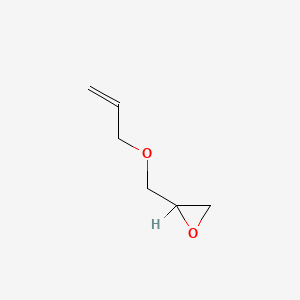
CAS 106-92-3PubChem CID 7838
Allyl glycidyl ether
Allyl glycidyl ether appears as a colorless liquid with a pleasant odor. Slightly less dense than water and insoluble in water. Hence floats on water. Poisonous by ingestion and mildly toxic by inhalation and skin contact. Very irritating to skin and eyes. Used to make other chemicals. — CAMEO Chemicals
- Nom IUPAC
- 2-(prop-2-enoxymethyl)oxirane
- Formule moléculaire
- C6H10O2
- Masse moléculaire
- 114.14 g/mol
- Masse exacte
- 114.068079557 Da
- XLogP3
- 0,4
- Surface polaire topologique
- 21,8 Ų
- Donneurs de liaisons hydrogène
- 0
- Accepteurs de liaisons hydrogène
- 2
- Unités covalentes
- 1
- Stéréocentres définis
- 0
Également connu sous le nom de
Glycidyl allyl etherAllyl 2,3-epoxypropyl etherAllylglycidaetherAllil-glicidil-etere1-Allyloxy-2,3-epoxypropane1,2-Epoxy-3-allyloxypropaneDenacol EX 111Propane, 1-(allyloxy)-2,3-epoxy-
16 autres noms signalés
1-(Allyloxy)-2,3-epoxypropane1-Allyloxy-2,3-epoxypropanEther, allyl 2,3-epoxypropylOxyde d'allyle et de glycidyle1-Allilossi-2,3 epossipropano1-Allyloxy-2,3-epoxy-propaanNCI-C56666[(2-Propenyloxy)methyl]oxiraneNSC-631NSC-18596DTXCID6046Oxirane, 2-((2-propen-1-yloxy)methyl)-((ALLYLOXY)METHYL)OXIRANE((2-propenyloxy)methyl)oxiraneOxirane, 2-[(2-propen-1-yloxy)methyl]-RefChem:110869
Identifiants de bases de données externes
Preuves issues de bases de données scientifiques complémentaires
NIH PubChem PUG-View
Correspondance exacte d’identifiant7838
Attributed physical-property, hazard, environmental and use annotations.
- Autoignition Temperature: 264 °C Source: ILO-WHO International Chemical Safety Cards (ICSCs)
- Boiling Point: 309 °F at 760 mmHg (NTP, 1992) Source: CAMEO Chemicals
- Boiling Point: 153.9 °C AT 760 MM HG Source: Hazardous Substances Data Bank (HSDB)
- Boiling Point: 154 °C Source: ILO-WHO International Chemical Safety Cards (ICSCs)
- Boiling Point: 309 °F Source: Occupational Safety and Health Administration (OSHA)
- Boiling Point: 309 °F Source: The National Institute for Occupational Safety and Health (NIOSH)
- Color/Form: COLORLESS LIQUID Source: Hazardous Substances Data Bank (HSDB)
- Color/Form: Colorless liquid ... Source: Hazardous Substances Data Bank (HSDB)
- Density: 0.969 at 68 °F (NTP, 1992) - Less dense than water; will float Source: CAMEO Chemicals
- Density: SP GR: 0.9698 AT 20 °C/40 °C Source: Hazardous Substances Data Bank (HSDB)
- Density: Relative density (water = 1): 0.97 Source: ILO-WHO International Chemical Safety Cards (ICSCs)
- Density: 0.97 Source: Occupational Safety and Health Administration (OSHA)
- Density: 0.97 Source: The National Institute for Occupational Safety and Health (NIOSH)
- Flash Point: 135 °F (NTP, 1992) Source: CAMEO Chemicals
- Flash Point: 57 °C Source: Haz-Map, Information on Hazardous Chemicals and Occupational Diseases
- Flash Point: 135 °F (OPEN CUP) Source: Hazardous Substances Data Bank (HSDB)
- Flash Point: 45 °C c.c. Source: ILO-WHO International Chemical Safety Cards (ICSCs)
- Flash Point: 135 °F Source: Occupational Safety and Health Administration (OSHA)
- Flash Point: 135 °F Source: The National Institute for Occupational Safety and Health (NIOSH)
- LogP: 0.46 (estimated) Source: ILO-WHO International Chemical Safety Cards (ICSCs)
- Melting Point: -148 °F (NTP, 1992) Source: CAMEO Chemicals
- Melting Point: FREEZING POINT: FORMS GLASS @ -100 °C Source: Hazardous Substances Data Bank (HSDB)
- Melting Point: -100 °C Source: ILO-WHO International Chemical Safety Cards (ICSCs)
- Melting Point: -148 °F [forms glass] Source: Occupational Safety and Health Administration (OSHA)
- Melting Point: -148 °F [forms glass] Source: The National Institute for Occupational Safety and Health (NIOSH)
- Odor: CHARACTERISTIC, NOT UNPLEASANT ODOR Source: Hazardous Substances Data Bank (HSDB)
- Odor: ... Pleasant odor. Source: Hazardous Substances Data Bank (HSDB)
- Physical Description: Allyl glycidyl ether appears as a colorless liquid with a pleasant odor. Slightly less dense than water and insoluble in water. Hence floats on water. Poisonous by ingestion and mildly toxic by inhalation and skin contact. Very irritating to skin and eyes. Used to make other chemicals. Source: CAMEO Chemicals
- Physical Description: Liquid Source: EPA Chemical Data Reporting (CDR)
- Physical Description: Colorless liquid with a pleasant odor; [NIOSH] Source: Haz-Map, Information on Hazardous Chemicals and Occupational Diseases
- Physical Description: COLOURLESS LIQUID WITH CHARACTERISTIC ODOUR. Source: ILO-WHO International Chemical Safety Cards (ICSCs)
- Physical Description: Colorless liquid with a pleasant odor. Source: Occupational Safety and Health Administration (OSHA)
- Physical Description: Colorless liquid with a pleasant odor. Source: The National Institute for Occupational Safety and Health (NIOSH)
- Refractive Index: INDEX OF REFRACTION: 1.4348 @ 20 °C Source: Hazardous Substances Data Bank (HSDB)
- Solubility: greater than or equal to 100 mg/mL at 65.3 °F (NTP, 1992) Source: CAMEO Chemicals
- Solubility: 14.1% IN WATER; MISCIBLE WITH ACETONE, TOLUENE, & OCTANE Source: Hazardous Substances Data Bank (HSDB)
- Solubility: Solubility in water, g/100ml: 14 (freely soluble) Source: ILO-WHO International Chemical Safety Cards (ICSCs)
- Solubility: 14% Source: The National Institute for Occupational Safety and Health (NIOSH)
- Vapor Pressure: 3.6 mmHg at 68 °F ; 5.8 mmHg at 86 °F (NTP, 1992) Source: CAMEO Chemicals
- Vapor Pressure: 4.7 [mmHg] Source: Haz-Map, Information on Hazardous Chemicals and Occupational Diseases
- Vapor Pressure: 4.7 MM HG AT 25 °C Source: Hazardous Substances Data Bank (HSDB)
- Vapor Pressure: Vapor pressure, kPa at 25 °C: 0.63 Source: ILO-WHO International Chemical Safety Cards (ICSCs)
- Vapor Pressure: 2 mmHg Source: Occupational Safety and Health Administration (OSHA)
- Vapor Pressure: 2 mmHg Source: The National Institute for Occupational Safety and Health (NIOSH)
- Substance: Allyl Glycidyl Ether Source: NTP Technical Reports
- NTP Technical Report: TR-376: Toxicology and Carcinogenesis Studies of Allyl Glycidyl Ether (CASRN 106-92-3) in Osborne-Mendel Rats and B6C3F1 Mice (Inhalation Studies) (1990 ) Source: NTP Technical Reports
- Peer Review Date: 06/27/89 Source: NTP Technical Reports
- Conclusion for Male Rat: Equivocal Evidence Source: NTP Technical Reports
- Conclusion for Female Rat: No Evidence Source: NTP Technical Reports
- Conclusion for Male Mice: Some Evidence Source: NTP Technical Reports
- Conclusion for Female Mice: Equivocal Evidence Source: NTP Technical Reports
- Summary: Under the conditions of these 2-year inhalation studies, there was equivocal evidence of carcinogenic activity of allyl glycidyl ether for male Osborne-Mendel rats, based on the presence of one papillary adenoma of respiratory epithelial origin, one squamous cell carcinoma of respiratory epithelial origin, and one poorly differentiated adenocarcinoma of olfactory epithelial origin, all occurring in the nasal passage of males exposed to 10 ppm. There was no evidence of carcinogenic activity of allyl glycidyl ether for female rats. One papillary adenoma of the respiratory epithelium was present in a female rat exposed to 5 ppm. There was some evidence of carcinogenic activity of allyl glycidyl ether for male B6C3F1 mice, based on the presence of three adenomas of the respiratory epithelium, dysplasia in four males, and focal basal cell hyperplasia of the respiratory epithelium in seven males in the nasal passage of mice exposed to 10 ppm. There was equivocal evidence of carcinogenic activity of allyl glycidyl ether for female mice, based on the presence of one adenoma of the respiratory epithelium and focal basal cell hyperplasia of the respiratory epithelium in seven females exposed Source: NTP Technical Reports
- Exposure Routes: The substance can be absorbed into the body by inhalation, through the skin and by ingestion. Source: ILO-WHO International Chemical Safety Cards (ICSCs)
- Exposure Routes: inhalation, skin absorption, ingestion, skin and/or eye contact Source: The National Institute for Occupational Safety and Health (NIOSH)
- First Aid: EYES: First check the victim for contact lenses and remove if present. Flush victim's eyes with water or normal saline solution for 20 to 30 minutes while simultaneously calling a hospital or poison control center. Do not put any ointments, oils, or medication in the victim's eyes without specific instructions from a physician. IMMEDIATELY transport the victim after flushing eyes to a hospital even if no symptoms (such as redness or irritation) develop.; SKIN: IMMEDIATELY flood affected skin with water while removing and isolating all contaminated clothing. Gently wash all affected skin areas thoroughly with soap and water. IMMEDIATELY call a hospital or poison control center even if no symptoms (such as redness or irritation) develop. IMMEDIATELY transport the victim to a hospital for treatment after washing the affected areas.; INHALATION: IMMEDIATELY leave the contaminated area; take deep breaths of fresh air. IMMEDIATELY call a physician and be prepared to transport the victim to a hospital even if no symptoms (such as wheezing, coughing, shortness of breath, or burning in the mouth, throat, or chest) develop. Provide proper respiratory protection to rescuers entering an unknow Source: CAMEO Chemicals
- ERG2024, Guide 129 (Allyl glycidyl ether): General First Aid:; · Call 911 or emergency medical service.; · Ensure that medical personnel are aware of the material(s) involved, take precautions to protect themselves and avoid contamination.; · Move victim to fresh air if it can be done safely.; · Administer oxygen if breathing is difficult.; · If victim is not breathing:; -- DO NOT perform mouth-to-mouth resuscitation; the victim may have ingested or inhaled the substance.; -- If equipped and pulse detected, wash face and mouth, then give artificial respiration using a proper respiratory medical device (bag-valve mask, pocket mask equipped with a one-way valve or other device).; -- If no pulse detected or no respiratory medical device available, provide continuous compressions. Conduct a pulse check every two minutes or monitor for any signs of spontaneous respirations.; · Remove and isolate contaminated clothing and shoes.; · For minor skin contact, avoid spreading material on unaffected skin.; · In case of contact with substance, remove immediately by flushing skin or eyes with running water for at least 20 minutes.; · For severe burns, immediate medical attention is required.; · Effects of exposure (inhalation, ingestion, Source: Emergency Response Guidebook (ERG)
- First Aid: (General first aid procedures); Eye: Irrigate immediately - If this chemical contacts the eyes, immediately wash (irrigate) the eyes with large amounts of water, occasionally lifting the lower and upper lids. Get medical attention immediately.; Skin: Water flush promptly - If this chemical contacts the skin, flush the contaminated skin with water promptly. If this chemical penetrates the clothing, immediately remove the clothing and flush the skin with water promptly. If irritation persists after washing, get medical attention.; Breathing: Respiratory support; Swallow: Medical attention immediately - If this chemical has been swallowed, get medical attention immediately. Source: The National Institute for Occupational Safety and Health (NIOSH)
- Signal: Danger Source: Regulation (EC) No 1272/2008 of the European Parliament and of the Council
- GHS Hazard Statements: H226: Flammable liquid and vapor [Warning Flammable liquids]; H302: Harmful if swallowed [Warning Acute toxicity, oral]; H315: Causes skin irritation [Warning Skin corrosion/irritation]; H317: May cause an allergic skin reaction [Warning Sensitization, Skin]; H318: Causes serious eye damage [Danger Serious eye damage/eye irritation]; H332: Harmful if inhaled [Warning Acute toxicity, inhalation]; H335: May cause respiratory irritation [Warning Specific target organ toxicity, single exposure; Respiratory tract irritation]; H341: Suspected of causing genetic defects [Warning Germ cell mutagenicity]; H351: Suspected of causing cancer [Warning Carcinogenicity]; H361f ***: Suspected of damaging fertility [Warning Reproductive toxicity]; H412: Harmful to aquatic life with long lasting effects [Hazardous to the aquatic environment, long-term hazard] Source: Regulation (EC) No 1272/2008 of the European Parliament and of the Council
- Precautionary Statement Codes: P203, P210, P233, P240, P241, P242, P243, P261, P264, P264+P265, P270, P271, P272, P273, P280, P301+P317, P302+P352, P303+P361+P353, P304+P340, P305+P354+P338, P317, P318, P319, P321, P330, P332+P317, P333+P317, P362+P364, P370+P378, P403+P233, P403+P235, P405, and P501 (click each P-code to see the statement) Source: Regulation (EC) No 1272/2008 of the European Parliament and of the Council
- Signal: Danger Source: European Chemicals Agency (ECHA)
- GHS Hazard Statements: H226 (100%): Flammable liquid and vapor [Warning Flammable liquids]; H302 (100%): Harmful if swallowed [Warning Acute toxicity, oral]; H315 (100%): Causes skin irritation [Warning Skin corrosion/irritation]; H317 (100%): May cause an allergic skin reaction [Warning Sensitization, Skin]; H318 (100%): Causes serious eye damage [Danger Serious eye damage/eye irritation]; H331 (39.5%): Toxic if inhaled [Danger Acute toxicity, inhalation]; H332 (60.3%): Harmful if inhaled [Warning Acute toxicity, inhalation]; H335 (100%): May cause respiratory irritation [Warning Specific target organ toxicity, single exposure; Respiratory tract irritation]; H341 (100%): Suspected of causing genetic defects [Warning Germ cell mutagenicity]; H351 (100%): Suspected of causing cancer [Warning Carcinogenicity]; H361 (99.7%): Suspected of damaging fertility or the unborn child [Warning Reproductive toxicity]; H412 (96.3%): Harmful to aquatic life with long lasting effects [Hazardous to the aquatic environment, long-term hazard] Source: European Chemicals Agency (ECHA)
- Precautionary Statement Codes: P203, P210, P233, P240, P241, P242, P243, P261, P264, P264+P265, P270, P271, P272, P273, P280, P301+P317, P302+P352, P303+P361+P353, P304+P340, P305+P354+P338, P316, P317, P318, P319, P321, P330, P332+P317, P333+P317, P362+P364, P370+P378, P403+P233, P403+P235, P405, and P501 (click each P-code to see the statement) Source: European Chemicals Agency (ECHA)
- ECHA C&L Notifications Summary: Aggregated GHS information provided per 375 reports by companies from 20 notifications to the ECHA C&L Inventory. Each notification may be associated with multiple companies.; Information may vary between notifications depending on impurities, additives, and other factors. The percentage value in parenthesis indicates the notified classification ratio from companies that provide hazard codes. Only hazard codes with percentage values above 10% are shown. For more detailed information, please visit ECHA C&L website. Source: European Chemicals Agency (ECHA)
- Signal: Danger Source: NITE-CMC
- GHS Hazard Statements: H226: Flammable liquid and vapor [Warning Flammable liquids]; H302: Harmful if swallowed [Warning Acute toxicity, oral]; H315: Causes skin irritation [Warning Skin corrosion/irritation]; H317: May cause an allergic skin reaction [Warning Sensitization, Skin]; H318: Causes serious eye damage [Danger Serious eye damage/eye irritation]; H330: Fatal if inhaled [Danger Acute toxicity, inhalation]; H341: Suspected of causing genetic defects [Warning Germ cell mutagenicity]; H351: Suspected of causing cancer [Warning Carcinogenicity]; H361: Suspected of damaging fertility or the unborn child [Warning Reproductive toxicity]; H370: Causes damage to organs [Danger Specific target organ toxicity, single exposure]; H372: Causes damage to organs through prolonged or repeated exposure [Danger Specific target organ toxicity, repeated exposure]; H402: Harmful to aquatic life [Hazardous to the aquatic environment, acute hazard]; H412: Harmful to aquatic life with long lasting effects [Hazardous to the aquatic environment, long-term hazard] Source: NITE-CMC
- Precautionary Statement Codes: P203, P210, P233, P240, P241, P242, P243, P260, P261, P264, P264+P265, P270, P271, P272, P273, P280, P284, P301+P317, P302+P352, P303+P361+P353, P304+P340, P305+P354+P338, P308+P316, P316, P317, P318, P319, P320, P321, P330, P332+P317, P333+P317, P362+P364, P370+P378, P403+P233, P403+P235, P405, and P501 (click each P-code to see the statement) Source: NITE-CMC
- GHS Hazard Statements: H226: Flammable liquid and vapor [Warning Flammable liquids]; H302: Harmful if swallowed [Warning Acute toxicity, oral]; H315: Causes skin irritation [Warning Skin corrosion/irritation]; H317: May cause an allergic skin reaction [Warning Sensitization, Skin]; H319: Causes serious eye irritation [Warning Serious eye damage/eye irritation]; H330: Fatal if inhaled [Danger Acute toxicity, inhalation]; H341: Suspected of causing genetic defects [Warning Germ cell mutagenicity]; H361: Suspected of damaging fertility or the unborn child [Warning Reproductive toxicity]; H370: Causes damage to organs [Danger Specific target organ toxicity, single exposure]; H372: Causes damage to organs through prolonged or repeated exposure [Danger Specific target organ toxicity, repeated exposure] Source: NITE-CMC
- Precautionary Statement Codes: P203, P210, P233, P240, P241, P242, P243, P260, P261, P264, P264+P265, P270, P271, P272, P280, P284, P301+P317, P302+P352, P303+P361+P353, P304+P340, P305+P351+P338, P308+P316, P316, P318, P319, P320, P321, P330, P332+P317, P333+P317, P337+P317, P362+P364, P370+P378, P403+P233, P403+P235, P405, and P501 (click each P-code to see the statement) Source: NITE-CMC
- Target Organs: Eyes, skin, respiratory system, blood, reproductive system Source: The National Institute for Occupational Safety and Health (NIOSH)
- Consumer Uses: Monomers; Intermediate Source: EPA Chemical Data Reporting (CDR)
- Industry Uses: Intermediate; Bleaching agent; Monomers Source: EPA Chemical Data Reporting (CDR)
- Sources/Uses: Used as a reactive diluent and intermediate in the production of resins; [ACGIH] Source: Haz-Map, Information on Hazardous Chemicals and Occupational Diseases
- Industrial Processes with risk of exposure: Plastic Composites Manufacturing [Category: Industry] Source: Haz-Map, Information on Hazardous Chemicals and Occupational Diseases
- Uses: STABILIZER OF CHLORINATED COMPOUNDS, VINYL RESINS, RUBBER; RESIN INTERMEDIATE Source: Hazardous Substances Data Bank (HSDB)
Mis en correspondance par: Existing checksum-valid CAS to unique PubChem CID match. Récupéré le: 2026-08-31. Ouvrir la fiche source
Les classifications scientifiques et les annotations de danger apportent du contexte et ne remplacent pas la décision réglementaire propre au marché indiquée ci-dessus.
Couverture des sources complémentaires et état des correspondances
| Source | Résultat | Vérifié |
|---|---|---|
| EMBL-EBI ChEBI | Aucune fiche exacte | 2026-08-31 |
| NIH PubChem PUG-View | Correspondance exacte | 2026-08-31 |
Une absence de correspondance enregistrée est une preuve utile que la source a été vérifiée ; ce n’est pas l’affirmation que la substance n’existe pas ailleurs.
Récupéré depuis NIH PubChem le 2026-09-02 par correspondance CAS à somme de contrôle valide. Les propriétés chimiques ne remplacent pas la décision réglementaire de cette page.
Comment le CAS 106-92-3 est utilisé sur ce site
Le CAS 106-92-3 est l’identifiant du Chemical Abstracts Service utilisé pour rattacher cette page à une substance précise. Dans le jeu de données actuel, 1 fiche d’annexe de l’UE partage cet identifiant, ce qui vous aide à vérifier si la même substance apparaît dans un seul contexte réglementaire ou dans plusieurs.
Utilisez cette page lorsqu’une spécification fournisseur, une FDS ou un dossier de matière première vous donne le CAS 106-92-3 et que vous devez voir au même endroit toutes les fiches liées des annexes II à VI. Les cartes d’entrées ci-dessus sont le moyen le plus rapide d’accéder aux limites de concentration, aux avertissements, à l’annexe concernée et aux conditions par type de produit.
Questions fréquentes
Une substance identifiée par le CAS 106-92-3 peut figurer dans plusieurs annexes du règlement de l’UE sur les cosmétiques lorsqu’elle est soumise à des conditions différentes selon les contextes. Par exemple, une substance peut être soumise à restrictions à l’annexe III avec des conditions précises, et le même CAS peut aussi figurer à l’annexe IV comme colorant autorisé, dans une entrée distincte avec ses propres conditions. Chaque entrée doit être examinée individuellement.
Recoupez le numéro CAS avec les fiches de spécification de vos matières premières et vos certificats d’analyse. Lorsqu’un CAS figure à l’annexe II, vérifiez son absence. Lorsqu’il figure à l’annexe III, vérifiez que les limites de concentration et les conditions de type de produit sont respectées dans votre formulation. Toutes les entrées d’annexe partageant ce numéro CAS sont énumérées ci-dessus.
Un numéro CAS est attribué par le Chemical Abstracts Service (États-Unis) et reconnu dans le monde entier. Un numéro CE est un identifiant de la Commission européenne issu d’inventaires tels que l’EINECS, l’ELINCS ou la liste NLP. Les deux identifiants peuvent figurer dans les entrées des annexes cosmétiques de l’UE. Certaines substances ont les deux, d’autres un seul, et certaines entrées plus anciennes peuvent n’en avoir aucun.
Le vérificateur INCI accepte les noms d’ingrédients, les numéros CAS et les numéros CE. Vérifiez directement ce numéro CAS, puis contrôlez le résultat auprès des fiches de spécification des fournisseurs et de toutes les conditions d’annexe associées.
Outils et étapes suivantes
Vérifiez votre formule
Analysez une liste INCI complète, puis utilisez le CAS 106-92-3 pour recouper les documents fournisseurs relatifs aux substances identifiées.
Vérificateur INCIParcourir les annexes
Parcourez toutes les annexes du règlement de l’UE sur les cosmétiques par catégorie.
Toutes les annexesRechercher par nom
Recherchez les noms INCI, alias ou identifiants associés qui figurent à côté du CAS 106-92-3 dans votre documentation.
Rechercher