
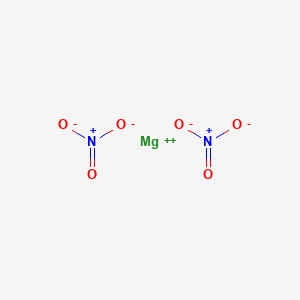
Magnesium nitrate
Magnesium nitrate is the inorganic nitrate salt of magnesium. It has a role as a fertilizer. It is a magnesium salt and an inorganic nitrate salt. — ChEBI
- Nom IUPAC
- magnesium dinitrate
- Formule moléculaire
- MgN2O6
- Masse moléculaire
- 148.32 g/mol
- Masse exacte
- 147.9606774 Da
- Surface polaire topologique
- 126,0 Ų
- Donneurs de liaisons hydrogène
- 0
- Accepteurs de liaisons hydrogène
- 6
- Unités covalentes
- 3
- Stéréocentres définis
- 0
Également connu sous le nom de
16 autres noms signalés
Identifiants de bases de données externes
- ChEBI:CHEBI:64736
- ChEMBL:CHEMBL3303299
- EPA DTXSID:DTXSID4049664
Preuves issues de bases de données scientifiques complémentaires
EMBL-EBI ChEBI
magnesium nitrate
The inorganic nitrate salt of magnesium.
- Formule
- Mg.2NO3
- Masse moyenne
- 148.313 g/mol
- Masse monoisotopique
- 147.96068 Da
- Charge formelle
- 0
- inorganic nitrate salt — is a (CHEBI:51084)
- magnesium salt — is a (CHEBI:33975)
- fertilizer — has role (CHEBI:33287)
- fertilizer — has role (CHEBI:33287)
- inorganic nitrate salt — is a (CHEBI:51084)
- magnesium salt — is a (CHEBI:33975)
Noms supplémentaires validés
Références croisées de cette source
- CAS: 10377-60-3 — ChemIDplus
- REGISTRY_NUMBER: 16055468 — Reaxys
Mis en correspondance par: Exact CAS cross-reference in the ChEBI compound record. Source mise à jour le: 2020-04-02. Récupéré le: 2026-08-31. Ouvrir la fiche source
NIH PubChem PUG-View
Attributed physical-property, hazard, environmental and use annotations.
- Boiling Point: Decomposes at 626 °F (USCG, 1999) Source: CAMEO Chemicals
- Color/Form: White cubic crystals Source: Hazardous Substances Data Bank (HSDB)
- Density: 1.46 (USCG, 1999) - Denser than water; will sink Source: CAMEO Chemicals
- Density: Approx 2.3 Source: Hazardous Substances Data Bank (HSDB)
- Density: Density, 2.0256 @ 25 °C; MP, 129 °C /Dihydrate/ Source: Hazardous Substances Data Bank (HSDB)
- Density: Colorless, monoclinic, crystals; BP, decomposes @ 330 °C with loss of 5 H2O; MP, 95 °C; density, 1.464; deliquescent /Hexahydrate/ Source: Hazardous Substances Data Bank (HSDB)
- Density: ~2.3 @25 °C Source: PAC Chemical Database, U.S. Department of Energy
- Melting Point: 192 °F (USCG, 1999) Source: CAMEO Chemicals
- Physical Description: Magnesium nitrate appears as a white crystalline solid. Produces toxic oxides of nitrogen if heated to decomposition. Used in pyrotechnics. Source: CAMEO Chemicals
- Physical Description: Liquid; Large Crystals; CBI; Dry Powder; Other Solid Source: EPA Chemical Data Reporting (CDR)
- Physical Description: Colorless or white hygroscopic solid; [ICSC] White odorless crystals; Deliquescent; [MSDSonline] Source: Haz-Map, Information on Hazardous Chemicals and Occupational Diseases
- Physical Description: HYGROSCOPIC COLOURLESS OR WHITE CRYSTALS. Source: ILO-WHO International Chemical Safety Cards (ICSCs)
- Solubility: Very soluble in water Source: Hazardous Substances Data Bank (HSDB)
- Solubility: 71.2 g/100g H2O at 25 °C Source: Hazardous Substances Data Bank (HSDB)
- Solubility: Solubility in water: very good Source: ILO-WHO International Chemical Safety Cards (ICSCs)
- Vapor Pressure: 0.49 [mmHg] Source: Haz-Map, Information on Hazardous Chemicals and Occupational Diseases
- Vapor Pressure: 0.494 mm Hg @ 25 °C (65.2 Pa) Source: Hazardous Substances Data Bank (HSDB)
- Vapor Pressure: 0.494 [mm Hg] @25 °C Source: PAC Chemical Database, U.S. Department of Energy
- Carcinogen Classification: Ingested nitrate or nitrite under conditions that result in endogenous nitrosation is probably carcinogenic to humans (Group 2A). (L135) Source: Toxin and Toxin Target Database (T3DB)
- Exposure Routes: The substance can be absorbed into the body by inhalation of its aerosol and by ingestion. Source: ILO-WHO International Chemical Safety Cards (ICSCs)
- Exposure Routes: Oral (L1137) ; inhalation (L1137) Source: Toxin and Toxin Target Database (T3DB)
- First Aid: Get medical attention.; INHALATION: Remove to fresh air. If not breathing, give artificial respiration. If breathing is difficult, give oxygen.; EYES: Flush with water for at least 15 min., lifting lids occasionally. Contact lenses should not be worn when working with this chemical.; SKIN: Remove contaminated clothing and shoes. Wash with soap and water.; INGESTION: Induce vomiting immediately by giving two glasses of water or milk and sticking finger down throat. (USCG, 1999) Source: CAMEO Chemicals
- ERG2024, Guide 140 (Magnesium nitrate): General First Aid:; · Call 911 or emergency medical service.; · Ensure that medical personnel are aware of the material(s) involved, take precautions to protect themselves and avoid contamination.; · Move victim to fresh air if it can be done safely.; · Administer oxygen if breathing is difficult.; · If victim is not breathing:; -- DO NOT perform mouth-to-mouth resuscitation; the victim may have ingested or inhaled the substance.; -- If equipped and pulse detected, wash face and mouth, then give artificial respiration using a proper respiratory medical device (bag-valve mask, pocket mask equipped with a one-way valve or other device).; -- If no pulse detected or no respiratory medical device available, provide continuous compressions. Conduct a pulse check every two minutes or monitor for any signs of spontaneous respirations.; · Remove and isolate contaminated clothing and shoes.; · For minor skin contact, avoid spreading material on unaffected skin.; · In case of contact with substance, remove immediately by flushing skin or eyes with running water for at least 20 minutes.; · For severe burns, immediate medical attention is required.; · Effects of exposure (inhalation, ingestion, Source: Emergency Response Guidebook (ERG)
- Note: This chemical does not meet GHS hazard criteria for 9.6% (269 of 2789) of reports. Source: European Chemicals Agency (ECHA)
- Signal: Danger Source: European Chemicals Agency (ECHA)
- GHS Hazard Statements: H272 (78.4%): May intensify fire; oxidizer [Danger Oxidizing liquids; Oxidizing solids]; H315 (37.3%): Causes skin irritation [Warning Skin corrosion/irritation]; H319 (64.2%): Causes serious eye irritation [Warning Serious eye damage/eye irritation]; H335 (18.9%): May cause respiratory irritation [Warning Specific target organ toxicity, single exposure; Respiratory tract irritation] Source: European Chemicals Agency (ECHA)
- Precautionary Statement Codes: P210, P220, P261, P264, P264+P265, P271, P280, P302+P352, P304+P340, P305+P351+P338, P319, P321, P332+P317, P337+P317, P362+P364, P370+P378, P403+P233, P405, and P501 (click each P-code to see the statement) Source: European Chemicals Agency (ECHA)
- ECHA C&L Notifications Summary: Aggregated GHS information provided per 2789 reports by companies from 32 notifications to the ECHA C&L Inventory. Each notification may be associated with multiple companies.; Reported as not meeting GHS hazard criteria per 269 of 2789 reports by companies.; There are 31 notifications provided by 2520 of 2789 reports by companies with hazard statement code(s).; Information may vary between notifications depending on impurities, additives, and other factors. The percentage value in parenthesis indicates the notified classification ratio from companies that provide hazard codes. Only hazard codes with percentage values above 10% are shown. For more detailed information, please visit ECHA C&L website. Source: European Chemicals Agency (ECHA)
- Signal: Danger Source: NITE-CMC
- GHS Hazard Statements: H272: May intensify fire; oxidizer [Danger Oxidizing liquids; Oxidizing solids]; H319: Causes serious eye irritation [Warning Serious eye damage/eye irritation]; H370: Causes damage to organs [Danger Specific target organ toxicity, single exposure]; H372: Causes damage to organs through prolonged or repeated exposure [Danger Specific target organ toxicity, repeated exposure] Source: NITE-CMC
- Precautionary Statement Codes: P210, P220, P260, P264, P264+P265, P270, P280, P305+P351+P338, P308+P316, P319, P321, P337+P317, P370+P378, P405, and P501 (click each P-code to see the statement) Source: NITE-CMC
- GHS Hazard Statements: H272: May intensify fire; oxidizer [Danger Oxidizing liquids; Oxidizing solids]; H315: Causes skin irritation [Warning Skin corrosion/irritation]; H319: Causes serious eye irritation [Warning Serious eye damage/eye irritation]; H371: May cause damage to organs [Warning Specific target organ toxicity, single exposure] Source: NITE-CMC
- Precautionary Statement Codes: P210, P220, P260, P264, P264+P265, P270, P280, P302+P352, P305+P351+P338, P308+P316, P321, P332+P317, P337+P317, P362+P364, P370+P378, P405, and P501 (click each P-code to see the statement) Source: NITE-CMC
- Health Effects: Nitrate and nitrite poisoning causes methemoglobinemia. Nitrites may cause pregnancy complications and developmental effects. They may also be carcinogenic. (L1137) Source: Toxin and Toxin Target Database (T3DB)
- Toxicity Summary: Nitrate's toxicity is a result of it's conversion to nitrite once in the body. Nitrite causes the autocatalytic oxidation of oxyhemoglobin to hydrogen peroxide and methemoglobin. This elevation of methemoglobin levels is a condition known as methemoglobinemia, and is characterized by tissue hypoxia, as methemoglobin cannot bind oxygen. (A2450, L1613) Source: Toxin and Toxin Target Database (T3DB)
- Consumer Uses: Intermediate; Soil amendments (fertilizers); Not Known or Reasonably Ascertainable; Deodorizer; Processing aids not otherwise specified; Other Source: EPA Chemical Data Reporting (CDR)
- Industry Uses: Soil amendments (fertilizers); Filler; Not Known or Reasonably Ascertainable; Etching agent; Intermediate; Other; Deodorizer; Processing aids not otherwise specified Source: EPA Chemical Data Reporting (CDR)
- Sources/Uses: Naturally occurring as the hydrated mineral nitromagnesite; [Merck Index] Used in pyrotechnics, petrochemical catalysts, desensitizers for lithographic plates, and the production of ammonium nitrate and nitric acid; [HSDB] Source: Haz-Map, Information on Hazardous Chemicals and Occupational Diseases
- Activities with risk of exposure: Lithography printing [Category: Hobbies] Source: Haz-Map, Information on Hazardous Chemicals and Occupational Diseases
- Uses: USED AS CATALYST IN MANUFACTURE OF PETROCHEMICALS AND AS A DESENSITIZER FOR LITHOGRAPHIC PLATES Source: Hazardous Substances Data Bank (HSDB)
- Uses: Pyrotechnics and as a catalyst in the manufacture of petrochemicals. Source: Hazardous Substances Data Bank (HSDB)
- Uses: ... A prilling /flow/ aid in the manufacture of ammonium nitrate. Source: Hazardous Substances Data Bank (HSDB)
- Uses: ... An alternative to sulfuric acid in the purification of nitric acid. Source: Hazardous Substances Data Bank (HSDB)
Mis en correspondance par: Existing checksum-valid CAS to unique PubChem CID match. Récupéré le: 2026-08-31. Ouvrir la fiche source
Les classifications scientifiques et les annotations de danger apportent du contexte et ne remplacent pas la décision réglementaire propre au marché indiquée ci-dessus.
Couverture des sources complémentaires et état des correspondances
| Source | Résultat | Vérifié |
|---|---|---|
| EMBL-EBI ChEBI | Correspondance exacte | 2026-08-31 |
| NIH PubChem PUG-View | Correspondance exacte | 2026-08-31 |
Une absence de correspondance enregistrée est une preuve utile que la source a été vérifiée ; ce n’est pas l’affirmation que la substance n’existe pas ailleurs.
Récupéré depuis NIH PubChem le 2026-08-31 par correspondance CAS à somme de contrôle valide. Les propriétés chimiques ne remplacent pas la décision réglementaire de cette page.