
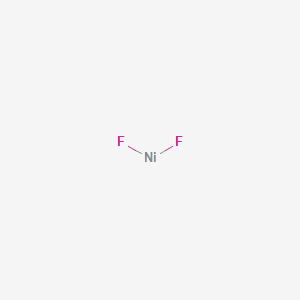
Nickel difluoride
Nickel fluoride is a fluoride of nickel. Nickel is a chemical compound with the atomic number 28. It is found abundantly in nature in laterite ore minerals, such as limonite, garnierite, and pentlandite. Nickel has a biological role and is found in certain enzymes, including urease, hydrogenase, methylcoenzyme M reductase, and carbon monoxide dehydrogenase. (L40, L41) — Toxin and Toxin Target Database (T3DB)
- Nom IUPAC
- difluoronickel
- Formule moléculaire
- F2Ni
- Masse moléculaire
- 96.690 g/mol
- Masse exacte
- 95.932148 Da
- Surface polaire topologique
- 0,0 Ų
- Donneurs de liaisons hydrogène
- 0
- Accepteurs de liaisons hydrogène
- 2
- Unités covalentes
- 1
- Stéréocentres définis
- 0
Également connu sous le nom de
12 autres noms signalés
Preuves issues de bases de données scientifiques complémentaires
NIH PubChem PUG-View
Attributed physical-property, hazard, environmental and use annotations.
- Color/Form: Yellowish to green tetragonal crystals (Rutile type) Source: Hazardous Substances Data Bank (HSDB)
- Color/Form: A light yellow colored powder Source: Hazardous Substances Data Bank (HSDB)
- Density: 4.72 Source: Hazardous Substances Data Bank (HSDB)
- Melting Point: Sublimes at 1000 °C Source: Hazardous Substances Data Bank (HSDB)
- Physical Description: Yellow to green crystals, slightly soluble in water; [Merck Index] Source: Haz-Map, Information on Hazardous Chemicals and Occupational Diseases
- Solubility: Insoluble in ethanol and ethyl ether Source: Hazardous Substances Data Bank (HSDB)
- Solubility: Insol in alcohol, ether Source: Hazardous Substances Data Bank (HSDB)
- Solubility: 4 g/100 ml water @ 25 °C Source: Hazardous Substances Data Bank (HSDB)
- Solubility: Sol in aq hydrogen fluoride; insol in anhydrous hydrogen fluoride Source: Hazardous Substances Data Bank (HSDB)
- Carcinogen Classification: 1, carcinogenic to humans. (L135) Source: Toxin and Toxin Target Database (T3DB)
- Exposure Routes: Inhalation (L41) ; oral (L41) ; dermal (L41) Source: Toxin and Toxin Target Database (T3DB)
- Signal: Danger Source: Regulation (EC) No 1272/2008 of the European Parliament and of the Council
- GHS Hazard Statements: H317: May cause an allergic skin reaction [Warning Sensitization, Skin]; H334: May cause allergy or asthma symptoms or breathing difficulties if inhaled [Danger Sensitization, respiratory]; H341: Suspected of causing genetic defects [Warning Germ cell mutagenicity]; H350i: May cause cancer by inhalation [Danger Carcinogenicity]; H360D ***: May damage the unborn child [Danger Reproductive toxicity]; H372 **: Causes damage to organs through prolonged or repeated exposure [Danger Specific target organ toxicity, repeated exposure]; H400: Very toxic to aquatic life [Warning Hazardous to the aquatic environment, acute hazard]; H410: Very toxic to aquatic life with long lasting effects [Warning Hazardous to the aquatic environment, long-term hazard] Source: Regulation (EC) No 1272/2008 of the European Parliament and of the Council
- Precautionary Statement Codes: P203, P233, P260, P261, P264, P270, P271, P272, P273, P280, P284, P302+P352, P304+P340, P318, P319, P321, P333+P317, P342+P316, P362+P364, P391, P403, P405, and P501 (click each P-code to see the statement) Source: Regulation (EC) No 1272/2008 of the European Parliament and of the Council
- Signal: Danger Source: European Chemicals Agency (ECHA)
- GHS Hazard Statements: H317 (100%): May cause an allergic skin reaction [Warning Sensitization, Skin]; H334 (> 99.9%): May cause allergy or asthma symptoms or breathing difficulties if inhaled [Danger Sensitization, respiratory]; H341 (> 99.9%): Suspected of causing genetic defects [Warning Germ cell mutagenicity]; H350 (95.2%): May cause cancer [Danger Carcinogenicity]; H360 (95.1%): May damage fertility or the unborn child [Danger Reproductive toxicity]; H372 (> 99.9%): Causes damage to organs through prolonged or repeated exposure [Danger Specific target organ toxicity, repeated exposure]; H400 (> 99.9%): Very toxic to aquatic life [Warning Hazardous to the aquatic environment, acute hazard]; H410 (> 99.9%): Very toxic to aquatic life with long lasting effects [Warning Hazardous to the aquatic environment, long-term hazard] Source: European Chemicals Agency (ECHA)
- Precautionary Statement Codes: P203, P233, P260, P261, P264, P270, P271, P272, P273, P280, P284, P302+P352, P304+P340, P318, P319, P321, P333+P317, P342+P316, P362+P364, P391, P403, P405, and P501 (click each P-code to see the statement) Source: European Chemicals Agency (ECHA)
- ECHA C&L Notifications Summary: Aggregated GHS information provided per 2187 reports by companies from 13 notifications to the ECHA C&L Inventory. Each notification may be associated with multiple companies.; Information may vary between notifications depending on impurities, additives, and other factors. The percentage value in parenthesis indicates the notified classification ratio from companies that provide hazard codes. Only hazard codes with percentage values above 10% are shown. For more detailed information, please visit ECHA C&L website. Source: European Chemicals Agency (ECHA)
- Signal: Danger Source: Hazardous Chemical Information System (HCIS), Safe Work Australia
- GHS Hazard Statements: H302: Harmful if swallowed [Warning Acute toxicity, oral]; H315: Causes skin irritation [Warning Skin corrosion/irritation]; H317: May cause an allergic skin reaction [Warning Sensitization, Skin]; H318: Causes serious eye damage [Danger Serious eye damage/eye irritation]; H332: Harmful if inhaled [Warning Acute toxicity, inhalation]; H334: May cause allergy or asthma symptoms or breathing difficulties if inhaled [Danger Sensitization, respiratory]; H341: Suspected of causing genetic defects [Warning Germ cell mutagenicity]; H350i: May cause cancer by inhalation [Danger Carcinogenicity]; H360D: May damage the unborn child [Danger Reproductive toxicity]; H372: Causes damage to organs through prolonged or repeated exposure [Danger Specific target organ toxicity, repeated exposure] Source: Hazardous Chemical Information System (HCIS), Safe Work Australia
- Precautionary Statement Codes: P203, P233, P260, P261, P264, P264+P265, P270, P271, P272, P280, P284, P301+P317, P302+P352, P304+P340, P305+P354+P338, P317, P318, P319, P321, P330, P332+P317, P333+P317, P342+P316, P362+P364, P403, P405, and P501 (click each P-code to see the statement) Source: Hazardous Chemical Information System (HCIS), Safe Work Australia
- Health Effects: The most common harmful health effect of nickel in humans is an allergic reaction. This usually manifests as a skin rash, although some people experience asthma attacks. Long term inhahation of nickel causes chronic bronchitis and reduced lung function, as well as damage to the naval cavity. Ingestion of excess nickel results in damage to the stomach, blood, liver, kidneys, and immune system, as well as having adverse effects on reproduction and development. (L41) Source: Toxin and Toxin Target Database (T3DB)
- Toxicity Summary: Nickel is known to substitute for other essential elements in certain enzmes, such as calcineurin. It is genotoxic, and some nickel compounds have been shown to promote cell proliferation. Nickel has a high affinity for chromatin proteins, particularly histones and protamines. The complexing of nickel ions with heterochromatin results in a number of alterations including condensation, DNA hypermethylation, gene silencing, and inhibition of histone acetylation, which have been shown to disturb gene expression. Nickel has also been shown to alter several transcription factors, including hypoxia-inducible transcription factor, activating transcription factor, and NF-KB transcription factor. There is also evidence that nickel ions inhibit DNA repair, either by directly inhibiting DNA repair enzymes or competing with zinc ions for binding to zinc-finger DNA binding proteins, resulting in structural changes in DNA that prevent repair enzymes from binding. Nickel ions can also complex with a number of cellular ligands including amino acids, peptides, and proteins resulting in the generation of oxygen radicals, which induce base damage, DNA strand breaks, and DNA protein crosslinks. (L41, Source: Toxin and Toxin Target Database (T3DB)
- Sources/Uses: Used in catalysts, varistors, battery cathodes, and to make elemental fluorine for research and lasers; [HSDB] Source: Haz-Map, Information on Hazardous Chemicals and Occupational Diseases
- Industrial Processes with risk of exposure: Battery Manufacturing [Category: Industry] Source: Haz-Map, Information on Hazardous Chemicals and Occupational Diseases
- Uses: IN BATTERY CATHODES Source: Hazardous Substances Data Bank (HSDB)
- Uses: Used in marking ink compositions for fluorescent lamps, as a catalyst in transhalogenation of fluoroolefins, in the manufacture of varistors, as a catalyst for hydrofluorination, in the synthesis of xenon hexafluoride, and in the preparation of high purity elemental fluorine for research and for chemical lasers. Source: Hazardous Substances Data Bank (HSDB)
Mis en correspondance par: Existing checksum-valid CAS to unique PubChem CID match. Récupéré le: 2026-08-31. Ouvrir la fiche source
Les classifications scientifiques et les annotations de danger apportent du contexte et ne remplacent pas la décision réglementaire propre au marché indiquée ci-dessus.
Couverture des sources complémentaires et état des correspondances
| Source | Résultat | Vérifié |
|---|---|---|
| EMBL-EBI ChEBI | Aucune fiche exacte | 2026-08-31 |
| NIH PubChem PUG-View | Correspondance exacte | 2026-08-31 |
Une absence de correspondance enregistrée est une preuve utile que la source a été vérifiée ; ce n’est pas l’affirmation que la substance n’existe pas ailleurs.
Récupéré depuis NIH PubChem le 2026-09-02 par correspondance CAS à somme de contrôle valide. Les propriétés chimiques ne remplacent pas la décision réglementaire de cette page.