
Geranyl Acetate
2,6-Octadien-1-ol, 3,7-dimethyl- ,1-acetate, (2E)
Geranyl Acetate figure à l’annexe III et ne peut être utilisé que dans les conditions indiquées dans cette fiche.
Détails de la fiche
Autres restrictions
The presence of the substance shall be indicated in the list of ingredients referred to in Article 19(1), point (g), when its concentration exceeds: — 0,001 % in leave-on products — 0,01 % in rinse-off products.
Nom du glossaire INCI
Geranyl Acetate
Nom chimique
2,6-Octadien-1-ol, 3,7-dimethyl- ,1-acetate, (2E)
Informations réglementaires
Ingrédients identifiés
Données clés
Identité et propriétés chimiques
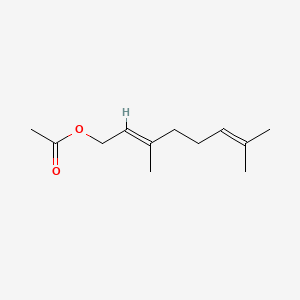
Geranyl Acetate
Geranyl acetate is a clear colorless liquid with an odor of lavender. (NTP, 1992) — CAMEO Chemicals
- Nom IUPAC
- [(2E)-3,7-dimethylocta-2,6-dienyl] acetate
- Formule moléculaire
- C12H20O2
- Masse moléculaire
- 196.29 g/mol
- Masse exacte
- 196.146329876 Da
- XLogP3
- 3,5
- Surface polaire topologique
- 26,3 Ų
- Donneurs de liaisons hydrogène
- 0
- Accepteurs de liaisons hydrogène
- 2
- Unités covalentes
- 1
- Stéréocentres définis
- 0
Également connu sous le nom de
16 autres noms signalés
Identifiants de bases de données externes
- ChEBI:CHEBI:5331
- ChEBI:CHEBI:88568
- ChEMBL:CHEMBL1369384
- EPA DTXSID:DTXSID0020654
- PubMed:23449869
- PubMed:17924309
- PubMed:12692346
Preuves issues de bases de données scientifiques complémentaires
EMBL-EBI ChEBI
geranyl acetate
A monoterpenoid that is the acetate ester derivative of geraniol.
- Formule
- C12H20O2
- Masse moyenne
- 196.290 g/mol
- Masse monoisotopique
- 196.14633 Da
- Charge formelle
- 0
- acetate ester — is a (CHEBI:47622)
- monoterpenoid — is a (CHEBI:25409)
- plant metabolite — has role (CHEBI:76924)
- geraniol — has functional parent (CHEBI:17447)
- plant metabolite — has role (CHEBI:76924)
- acetate ester — is a (CHEBI:47622)
- monoterpenoid — is a (CHEBI:25409)
- 25698327 Source: PubMed
Noms supplémentaires validés
Références croisées de cette source
- CAS: 105-87-3 — KEGG COMPOUND
- CAS: 105-87-3 — NIST Chemistry WebBook
- REGISTRY_NUMBER: 1722815 — Reaxys
- MANUAL_X_REF: C00003046 — KNApSAcK
- MANUAL_X_REF: C09861 — KEGG COMPOUND
- MANUAL_X_REF: CPD-9758 — MetaCyc
- MANUAL_X_REF: Geranyl_acetate — Wikipedia
- MANUAL_X_REF: HMDB0035157 — HMDB
Mis en correspondance par: Exact CAS cross-reference in the ChEBI compound record. Source mise à jour le: 2020-10-28. Récupéré le: 2026-08-31. Ouvrir la fiche source
NIH PubChem PUG-View
Attributed physical-property, hazard, environmental and use annotations.
- Boiling Point: 468 °F at 760 mmHg (NTP, 1992) Source: CAMEO Chemicals
- Boiling Point: Approx. 242 °C with decomposition. Source: Hazardous Substances Data Bank (HSDB)
- Boiling Point: 240.00 to 245.00 °C. @ 760.00 mm Hg Source: Human Metabolome Database (HMDB)
- Boiling Point: 240-245 °C Source: Joint FAO/WHO Expert Committee on Food Additives (JECFA)
- Color/Form: Clear, colorless liquid Source: Hazardous Substances Data Bank (HSDB)
- Density: 0.907 at 77 °F (NTP, 1992) - Less dense than water; will float Source: CAMEO Chemicals
- Density: 0.9174 at 15 °C/15 °C Source: Hazardous Substances Data Bank (HSDB)
- Density: 0.900-0.914 Source: Joint FAO/WHO Expert Committee on Food Additives (JECFA)
- Flash Point: greater than 200 °F (NTP, 1992) Source: CAMEO Chemicals
- Flash Point: >212 °F (>100 °C) closed cup Source: Hazardous Substances Data Bank (HSDB)
- LogP: log Kow = 4.04 Source: Hazardous Substances Data Bank (HSDB)
- LogP: 4.04 Source: Human Metabolome Database (HMDB)
- Melting Point: < 25 °C Source: Human Metabolome Database (HMDB)
- Odor: Odor of lavender Source: Hazardous Substances Data Bank (HSDB)
- Odor: Sweet, fruity-floral, rosy, somewhat green and remotely Lavender-like odor of moderate tenacity. Source: Hazardous Substances Data Bank (HSDB)
- Odor: Sweet, fragrant odor Source: Hazardous Substances Data Bank (HSDB)
- Physical Description: Geranyl acetate is a clear colorless liquid with an odor of lavender. (NTP, 1992) Source: CAMEO Chemicals
- Physical Description: Liquid; CBI Source: EPA Chemical Data Reporting (CDR)
- Physical Description: Clear colorless liquid with a sweet odor like lavender; [HSDB] Source: Haz-Map, Information on Hazardous Chemicals and Occupational Diseases
- Physical Description: Solid Source: Human Metabolome Database (HMDB)
- Physical Description: colourless liquid with a floral odour Source: Joint FAO/WHO Expert Committee on Food Additives (JECFA)
- Refractive Index: INDEX OF REFRACTION: 1.4580-1.4640 AT 20 °C; 1.4570-1.4620 Source: Hazardous Substances Data Bank (HSDB)
- Refractive Index: Index of refraction = 1.4624 at 20 °C Source: Hazardous Substances Data Bank (HSDB)
- Refractive Index: 1.458-1.464 Source: Joint FAO/WHO Expert Committee on Food Additives (JECFA)
- Solubility: less than 1 mg/mL at 68 °F (NTP, 1992) Source: CAMEO Chemicals
- Solubility: 1.8 IN 70% ALCOHOL; SOL IN MOST ORG SOLVENTS Source: Hazardous Substances Data Bank (HSDB)
- Solubility: Soluble in most fixed oils; slightly soluble in propylene glycol. Source: Hazardous Substances Data Bank (HSDB)
- Solubility: Solubility in alcohol: 1 mL in 9 mL 70% alcohol Source: Hazardous Substances Data Bank (HSDB)
- Solubility: Insoluble in glycerol; soluble in alcohol, ether Source: Hazardous Substances Data Bank (HSDB)
- Solubility: For more Solubility (Complete) data for GERANYL ACETATE (6 total), please visit the HSDB record page. Source: Hazardous Substances Data Bank (HSDB)
- Solubility: soluble in alcohol, most fixed oils; slightly soluble in propylene glycol; insoluble in glycerine, water Source: Joint FAO/WHO Expert Committee on Food Additives (JECFA)
- Solubility: 1 ml in 9 ml 70% alcohol (in ethanol) Source: Joint FAO/WHO Expert Committee on Food Additives (JECFA)
- Vapor Pressure: 0.02 mmHg at 68 °F ; 1 mmHg at 164.3 °F (NTP, 1992) Source: CAMEO Chemicals
- Vapor Pressure: 0.03 [mmHg] Source: Haz-Map, Information on Hazardous Chemicals and Occupational Diseases
- Substance: Geranyl acetate Source: NTP Technical Reports
- NTP Technical Report: TR-252: Carcinogenesis Studies of Food Grade Geranyl Acetate (71% Geranyl Acetate, 29% Citronellyl Acetate) (CASRN 105-87-3) in F344/N Rats and B6C3F1 Mice (Gavage Study) (1987 ) Source: NTP Technical Reports
- Peer Review Date: 09/22/82 Source: NTP Technical Reports
- Conclusion for Male Rat: No Evidence Source: NTP Technical Reports
- Conclusion for Female Rat: No Evidence Source: NTP Technical Reports
- Conclusion for Male Mice: No Evidence Source: NTP Technical Reports
- Conclusion for Female Mice: No Evidence Source: NTP Technical Reports
- Summary: Under the conditions of these studies, geranyl acetate was not carcinogenic for F344/N rats or B6C3F1 mice of either sex; however, the reduced survival observed in high dose male rats, high dose male mice, and high and low dose female mice lowered the sensitivity of these studies for detecting neoplastic responses in these groups. In male rats the marginal increases of squamous cell papillomas of the skin and tubular cell adenomas of the kidney may have been related to administration of geranyl acetate. Source: NTP Technical Reports
- Carcinogen Classification: No indication of carcinogenicity to humans (not listed by IARC). Source: Toxin and Toxin Target Database (T3DB)
- First Aid: EYES: First check the victim for contact lenses and remove if present. Flush victim's eyes with water or normal saline solution for 20 to 30 minutes while simultaneously calling a hospital or poison control center. Do not put any ointments, oils, or medication in the victim's eyes without specific instructions from a physician. IMMEDIATELY transport the victim after flushing eyes to a hospital even if no symptoms (such as redness or irritation) develop.; SKIN: IMMEDIATELY flood affected skin with water while removing and isolating all contaminated clothing. Gently wash all affected skin areas thoroughly with soap and water. If symptoms such as redness or irritation develop, IMMEDIATELY call a physician and be prepared to transport the victim to a hospital for treatment.; INHALATION: IMMEDIATELY leave the contaminated area; take deep breaths of fresh air. If symptoms (such as wheezing, coughing, shortness of breath, or burning in the mouth, throat, or chest) develop, call a physician and be prepared to transport the victim to a hospital. Provide proper respiratory protection to rescuers entering an unknown atmosphere. Whenever possible, Self-Contained Breathing Apparatus (SCBA) shou Source: CAMEO Chemicals
- Signal: Warning Source: European Chemicals Agency (ECHA)
- GHS Hazard Statements: H315 (79.8%): Causes skin irritation [Warning Skin corrosion/irritation]; H317 (77.6%): May cause an allergic skin reaction [Warning Sensitization, Skin]; H411 (20.5%): Toxic to aquatic life with long lasting effects [Hazardous to the aquatic environment, long-term hazard]; H412 (77.2%): Harmful to aquatic life with long lasting effects [Hazardous to the aquatic environment, long-term hazard] Source: European Chemicals Agency (ECHA)
- Precautionary Statement Codes: P261, P264, P272, P273, P280, P302+P352, P321, P332+P317, P333+P317, P362+P364, P391, and P501 (click each P-code to see the statement) Source: European Chemicals Agency (ECHA)
- ECHA C&L Notifications Summary: Aggregated GHS information provided per 2195 reports by companies from 24 notifications to the ECHA C&L Inventory. Each notification may be associated with multiple companies.; Information may vary between notifications depending on impurities, additives, and other factors. The percentage value in parenthesis indicates the notified classification ratio from companies that provide hazard codes. Only hazard codes with percentage values above 10% are shown. For more detailed information, please visit ECHA C&L website. Source: European Chemicals Agency (ECHA)
- GHS Hazard Statements: Not Classified Source: NITE-CMC
- NFPA Health Rating: 1 - Materials that, under emergency conditions, can cause significant irritation. Source: Hazardous Substances Data Bank (HSDB)
- NFPA Fire Rating: 1 - Materials that must be preheated before ignition can occur. Materials require considerable preheating, under all ambient temperature conditions, before ignition and combustion can occur. Source: Hazardous Substances Data Bank (HSDB)
- NFPA Instability Rating: 0 - Materials that in themselves are normally stable, even under fire conditions. Source: Hazardous Substances Data Bank (HSDB)
- Environmental Bioconcentration: An estimated BCF of 260 was calculated in fish for geranyl acetate(SRC), using a log Kow of 4.04(1) and a regression-derived equation(2). According to a classification scheme(3), this BCF suggests the potential for bioconcentration in aquatic organisms is high, provided the compound is not metabolized by the organism(SRC). Source: Hazardous Substances Data Bank (HSDB)
- Environmental Fate: TERRESTRIAL FATE: Based on a classification scheme(1), an estimated Koc value of 3,700(SRC), determined from a log Kow of 4.04(2) and a regression-derived equation(3), indicates that geranyl acetate is expected to have slight mobility in soil(SRC). Volatilization of geranyl acetate from moist soil surfaces is expected to be an important fate process(SRC) given an estimated Henry's Law constant of 2.4X10⁻³ atm-cu m/mole(SRC), using a fragment constant estimation method(4). However, adsorption to soil is expected to attenuate volatilization(SRC). Geranyl acetate is not expected to volatilize from dry soil surfaces(SRC) based upon an estimated vapor pressure of 3.3X10⁻² mm Hg(5). Biodegradation data were not available(SRC, 2007). Source: Hazardous Substances Data Bank (HSDB)
- Environmental Fate: AQUATIC FATE: Based on a classification scheme(1), an estimated Koc value of 3,700(SRC), determined from a log Kow of 4.04(2) and a regression-derived equation(3), indicates that geranyl acetate is expected to adsorb to suspended solids and sediment(SRC). Volatilization from water surfaces is expected(3) based upon an estimated Henry's Law constant of 2.4X10⁻³ atm-cu m/mole(SRC), developed using a fragment constant estimation method(4). Using this Henry's Law constant and an estimation method(3), volatilization half-lives for a model river and model lake are 7.4 hours and 6.5 days, respectively(SRC). However, volatilization from water surfaces is expected to be attenuated by adsorption to suspended solids and sediment in the water column. The estimated volatilization half-life from a model pond is 30 days if adsorption is considered(5). According to a classification scheme(6), an estimated BCF of 260(SRC), from its log Kow(2) and a regression-derived equation(7), suggests the potential for bioconcentration in aquatic organisms is high, provided the compound is not metabolized by the organism(SRC). Biodegradation data were not available(SRC, 2007). Source: Hazardous Substances Data Bank (HSDB)
- Environmental Fate: ATMOSPHERIC FATE: According to a model of gas/particle partitioning of semivolatile organic compounds in the atmosphere(1), geranyl acetate, which has an estimated vapor pressure of 3.3X10⁻² mm Hg at 25 °C(2), is expected to exist solely as a vapor in the ambient atmosphere. Vapor-phase geranyl acetate is degraded in the atmosphere by reaction with photochemically-produced hydroxyl radicals(SRC); the half-life for this reaction in air is estimated to be 2 hrs(SRC), calculated from its rate constant of 1.8X10⁻¹⁰ cu cm/molecule-sec at 25 °C(SRC) that was derived using a structure estimation method(3). The rate constant for the vapor-phase reaction of geranyl acetate with ozone has been estimated as 8.60X10⁻¹⁶ cu cm/molecule-sec at 25 °C(SRC) that was derived using a structure estimation method(3). This corresponds to an atmospheric half-life of about 19 minutes(4). Geranyl acetate does contain chromophores that absorb at wavelengths >290 nm and therefore may be susceptible to direct photolysis by sunlight(5). Source: Hazardous Substances Data Bank (HSDB)
- Consumer Uses: Fragrance Source: EPA Chemical Data Reporting (CDR)
- Industry Uses: Other; Fragrance Source: EPA Chemical Data Reporting (CDR)
- Sources/Uses: Occurs in several essential oils; Used in perfumes and flavors; [Hawley] Source: Haz-Map, Information on Hazardous Chemicals and Occupational Diseases
- Uses: Perfumery, flavoring Source: Hazardous Substances Data Bank (HSDB)
- Uses: Used as a synthetic flavoring substance and adjuvant. Source: Hazardous Substances Data Bank (HSDB)
- Uses: Used frequently in perfumery to create not only flowery-fruity nuances (example, rose), but also for citrus and lavender notes. A small amount is added to fruit aromas for shading. Source: Hazardous Substances Data Bank (HSDB)
- Uses: Widely used in perfume compositions as a sweetener and modifier in floral, fruit, herbaceous and Citrusy fragrance types. Used in flavor composition for a great variation of types: apricot, apple, banana, blackcurrant, gooseberry, ginger ale, grape, honey, lemon, peach, pear, lime, wine, and in various spice complexes, berry variations, and floral flavor types. Source: Hazardous Substances Data Bank (HSDB)
- Uses: Reported uses: Alcoholic and nonalcoholic beverages; baked goods, chewing gum, frozen dairy, gelatin (pudding), gravies, hard and soft candy, meat products. Source: Hazardous Substances Data Bank (HSDB)
Mis en correspondance par: Existing checksum-valid CAS to unique PubChem CID match. Récupéré le: 2026-08-31. Ouvrir la fiche source
Les classifications scientifiques et les annotations de danger apportent du contexte et ne remplacent pas la décision réglementaire propre au marché indiquée ci-dessus.
Couverture des sources complémentaires et état des correspondances
| Source | Résultat | Vérifié |
|---|---|---|
| EMBL-EBI ChEBI | Correspondance exacte | 2026-08-31 |
| NIH PubChem PUG-View | Correspondance exacte | 2026-08-31 |
Une absence de correspondance enregistrée est une preuve utile que la source a été vérifiée ; ce n’est pas l’affirmation que la substance n’existe pas ailleurs.
Récupéré depuis NIH PubChem le 2026-09-02 par correspondance CAS à somme de contrôle valide. Les propriétés chimiques ne remplacent pas la décision réglementaire de cette page.
Liens d’inventaire pour Geranyl Acetate
Fiches associées pour Geranyl Acetate
Les correspondances directes sont limitées pour cette fiche ; des entrées voisines de l’annexe III sont donc également affichées.
Phenol, 2-methoxy- 4-(2-propenyl)-, acetate
Santalum Album Oil
Pinene
Rosa Damascena Flower Oil; Rosa Damascena Flower Extract; Rosa Alba Flower Oil; Rosa Alba Flower Ex…
Pogostemon Cablin Oil
Pelargonium Graveolens Flower Oil
Narcissus Poeticus Extract; Narcissus Pseudonarcissus Flower Extract; Narcissus Jonquilla Extract, …
Ce que signifie l’annexe III pour Geranyl Acetate
Geranyl Acetate est une substance soumise à restrictions en vertu de l’annexe III du règlement (CE) n° 1223/2009 relatif aux produits cosmétiques. Son utilisation dans les cosmétiques n’est autorisée que dans les conditions précises énoncées dans l’entrée ci-dessus, y compris les limites de concentration, les restrictions de type de produit et les mentions d’avertissement requises.
Lorsque cette substance entre dans une formulation, toutes les conditions — concentration maximale, champ d’application du produit et mentions d’avertissement — doivent être respectées simultanément. Le respect d’une condition ne dispense pas des autres.
Cette fiche est liée à 1 ingrédient de l’inventaire CosIng pour le recoupement des noms et des identifiants. La page fait également apparaître 12 fiches d’annexe associées présentant des identifiants, une logique d’annexe ou des schémas de dénomination qui se recoupent.
Liste de contrôle de conformité
- Consignez les conditions d’emploi dans le dossier d’information produit (DIP).
Questions fréquentes
Note de source pour la fiche Geranyl Acetate de l’annexe III
Cette page résume une fiche de l’annexe III pour Geranyl Acetate à partir de documents publics de la Commission européenne sur les cosmétiques et ajoute les correspondances d’inventaire ou d’identifiants associées lorsqu’elles sont disponibles.
Utilisez cette page de fiche pour examiner les conditions de l’annexe III pour Geranyl Acetate, mais confirmez toute décision réglementaire finale auprès du libellé officiel en vigueur de l’annexe et des fichiers sources.
Outils et étapes suivantes
Vérifiez votre formule
Collez une liste INCI complète pour détecter Geranyl Acetate et d’autres fiches d’annexe de l’UE signalées en une seule passe.
Vérificateur INCIComparer des entrées
Comparez Geranyl Acetate côte à côte avec une autre fiche d’annexe pour examiner les différences de restrictions, de concentrations et d’annexe.
ComparerParcourir l’annexe
Consultez toutes les fiches de l’annexe III et comparez les conditions réglementaires entre les substances de cette annexe.
Ouvrir l’annexe III