
TRICLOCARBAN
1-(4-Chlorophenyl)-3-(3,4-dichlorophenyl)urea (13)
TRICLOCARBAN figure à l’annexe III et ne peut être utilisé que dans les conditions indiquées dans cette fiche. Concentration maximale dans cette fiche : 1.5%.
Détails de la fiche
Concentration maximale
1.5%
Type de produit
Autres restrictions
Purity criteria:
3, 3', 4, 4'-Tetrachloroazobenzene
Nom du glossaire INCI
TRICLOCARBAN
Nom chimique
1-(4-Chlorophenyl)-3-(3,4-dichlorophenyl)urea (13)
Informations réglementaires
Ingrédients identifiés
Données clés
Identité et propriétés chimiques
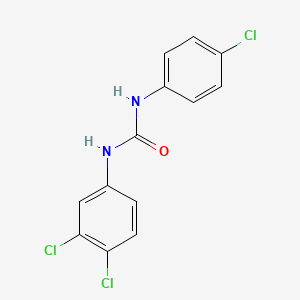
Triclocarban
Triclocarban is a member of the class of phenylureas that is urea substituted by a 4-chlorophenyl group and a 3,4-dichlorophenyl group at positions 1 and 3 respectively. It has a role as an antimicrobial agent, a xenobiotic, an antiseptic drug, a disinfectant and an environmental contaminant. It is a member of phenylureas, a dichlorobenzene and a member of monochlorobenzenes. It is functionally related to a 1,3-diphenylurea. — ChEBI
- Nom IUPAC
- 1-(4-chlorophenyl)-3-(3,4-dichlorophenyl)urea
- Formule moléculaire
- C13H9Cl3N2O
- Masse moléculaire
- 315.6 g/mol
- Masse exacte
- 313.978046 Da
- XLogP3
- 5,3
- Surface polaire topologique
- 41,1 Ų
- Donneurs de liaisons hydrogène
- 2
- Accepteurs de liaisons hydrogène
- 1
- Unités covalentes
- 1
- Stéréocentres définis
- 0
Également connu sous le nom de
16 autres noms signalés
Identifiants de bases de données externes
- ChEBI:CHEBI:48347
- ChEMBL:CHEMBL1076347
- EPA DTXSID:DTXSID4026214
- PubMed:38631510
- PubMed:37385329
- PubMed:35413382
- PubMed:35164063
- PubMed:32065294
- PubMed:31868902
- PubMed:31576746
- PubMed:30940137
- PubMed:30657620
- PubMed:30592132
- PubMed:27979590
- PubMed:26827900
Preuves issues de bases de données scientifiques complémentaires
EMBL-EBI ChEBI
triclocarban
A member of the class of phenylureas that is urea substituted by a 4-chlorophenyl group and a 3,4-dichlorophenyl group at positions 1 and 3 respectively.
- Formule
- C13H9Cl3N2O
- Masse moyenne
- 315.587 g/mol
- Masse monoisotopique
- 313.97805 Da
- Charge formelle
- 0
- phenylureas — is a (CHEBI:134043)
- dichlorobenzene — is a (CHEBI:23697)
- monochlorobenzenes — is a (CHEBI:83403)
- disinfectant — has role (CHEBI:48219)
- antiseptic drug — has role (CHEBI:48218)
- xenobiotic — has role (CHEBI:35703)
- antimicrobial agent — has role (CHEBI:33281)
- environmental contaminant — has role (CHEBI:78298)
- 1,3-diphenylurea — has functional parent (CHEBI:41320)
- disinfectant — has role (CHEBI:48219)
- antiseptic drug — has role (CHEBI:48218)
- xenobiotic — has role (CHEBI:35703)
- antimicrobial agent — has role (CHEBI:33281)
- environmental contaminant — has role (CHEBI:78298)
- phenylureas — is a (CHEBI:134043)
- dichlorobenzene — is a (CHEBI:23697)
- monochlorobenzenes — is a (CHEBI:83403)
Noms supplémentaires validés
Références croisées de cette source
Mis en correspondance par: Exact CAS cross-reference in the ChEBI compound record. Source mise à jour le: 2018-12-13. Récupéré le: 2026-08-31. Ouvrir la fiche source
NIH PubChem PUG-View
Attributed physical-property, hazard, environmental and use annotations.
- Boiling Point: 250 °C at 97.8 kPa (733 mm Hg) Source: Hazardous Substances Data Bank (HSDB)
- Color/Form: Fine white plates Source: Hazardous Substances Data Bank (HSDB)
- Color/Form: Fine plates Source: Hazardous Substances Data Bank (HSDB)
- Color/Form: Fine, white to off-white powder Source: Hazardous Substances Data Bank (HSDB)
- Density: 0.336 g/cu cm at 20 °C Source: Hazardous Substances Data Bank (HSDB)
- Dissociation Constants: pKa = 12.7 Source: Hazardous Substances Data Bank (HSDB)
- LogP: log Kow = 4.342 at 25 °C, pH 8.1 Source: Hazardous Substances Data Bank (HSDB)
- Melting Point: 482 to 493 °F (NTP, 1992) Source: CAMEO Chemicals
- Melting Point: 491.2- 493 Source: DrugBank
- Melting Point: 254.4 °C Source: Hazardous Substances Data Bank (HSDB)
- Melting Point: MP: 255.2-256 °C Source: Hazardous Substances Data Bank (HSDB)
- Odor: Slight, characteristic odor Source: Hazardous Substances Data Bank (HSDB)
- Physical Description: Triclocarban appears as fine white plates or white powder. (NTP, 1992) Source: CAMEO Chemicals
- Physical Description: White solid; [Merck Index] Source: Haz-Map, Information on Hazardous Chemicals and Occupational Diseases
- Solubility: less than 1 mg/mL at 79 °F (NTP, 1992) Source: CAMEO Chemicals
- Solubility: Insoluble Source: DrugBank
- Solubility: In water, 0.11 mg/L at 20 °C Source: Hazardous Substances Data Bank (HSDB)
- Solubility: Practically insoluble in water Source: Hazardous Substances Data Bank (HSDB)
- Solubility: 1 g dissolves in 25 mL acetone; 3 mL dimethyl formamide Source: Hazardous Substances Data Bank (HSDB)
- Solubility: In methanol, 1.6 g/L at 35 °C Source: Hazardous Substances Data Bank (HSDB)
- First Aid: EYES: First check the victim for contact lenses and remove if present. Flush victim's eyes with water or normal saline solution for 20 to 30 minutes while simultaneously calling a hospital or poison control center. Do not put any ointments, oils, or medication in the victim's eyes without specific instructions from a physician. IMMEDIATELY transport the victim after flushing eyes to a hospital even if no symptoms (such as redness or irritation) develop.; SKIN: IMMEDIATELY flood affected skin with water while removing and isolating all contaminated clothing. Gently wash all affected skin areas thoroughly with soap and water. If symptoms such as redness or irritation develop, IMMEDIATELY call a physician and be prepared to transport the victim to a hospital for treatment.; INHALATION: IMMEDIATELY leave the contaminated area; take deep breaths of fresh air. If symptoms (such as wheezing, coughing, shortness of breath, or burning in the mouth, throat, or chest) develop, call a physician and be prepared to transport the victim to a hospital. Provide proper respiratory protection to rescuers entering an unknown atmosphere. Whenever possible, Self-Contained Breathing Apparatus (SCBA) shou Source: CAMEO Chemicals
- Signal: Warning Source: European Chemicals Agency (ECHA)
- GHS Hazard Statements: H400 (96.8%): Very toxic to aquatic life [Warning Hazardous to the aquatic environment, acute hazard]; H410 (100%): Very toxic to aquatic life with long lasting effects [Warning Hazardous to the aquatic environment, long-term hazard] Source: European Chemicals Agency (ECHA)
- Precautionary Statement Codes: P273, P391, and P501 (click each P-code to see the statement) Source: European Chemicals Agency (ECHA)
- ECHA C&L Notifications Summary: Aggregated GHS information provided per 185 reports by companies from 6 notifications to the ECHA C&L Inventory. Each notification may be associated with multiple companies.; Information may vary between notifications depending on impurities, additives, and other factors. The percentage value in parenthesis indicates the notified classification ratio from companies that provide hazard codes. Only hazard codes with percentage values above 10% are shown. For more detailed information, please visit ECHA C&L website. Source: European Chemicals Agency (ECHA)
- Signal: Warning Source: Hazardous Substances Data Bank (HSDB)
- GHS Hazard Statements: H400: Very toxic to aquatic life [Warning Hazardous to the aquatic environment, acute hazard]; H410: Very toxic to aquatic life with long lasting effects [Warning Hazardous to the aquatic environment, long-term hazard] Source: Hazardous Substances Data Bank (HSDB)
- Precautionary Statement Codes: P273, P391, and P501 (click each P-code to see the statement) Source: Hazardous Substances Data Bank (HSDB)
- Toxicity Summary: IDENTIFICATION AND USE: Triclocarban (TCC) is a solid. It has anti-microbial activity and is used globally in a wide range of personal cleansing products that include deodorant soaps, detergents, cleansing lotions, and wipes. In North America, TCC is used exclusively as an antimicrobial and preservative in bar and liquid soaps and body washes. HUMAN STUDIES: Studies in humans indicate no evidence of skin sensitization or severe irritation. Petrolatum (0.1mL) containing 0, 1, 3, 6, and 9% TCC was applied continuously for 21 days on ten males. Minimal skin irritation was observed with the 9% concentration. There was no evidence of skin sensitization in volunteers tested with TCC (1.5% and 10%). The potential impact of exposure to TCC on fetal abnormalities was studied in 39 pregnant women diagnosed with fetal or post-birth abnormalities. Significantly increased levels of TCC were detected in maternal sera from mothers with abnormal births. TCC was also studied for its endocrine-disrupting effects. TCC exerted estrogenic activities by inducing luciferase activities in an ER reporter gene assay, promoting the proliferation of the MCF-7 cells, up-regulating the expression of pS2 and dow Source: Hazardous Substances Data Bank (HSDB)
- Environmental Bioconcentration: BCF values for triclocarban in rice fish (Oryzias latipes), exposed for 28 days to 20 and 2.0 ug/L were 80 and 81, respectively(1). A log BCF of 2.86 (BCF = 724) was measured using medaka (Oryzias latipes) exposed to 20 ug/L of triclocarban for 24 hours(2). According to a classification scheme(3), these BCF values suggest bioconcentration in aquatic organisms is moderate to high(SRC). Triclocarban BAFs in algae of 1600 to 2700 from three locations downstream of a waste water treatment plant in Pecan Creek, TX(4). Triclocarban bioaccumulation peaked at day 5 of a 56 day study of worms (Lumbriculus variegatus) in soil containing 22.4 ug/g dry weight triclocarban(5). Body burdens of 25 and 133 ng/g wet wt, corresponding to a biota soil accumulation factor range of 0.22 to 0.7, were reported after 28 days in earthworm (Eisenia foetida) present in 2 soils (Ashkum heavy-textured silty clay loam; Chelsea light-textured fine sand). The soils were amended with municipal (Chicago, IL) biosolids containing an average triclocarban concentration of 9200 ng/g dry wt, resulting in an average trace level soil concentration of 9 ng/g dry wt(6). Source: Hazardous Substances Data Bank (HSDB)
- Environmental Fate: TERRESTRIAL FATE: Based on a classification scheme(1), Koc values of 12,000(2) to 71,687(3) indicate that triclocarban is expected to be immobile in soil(SRC). Volatilization of triclocarban from moist soil surfaces is not expected to be an important fate process(SRC) given an estimated Henry's Law constant of 4.5X10⁻¹¹ atm-cu m/mole(SRC), developed using a fragment constant estimation method(4). Triclocarban is not expected to volatilize from dry soil surfaces(SRC) based upon an estimated vapor pressure of 3.6X10⁻⁹ mm Hg at 25 °C(SRC), determined from a fragment constant method(5). Utilizing the Japanese MITI test, 1% of the Theoretical BOD was reached in 4 weeks(6) indicating that biodegradation is not an important environmental fate process in soil(SRC). However using a continuous flow activated sludge, 50-100% degradation was obtained in 12 weeks, following lag periods of up to two weeks(7). Source: Hazardous Substances Data Bank (HSDB)
- Environmental Fate: TERRESTRIAL FATE: Dewatered municipal biosolids (DMBs) were applied to a field at a rate of approximately 22 Mg dw/ha in October 2008. Pharmaceuticals and personal care products (PPCPs) were monitored in groundwater, tile drainage, soil, DMB aggregates incorporated into the soil post-land application, and in the grain of wheat grown on the field for a period of approximately 1 year following application. Over 80 PPCPs were analyzed in the source DMB. PPCPs selected for in-depth monitoring included ... triclocarban .... PPCPs in tile were observed twice, approximately 3 weeks and 2 months post-application. Of all PPCPs measured in tile drainage, only carbamazepine, ibuprofen, acetaminophen, triclosan, triclocarban, venlafaxine, and citalopram were detected (5-74 ng/L). PPCPs were not detected in groundwater >2 m depth below the soil surface, and concentrations above detection limits at 2 m depth were only observed once just after the first rain event post-application. In groundwater, all compounds found in tile, except carbamazepine, acetaminophen and citalopram, were detected (10-19 ng/L). PPCPs were detected in DMB aggregates incorporated in soil up to 1 year post-application, wit Source: Hazardous Substances Data Bank (HSDB)
- Environmental Fate: AQUATIC FATE: Based on a classification scheme(1), Koc values of 12,000(2) to 71687(3) indicate that triclocarban is expected to adsorb to suspended solids and sediment(SRC). Volatilization from water surfaces is not expected(4) based upon an estimated Henry's Law constant of 4.5X10⁻¹¹ atm-cu m/mole(SRC), developed using a fragment constant estimation method(5). According to a classification scheme(6), BCF values of 80(7) to 724(8) suggest the potential for bioconcentration in aquatic organisms is moderate to high(SRC). Utilizing the Japanese MITI test, 1% of the Theoretical BOD was reached in 4 weeks(7) indicating that biodegradation is not an important environmental fate process in water(SRC). However using a continuous flow activated sludge, 50-100% degradation was obtained in 12 weeks, following lag periods of up to two weeks(9). Source: Hazardous Substances Data Bank (HSDB)
- Environmental Fate: ATMOSPHERIC FATE: According to a model of gas/particle partitioning of semivolatile organic compounds in the atmosphere(1), triclocarban, which has an estimated vapor pressure of 3.6X10⁻⁹ mm Hg at 25 °C(SRC), determined from a fragment constant method(2), is expected to exist solely in the particulate phase in the ambient atmosphere. Particulate-phase triclocarban may be removed from the air by wet and dry deposition(SRC). Triclocarban contains chromophores that absorb at wavelengths >290 nm(3) and, therefore, may be susceptible to direct photolysis by sunlight(SRC). Source: Hazardous Substances Data Bank (HSDB)
- Sources/Uses: Used as an antiseptic in cleaning products; [Merck Index] Used for skin and mucous membrane disinfection; [Reference #1] Source: Haz-Map, Information on Hazardous Chemicals and Occupational Diseases
- Industrial Processes with risk of exposure: Using Disinfectants or Biocides [Category: Clean] Source: Haz-Map, Information on Hazardous Chemicals and Occupational Diseases
- Uses: For 3,4,4'-trichlorocarbanilide (USEPA/OPP Pesticide Code: 027901) there are 0 labels match. /SRP: Not registered for current use in the U.S., but approved pesticide uses may change periodically and so federal, state and local authorities must be consulted for currently approved uses./ Source: Hazardous Substances Data Bank (HSDB)
- Uses: Bacteriostat and antiseptic in soaps and other cleansing compositions. Source: Hazardous Substances Data Bank (HSDB)
- Uses: Bacteriostat in ... plastics. Source: Hazardous Substances Data Bank (HSDB)
- Uses: Triclocarban is an anti-microbial active ingredient used globally in a wide range of personal cleansing products that include deodorant soaps, detergents, cleansing lotions, and wipes. In North America, triclocarban is used exclusively as an antimicrobial and preservative in bar and liquid soaps and body washes. Source: Hazardous Substances Data Bank (HSDB)
- Uses: Deodorant soaps contain an active ingredient such as 3,4,4'-trichlorocarbanilide (trichlocarban) to inhibit the growth of skin bacteria responsible for the formation of odor-causing substances from perspiration Source: Hazardous Substances Data Bank (HSDB)
Mis en correspondance par: Existing checksum-valid CAS to unique PubChem CID match. Récupéré le: 2026-08-31. Ouvrir la fiche source
Les classifications scientifiques et les annotations de danger apportent du contexte et ne remplacent pas la décision réglementaire propre au marché indiquée ci-dessus.
Couverture des sources complémentaires et état des correspondances
| Source | Résultat | Vérifié |
|---|---|---|
| EMBL-EBI ChEBI | Correspondance exacte | 2026-08-31 |
| NIH PubChem PUG-View | Correspondance exacte | 2026-08-31 |
Une absence de correspondance enregistrée est une preuve utile que la source a été vérifiée ; ce n’est pas l’affirmation que la substance n’existe pas ailleurs.
Récupéré depuis NIH PubChem le 2026-08-31 par correspondance CAS à somme de contrôle valide. Les propriétés chimiques ne remplacent pas la décision réglementaire de cette page.
Liens d’inventaire pour TRICLOCARBAN
Fiches associées pour TRICLOCARBAN
Acetyl hexamethyl indan; 1,1,2,3,3,6-Hexamethylindan-5-yl methyl ketone
Tagetes minuta flower extract; Tagetes minuta flower oil
Tagetes patula flower extract; Tagetes patula flower oil
o-Phenylphenol, Sodium o-Phenylphenate
1-Hydroxy-4-methyl-6-(2,4,4-trimethylpentyl)-2 pyridon, piroctone olamine
Ce que signifie l’annexe III pour TRICLOCARBAN
TRICLOCARBAN est une substance soumise à restrictions en vertu de l’annexe III du règlement (CE) n° 1223/2009 relatif aux produits cosmétiques. Son utilisation dans les cosmétiques n’est autorisée que dans les conditions précises énoncées dans l’entrée ci-dessus, y compris les limites de concentration, les restrictions de type de produit et les mentions d’avertissement requises.
Lorsque cette substance entre dans une formulation, toutes les conditions — concentration maximale, champ d’application du produit et mentions d’avertissement — doivent être respectées simultanément. Le respect d’une condition ne dispense pas des autres.
Cette fiche est liée à 1 ingrédient de l’inventaire CosIng pour le recoupement des noms et des identifiants. La page fait également apparaître 12 fiches d’annexe associées présentant des identifiants, une logique d’annexe ou des schémas de dénomination qui se recoupent.
Liste de contrôle de conformité
- Veillez à ce que la concentration de la formulation ne dépasse pas : 1.5%
- Confirmez la compatibilité avec le type de produit : Rinse-off products
- Consignez les conditions d’emploi dans le dossier d’information produit (DIP).
Questions fréquentes
Note de source pour la fiche TRICLOCARBAN de l’annexe III
Cette page résume une fiche de l’annexe III pour TRICLOCARBAN à partir de documents publics de la Commission européenne sur les cosmétiques et ajoute les correspondances d’inventaire ou d’identifiants associées lorsqu’elles sont disponibles.
Utilisez cette page de fiche pour examiner les conditions de l’annexe III pour TRICLOCARBAN, mais confirmez toute décision réglementaire finale auprès du libellé officiel en vigueur de l’annexe et des fichiers sources.
Outils et étapes suivantes
Vérifiez votre formule
Collez une liste INCI complète pour détecter TRICLOCARBAN et d’autres fiches d’annexe de l’UE signalées en une seule passe.
Vérificateur INCIComparer des entrées
Comparez TRICLOCARBAN côte à côte avec une autre fiche d’annexe pour examiner les différences de restrictions, de concentrations et d’annexe.
ComparerParcourir l’annexe
Consultez toutes les fiches de l’annexe III et comparez les conditions réglementaires entre les substances de cette annexe.
Ouvrir l’annexe III